
Memory, Sorrow, and Thorn · Canonical Character Profile
Penemhwy
Penemhwy is Maegwin’s mother and King Lluth’s first recorded wife, dead since Maegwin was four. She never steps into a living scene, yet Book 4 makes her absence speak: when Maegwin’s imagined heaven begins to fracture, she asks why Penemhwy is not there among the beloved dead.
At a Glance
The mother Maegwin loses at four—and still expects to find beyond death
- Canonical name
- Penemhwy; the Book 1 ledger also preserves the variant Penemhwye
- Position
- King Lluth ubh-Llythinn’s first recorded wife
- Child
- Princess Maegwin
- Death
- Died when Maegwin was four
- Book 1 function
- Establishes Maegwin’s maternal loss and Lluth’s household chronology
- Book 4 function
- Her absence helps fracture Maegwin’s belief that she stands among the beloved dead
- Appearance
- Not described
- Status
- Dead before Book 1; no literal afterlife manifestation confirmed
Maegwin’s First Loss
Penemhwy’s clearest biographical fact is measured in her daughter’s age
Penemhwy dies when Maegwin is four years old.
The series does not provide a year, cause, illness, accident, attacker, funeral, grave, or final words. It gives the age of the child left behind.
That framing makes Penemhwy’s death part of Maegwin’s development before Maegwin has the language or power to control what follows.
Four is old enough for attachment and fragments of memory, but the books do not describe a specific remembered face, voice, touch, lesson, or room. We cannot manufacture childhood flashbacks simply because the emotional structure invites them.
What remains is durable absence.
Maegwin grows into a princess who repeatedly loses the people and places holding her world together. Penemhwy’s death is the earliest named break in that pattern.
The profile should not reduce every later choice to maternal trauma. Maegwin’s politics, love for Eolair, devotion, courage, pride, isolation, and visionary crisis have many causes.
But when the adult daughter imagines reunion among the dead, Penemhwy belongs on the expected list. That expectation proves the mother’s emotional place survived even where detailed memory did not.
Lluth’s First Recorded Wife
Her death begins the three-wife chronology shaping Hernystir’s royal family
Penemhwy is King Lluth’s first recorded wife and Maegwin’s mother.
After Penemhwy dies, Fiathna takes her place and becomes the mother of Prince Gwythinn. Later, Inahwen becomes Lluth’s third wife and the current queen during Book 1.
The sequence matters because it establishes Maegwin and Gwythinn as half-siblings and explains why Inahwen, only one year younger than Maegwin, occupies the socially awkward role of stepmother.
Penemhwy’s “first” position is relative to the wives the narrative records. The wording should not claim Lluth had no earlier unrecorded marriage unless the text says so.
Nor does the sequence reveal whether Penemhwy was queen under a formal title, what family she came from, whether the marriage was political or affectionate, or how she participated in Hernystiri governance.
Her daughter is older than Gwythinn by five years. That gives a minimum household order but not reliable marriage or birth dates.
The family chronology can tempt a page into treating women like slots beside a king. This profile keeps the structure because it is canon, while naming how little personal life the structure preserves.
The Daughter Who Outlives the Household
Penemhwy remains one fixed point while Maegwin’s world repeatedly changes shape
Maegwin grows into Lluth’s tall, sorrel-haired elder child, politically attentive and privately in love with Count Eolair.
Book 1 introduces her inside a court already under pressure from failed harvests, unnatural weather, Elias’s demands, and Hernystir’s weakening position.
She loves her younger half-brother Gwythinn even while correcting his impulsiveness. She struggles with Inahwen’s near-peer age without denying the young queen’s good heart.
Penemhwy does not appear to guide any of those relationships directly. Her influence cannot be described through teachings or inherited habits the text never supplies.
Instead, her place is negative space: the mother Maegwin cannot consult as Lluth’s family and kingdom collapse.
That does not make Penemhwy responsible for her daughter’s loneliness. It shows why Maegwin’s burden has so few older women attached to it by uncomplicated kinship.
Later grief over Lluth and Gwythinn accumulates around the much earlier maternal loss. The series does not let death stay singular; each absence changes the shape of all the others.
The Person Missing from Maegwin’s Heaven
Book 4 turns Penemhwy’s absence into evidence against the world Maegwin believes she sees
In Book 4, Maegwin approaches occupied Naglimund while living inside a powerful misreading of reality.
She believes herself among gods, heroes, and the honored dead. The Sithi around her become divine figures in that interpretation, while the devastated mortal world is translated into a sacred journey.
Near the keep, she senses a vast and empty presence whose hatred of life is braided with agonized longing for quiet and death.
The experience feels familiar to her as a sibling might.
Then the heaven-story begins to fail its own test. If this is truly the realm where the beloved dead gather, why are Gwythinn, King Lluth, and Penemhwy absent?
Penemhwy is not shown as a ghost refusing to appear. Her absence exists inside Maegwin’s reasoning. It is a discrepancy that the daughter can finally articulate.
This distinction protects both characters. The scene confirms Maegwin expects her mother among the dead; it does not confirm the cosmology, Penemhwy’s location after death, or a supernatural message from her.
The missing mother becomes a reality anchor. Penemhwy does not rescue Maegwin by materializing. The truth begins to return because the false heaven cannot account for the people Maegwin most needs it to contain.
Absence as a Receipt
What is not present can still be narratively active without becoming paranormal proof
Penemhwy’s Book 4 relevance depends on absence, which must be handled precisely.
Maegwin names or remembers the missing dead within a distorted interpretive state. That is direct evidence about Maegwin’s attachment and doubt.
It is not direct evidence that Penemhwy should literally appear, that souls gather in one place, or that some hostile power has hidden her.
A weaker fandom entry might write that Penemhwy “fails to appear in the afterlife.” That language would promote Maegwin’s framework into objective cosmology.
The stronger wording is that Maegwin cannot find Penemhwy in the world she believes is heaven, and that contradiction weakens the belief.
This also keeps the profile from confusing narrative presence with physical appearance. Penemhwy appears as a remembered relationship across two books even though she receives no living scene.
Her canonical volume membership is therefore Books 1 and 4: Book 1 establishes the mother and death; Book 4 renews her emotional function through Maegwin’s explicit missing-person test.
Penemhwy or Penemhwye?
The canonical record preserves the display name while acknowledging the ledger variant
The central registry uses Penemhwy.
The Book 1 reading ledger also preserves the form Penemhwye in the household chronology, while the Book 4 receipt uses Penemhwy.
This profile keeps Penemhwy as the canonical display name and records Penemhwye as an alias or textual variant rather than creating two women.
That choice prevents duplicate profiles, split directory counts, and broken cross-volume relationships.
It does not claim one spelling is universally correct across every edition without collation. The owned-edition reading record establishes that both forms appear in the working evidence.
Search should surface the same canonical post for either spelling. Cards and headings should remain consistent unless a future edition audit proves the registry name needs correction.
Connections
The daughter, husband, successor wives, and beloved dead around Penemhwy
Princess Maegwin
Penemhwy’s daughter, four when her mother dies and still looking for her within Book 4’s broken heaven-story.
King Lluth ubh-Llythinn
Penemhwy’s husband and Maegwin’s father; no details of their marriage are supplied.
Fiathna
Lluth’s second recorded wife, who takes Penemhwy’s household place and becomes Gwythinn’s mother.
Prince Gwythinn
Maegwin’s beloved younger half-brother, later one of the dead she cannot find alongside Penemhwy.
Queen Inahwen
Lluth’s third wife and current Book 1 queen, nearly Maegwin’s age.
Count Eolair
The man Maegwin loves and repeatedly pushes away; no direct relationship with Penemhwy is confirmed.
Why Penemhwy Matters
She is maternal memory functioning as a test of truth
Penemhwy matters because her absence survives across the series.
In Book 1, her death explains part of the family Maegwin inherited. In Book 4, the adult daughter’s expectation of reunion reveals how deeply the lost mother remains embedded in her emotional world.
She also gives Maegwin one route back toward doubt. A fantasy cannot call itself heaven while excluding the people whose presence would make heaven recognizable.
That function is powerful precisely because Penemhwy never becomes an apparition delivering exposition.
A complete profile must therefore resist two opposite mistakes: omitting her because she lacks a direct scene, or inventing a personality so the page resembles a conventional biography.
The canon gives motherhood, marriage position, death timing, remembered importance, and absence inside Maegwin’s crisis. Those facts are enough to build a meaningful page when organized around what they actually do.
Character Image Continuity
A living mother in Hernystir—not a ghost designed from Maegwin’s grief
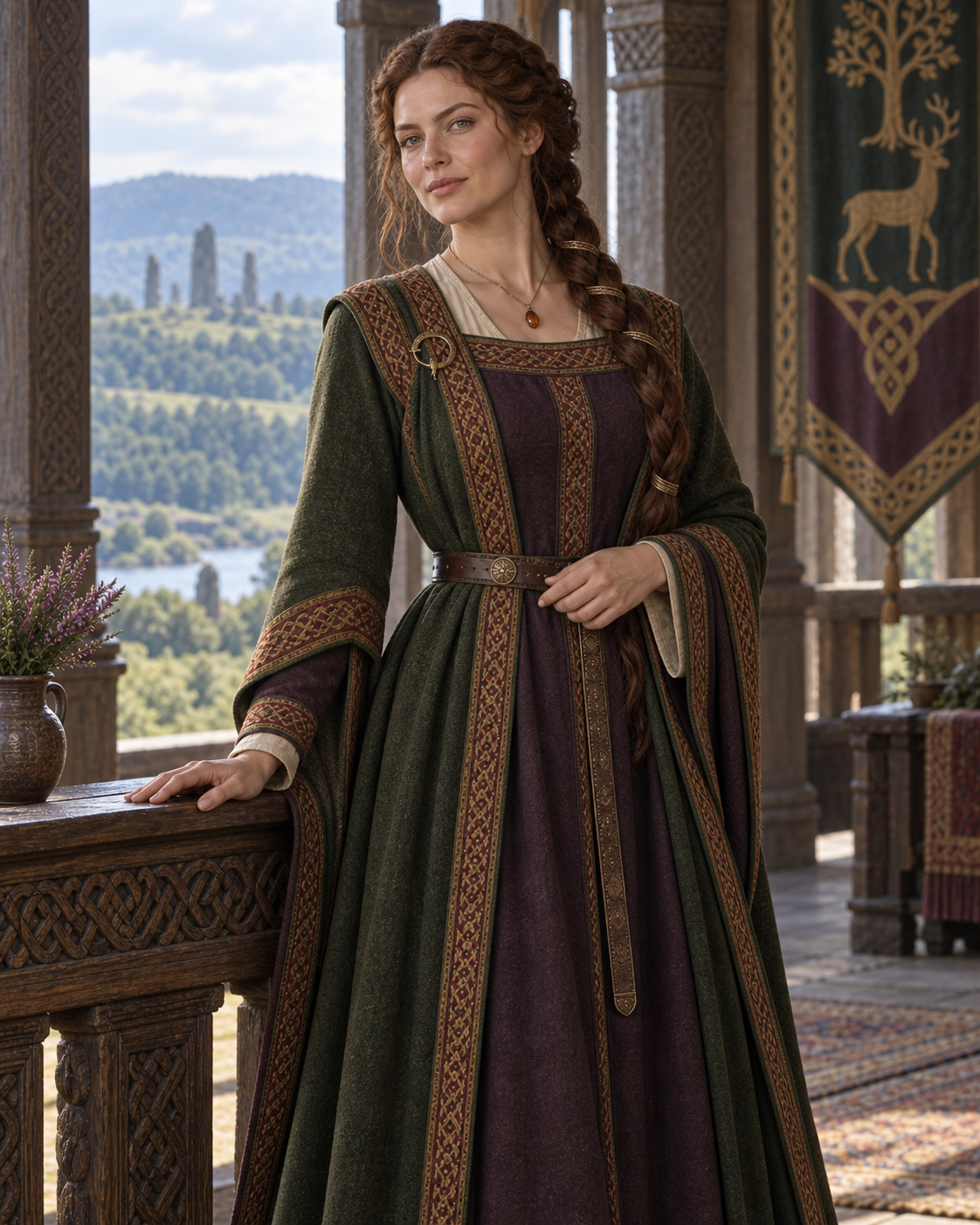
Penemhwy’s approved identity portrays one exceptionally beautiful adult Hernystiri royal woman during her lifetime. She remains visually distinct from Fiathna and Inahwen and plausibly related to Maegwin through broad high cheekbones and eye-set without copying Maegwin’s face.
Canon does not provide age, hair, eyes, complexion, height, body, facial features, clothing, jewelry, crown, cause of death, or burial styling. Her exact age, face, body, coloring, auburn hair, braid and bronze cords, moss-and-plum clothing, brooch, amber pendant, gallery, textiles, deer motif, standing stones, heather, pose, season, and light are CVM editorial reconstruction.
This exact living face, adult age baseline, graceful body, hazel-green eyes, light-brown complexion, dark-auburn braid, bronze cords, moss-and-plum palette, brooch, and amber pendant now govern directory cards, profile hero, Hernystir family-history imagery, Maegwin childhood context, and Book 4 reality-fracture coverage.
No ghost, corpse, deathbed, funeral, or empty silhouette may replace the canonical hero. Book 4’s absence cannot be converted into a spectral manifestation the text never supplies.
On the Record
Books 1 and 4, one canonical mother, no invented life between the receipts
This is Penemhwy’s one canonical, full-spoiler character profile. Her confirmed relevance spans The Dragonbone Chair and the fourth published volume of To Green Angel Tower.
Book 1 confirms that Penemhwy is Maegwin’s mother and Lluth’s first recorded wife, and that she dies when Maegwin is four. It also establishes the later household order of Fiathna and Inahwen.
Book 4 confirms that Maegwin expects Penemhwy among the honored or beloved dead and recognizes her absence as one contradiction inside the heaven she thinks she inhabits.
The record does not confirm Penemhwy’s appearance, age, origin, parents, marriage circumstances, personality, relationship with Lluth, parenting behavior, illness, death cause, burial, final words, supernatural manifestation, or literal afterlife location.
Status: dead before Book 1. The approved living identity powers the hero, featured image, cards, and social metadata across both volume scopes; it is an editorial reconstruction of Penemhwy in life, not evidence of a literal afterlife manifestation.