
Memory, Sorrow, and Thorn · Canonical Creature Profile
Hidohebhi the Black
Hidohebhi is the black mother-worm whose death battle with Hakatri and Ineluki breaks the Sithi royal family long before Asu’a falls. She dies, Hakatri survives in unending pain, Ineluki inherits both the crown’s burden and the obsession that helps destroy him, and one of her teeth becomes Ti-tuno—the horn whose call crosses peoples, kingdoms, and centuries before the final war.
At a Glance
The dead dragon whose body remains inside the trilogy’s bloodline, succession, and signal system
- Names
- Hidohebhi the Black; Drochnathair in Hernystiri tradition
- Kind
- Dragon; mother-worm
- Ancestor
- Descended from Khaerukama’o the Golden
- Children
- Shurakai the Red and Igjarjuk the White
- Slayers
- Hakatri and Ineluki
- Relic
- Her tooth becomes the horn Ti-tuno, later called Cellian
- Status
- Dead centuries before the main action
The Dragon Line
Black mother, red child, white child—and no permission to turn coloring into morality
Hidohebhi descends from Khaerukama’o the Golden, the oldest named ancestor in the dragon line preserved by the story. She is mother to red Shurakai and white Igjarjuk. The record explicitly describes her as more powerful than her children.
The colors help distinguish lineage and individuals; they do not produce a neat alignment chart. Shurakai’s death establishes Prester John’s fame and gives him the sword he calls Bright-Nail. Igjarjuk’s blood marks Simon during the Urmsheim confrontation. Hidohebhi’s death wounds Hakatri beyond healing and leaves a tooth that becomes Ti-tuno. Each encounter changes political history, but none reduces the dragon to a convenient monster-shaped treasure chest.
Hernystiri tradition remembers Hidohebhi as Drochnathair. Multiple names matter because the same creature survives in different cultural archives. “Hidohebhi the Black” belongs to one transmitted history; “Drochnathair” proves that mortals preserve their own relationship to the event. A complete profile keeps both without pretending the accounts supply a full biography.
The Death Battle
Hakatri and Ineluki kill the mother-worm, but victory refuses to behave like triumph
The royal brothers Hakatri and Ineluki fight Hidohebhi together. Hakatri is the elder son of Iyu’unigato and Amerasu, the original heir; Ineluki is the younger brother whose name evokes bright speech.
They slay the dragon. In a simpler heroic genealogy, that sentence would end with a crown, a song, and two princes riding home. Here, Hidohebhi’s death burns Hakatri so terribly that survival becomes continuous agony. The wound cannot be repaired by ordinary Sithi art or medicine.
The ledger does not preserve a blow-by-blow choreography. It does not say which brother lands a final stroke, whether Hidohebhi speaks, why the confrontation begins, or how many others witness it. Those gaps are not invitations to manufacture a boss battle. The confirmed consequence is already enormous: a dragon dies, an heir is ruined, and the younger brother’s future changes direction.
Hakatri’s Wound
Hidohebhi’s fire changes the Sithi succession before Ineluki ever becomes the Storm King
Hakatri survives but remains in unending pain. Iyu’unigato eventually sends him westward by boat with a trusted servant in search of relief or healing. His ultimate fate remains unresolved in the owned four-book record.
With the elder heir removed, Ineluki becomes the successor. He also pursues increasingly dangerous knowledge in the hope of healing or restoring his brother. Love is not an incidental excuse pasted onto later ambition; Hakatri’s suffering helps shape the road toward forbidden Making.
This does not make Hidohebhi morally responsible for every choice Ineluki later makes. She wounds Hakatri during the battle that kills her. Ineluki chooses how far to pursue power, how to answer Asu’a’s siege, and how to transform himself and the Red Hand. The distinction matters because causation is not absolution.
Still, the dragon battle is one of the trilogy’s critical prehistories. Remove it and the royal order remains different, Hakatri may remain heir, Ineluki’s research lacks its most intimate urgency, and the emotional architecture behind the Storm King changes. A creature dead long before Simon’s birth has already altered the throne he is trying to save.
Amerasu and Iyu’unigato
The parents lose one son westward and watch the other turn rescue into catastrophe
Amerasu and Iyu’unigato mourn an apparent ending of their people during Asu’a’s long siege, but Hidohebhi has already made that grief familial. Their elder son is alive somewhere beyond reach, burned and suffering. Their younger son inherits the future while trying to reverse the past.
Iyu’unigato’s decision to send Hakatri west is both hope and separation. Amerasu later survives to oppose the transformed Ineluki and carry knowledge into Simon’s generation. Hidohebhi’s death therefore sits behind not only the brothers’ divergence but also the parents’ impossible division between lost child, remaining child, and the consequences of attempted restoration.
The books do not give Hidohebhi access to this aftermath. We cannot say she intended dynastic damage or foresaw it. Her profile can trace the consequence without giving a dragon omniscient villain strategy she never receives on the page.
The Tooth That Becomes Ti-tuno
Her body enters history again as a call passed between Sithi, Hernystiri, Nabbanai, and Erkynlanders
One of Hidohebhi’s teeth becomes a horn crafted in Mezutu’a. Its true Making-name is Ti-tuno. Later mortal tradition calls it Cellian. Material and making work together: the power is not merely “dragon tooth” and not merely the craft imposed upon it.
Iyu’unigato gives the horn to Prince Sinnach before Ach Samrath. That custody ties Hidohebhi’s remains to the Sithi–Hernystiri alliance confronting Fingil. King Lluthinn later includes it in Ebekah’s bridal dowry. Prester John gives it to her protector Camaris. The horn eventually returns to Amerasu, who sends it back into mortal hands with Simon.
This chain matters because Ti-tuno is never the property of one uncomplicated nation. It moves through alliance, marriage, guardianship, royal exchange, recovery, and emergency. Its history crosses the same human–Sithi boundary that Hidohebhi’s death initially appears to reinforce.
By the time the Nisses rhyme’s “Call” and “Call-bearer” language becomes operational, the object contains centuries of custody. The signal heard in the final conflict begins with the tooth of a dragon killed before Asu’a fell.
Body, Relic, and Consent
The trilogy turns a slain creature into inheritance without asking us to forget that it was once anatomy
Ti-tuno is wondrous, useful, and bound to resistance against the Storm King. It is also a tooth removed from a dead mother-dragon. Both facts remain true.
The story offers no evidence about Hidohebhi’s wishes, culture, speech, or relationship to bodily remains. A modern reader can notice the transformation from creature to artifact without pretending the text supplies a simple ethical verdict. The lack of consent evidence should prevent sentimental claims as much as celebratory ones.
What the custody record does show is the mortal and Sithi habit of turning dangerous bodies into political technology: dragon tooth into horn, keel iron into sword, bone and memory into instruments that outlive their makers. Hidohebhi’s profile belongs beside Ti-tuno because separating object lore from creature history makes the relic look cleaner than it is.
Connections
The family, slayers, descendants, and relic-bearers around the black mother-worm
Hakatri
Elder Sithi prince who helps kill Hidohebhi and survives her fire in unending pain.
Ineluki
Younger slayer whose brother’s wound and changed succession help drive his dangerous research.
Shurakai
Her red dragon child, later killed by Prester John beneath the Hayholt.
Igjarjuk
Her white northern child, encountered by Simon and the Thorn expedition at Urmsheim.
Khaerukama’o
The Golden dragon ancestor from whom Hidohebhi’s line descends.
Ti-tuno
The horn made from her tooth, carried through centuries of alliance and succession.
Why Hidohebhi Matters
She connects the Storm King’s emotional origin to the coalition’s eventual call for help
Hidohebhi’s narrative importance runs in two directions. Her death wounds Hakatri and helps shape Ineluki’s succession, research, and grief. Her tooth becomes Ti-tuno, an object that later helps people act against the catastrophe Ineluki becomes.
That symmetry should not be flattened into prophecy. The record does not say Hidohebhi was destined to create both wound and remedy. It shows history reusing matter in ways no participant controls. A dead dragon’s body becomes part of a resistance to a dead prince whose life was changed by killing her.
She also keeps the dragon encounters from standing alone as three unrelated set pieces. Hidohebhi, Shurakai, and Igjarjuk form a lineage touching Sithi, Hernystiri, Erkynlandish, Qanuc, and Nabbanai history. The dragons are braided into the political world, not waiting in isolated caves for heroes to collect upgrades.
On the Record
Historical creature, Books 1–3, with appearance boundaries kept deliberately strict
This is Hidohebhi’s one canonical full-spoiler creature profile. Book 1 establishes the royal-brother battle, Hakatri’s wound, her children, ancestry, and Hernystiri name. Books 2 and 3 extend the Ti-tuno evidence and its Making/custody significance. Her existing Books 1–3 scope is retained because the completed ledger does not require a Book 4 directory membership.
The evidence confirms that she is a black mother-dragon, more powerful than Shurakai and Igjarjuk, descended from Khaerukama’o, slain by Hakatri and Ineluki, and responsible for the fire wound Hakatri carries afterward. It confirms that a tooth becomes Ti-tuno. It does not provide exact scale, horn configuration, wings, eyes, facial anatomy, personality, speech, lair, motive, or a reliable battle sequence.
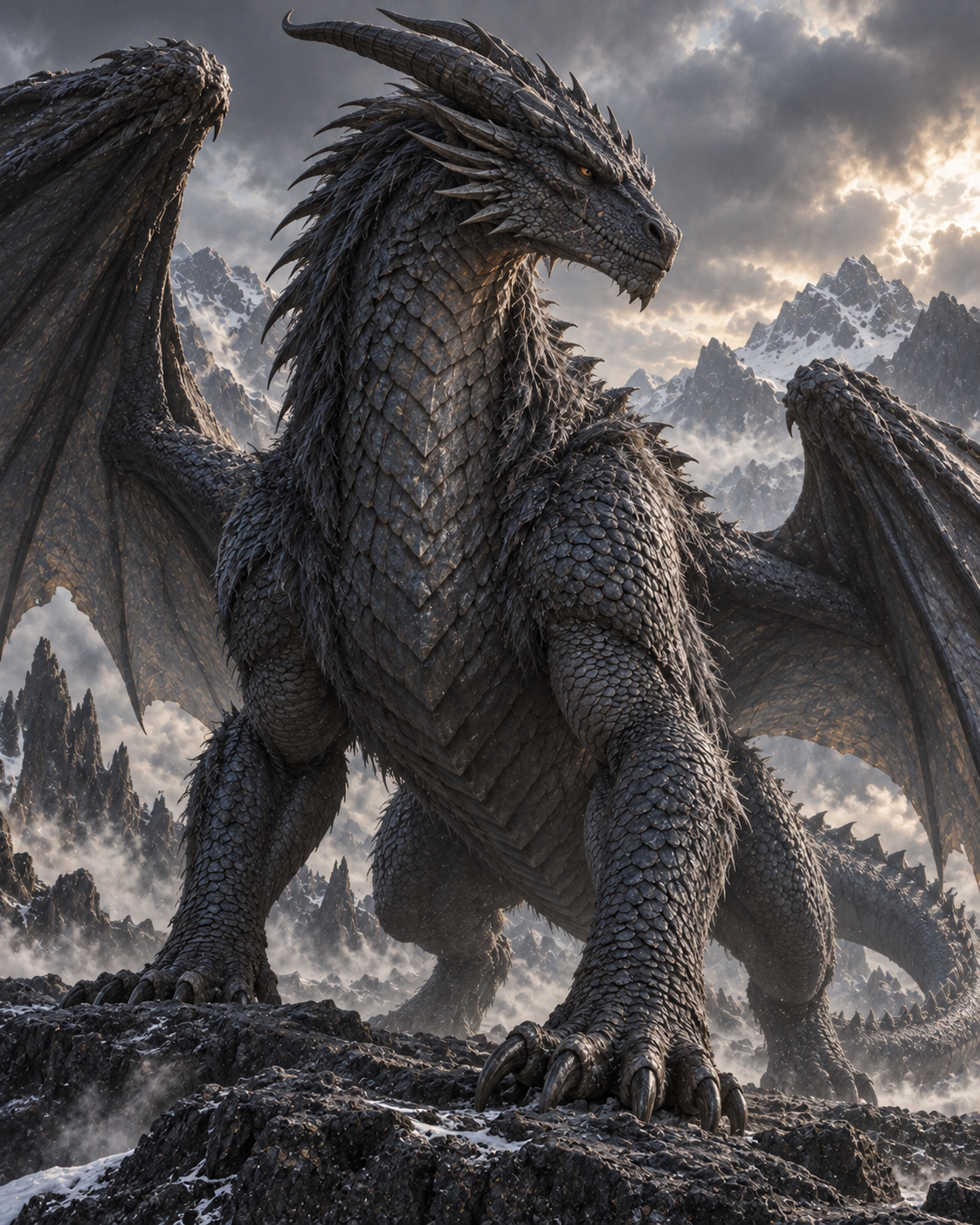
Visual state: approved and locked. Hidohebhi is one colossal ancient black mother-dragon with exactly four legs, two shoulder wings, one long neck, one horn-crowned head, and one tail; obsidian-charcoal layered scales, narrow amber eyes, immense deep chest, heavy ancestral horns, cheek spines, and weathered plate armor make her visibly older and more formidable than Igjarjuk. The books establish only her black color, sex and maternal role, dragon kind, lineage, superior power, death, fire wound to Hakatri, and tooth relic. Exact scale, four-limbed two-winged family anatomy, horns, eyes, scars, scale map, body proportions, mountain setting, and light are editorial reconstruction. Preserve this exact anatomy across battle, lineage, tooth-relic, history, card, hero, and social images. “Hot fantasy” means magnificent creature authority, never humanization or generic AI-dragon drift.