
Memory, Sorrow, and Thorn · Canonical Creature Profile
Shurakai
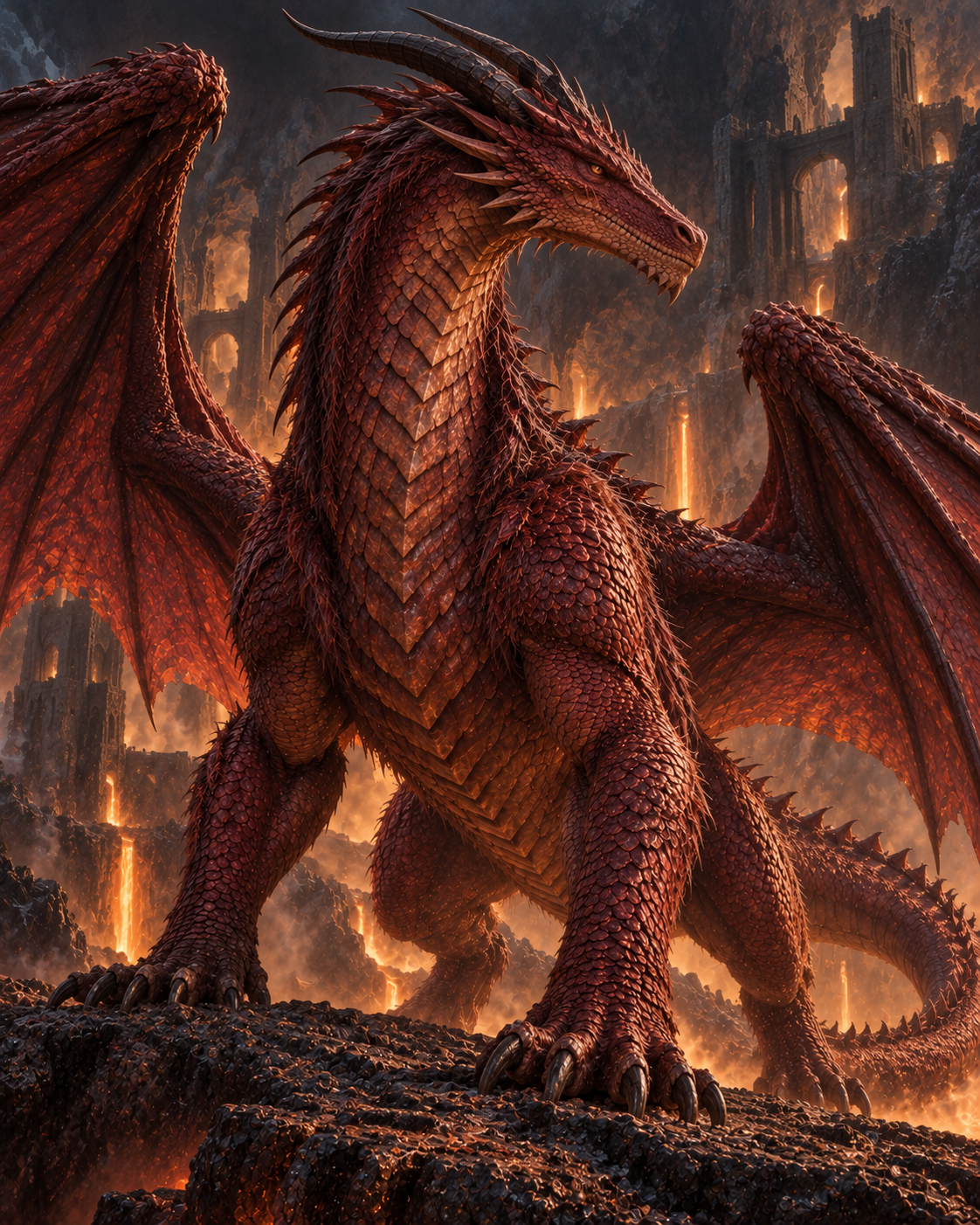
Shurakai is the Red Worm beneath the Hayholt, the dragon Prester John kills on Saint Tunath’s Day—and then turns into furniture. Her skull hangs over the Dragonbone Chair, her bones support a royal dynasty, and the story of her defeat transforms a wandering farmer’s son into a providential king. Dead dragons do not speak, which makes them extremely convenient political witnesses.
At a Glance
The slain dragon who keeps ruling from beneath a king
- Kind
- Dragon, called the Red Worm
- Lineage
- Child of Hidohebhi the Black; sibling of white Igjarjuk
- Location
- Beneath Asu’a, later the Hayholt
- Slayer
- Prester John on Saint Tunath’s Day, Founding-year 1083
- Remains
- Bones and skull made into the Dragonbone Chair
- Status
- Dead for eighty years when John dies on the battle’s anniversary
The Visual Receipt
Red in life, parchment-colored in death, and still terrifying above the throne
Shurakai is remembered as a red dragon. The direct physical receipt belongs to the remains: a long serpentine skull and jaws projecting over the throne like a canopy, black eye sockets, teeth curving like hand-length spikes, and parchment-colored bone crossed by fine cracks.
Simon experiences the dead skull as somehow terribly alive. That sensation is not proof of consciousness inside the relic. It is proof that the throne’s design works. Anyone approaching the High King must step beneath the mouth of the conquered creature and feel the violence that founded the seat.
Future creature art should be magnificent rather than cute, anthropomorphic, or interchangeable with modern game dragons. One approved design must connect the living Red Worm beneath Asu’a, the death battle, the stripped bones, the throne canopy, and every later historical reconstruction. Scale, cranial shape, tooth pattern, horn structure, and red coloration must stay consistent.
Dragon Lineage
Shurakai is not the first dragon—and the generations are diminishing
Shurakai descends from Hidohebhi the Black, also remembered in Hernystiri tradition as Drochnathair. Hidohebhi is the more powerful mother-worm slain by Hakatri and Ineluki. Her death-battle burns Hakatri beyond healing and helps drive Ineluki toward the forbidden knowledge that eventually shapes the Storm King.
Shurakai’s sibling is Igjarjuk, the white-scaled, pale-furred ice dragon Simon encounters in the north. Jiriki explains that dragons diminish by generation. Both Shurakai and Igjarjuk descend through Hidohebhi from Khaerukama’o the Golden.
The genealogy prevents the Dragonbone Chair from becoming an isolated monster trophy. Dragon history intersects with Sithi royal trauma, Ineluki’s fall, Simon’s quest for Thorn, and the deep material memory of Osten Ard. John’s famous victory occurs late in a much older story.
Saint Tunath’s Day, 1083
A wandering stranger goes beneath the castle and comes back with a kingdom-sized legend
Prester John arrives from Warinsten and confronts Shurakai beneath the castle. The official story places divine favor around the unlikely hero. John drives the dragon through Erchester’s gates and kills her on Saint Tunath’s Day.
Saint Eahlstan Fiskerne, the Fisher King from Gleniwent stock, dies by Shurakai before John destroys the dragon. That distinction matters. Eahlstan is dragon-slain, not the dragon-slayer. The polished legend can blur surrounding casualties once one victorious name becomes useful enough.
John descends carrying a spear and emerges with Bright-Nail. That material change becomes one of the mystery’s most important receipts. The dwarrows claim they forged Minneyar; Fingil carried it into Asu’a; John later found and renamed it Bright-Nail. Shurakai’s lair or death-scene therefore sits at the hinge between a hidden older sword and the king’s public weapon.
Morgenes Versus the Song
The doctor asks the rude historical question: how convenient was all of this?
Morgenes’s manuscript challenges the providential version Simon has absorbed. John could not have known the Red Worm would appear in Erkynland. His arrival, the battle, his obscure origin as a farmer’s son, and his later rise demand investigation rather than devotional repetition.
That skepticism does not prove John staged the dragon or lacked courage. He still went beneath the castle and came back alive. Morgenes is dismantling inevitability: victory becomes more historically interesting when it is not proof that God pre-approved every later act of the victor.
Simon initially resists because John’s story helps structure his world. Later, he and Strangyeard reread the account for what it conceals about Bright-Nail. Shurakai’s death changes from childhood legend into an evidence scene.
The Dragonbone Chair
John does not merely remember the victory; he makes every visitor sit inside it
Shurakai’s bones become the massive yellowing-ivory throne at the Hayholt. The skull rises above the seated king, jaws open, turning the defeated body into architecture. The chair is title object, conquest monument, and deathbed stage.
The symbolism is aggressive. John’s authority rests literally on conquered antiquity. The beast’s remains certify the king’s strength every time he receives a petitioner. Yet the chair also outlives the simple meaning John gives it. When the kingdom fractures, the bones remain—evidence that spectacular victory cannot permanently secure a just succession.
Simon first sees the throne through awe and fear. The cracked bone, black sockets, and spike teeth make the past physically present. John eventually dies in the same symbolic field, exactly eighty years after the slaying. The conqueror’s body expires; the conquered body still frames the room.
The Anniversary
John’s life closes on the day his legend began
John dies on Saint Tunath’s Day after an extraordinarily long celebrated life—exactly eighty years after the dragon battle. The calendar coincidence immediately invites mythmaking. The kingdom can read it as divine completion, heroic symmetry, or a sign that an age has closed.
The ledger records the alignment without declaring supernatural causation. That boundary is important in a series where prophecy, ritual, and genuine magic coexist with political people eager to package coincidence.
Shurakai’s role in the anniversary is entirely posthumous. She does not return, curse John, or consciously summon the date. Her death has become the calendar by which his life is narrated.
Fire Beneath the Hayholt
Simon walks through present danger using a dragon story as his map
When Simon enters the foundry world beneath the castle, the heat recalls Shem’s tale of young John facing Shurakai below the Hayholt. The remembered dragon turns industrial fire and masked weaponsmiths into a repetition he cannot fully interpret.
Fever blurs history with immediate threat. Simon knows Shurakai’s bones are upstairs in the throne, yet wonders whether dragons have brothers. The question is childish in phrasing and perceptive in structure: defeating one named monster does not prove the forces around it disappeared.
The echo also reverses John’s legend. John descends into heat and emerges with a sword and a kingdom. Simon descends into the same mythic geography and finds secret forging serving a corrupted king. The location that once authorized rule now exposes what rule is manufacturing in darkness.
Connections
One dead dragon ties kings, swords, Sithi history, and historiography together
Prester John
Slayer who converts her bones into his throne and her defeat into the founding credential of his reign.
Hidohebhi
More powerful black mother-worm whose death wounds Hakatri and links Shurakai to Ineluki’s earliest tragedy.
Igjarjuk
White ice-dragon sibling whose encounter with Simon demonstrates the diminished but still catastrophic later generation.
Saint Eahlstan
Fisher King killed by Shurakai before John’s victory; a casualty easily eclipsed by the triumphant version of the tale.
Morgenes
Historian who questions the providential polish and preserves the detail needed to trace Bright-Nail.
Simon
Boy who first fears the skull, then learns to reread the dragon story as evidence rather than inherited certainty.
Why Shurakai Matters
The dragon dies once; the political use of the dragon keeps changing
Shurakai matters less as an active antagonist than as a contested historical body. John uses that body to proclaim conquest. Court songs use the battle to proclaim destiny. Morgenes uses inconsistencies to teach skepticism. Strangyeard and Jarnauga use the account to locate Minneyar’s path. Simon uses it to outgrow the history he was handed.
The profile therefore cannot stop at “red dragon slain by John.” That sentence gives the trophy label and misses the ecosystem. Her lineage reaches backward into Hidohebhi and Ineluki; her death reaches forward into Bright-Nail, the throne, John’s anniversary, and the war over what old stories actually mean.
Because Shurakai has no surviving voice, the series also asks who controls a defeated enemy’s remains. The throne is history written by the winner in bone.
On the Record
Scope, status, terminology, and visual boundaries
This is Shurakai’s one canonical full-spoiler historical creature profile. Books 1–3 retain scope through the Dragonbone Chair, John’s counter-history, Bright-Nail research, dragon genealogy, and later rereading. Shurakai is dead long before the main chronology.
The evidence confirms a red dragon, descent from Hidohebhi, sibling relationship to Igjarjuk, lair beneath the castle, death at John’s hands on Saint Tunath’s Day in 1083, and conversion of her bones into the throne. It does not confirm speech, private motive, humanlike gender psychology, or consciousness inside the remains.
The approved living design gives Shurakai exactly four legs, two shoulder wings, one long neck, one elongated horn-crowned head, and one tail, with garnet-to-ember scales, copper-gold eyes, a swept double horn crown, and restrained jaw spines. Only red coloration and the later long serpentine skull, black sockets, spike-like teeth, and parchment-colored cracked bone are directly anchored by the text. Every other living anatomical, color, cavern, masonry, and lighting detail is editorial reconstruction. This exact body now governs the battle, stripped skeleton, throne canopy, Bright-Nail history, directory, hero, social, and every later image.