
Memory, Sorrow, and Thorn · Canonical Character Profile
Ookequk
Ookequk is the great, fat Singing Man of Mintahoq who teaches Binabik that wisdom must travel: between Qanuc memory and southern letters, messenger birds and skin-scrolls, the waking world and the Road of Dreams. He dies before Simon can meet him, but his warning, archive, friendship with Morgenes, and recorded last words keep changing the living world long after his hillside grave falls silent.
At a Glance
The teacher whose voice survives because he prepared for a world that might not listen in time
- Name
- Ookequk; also rendered Ookekuq in the owned editions
- People
- Qanuc of Yiqanuc
- Office
- Singing Man of Mintahoq and the mountains of Yiqanuc
- Student
- Binbiniqegabenik, called Binabik
- Colleague
- Morgenes, through the League of the Scroll
- Companion
- One-eye, his great patient ram
- Status
- Dead before Simon meets Binabik; legacy active across the war
The Office
“Singing Man” means healer, priest, historian, archivist, and disaster memory—not entertainment
Ookequk is the Singing Man of Binabik’s mountain, but the Westerling translation is dangerously easy to underestimate. A Singing Man keeps old songs and old wisdom. Binabik compares the office to doctor and priest joined together, while Ookequk’s cave shows that even this description is incomplete.
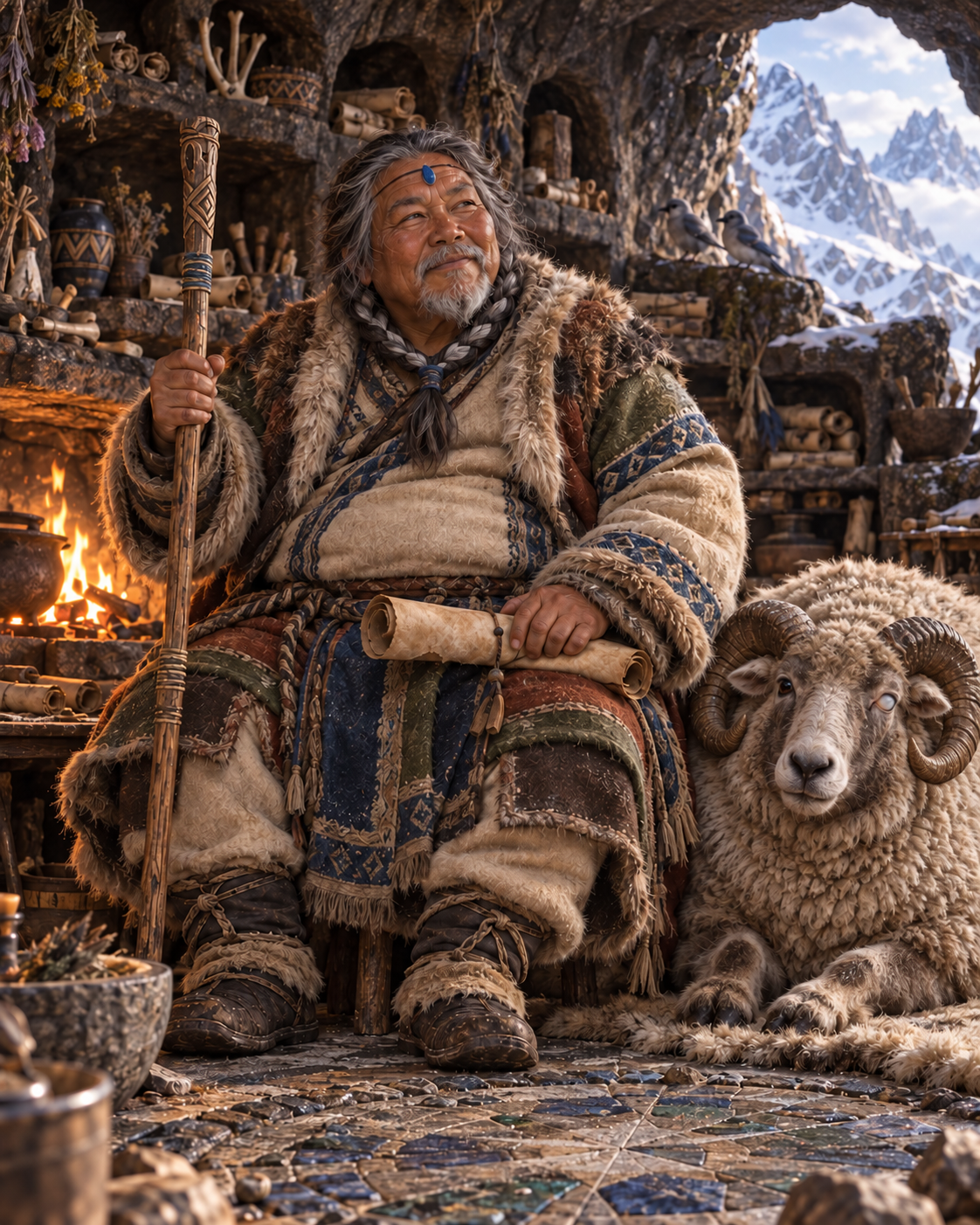
His low entrance rises into a beehive-like vault with roughly a thousand alcoves. Bones, flowers, pots, ritual objects, and greased hide scrolls sit in marked places. The runes are burned into skin rather than written in ordinary ink. A complex colored-stone map or star chart occupies the floor. This is home, ritual workshop, observatory, medical store, legal memory, and library in one living architecture.
The office therefore depends on relationships as much as objects. Ookequk knows Sithi speech because he learned it directly from the Sithi, and Jiriki remembers that the Gardenborn once loved the Qanuc well. He exchanges knowledge with southerners instead of treating the mountains as a sealed world. His authority grows from preserving local memory while recognizing that danger does not respect cultural borders.
The Man
Old, immense by Qanuc standards, and absolutely unwilling to romanticize a student’s foolishness
Binabik remembers Ookequk as a great, fat Qanuc man. He stands only about Binabik’s height but weighs more than Simon. He was already old before Binabik’s several years of study. He travels on One-eye, a great, fat, patient ram whose body and temperament echo his master’s grounded presence.
That physical specificity matters. Ookequk is not a wispy mystical elder designed to disappear into incense. He is substantial, funny, learned, mobile, and practical. When the young Binabik performs a three-day purity fast before apprenticeship, Ookequk boxes his ear and calls deliberate starvation presumptuous. Spiritual training does not require theatrical self-harm merely because a boy thinks suffering will look impressive.
The moment contains his pedagogy in miniature: reverence without vanity, discipline without worshipping misery, and affection sturdy enough to correct. The books give no evidence that he was gentle every minute or flawless in every judgment. They give us a teacher whose lessons become habits in Binabik—question the convenient answer, protect knowledge, and do not confuse solemnity with wisdom.
Teacher and Student
Binabik inherits an unfinished apprenticeship and mistakes incompleteness for failure
After Binabik’s parents disappear in dragon-snow on Little Nose, he throws nearly all his attention into study. Elders have selected him for apprenticeship, and Ookequk becomes teacher, intellectual parent, and the center of the young man’s working life.
When disturbing messages arrive, Ookequk chooses Binabik to accompany him south before the apprenticeship is complete. He presents the journey as a final test. Only later does Binabik understand that his master was answering a danger large enough to outweigh the normal calendar of training and the Rite of Quickening.
Ookequk’s sudden death leaves Binabik with knowledge but without the ceremonial assurance that he is ready. That wound shapes everything: the promise to protect Simon, the accusation that he abandoned Yiqanuc, his terror of being an oath-breaker, and his tendency to measure every hard decision against a teacher who is no longer present to answer.
The preserved testament eventually reveals Ookequk’s own judgment. He calls Binabik eager in learning and capable of becoming a greater Singing Man than himself. This is not empty deathbed praise. It names succession precisely when Binabik feels least entitled to it.
Morgenes and the League
The friendship is an exchange, not a southern scholar collecting picturesque mountain lore
Ookequk and Morgenes are old friends and intellectual correspondents, although the record does not preserve exactly where they first met. Ookequk teaches Morgenes the craft of message-carrying birds. Morgenes teaches him letters. They exchange ideas about the world for years.
Both belong to the League of the Scroll, a fellowship of learned people that never numbers more than seven. The scroll-and-quill pendant Binabik carries identifies Ookequk’s membership. When Ookequk and Morgenes die, Binabik infers that perhaps five members remain, although he has not yet been entrusted with the organization’s complete purpose or roster.
The friendship becomes operational when both elders recognize signs larger than Elias’s politics. Morgenes sends a warning that Simon will flee the Hayholt toward Naglimund in danger and asks Ookequk to find and protect him secretly. The exhausted messenger bird reaches Ookequk’s grave two days too late. Binabik accepts the obligation because the relationship between the dead men has created a living network of trust.
That inheritance is ethically complicated. Neither dead principal can clarify the request, and Simon does not know it exists. Yet without it, Simon likely dies alone. The League works not because perfect instructions arrive on time, but because people understand knowledge as responsibility rather than possession.
The Southern Journey
Abnormal Boghanik behavior tells Ookequk that the old categories are failing
Below Lake Drorshullven in the Frostmarch, Ookequk and Binabik encounter Boghanik—Bukken, or diggers—attacking armed travelers. Qanuc memory knows these creatures as predators of animals and isolated people, not organized assailants willing to strike groups capable of fighting back.
Ookequk does not dismiss the change as one strange day. Combined with messages from Morgenes and other correspondents, it indicates a pattern. He stops sleeping and searches for an answer on the Road of Dreams using dream-bark from the southern Wran.
Something appears to catch him there. His heart walks the dream road while his body struggles from afternoon past midnight. He murmurs phrases Binabik later compares with Brother Dochais’s terror, but the resemblance is not a complete diagnosis. Ookequk speaks calmly to his student and dies with his staff in hand.
Binabik buries him alone on a hillside without the proper Qanuc rites. He fears his master’s spirit may remain unsettled and carries shame for a burial made inadequate by circumstance. One-eye refuses to leave the mound. The patient ram remaining beside the improvised grave gives Ookequk’s death its most ordinary, unbearable witness.
Book 2 · The Death-Song
His last words do not bypass Qanuc law; they give the community evidence to change its judgment
When Binabik returns to Yiqanuc, he faces execution for failing to complete the Rite of Quickening and abandoning his betrothal. The Ice House has not melted, winter will not leave, and his people have real reasons to understand absence as betrayal.
Ookequk’s cave becomes the turning point. Sisqi recognizes a hide scroll sealed at both ends with the black-thong knot used for great power, private messages, spells, and death testaments. Her cultural and legal knowledge forces the council to open it before carrying out the sentence.
In the death-song, Ookequk names himself Singing Man of Mintahoq, Chugik, Tutusik, Rinsenatuq, Sikkihoq, Namyet, and all the mountains of Yiqanuc. He warns of a cold darkness from Vihyuyaq, the mountain of the immortal Cloud Children, powerful enough to break Yiqanuc stone. He says he took Binabik to help other wise people resist it and asks his people to honor the student in his place.
The testimony changes the hearing into a council. Nunuuika recognizes that tradition, once protective, has become a shackle under changed conditions. Binabik and Sludig are freed, and the Qanuc begin the descent from a mountain whose seasonal rites cannot defeat the supernatural winter.
Ookequk’s authority does not function as “the dead elder said so, everyone obey.” His evidence lets living leaders revise law without pretending the original communal injury was imaginary. That is a much more generous vision of tradition: memory strong enough to change course.
The Archive Keeps Traveling
Scrolls, birds, language, and one translation redirect the entire coalition
Ookequk’s materials continue to work after the trial. Sisqi learns Westerling from one of his books. One of his messenger birds helps her contact Binabik before the Qanuc arrive at Sesuad’ra. His Sithi-source scroll corrects the misleading translation “Stone of Farewell”: Sesuad’ra is the Leavetaking Stone, the place where the Zida’ya and Hikeda’ya separated.
That linguistic correction transforms a vague destination into historical geography. The group can locate Enki-e-Shao’saye and understand why the site carries power and sorrow. The route forward is not discovered by a prophecy conveniently glowing on a wall. It comes from an old scholar preserving someone else’s language accurately enough for a student to reopen the file under pressure.
Later investigators still count Ookequk’s scrolls among the surviving evidence about the Great Swords. The archive cannot answer every question, but incompleteness does not make it useless. Ookequk’s work repeatedly narrows uncertainty until action becomes possible.
Connections
The living network around a man who understood that knowledge needs relationships
Binabik
Student, successor, and inheritor of an unfinished education whose choices repeatedly enact Ookequk’s teaching.
Morgenes
Old friend, correspondent, and League colleague who exchanges letters for birdcraft and entrusts Simon’s protection to him.
Sisqi
Recognizes the testament’s legal seal, learns Westerling from his book, and turns preserved knowledge into communal action.
One-eye
His great patient ram, traveling companion, and final grave-side mourner.
Jiriki
Confirms Ookequk knew Sithi speech directly and preserves the older affection between Sithi and Qanuc.
The League of the Scroll
The small fellowship through which his local knowledge joins a wider resistance to the returning Storm King.
Why Ookequk Matters
He proves that a character can die before the quest and still remain structurally alive inside it
Ookequk never meets Simon on the page, yet Simon survives because Ookequk taught Binabik, befriended Morgenes, trained birds, preserved languages, investigated changed behavior, and recorded a warning before attempting a dangerous journey.
His legacy also refuses the fantasy cliché of wisdom as one secret answer delivered by one chosen sage. Ookequk leaves distributed tools: a student, a friendship, a legal testament, a multilingual archive, a star chart, birds, cultural memory, and the habit of noticing when established patterns stop explaining reality.
Most importantly, his teaching does not make Binabik obedient to a frozen script. It equips him to choose when duties collide. Ookequk’s true succession is not Binabik copying the old Singing Man. It is Binabik becoming capable of carrying wisdom into circumstances his teacher did not live to see.
On the Record
One historical profile, three relevant volume scopes, and no invented dream-road solution
This is Ookequk’s one canonical full-spoiler profile. Book 1 establishes his office, appearance, apprenticeship, League relationship, investigation, death, burial, and connection to the Sithi. Book 2 brings the company into his house, opens his death-song, uses his archive to locate Sesuad’ra, and extends his messenger network. Book 4 continues to invoke his scrolls and the inherited promise during the final search and war. The previous Book 1/4 membership omitted the decisive Book 2 material.
The record confirms his great fat build, approximate height, old age, One-eye, Singing Man office, Binabik apprenticeship, Morgenes friendship, birdcraft, letters, League membership, Sithi language, Boghanik investigation, dream-road seizure, death, improvised burial, testament, and archive. It does not establish exactly what attacked him on the Road of Dreams, precisely where he met Morgenes, or an eye color, hair description, exact age, and private costume design.
Visual state: approved and locked. Ookequk is one charismatic elderly Qanuc scholar with a broad weathered brown face, narrow smiling eyes, iron-gray under-chin braids, full gray beard, blue forehead stone, compact adult height, and the canonically great fat body shown without mockery. His staff, greased hide scroll, cave archive, messenger birds, colored-stone map, and great fat patient ram One-eye form the approved Mintahoq composition. The books establish his age, Qanuc scale, great fat build, staff, scholarship, archive, birds, and ram; exact face, coloring, hair, beard, clothing, blue stone, staff carving, scroll layout, archive objects, birds, ram coloring, and light are editorial reconstruction. Preserve this exact identity across teaching, southern travel, dream-road vigil, hillside burial memory, death-song, directory, hero, and social imagery. The same local attachment must power featured image, visible hero, cards, and Rank Math social metadata.