
Memory, Sorrow, and Thorn · Canonical Character Profile
Varellan
Varellan is Duke Leobardis and Duchess Nessalanta’s anxious youngest son: a slight young man once drawn toward the priesthood, pressed instead into bright armor, and eventually handed an army during Nabban’s civil fracture. His story is not that he lacks courage. It is that a family decides what courage must look like, then leaves him to bleed inside the costume.
At a Glance
The younger son fitted to somebody else’s idea of manhood
- Name
- Varellan
- House
- Benidrivine of Nabban
- Parents
- Duke Leobardis and Duchess Nessalanta
- Brother
- Benigaris
- Early vocation
- Once showed interest in the priesthood
- Military record
- Crannhyr disembarkation; command at Onestrine Pass; wounded surrender
- Status
- Alive when last directly confirmed
Book 1 · Crannhyr
His first clear appearance is useful, anxious work—not battlefield pageantry
Varellan arrives at Crannhyr with Leobardis’s Nabbanai force of roughly two thousand. While the duke’s flagship, Emettin’s Jewel, anchors the public arrival and Benigaris later brings Count Aspitis Preves, the youngest son organizes the unloading. It is logistical work: getting soldiers, equipment, and a ducal household off ships and into a coalition already living under the pressure of Elias’s rule and the unnatural winter.
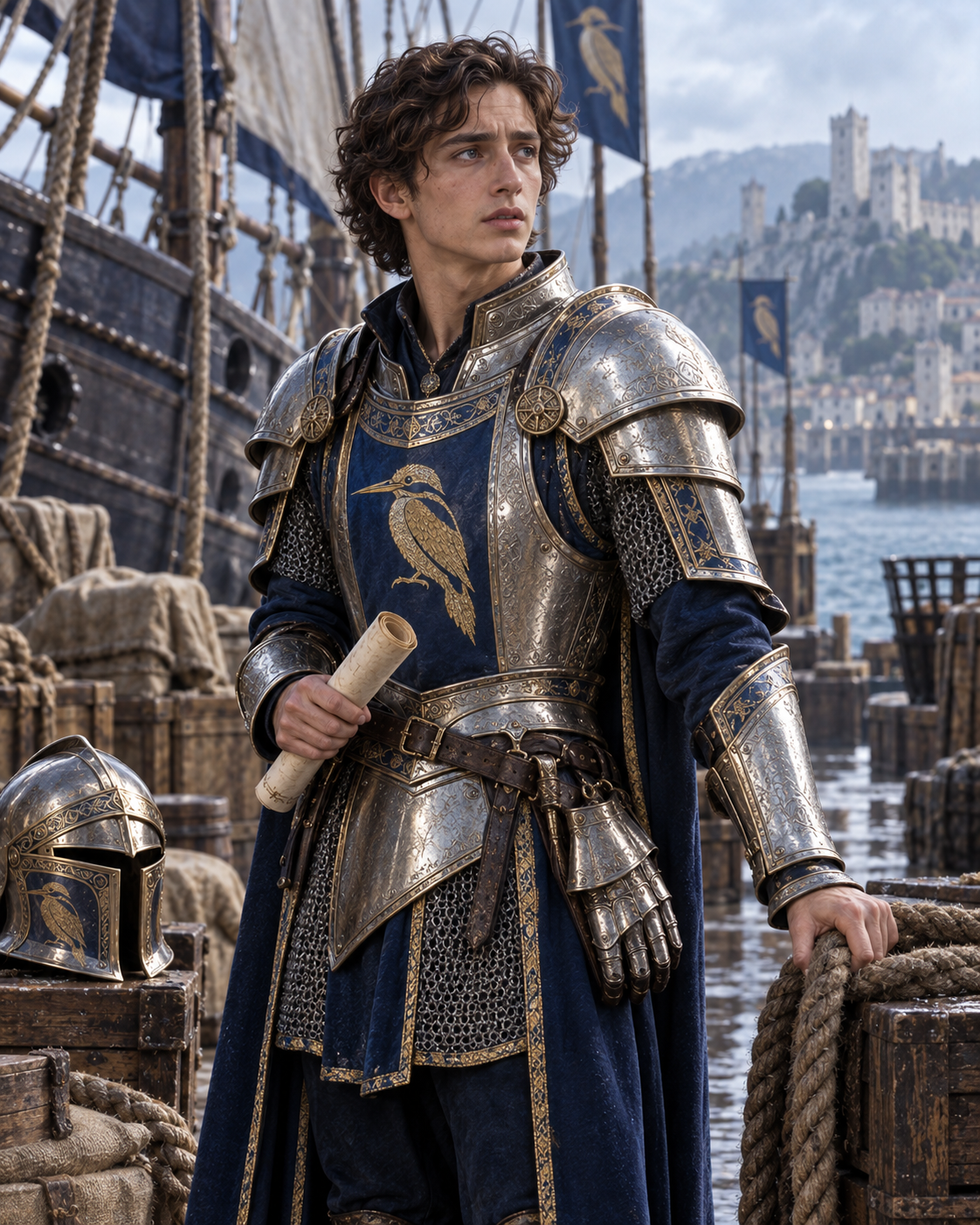
He is tentative and eager for his father’s approval. The text makes his discomfort visible before it explains it. Varellan has a thin face and is physically too small for the gleaming armor he wears. The armor does not transform him into a natural warrior; it advertises the mismatch between body, role, and family expectation.
That does not mean he is incompetent at Crannhyr. He is entrusted with a real task and carries it out. His anxiety coexists with service. The distinction matters because later defeat can tempt a lazy reading in which the young man was always merely weak. Book 1 gives us something sharper: a dutiful son doing the work placed in front of him while visibly asking whether the role will ever fit.
The Family Decision
Leobardis recognizes the coercion—and still treats it as too old to undo
Varellan once showed interest in the priesthood. We are not given a private theological manifesto, a formal vow, or proof that he would have remained a priest forever. What we are given is enough: the preference existed, and Leobardis realizes that he and Nessalanta mocked or smothered it until a military path became the acceptable future.
The realization is painfully incomplete. Leobardis can identify the parenting failure, see the bright armor hanging badly on his youngest son, and understand that Varellan’s uncertainty has been converted into compulsory soldierhood. He does not then stop the machine. Recognition arrives as regret rather than repair.
Nessalanta’s family politics make the pressure heavier. Her confidence favors force, dynasty, and the apparent certainty of the elder son. Benigaris occupies the polished martial position Varellan is expected to imitate: engraved silver armor, political command, and the performance of an heir who knows exactly what power should look like. The reader later learns how rotten that performance is. Varellan, meanwhile, looks uncertain because he has not learned to make coercion resemble destiny.
Brother and Heir
Benigaris does not merely overshadow Varellan; he helps create the war Varellan must command
Benigaris returns to Leobardis’s side with useful strategic counsel, and the duke is relieved to believe that war has reconciled his resistant heir to the family. That apparent restoration is a lie. Benigaris has killed Leobardis and seized Nabban’s direction while concealing the murder.
By the time Varellan commands at Onestrine Pass, he is not defending a stable family order. He is serving inside his brother’s usurpation and Nessalanta’s confidence that Josua’s coalition can be minimized. The record does not establish how much Varellan knows about Leobardis’s death or Benigaris’s culpability. It would be unfair to turn silence into complicity.
What the record does show is an asymmetry of responsibility. Benigaris creates and controls the political crisis. Varellan receives troops, a pass, and the expectation that he prove himself against an army that includes Seriddan, Hotvig, Josua, and the returned Camaris. One brother authors the betrayal; the other becomes its exposed military surface.
Book 4 · Onestrine Pass
Thousands of soldiers cannot rescue a commander from the lesson nobody let him learn
At Onestrine, Varellan yields two leagues in less than a fortnight despite commanding several thousand foot soldiers and five hundred knights. The numbers make the failure strategically serious, but they do not prove cowardice. He remains in command while opposing forces repeatedly offer terms and while Camaris’s presence changes the moral and tactical meaning of the campaign.
Seriddan’s force of more than five hundred Metessan pikemen holds a disciplined shield wall under arrows. Varellan overcommits against it. Camaris and Hotvig then strike his cavalry’s flank, while Josua times Freosel’s household troop as part of the larger maneuver. The young commander is not defeated by one magical flourish; he is caught by discipline, coordination, and a veteran’s ability to punish an eager commitment.
Camaris makes the battlefield terrifying. He cuts an armored knight nearly in half with Thorn and advances with the efficiency of a harvest. Cellian’s horn becomes psychological warfare. Yet Camaris also returns prisoners with offers of truce because he hates unnecessary war. Varellan’s side receives multiple chances to understand that the enemy is not seeking Nabban’s humiliation.
The combination exposes the real tragedy. Varellan has been trained into the visible obligations of nobility—armor, command, obedience—without the judgment or freedom that should accompany them. His eagerness to satisfy authority becomes tactical overcommitment on a battlefield where older men have arranged every available choice.
The Baton
Wounded, he offers the symbol of defeat; Josua and Camaris refuse to turn him into a trophy
Varellan survives the battle wounded and offers Josua the Benidrivine warmaster’s baton. The gesture accepts defeat through the language of house and command. Josua refuses it—not because the surrender is meaningless, but because accepting it would make his coalition look like a foreign conquest of Nabban.
He redirects the surrender to Camaris, the rightful elder of House Benidrivine. That move returns Nabban’s reckoning to Nabbanai legitimacy rather than letting Josua collect another realm as spoils.
Camaris’s response is the moral center of Varellan’s arc. He calls the young man’s error innocent and blameless. Then he offers freedom to surrendered soldiers willing to help liberate Nabban. Camaris knows what a true betrayal looks like. He distinguishes Benigaris’s murder and seizure of power from the younger son’s failed service inside a structure built by others.
This is mercy with political intelligence, not sentimental erasure. Men have died; Varellan has lost ground and command; the consequences remain. But the victors refuse the easy lie that every person standing beneath a corrupted banner bears equal guilt. The boy in ill-fitting armor is finally judged by somebody who sees the difference between obedience, error, and treachery.
Connections
The family and commanders who define Varellan’s narrow field of choice
Duke Leobardis
His father recognizes that parental mockery helped force Varellan away from priesthood and toward military life, but recognizes it too late to repair the path.
Duchess Nessalanta
His mother’s dynastic certainty and contempt for hesitation reinforce the family standard he struggles to inhabit.
Benigaris
His elder brother murders Leobardis, controls Nabban, and leaves Varellan defending the political consequences.
Camaris
The elder Benidrivine defeats Varellan’s forces, accepts the redirected surrender, and explicitly calls his error innocent and blameless.
Prince Josua
The coalition leader refuses the warmaster’s baton so victory cannot masquerade as foreign conquest.
Seriddan and Hotvig
Their disciplined infantry and flanking cavalry help turn Varellan’s overcommitment into defeat.
Why Varellan Matters
He is what happens when nobility confuses vocation with family branding
Varellan is not one of the trilogy’s largest presences, but his two major appearances form a complete argument. At Crannhyr, he performs useful service while wearing the visible mismatch imposed by his parents. At Onestrine, that mismatch has scaled into command, casualties, defeat, and surrender.
The books do not reward him with a sudden revelation that he was secretly the greatest warrior in the room. They offer something more humane. Camaris names the limit of his guilt. Josua refuses to exploit his defeat. The coalition turns surrendered soldiers toward liberation rather than vengeance.
His arc also sharpens the contrast between appearance and character inside House Benidrivine. Benigaris looks like the martial heir and commits the central family betrayal. Varellan looks uncertain, fails militarily, and remains morally distinguishable from the usurper. Competence matters; so does the purpose it serves.
On the Record
What the four-book reading confirms—and what it does not
This is Varellan’s one canonical full-spoiler profile. He belongs in the Book 1 and Book 4 directory views: Book 1 contains his direct Crannhyr appearance and family context; Book 4 contains the Onestrine campaign, wound, and surrender. He should not be duplicated into separate “young Varellan” and “commander Varellan” posts.
The reading record confirms his parentage, younger-son position, thin face, small build relative to his bright armor, tentative eagerness, earlier interest in priesthood, Crannhyr responsibility, Onestrine troop strength and territorial losses, tactical overcommitment, wound, baton, and Camaris’s judgment. It does not confirm private vows, exact age, hair or eye color, knowledge of Benigaris’s murder, or a later death. His last directly evidenced status is alive.
The approved identity establishes one exceptionally handsome young Nabbanai noble with a long thin heart-oval face, warm light-olive skin, gray-blue eyes, dark chestnut curls, slight clean-shaven body, and beautifully made silver-and-blue armor visibly too broad and long for him. His exact age, face, coloring, eyes, hair, attempted mustache shadow, armor construction, enamel, gold trim, bird ornament, pendant, parchment, rope, helmet, ship, harbor, banners, architecture, pose, weather, and light are CVM editorial reconstruction.
This exact face, age baseline, slight body, coloring, curls, and armor now govern every card, hero, Crannhyr scene, family context, Onestrine wound and surrender, and social image. Later battle wear may change condition without turning him into a different man, a Benigaris clone, or the physically imposing warrior his family wanted.