
Memory, Sorrow, and Thorn · Canonical Character Profile
Gwythinn
Prince Gwythinn is tall, handsome, furious, funny with his sister, and being trained for a crown while Hernystir starves. He puts steel to Guthwulf’s throat, demands war at Naglimund, races home when his father falls, and returns to Maegwin as Skali’s mutilated “gift”—a beloved heir turned into occupation theater.
At a Glance
The expected king whose righteous anger keeps reaching for a sword
- Title
- Prince of Hernystir and expected heir of King Lluth
- Family
- Son of Lluth and Fiathna; younger half-brother of Maegwin
- Political position
- Opposes Elias and demands military resistance
- Strength
- Open courage, national loyalty, readiness to hear Jarnauga
- Weakness
- Impulsiveness and a habit of letting justified fury outrun discipline
- End status
- Dead; tortured and mutilated by Skali’s occupiers
The Visual Receipt
Sorrel mane, warrior height, gold torque—and youth that believes readiness is the same as judgment
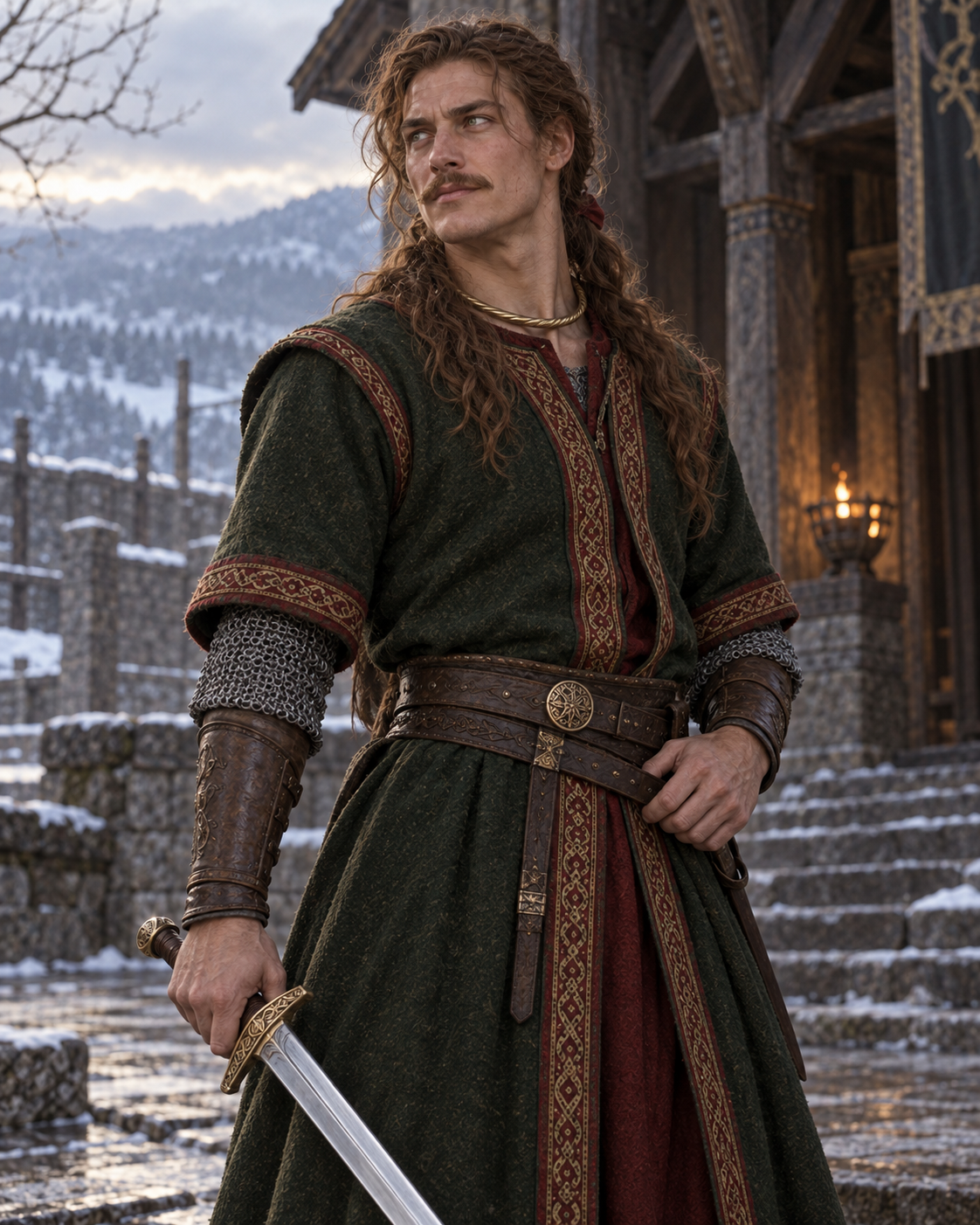
Gwythinn is a tall, handsome young warrior, approximately Maegwin’s unusual height. His long sorrel-brown hair is tied with red cloth; he wears a long mustache and gold neck torque. His worn Hernystiri clothing and bright gold-and-silver weapons place national pride beside a kingdom already strained by weather and scarcity.
The approved living identity preserves that cultural specificity in one genuinely attractive young fighting body: exceptionally tall and lean-powerful, with long brown-sorrel hair visibly tied in plain red cloth, a long matching mustache without beard, strong cheekbones, gray-green eyes, one gold torque, repaired green-and-red Hernystiri wool, light mail, and a single bright silver blade with restrained gold hilt. He cannot become a generic clean-shaven prince or interchangeable Viking costume.
The books establish his height, handsomeness, youth, matching Maegwin’s unusual height, sorrel coloring, long mane, red tie, long mustache, gold torque, worn clothing, bright weapons, and warrior identity. Exact age, face, eye color, complexion, body proportions, garment weave, mail, belt, sword ornament, Taig courtyard, snow, and light are editorial reconstruction. This one face connects sibling banter, the Taig confrontation, Naglimund council, military return, captivity, death, cairn, and memorial imagery. Any depiction of his mutilated body must preserve dignity and narrative purpose rather than turn torture into spectacle.
Book 1 · The Dragonbone Chair
The prince arrives with twenty soldiers and enough anger for an army
Gwythinn first reaches the Hayholt among delegations gathering around Prester John’s death. He brings only twenty Hernystiri, their bright weapons outshining worn clothing. The visual already tells the political story: an old allied kingdom maintaining ceremony while material strain shows through it.
At home, brief spring follows destructive cold, but crops, livestock, and people remain damaged. Gwythinn resents Elias’s demand for tribute and the High King’s earlier failure to help when Naerved, Elvritshalla, and Frostmarch roads suffered. His anger is not empty nationalism. It grows from repeated abandonment.
Maegwin, five years older, teases and corrects him because he is expected to become king. She pays attention to the discipline that must accompany his courage. Gwythinn needles her about Eolair and understands more of the court’s romantic gossip than she wants acknowledged. Their relationship gives him warmth before politics tightens.
Guthwulf at the Taig
One insult turns legitimate grievance into a blade at an envoy’s throat
Guthwulf demands Lluth’s allegiance and payment while Hernystir’s people and cattle starve. Lluth says he can pay no greater tithe without worsening death. Guthwulf repeats the phrase with mockery.
Gwythinn draws his sword and nicks the envoy’s throat. Guthwulf prevents his own men from retaliating; Lluth orders his son to stop because diplomatic protection still governs the hall. The king’s intervention saves both the envoy and his heir from a killing that would surrender Hernystir’s moral position.
The scene captures Gwythinn’s central tension. He is right about the insult, the coercion, and Elias’s abandonment. He is wrong to let Guthwulf choose the ground on which Hernystiri resistance will be judged.
The Raed at Naglimund
He demands war, but he also makes room for the warning everyone calls superstition
Gwythinn arrives at Naglimund with reinforcements as refugees crowd the commons. At the formal council he calls for war after Guthwulf’s threats against Lluth, Hernysadharc, and Hernystiri children.
When Jarnauga warns that the unnatural winter belongs to a danger larger than Elias, Devasalles dismisses northern superstition. Gwythinn argues the old man should speak before the gathering chooses war or expels him. The impulsive prince can still recognize that urgency does not excuse refusing evidence.
His position remains martial. He sees Elias behind dispossession, threats, and compliant agents. Waiting while Hernystir bleeds feels obscene. That judgment will pull him home when news of Lluth’s wound arrives.
Who Travels Under the Prince’s Banner
A small delegation can carry consequences its leader does not yet understand
Cadrach reaches the Hayholt with Gwythinn’s party and identifies himself as a Vilderivan friar. Nothing in the surviving record suggests Gwythinn knows the traveler’s former Scrollbearer identity, torture history, or entanglement with Pryrates.
The connection matters without assigning guilt. Political parties create cover, access, and credibility for people whose private histories remain hidden. Gwythinn’s twenty Hernystiri bring visible national representation; one apparently harmless companion quietly carries knowledge that will reshape the sword quest.
Brother and Heir
Maegwin trains the future king until the future disappears
Gwythinn’s mother Fiathna follows Penemhwye as Lluth’s second wife. Maegwin loses her own mother at four and grows up five years older than her half-brother. Inahwen, Lluth’s third wife, is later almost Maegwin’s peer in age.
The household assumes Gwythinn will rule. Maegwin monitors his speech and temper because she understands the responsibility attached to that expectation. She is not merely the overlooked competent daughter in a simple modern parable; she loves him, laughs with him, and tries to prepare him.
War destroys the planned succession. Lluth returns mortally wounded. Gwythinn leaves men at Naglimund and races toward Hernystir. Maegwin becomes the authority left in the Taig and later Grianspog, performing the leadership she had been teaching her brother to carry.
Skali’s “Gift”
Occupation turns a prince’s body into a message to his sister
Skali’s forces capture Gwythinn. At Moir Brach, the occupier arrives with roughly fifty men, hostages, and a black-wrapped burden. He demands the wizard’s boy and Princess Miriamele, threatens captives, and leaves the package when the resistance cannot comply.
The wrapping reveals Gwythinn’s tortured and mutilated body. Eolair weeps. Maegwin remains dry-eyed, strikes him when comfort feels like another demand she cannot survive, and refuses to give Skali the visible collapse his theater seeks.
Gwythinn’s death is not merely proof that Skali is evil. It attacks Hernystir’s succession, Lluth’s household, Maegwin’s remaining emotional structure, and the resistance’s belief that royal hostages retain exchange value. The body is intended to govern the living through terror.
Maegwin later tends Gwythinn and Lluth’s cairns while singing “The Leavetaking Stone.” She wonders why she should not join them, then makes survival the final duty of the broken house.
Connections
The people who love, discipline, threaten, follow, and mourn him
Maegwin
Older half-sister, political tutor, grieving survivor, and the person forced to inherit what his expected kingship leaves empty.
King Lluth
Father and ruler who validates Gwythinn’s grievance while stopping him from murdering a protected envoy.
Eolair
Lluth’s count and Maegwin’s beloved. Eolair carries news, fights for Hernystir, and openly mourns Gwythinn’s body.
Guthwulf
Coercive envoy whose insult provokes the prince’s blade and reveals the distance between anger and statecraft.
Jarnauga
Warning-bearer whom Gwythinn insists the Raed should hear before dismissing the northern evidence.
Skali
Occupier and torturer who weaponizes Gwythinn’s corpse against Hernystir’s remaining leadership.
Why He Matters
He is right about the emergency and unfinished as the king it requires
Gwythinn’s impatience is easy to criticize from a safe room. His people starve, roads fail, the High King threatens children, and Lluth bleeds while allies debate. Waiting is not neutral.
But the sword at Guthwulf’s throat shows why Maegwin keeps correcting him. A future king must prevent the enemy from turning justified anger into strategic disaster. Gwythinn possesses courage and loyalty; he has not yet learned to govern every impulse they produce.
His death freezes that development. We never learn whether experience would have joined fire to discipline. The profile must resist making the torture retrospectively perfect him. He dies loved, brave, flawed, and still becoming.
Books 2–4 · The Brother Who Is Missing
His absence helps unravel Maegwin’s invented heaven
Maegwin’s later visions promise a gathering of dead heroes, yet Lluth, Gwythinn, and Penemhwye are absent. She begins asking why. The missing brother becomes evidence against the consolation that has carried her through leadership and grief.
Hernystir’s rebuilding proceeds without its expected heir. Eolair’s eventual return west chooses living work over permanent attendance on immortal allies, honoring the people Gwythinn wanted to defend rather than only the prince he could not save.
On the Record
Scope, status, and visual boundaries
This is Gwythinn’s one canonical full-spoiler profile. His direct action and death occur in Book 1; later volumes carry Maegwin’s cairn tending, visions, grief, Hernystir’s broken succession, and rebuilding. The current registry’s Books 1, 2, and 4 scope is preserved pending a final physical-edition mention audit.
The visual record confirms a tall handsome young man with long sorrel-brown hair tied in red, long mustache, gold neck torque, and Hernystiri warrior identity. His approved living portrait fixes one face, tall lean-powerful body, gray-green eyes, long sorrel mane, matching mustache, gold torque, green-and-red clothing, mail, and bright sword for every later use.
Visual state: approved and locked. Featured image, visible hero, directory cards, and Rank Math social image must use the same local attachment. Sibling scenes, Taig confrontation, council, military return, captivity, death, cairn, and memorial imagery must preserve this exact adult identity. Mutilation may be represented only with dignity and clear editorial need.