
Memory, Sorrow, and Thorn · Canonical Character Profile
Skali Sharp-nose of Kaldskryke
Skali is Isgrimnur’s large, hawk-faced cousin, Elias’s specially invited dinner guest, and the occupation lord who turns Hernystir from battlefield prize into stolen settlement. He tortures Gwythinn, threatens Maegwin, hunts Miriamele and Simon, clears forest for northern longhouses—and learns that a five-century Sithi debt can arrive with horses, iron-proof training, and absolutely no interest in his property plans.
At a Glance
The cousin who converts royal favor into land theft, torture, and settlement
- Full style
- Skali Sharp-nose of Kaldskryke
- People
- Rimmersman noble and leader of the Kaldskryke Ravens
- Family
- Unloved cousin and liegeman of Duke Isgrimnur
- Patron
- King Elias, who grants him Elvritshalla and occupied Hernystir
- Crimes
- Invasion, hostage terror, sexual threat, torture, murder, forced settlement, and forest destruction
- End status
- Dead; killed during the Sithi liberation of Hernystir
The Visual Receipt
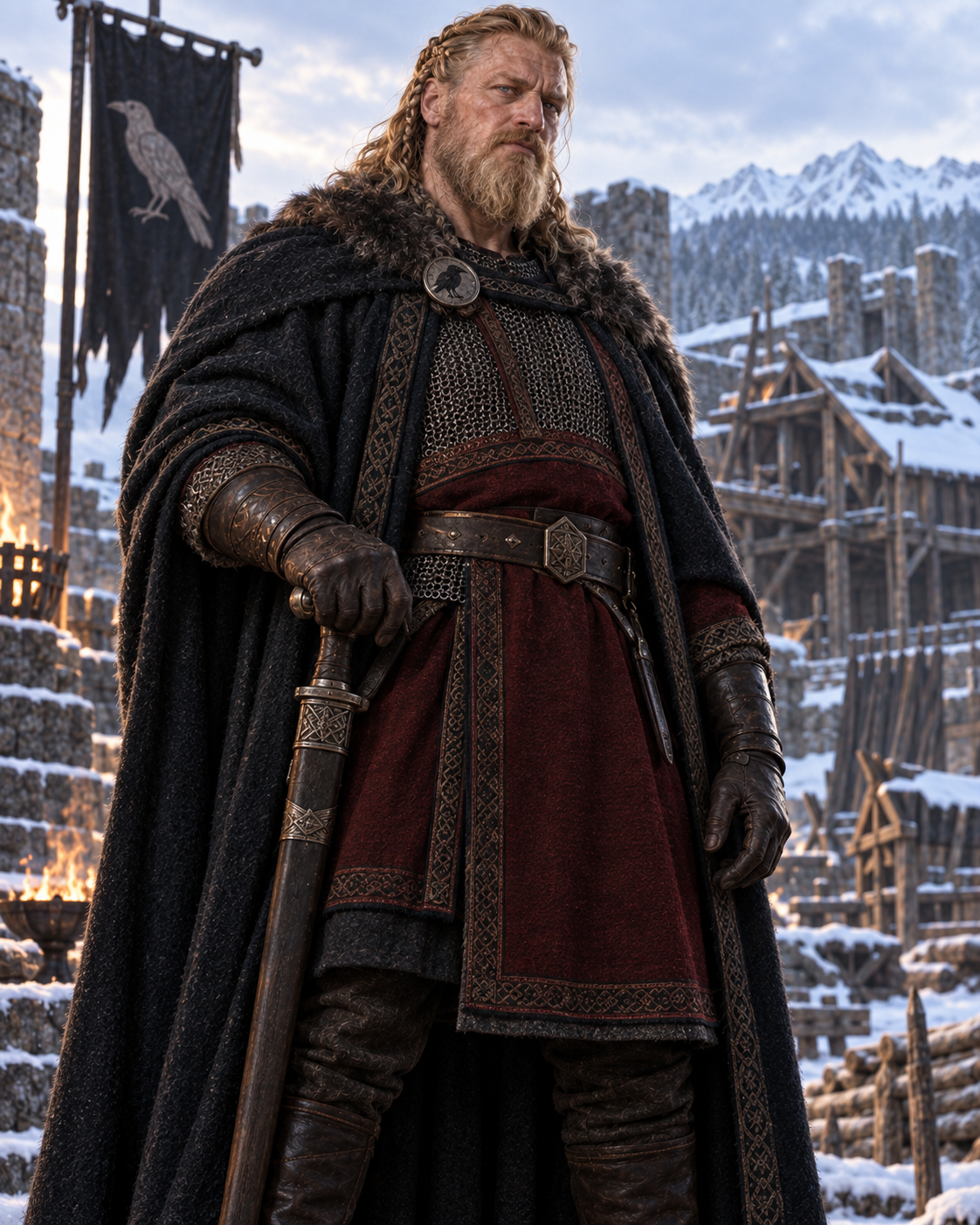
Large, blond-bearded, hawk-faced—and built to make stillness feel like a threat
Skali is a large Rimmersman with a hawk-like face and blond beard. At Moir Brach, Maegwin sees him at a distance standing wide-legged while his sour voice carries upward in mockery. His warriors carry the Kaldskryke raven, a visual mark that later lets Sludig identify men attached to the occupation.
The approved portrait makes him formidable and physically attractive without romanticizing what he does. Handsome villainy is allowed; soft-focus absolution is not. He belongs in the same northern visual universe as Isgrimnur and Isorn, but his sharper face, blond beard, predatory stillness, and raven insignia keep him distinct.
This one approved identity governs the Hayholt feast, northern court conflict, occupation, hostage wagon, Gwythinn’s “gift,” longhouse settlement, flight, Sithi defeat, death, directory, hero, and social imagery.
Book 1 · The Dragonbone Chair
Before the land grant, Elias announces the relationship with a dinner invitation
Skali arrives from Rimmersgard with ten deep-bearded kinsmen. He is already Isgrimnur’s unloved cousin, but the narrator-supplied dislike is context rather than evidence of future crimes. Skali still earns every later judgment through action.
At John’s funeral feast, Elias gives him a special place among the favored circle while Isgrimnur sits apart. The invitation is more than table gossip. The uncrowned heir rewards a rival liegeman and publicly humiliates one of John’s closest companions before the coronation.
An Elias joke hits Skali hard enough that his goblet strikes the plate. He then joins the laughter with Fengbald. The small moment shows a client learning the court rhythm: absorb the king’s blow, laugh with the powerful, keep the reward.
The Northern Road
Elias answers Isgrimnur’s missing garrison with Skali’s accusation
Isgrimnur reports that the Vestvennby garrison has been absent for more than a month, leaving the Wealdhelm Road exposed. Elias does not address the logistical danger directly. He repeats Skali’s claim that Isgrimnur hoards soldiers at Elvritshalla and Naarved.
Josua calls Skali a liar. Pryrates helps convert a military warning into a loyalty dispute the court can postpone. Skali’s function is already clear even when he is not the loudest speaker: provide the allegation that lets Elias treat an experienced duke’s evidence as self-interested disobedience.
When Bindesekk is found murdered near the Hayholt, Isgrimnur reveals he sent the man north to follow Skali and warn Isorn. He initially suspects his cousin, then rejects the obvious answer because the hidden body and broken arrow do not match Skali’s preferred methods. Even an enemy deserves an evidence boundary.
Dispossession
The king calls Isgrimnur traitor and hands Skali somebody else’s inheritance
Elias declares Isgrimnur a traitor, transfers Elvritshalla to Skali, and leaves Isorn confined as leverage. Thane Storfot blocks Isgrimnur at Vestvennby with fifty housecarls and offers to escort him into Skali’s “mercy.”
The grant rewards the cousin who undermined Isgrimnur at court and gives legal clothing to family theft. Skali’s power is not rogue violence outside the system. It is violence made administratively legitimate by Elias.
Later maps show the strategic result: Hernystir has fallen, Lluth is dead, Skali rules Rimmersgard, and Frostmarch order is collapsing behind the occupation. Royal patronage does not stabilize the north; it lets one client consume it.
Book 2 · Stone of Farewell
Hernystir becomes a hostage camp with a settlement plan
Skali and Elias destroy Hernysadharc and drive the surviving Hernystiri into Grianspog’s caves. The refuge survives through hunting, gathering, and raids while Maegwin searches for a strategy that will keep a few hundred elders, women, and children alive.
Skali’s occupation is not temporary looting. New Rimmersman longhouses replace the shrinking Circoille Forest. Families from frozen northern lands move onto seized Hernystiri country. Winning the field becomes only phase one; trees fall so conquest can harden into ordinary domestic life.
Abaingeat adapts commercially beneath Elias and Skali, but flexibility at one port does not erase the larger extraction. Elsewhere fields go unharvested, people flee, and the occupation exhausts both seized territory and the unstable Frostmarch behind it.
Moir Brach
Skali brings hostages, demands two missing young people, and leaves a prince wrapped in black
Skali waits below Moir Brach with roughly fifty men and a hostage wagon. He demands “the wizard’s boy” and Princess Miriamele, proving the occupation is tied to the wider hunt serving Elias and Pryrates.
He threatens the captives and displays a struggling young woman in Cifgha’s light-blue dress, although Maegwin cannot verify the girl’s identity at that distance. The uncertainty is part of the tactic. A hostage does not need to be identifiable if the audience fears she might be someone they love.
Skali then leaves a black-wrapped “gift”: Gwythinn’s tortured and mutilated body. The murder attacks succession, family, morale, and Maegwin’s remaining emotional structure at once. Eolair weeps; Maegwin refuses the collapse Skali staged the body to produce.
The Unarmed March
Maegwin comes without weapons; Skali answers with arrest and sexual threat
Maegwin leads the surviving Hernystiri down from Grianspog to demand that Skali leave. The march includes mostly elders, women, and children. Arnoran’s “Lily of the Cuimhne” turns fear into communal rhythm, but the people’s courage does not make them militarily safe.
Skali arrests the unarmed company, mocks the dead Hernystiri gods, and threatens Maegwin sexually. The scene removes any plausible claim that he is merely a hard administrator occupying enemy territory. He understands vulnerability and reaches immediately for humiliation.
Diawen’s promise that the gods favor Maegwin appears to fail—until the Sithi army arrives at the exact moment of despair. Real rescue validates Maegwin emotionally even though it does not prove every divine interpretation that led her people into danger.
Book 3 · To Green Angel Tower, Part I
The Fox’s Bargain arrives, and Skali discovers the land has a five-century memory
The Sithi ride west to repay Prince Sinnach’s faithfulness before Ach Samrath. Likimeya’s force blows apart Skali’s new fortification because it stands in the way and shatters an occupation that expected only exhausted human resistance.
Skali and many Ravens initially escape into the Frostmarch. Pryrates dismisses him as useful flank protection whose real strategic purpose was to delay the Sithi while the Storm King’s plan matured. The client who believed royal favor made him central is revealed as expendable timing.
Likimeya later presents Skali’s severed head as proof that Hernystir is free. Eolair recoils while she invokes Sinnach’s older customs. The trophy confirms death without making every element of the victory ethically comfortable.
Connections
The people who reward, resist, survive, and finally collect him
Isgrimnur
Cousin and liege-lord whose authority Skali undermines before accepting Elvritshalla from Elias.
King Elias
Patron who converts Skali’s rivalry into court favor, land grants, occupation power, and strategic service.
Maegwin
Hernystiri leader targeted through hostages, Gwythinn’s body, sexual threat, and the occupation of her people.
Gwythinn
Captured prince tortured and murdered so his body can function as terror theater.
Isorn
Isgrimnur’s son who recruits outlaws with the promise of land reclaimed from Skali and rejects inherited identity as destiny.
Likimeya
Sithi commander whose army breaks the occupation and eventually presents Skali’s head as proof.
Why Skali Matters
He shows conquest becoming paperwork, housing, forestry, and family migration
Skali is more than a battlefield villain. His arc maps how authoritarian patronage turns rivalry into title, title into occupation, and occupation into settlement. The longhouses matter as much as the hostage wagon because they reveal the plan to make theft look normal over time.
His relationship with Elias also clarifies responsibility. Pryrates manipulates the king; the king empowers Skali; Skali recruits men and families into seized land; local officers enforce the new order. Evil travels through choices at every level rather than descending from one magical source.
The Sithi defeat completes an ancient rhyme—Fingil’s conquest patterns repeating until Sinnach’s debt answers them—but Isorn insists descendants are not identical to ancestors. Skali is condemnable because he repeats the structure knowingly, not because he is born Rimmersman.
On the Record
Scope correction, status, aliases, and visual boundaries
This is Skali’s one canonical full-spoiler profile. His previous Book 1-only registry scope was incorrect. Direct action and consequence require Books 1, 2, and 3: court favor and dispossession begin in Book 1, occupation and hostage terror dominate Book 2, and Sithi liberation ends his life in Book 3.
The evidence confirms the Kaldskryke origin, Sharp-nose name, cousin relationship to Isgrimnur, large hawk-faced blond-bearded appearance, Elias patronage, Elvritshalla grant, Hernystir occupation, longhouse settlement, Gwythinn’s torture and murder, threat against Maegwin, initial escape, and eventual severed-head proof. Bindesekk’s murder remains unassigned because Isgrimnur explicitly doubts Skali’s method.
The approved identity presents him at about forty-two: exceptionally large and broad-shouldered, with a long angular hawk-like face, prominent narrow hooked nose, pale-gray eyes, shoulder-length wheat-blond hair with temple braids, and a full sharply groomed golden-blond beard. His exact age, face, eyes, hair, braid map, clothing, mail, raven clasp and standard, sword, occupation works, and winter light are editorial reconstruction. This exact identity now governs the feast, occupation, hostage confrontation, longhouse settlement, flight, death, directory, social, and later scene imagery. Attractive rendering must never blur the textual brutality.