
RaeRae Reacts · One Piece Episode 188
Kalgara Breaks the Old Rule to Save Shandora
One Piece Episode 188 lets Kalgara break with sacrifice, trust Noland’s cure, and open Shandora before a new wound ends the friendship.
Bottom line: One Piece Episode 188 lets Kalgara break a rule he once believed was sacred, then refuses to pretend one breakthrough solves every conflict between Shandora and Noland’s crew. Medicine saves the village. Friendship opens the city. A later act involving the sacred trees closes every door again before anyone explains what happened.
“Free From the Spell! The Great Warrior Sheds Tears” carries Episode 187’s argument from theory into consequence. Noland has promised a cure. Kalgara has called his suffering divine punishment. The episode makes both men act on what they believe, then shows how evidence, family, history, and unspoken grief can change or harden those beliefs.
What hit me: Kalgara breaking the sacrificial rule is not a clean conversion scene. He acts because the evidence in front of him becomes impossible to ignore, and because letting Mousse die suddenly feels like obedience without purpose. I believed the tears because the choice costs him part of the world he knew.
Then the sacred-tree conflict wrecks the new trust before anybody explains the practical reason. That frustration feels human. Noland’s crew sees disease control. Shandora sees ancestors cut down without consent. Both facts can exist at once. I wanted them to talk, which is exactly why the silence hurts.
Seto blocks the path to another execution
The villagers gather around the cage holding Noland’s crew and prepare to appease the gods through more deaths. Seto sits in front of the prisoners and tells his community to feel ashamed. The child who was sick has the clearest evidence that Noland’s medicine works.
Seto cannot overpower the crowd, but his body has already answered the argument. Green marks and expected death gave way to recovery after treatment. He places that living proof between frightened adults and another sacrifice.
Noland keeps fighting inside the crevice
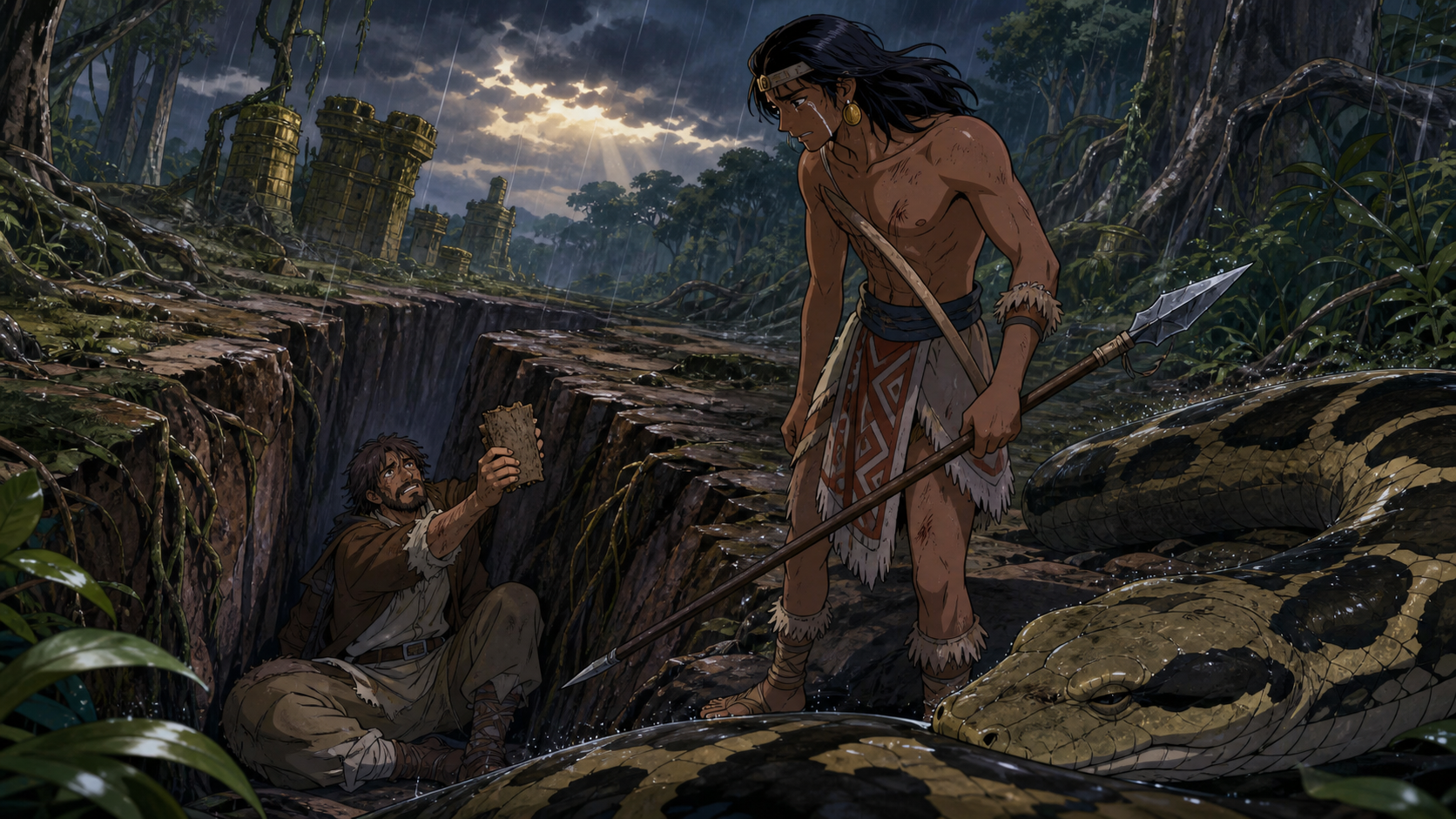
Kalgara watches Noland struggle against the collapsed earth. He says the trap is punishment and warns that the crew will die by evening. Noland keeps trying to climb because treatment materials must reach the village.
The effort unsettles Kalgara. A selfish invader would conserve strength or bargain only for his own escape. Noland spends his remaining strength on a deadline connected to people who plan to kill him.
That physical struggle keeps the debate from becoming two men trading speeches at a safe distance. Noland has almost no leverage. The ground can crush him, the deadline can expire, and Kalgara can simply walk away. Every attempt to climb therefore supports the claim that his concern for the village is sincere. Kalgara may reject the science, but he cannot honestly dismiss the sacrifice happening in front of him.
The village prepares to burn the wrong people
Noland’s crew and Mousse are led toward the sacrificial altar as sunset approaches. Fear has converted the earthquake into evidence that Kashigami’s death angered the gods. Every new disaster strengthens the explanation already holding power.
That circular logic cannot be disproved from inside the ritual. Disease proves anger. An earthquake proves anger. Killing outsiders promises relief. When relief fails, the answer becomes another death.
Noland names sacrifice as a human choice
Noland rejects the idea that tradition removes responsibility. People created the ritual, select the victim, bind the body, and carry the flame. Calling those actions divine cannot erase the hands performing them.
His words strike Kalgara where strength cannot protect him. The warrior can defend his ancestors and explain communal duty, but he still has to face what that duty asked him to permit.
The scene also separates respect for ancestors from obedience to every inherited practice. Noland never argues that Shandora should discard memory, community, or the voices of earlier generations. He argues that living people remain accountable for a killing performed in the present. That distinction becomes essential once the golden city reveals how much of Shandia’s inheritance deserves protection.
Mousse is Kalgara’s daughter
Kalgara reveals that Mousse is his own child. He was prepared to let her die because he trusted the priest and believed sacrifice might save everyone else. The confession turns faith into a private wound without making the village’s crisis smaller.
His love for Mousse and obedience to the rule existed together. That contradiction explains the tears later. Kalgara is not discovering that he cared. He is discovering what his certainty nearly made him do to someone he loved.
Noland explains where progress came from
Tree Fever struck Noland’s own home sixty years earlier. People suffered, studied the disease, found conine, and learned to extract treatment from Kona tree bark. Knowledge arrived because previous communities endured the same terror and preserved what worked.
Noland therefore speaks from inherited experience rather than detached superiority. His village once lacked the cure too. Progress means refusing to make later families pay the same price after an answer exists.
His explanation gives history a different function from the sacrificial ritual. One tradition repeats suffering because repetition feels faithful. Medical knowledge remembers suffering so later people can interrupt the pattern. Both systems look backward, but only one converts the dead into protection for the living. Episode 188 makes that contrast without treating knowledge as the achievement of one heroic man.
The bark in Noland’s hand is the missing proof
Noland entered the forest to find the medicine source and still holds the bark while trapped. The object connects every part of his story: diagnosis, treatment, environmental cause, and urgency.
Kalgara can see that Noland risked death to retrieve a plant for Shandora. The bark is more persuasive than an abstract lecture because somebody carried the cost of obtaining the evidence.
Kalgara kills the snake he was taught to worship
Kashigami’s offspring attacks Noland. Kalgara moves first and kills the snake, breaking the rule that defined the creature as a god. His spear protects the outsider he threatened moments earlier.
The act is not easy liberation. Kalgara believes he may have committed sacrilege. He chooses Noland’s life and the village’s possible cure while fear of punishment remains real inside him.
Kalgara’s tears keep the choice from reading as a sudden rejection of everything that shaped him. His hands act before his worldview has caught up. Courage here means moving through terror while accepting responsibility for the result. The defeated snake becomes visible proof that a sacred rule can be broken, while Kalgara’s face shows the emotional cost of breaking that rule.
The great warrior finally asks for help
Kalgara cries and asks whether Noland can truly save the village. The question surrenders certainty, not dignity. He gives another person the chance to know something he does not.
Noland answers with confidence grounded in treatment rather than personal greatness. The promise becomes possible because Kalgara created the opening and because earlier researchers created the cure.
Medicine reaches the village in time
Noland’s crew administers conine, and the epidemic begins to release its hold. The prisoners become caregivers to the same people preparing their execution. Mousse survives, and Kalgara reunites with his daughter.
The cure does not prove that every Shandia belief lacks value. The cure proves that this disease has a biological cause and this sacrifice cannot treat that cause. Precision matters when challenging a culture under crisis.
Relief reaches beyond a simple victory for Noland. Seto’s resistance, Mousse’s endurance, the crew’s loyalty, earlier researchers, and Kalgara’s decision all contribute to the rescue. The village survives through a chain of people who refused the role assigned to them. A sick child speaks against adults. A proposed sacrifice lives. Prisoners become healers. A warrior kills what he once worshipped.
Noland and Kalgara become friends through changed knowledge
Once the emergency passes, both men can see the other more clearly. Kalgara recognizes Noland’s courage and care. Noland recognizes the warrior’s devotion, strength, and willingness to change when evidence becomes undeniable.
The crew notices how happy Noland looks beside Kalgara. Friendship grows from action under pressure rather than instant chemistry. They know what the other risked.
Shandora opens beneath the bell
Kalgara leads the visitors into the golden city. The bell that guided Noland through the storm rings above a place outsiders have not entered for centuries. Gold covers the city, but Kalgara explains that wealth is not the heart of their protection.
The reveal changes the Jaya legend from a story about treasure into a story about people keeping a message, a homeland, and ancestral duty alive.
That reorientation matters for Noland and for the audience. Gold is the easiest part of Shandora to notice and the least useful key to understanding why the city endured. Kalgara invites Noland beyond the spectacle and names the responsibility underneath. Access becomes an act of trust because the visitor is allowed to learn what the guardians value, not merely what an explorer could carry away.
The Poneglyph is the inheritance they guard
Kalgara shows Noland the stone his ancestors protected. The Shandia cannot read the inscription, yet they preserve the Poneglyph because earlier generations fought to keep the record from disappearing.
Protection becomes an agreement across time. The present generation does not need full understanding before recognizing that conquest wanted the record erased.
The unreadable inscription also places a limit on easy cultural exchange. Noland can identify plants, diagnose disease, and map an island, but he cannot instantly solve every inheritance he encounters. Shandora contains knowledge outside his expertise. The episode respects that boundary and lets preservation count as meaningful work even when translation remains unavailable.
The Fire of Shandora calls the ancestors home
Kalgara explains that the bell guides ancestral souls back to the land and announces that their descendants remain in Shandora. The sound carries presence across death, sea, storm, and later the White Sea.
Noland finally understands the voice he heard during the storm. What began as navigation becomes relationship. The bell called him toward a people, and he can now answer their trust.
Treasure is offered with boundaries
Kalgara allows the crew to take gold except from the belfry. The gift thanks them for saving the village while protecting the object tied to ancestors and duty. Generosity does not require surrendering every boundary.
Noland tries to restrain eager crew members, which shows respect for consent after entry. Shandora decides what may leave. The visitors do not define gratitude for the community.
Pumpkin seeds carry a quieter exchange
Noland shares pumpkin seeds grown aboard his ship. The gift is small beside the gold, medicine, and bell, but seeds imagine a future after crisis. Cultivation requires soil, labor, seasons, and continued care.
The exchange also shows knowledge moving both directions. Noland collects plant samples while Shandora receives a new crop. Friendship becomes material practice rather than a speech.
Pumpkins later become part of life in the sky, which gives this modest gesture unusual weight across the larger saga. Episode 188 does not announce that future with a grand prophecy. A handful of seeds quietly records that the two communities met, shared, and changed one another. The gift survives even after the friendship enters its most painful silence.
The village turns cold without explaining why
Later, the crew returns and finds every welcome withdrawn. Villagers call them killers of gods, close their homes, and wait for the outsiders to leave. Seto tells Noland that Kalgara no longer wants to see him.
The abrupt silence matters because the audience shares Noland’s confusion. Some action has reopened a historical wound, but nobody has explained the meaning behind the anger. Friendship cannot repair a harm that remains unnamed.
Kalgara’s spear ends the episode
Noland goes to Shandora seeking an answer. Kalgara throws a spear that grazes his cheek and orders him away. The bell has stopped ringing for the first time since the crew arrived.
This React stops with that rejection. Episode 189 owns the sacred-tree explanation, Noland’s departure, Kalgara’s apology and promise, the Knock Up Stream, Noland’s failed return, and his execution.
The missing bell makes the rejection larger than one argument. Earlier, the sound guided Noland toward Shandora and expressed a continuing bond with the ancestors. Silence now removes both welcome and orientation. Noland leaves the encounter wounded without knowing which action carried such devastating meaning, while Kalgara chooses a warning strike instead of the explanation their friendship needs.
Final reaction to Kalgara’s tears
Episode 188 makes change brave without making change painless. Kalgara saves Noland before certainty disappears. He trusts medicine while still fearing the god he was taught to obey. That choice saves Mousse and the village.
The episode also warns against confusing one successful exchange with complete understanding. Noland can cure Tree Fever and still misunderstand sacred land. Kalgara can welcome a friend and still return to violence when grief arrives without conversation.
The official Japanese archive lists March 28, 2004 as the broadcast date, with Hirohiko Kamisaka credited for script, Takahiro Imamura for direction, Yuki Kinoshita for animation direction, and Miyuki Sato with Michiyo Kawasaki for art. The episode adapts Chapters 289 through the opening of 291.
RaeRae’s verdict: the most powerful moment is not Kalgara killing a snake. The moment is a warrior admitting that love requires learning something new. The final spear proves that learning one truth does not finish the work.