
RaeRae Reacts · One Piece Episode 162
Shura Burns the Merry Before Gan Fall Arrives
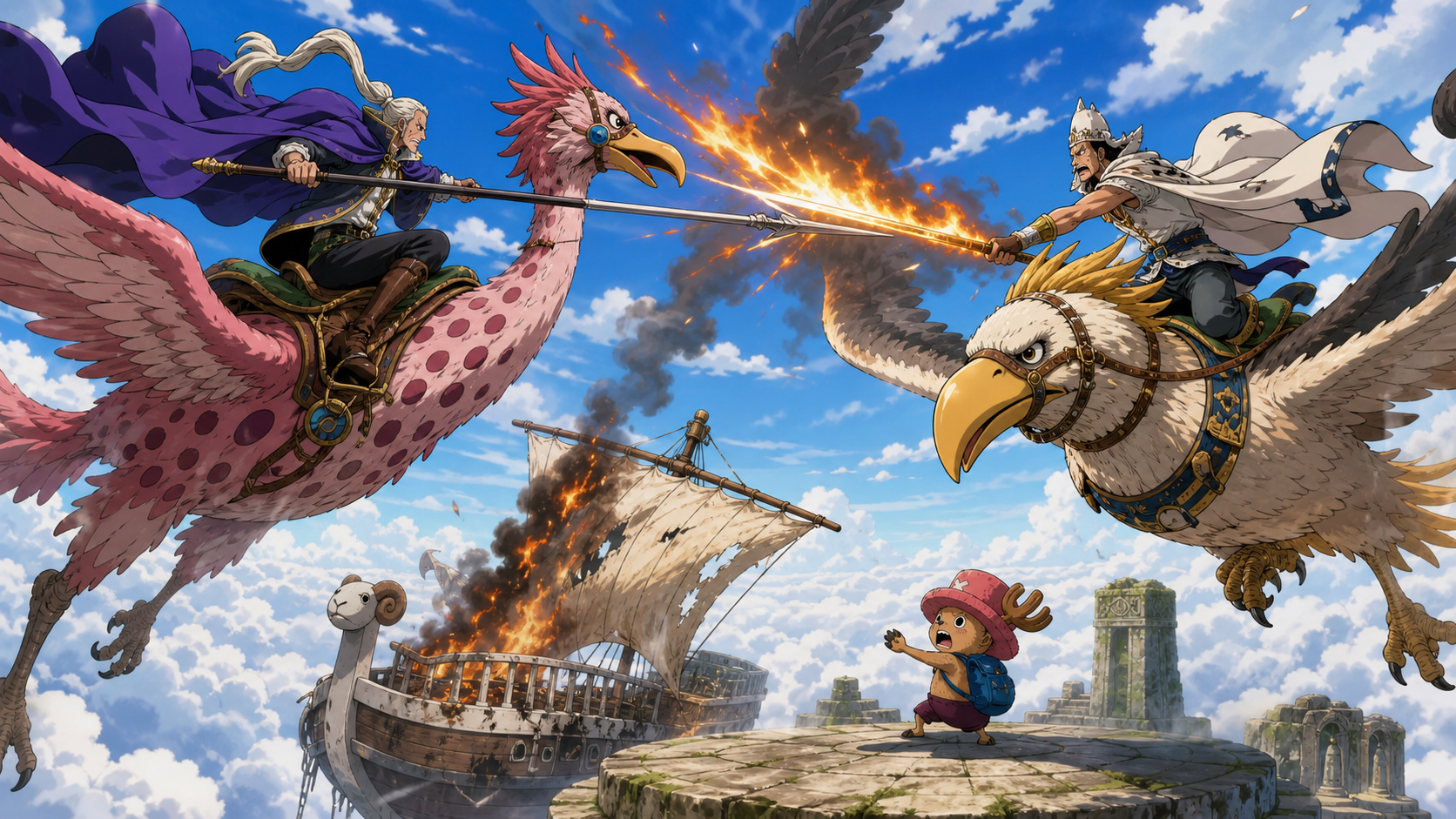
One Piece Episode 162 pushes Chopper into shipboard fire control before Gan Fall arrives to challenge Priest Shura above the altar.
Gan Fall hides Conis and Pagaya beyond Enel’s listening range
Episode 162 opens away from the altar, where Gan Fall has carried Conis and Pagaya to his home. The shelter matters because Enel’s Mantra does not reach this place.
That blind spot gives two injured civilians a chance to breathe without every frightened word becoming intelligence for the regime. Privacy has become emergency equipment.
Gan Fall should still treat the house as temporary protection. Shura knows the former God, patrol patterns can reveal movement, and any visitor could expose the route by accident.
Conis and Pagaya need water, injury checks, a quiet evacuation plan, and a clear signal if Gan Fall fails to return. A safe room without an exit plan becomes another trap.
Conis and Pagaya learn that refusing cruelty makes them outlaws
Gan Fall explains that Enel’s law now places father and daughter outside the approved order. Their offense was helping people survive a punishment designed to kill them.
The label outlaw sounds official, but legality and legitimacy are not the same. A ruler who criminalizes rescue reveals more about the government than the accused.
Gan Fall compares their position with the pirates they feared. The comparison does not erase harm pirates can cause. The comparison asks who gets to define criminality when power writes every rule.
Conis should preserve the names, commands, and sequence that forced her cooperation. Testimony becomes evidence later, especially when a regime depends on frightened citizens doubting their own memory.
Gan Fall carries the history of a peace that never arrived
Before Enel seized the divine seat, Gan Fall tried to negotiate with the Shandians. Four centuries of conflict could not be repaired by one meeting or one generous speech.
The effort still matters because negotiation recognized the Shandians as people with a claim, not obstacles inside somebody else’s sacred ground.
A durable agreement would require land access, historical truth, cultural protection, shared security, and a process for resolving violations. Peace cannot mean asking the dispossessed side to stop resisting while occupation continues.
Gan Fall’s regret also complicates the easy former-ruler narrative. Better intentions do not automatically repair an unequal system, but honest responsibility creates somewhere to begin.
The promise of beautiful music gives the war a different objective
Gan Fall believes the long war can end when beautiful music sounds across the sky again. The statement points toward memory and restoration rather than military victory.
Music can cross borders that laws reinforce. A shared sound may carry proof of home, a promise, or a history that neither current government fully owns.
The episode does not hand Conis a neat explanation, and that restraint works. She receives enough history to understand that Upper Yard contains more than Enel’s ordeal.
Gan Fall should leave a written account before returning to danger. Knowledge held by one aging witness can disappear in the same instant as the witness.
Chopper’s whistle creates a rescue clock instead of instant rescue
At the Sacrificial Altar, Chopper has already blown Gan Fall’s whistle. The signal solves one decision and starts a harder interval: surviving until help arrives.
Shura does not pause because a rescue request exists. Chopper remains alone with a damaged ship, an aerial priest, and Fuza circling above the platform.
He needs cover that protects his body without hiding every view of the Merry. Stone blocks can interrupt a lance path while transformations make his movement less predictable.
The whistle should stay secured after use. Chopper cannot assume the object has no later evidentiary value or that Gan Fall heard a perfect signal through distance and wind.
Shura attacks the Merry because home is easier to hit than Chopper
Shura turns his attention toward the Going Merry. A stationary ship cannot dodge Fuza, and Chopper cannot ignore an attack on the crew’s only familiar shelter.
The choice is tactical cruelty. Threatening the ship pulls Chopper from cover and forces the doctor to defend timber, sails, medicine, food, navigation tools, and the crew’s path home.
Chopper should not chase Fuza through open air. He should protect fire-sensitive stores, keep a clear route across the deck, and strike only when Shura commits to a low pass.
The Merry is not background scenery. Every burn mark changes what the crew can safely do after the ordeal ends.
A flame lance turns a repair problem into a shipboard fire
Shura’s weapon carries heat and flame into a battlefield built from dry sailcloth, rope, and wood. One pass can create several fires beyond Chopper’s reach.
His priorities must follow shipboard triage: people first, route of escape second, flames near critical structure third, replaceable equipment last.
Chopper should cut away burning cloth before fire reaches the mast, close containers holding medical supplies, and avoid trapping smoke below deck.
Cloud surroundings create a cruel illusion of abundant water. Chopper cannot assume unfamiliar cloud material will extinguish flame or support his weight while he collects anything useful.
Fuza makes every straight defensive plan expire in seconds
Fuza gives Shura speed, height, and the freedom to reverse direction beyond Chopper’s reach. The mount turns a long lance into a moving perimeter.
Chopper cannot watch priest, weapon tip, bird, fire, and ship damage with equal focus. He needs a narrow rule: track the mount’s chest and wing angle, then move before the weapon enters range.
Heavy Point may protect a fixed space, while smaller forms help him change direction. Neither form solves an attacker who controls altitude.
The safest attack window begins when Fuza descends and must climb again. Chopper should defend the ship without stepping into the center of that flight path.
Gan Fall leaves safety because the whistle was a promise
Gan Fall hears the call and departs for the altar. The response proves that the whistle was not ceremonial comfort. He attached action to his word.
Leaving Conis and Pagaya carries risk, but refusing the call would teach every survivor that promised rescue disappears when danger becomes inconvenient.
Before departure, Gan Fall should confirm the shelter boundary, identify supplies, and tell both civilians how long to wait before moving.
Conis and Pagaya should not follow. Their best contribution is preserving the safe location and the history Gan Fall trusted them to hear.
Pierre carries the rescue through terrain built for a priest
Pierre gives Gan Fall the aerial mobility necessary to reach an altar surrounded by cloud sea. The pair can meet Shura in the air instead of asking Chopper to survive another ground pass.
Speed remains essential because smoke can obscure the signal location. Gan Fall should approach from outside the most obvious lane and use the burning sail as a visual marker.
Pierre also becomes a rescue platform if Chopper or Gan Fall falls from the stone. That role deserves protection rather than treating the bird as disposable transportation.
Gan Fall must keep Shura’s lance away from Pierre’s wings. One injury could remove combat mobility and the only immediate evacuation route.
The former God meets the priest inside Enel’s chain of command
Gan Fall’s arrival changes the conflict from execution to challenge. Shura no longer faces one isolated ship’s doctor. He faces the ruler Enel displaced.
The title God cannot decide who deserves obedience. Gan Fall’s strongest claim in this moment is simpler: somebody called for help, and he came.
Shura represents a system where priests manufacture ordeals and count survivors. Gan Fall represents an imperfect past that at least recognizes rescue as duty.
Chopper should use the interruption to move away from their line of attack, assess the fire, and prepare medical support. Watching the duel is not his assignment.
Gan Fall and Shura turn the sky above the altar into a lance corridor
Pierre and Fuza rush through a battle too fast for Chopper to follow cleanly. Their riders carry long weapons, so danger extends well beyond each bird’s body.
Chopper needs to stay below the flight corridor and away from the altar edge. A deflected lance, falling rider, feather, or burst of flame can injure him without becoming a deliberate attack.
Gan Fall should force Shura away from the Merry rather than circle directly over the mast. Protecting the caller includes protecting the space where the caller must survive.
The duel looks heroic, but aerial combat above a burning wooden ship is also a workplace nightmare with no safety officer anywhere.
Shura’s speed exposes the cost of fighting on familiar ground
Shura knows the airspace, Fuza’s acceleration, and the reach of his weapon. Gan Fall arrives with urgency but without time to study the current altar conditions.
Defenders often receive moral clarity without tactical advantage. Gan Fall must avoid confusing courage with permission to charge through the most predictable lane.
He can use Pierre’s tighter turns, cloud cover, and changes in height to interrupt Shura’s preferred approach. A direct contest favors the priest’s heated lance.
Chopper can help by calling out fire, damage, and Shura’s position only when shouting will not reveal his own movement.
Chopper has to save the patient, the ship, and the rescuer at once
The doctor’s workload multiplies as soon as Gan Fall arrives. Chopper may need to treat burns, impact trauma, puncture wounds, smoke exposure, or injuries to either bird.
He should prepare clean cloth, pressure dressings, water known to be safe, and a stable area away from the mast. Medical supplies must remain reachable if the deck shifts or another fire starts.
Chopper also needs to assess himself. Fear and smoke can narrow attention, while an unnoticed injury could make him collapse during treatment.
No single person can perform fire control, lookout duty, and trauma care indefinitely. Rescue must create enough distance for prioritization, not simply add another body to protect.
Enel’s blind spot proves that Mantra is power with boundaries
Gan Fall’s home sits outside Enel’s listening range, while the altar remains inside a punishment network. The contrast turns divine omniscience into a system with coverage limits.
That boundary matters strategically. Resistance can protect planning spaces by learning where surveillance weakens instead of assuming every thought and word belongs to Enel.
Conis and Pagaya should avoid creating an obvious travel pattern toward the shelter. A hidden zone becomes useless once guards identify every road leading there.
Gan Fall should share the existence of the limitation carefully. Widespread knowledge can help survivors organize, but careless disclosure can help Enel close the gap.
Burning the Merry attacks the crew’s future, not only their property
The Going Merry carries accumulated repairs, private belongings, food, medicine, maps, and proof that the crew crossed impossible distances together.
Shura’s fire therefore reaches beyond a single scene. Lost supplies can worsen later injuries, block travel, and force dangerous recovery work after the priest leaves.
Chopper should document every damaged area once the deck becomes safe. Scorched rigging may look intact while losing enough strength to fail under later wind.
The crew also needs a fire plan before another separation: assigned extinguishing tools, protected medical storage, evacuation points, and one person responsible for checking hidden embers.
Episode 162 makes legitimacy answer a rescue call
Conis and Pagaya hear how governments create outlaws. Chopper watches Shura treat a home as leverage. Gan Fall responds by placing himself between priest and sacrifice.
The episode’s political argument lives inside those actions. Authority that demands obedience while abandoning the vulnerable cannot repair legitimacy with a title.
Gan Fall remains responsible for the failures of his old rule and the unfinished Shandian peace. Responding to Chopper does not erase that history. The response shows the duty he still chooses.
Shura has Enel’s approval, aerial advantage, and official office. Gan Fall has a promise made to one frightened pirate. The promise carries more moral weight.
RaeRae’s verdict is to protect the ship and distrust divine job titles
Keep this one. Chopper finally calls for help, Shura responds by setting the family home on fire, and Gan Fall arrives on a pink bird to conduct the loudest possible performance review.
The operational list stays brutal. Chopper must contain the fire, preserve medical supplies, avoid the aerial corridor, prepare trauma care, and keep an escape route open. Gan Fall must draw Shura away from the Merry, protect Pierre, and survive the heated lance. Conis and Pagaya must remain inside the Mantra blind spot and preserve the history they just learned.
The larger crew still has no idea that their ship is burning while separate ordeals consume their attention. That information gap may cost more than any single failed attack.
RaeRae’s final note: when a priest calls arson sacred duty, stop debating theology and move the bandages away from the sail.