
RaeRae Reacts · One Piece Episode 163
Chopper Jumps After Gan Fall
One Piece Episode 163 traps Gan Fall inside Shura’s String Ordeal while Luffy discovers the control line behind Satori’s Ball Dragon.
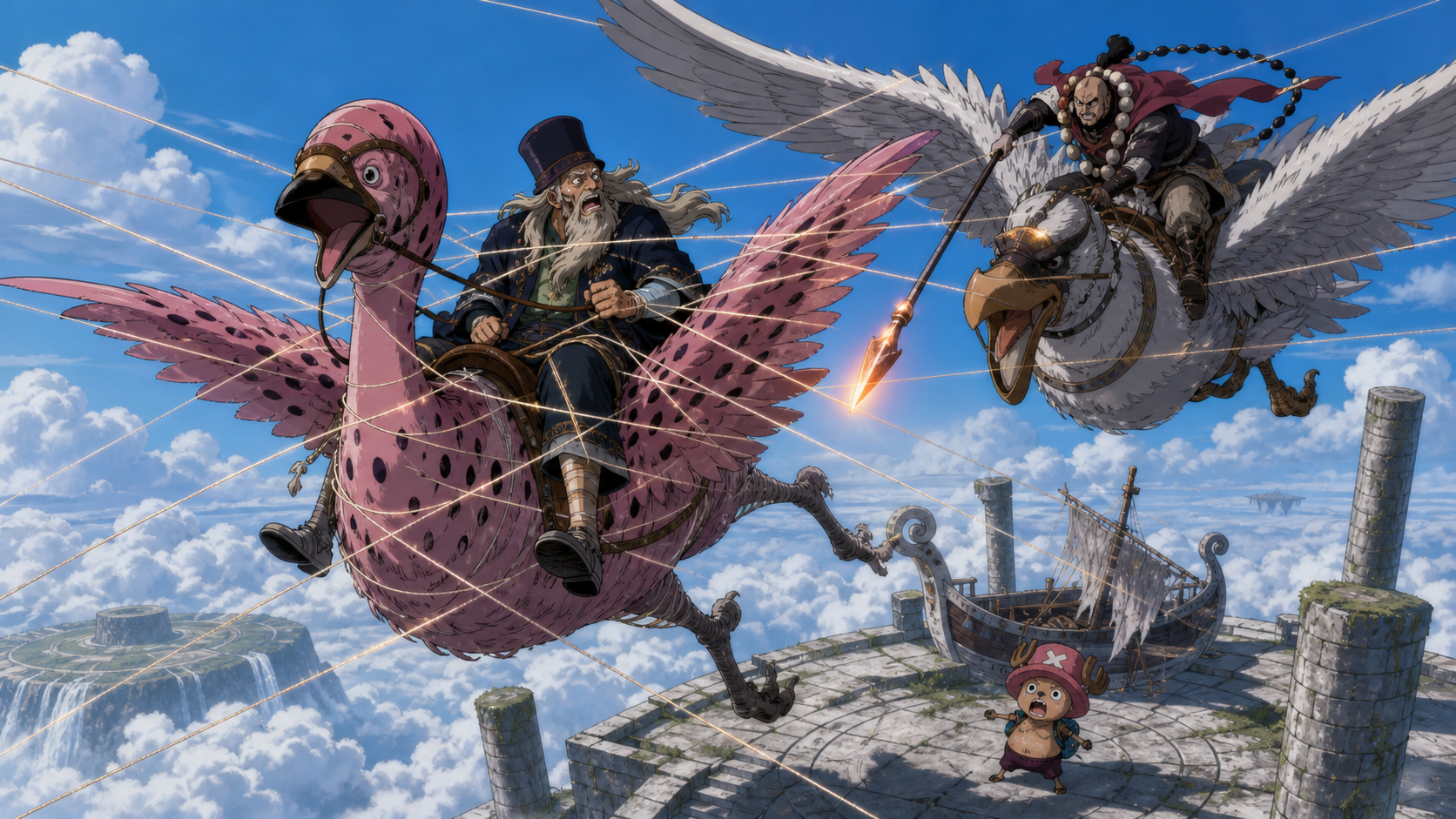
Shura turns the open sky into a String Ordeal
Episode 163 resumes with Gan Fall and Shura moving too quickly for Chopper to track. The former God appears to have answered the whistle in time, but Shura has already shaped the air around the altar.
Nearly invisible strings cross the flight path. Open sky stops being open the moment one rider enters a route prepared by the priest.
Gan Fall should assume every direct approach contains a trap. A rescue route becomes predictable because urgency pushes the rescuer toward the caller as quickly as possible.
Pierre needs altitude changes, test passes, and a retreat lane before committing. Speed cannot protect a wing or rider from a line neither can see.
Gan Fall freezes because the trap catches movement, not courage
The strings stop Gan Fall and Pierre in midair. Chopper sees a powerful rescuer become helpless without losing a contest of strength.
That distinction matters. Gan Fall does not fail because he lacks resolve. He enters an engineered zone where moving harder can tighten restraints or cause deeper injury.
He should reduce movement, protect his throat and hands, identify which lines carry tension, and communicate the trap to Chopper below.
Pierre’s wings create a larger contact surface. Every frantic beat risks tangling more feathers and transferring force into the rider’s body.
Shura calls entanglement justice because cruelty needs branding
Shura treats the String Ordeal as proof of divine authority. The trap does not measure guilt, courage, or truth. The trap measures whether somebody crosses hidden lines.
Calling the mechanism an ordeal gives arbitrary violence a ceremonial name. Victims are then blamed for failing a test whose rules were concealed.
Chopper should remember that survival never validates the system. Escaping a rigged trial means the victim escaped, not that the trial became fair.
Gan Fall’s presence also exposes the political purpose. Enel’s priest can publicly defeat a former ruler and turn rescue into a warning for everyone watching.
Shura strikes after immobilization because the outcome was designed
Once the strings halt Gan Fall, Shura attacks. The sequence removes any pretense of an honorable aerial duel.
Hidden restraint creates the opening, Fuza controls the distance, and the heated lance delivers damage. Each component belongs to one coordinated execution system.
Gan Fall needs to protect vital areas and avoid pulling against every line at once. Chopper needs to mark where the strings catch sunlight before attempting a rescue.
Rushing directly underneath would place the doctor inside the same vertical corridor when bodies, weapons, or severed lines begin falling.
Chopper watches his rescue become another patient
Gan Fall answered Chopper’s emergency call and now needs emergency care himself. The reversal can turn gratitude into reckless obligation.
Chopper is a doctor before he is a witness. He should prepare for puncture trauma, blood loss, falls, burns, and injuries to Pierre while staying outside Shura’s next pass.
The Going Merry remains damaged behind him. Chopper cannot leave hidden embers unchecked, but an injured person falling into cloud water becomes the immediate priority.
He needs one stable rope, flotation support that works in this environment, and a position where Shura cannot strike both rescuer and patient in one line.
Gan Fall falls and Chopper chooses the patient before the plan
Gan Fall drops toward the cloud sea beside the altar. Chopper reacts by jumping after him even though his Devil Fruit power means he cannot swim.
The choice is emotionally correct and operationally disastrous. A rescuer who becomes unconscious in the water doubles the number of people somebody else must save.
Chopper should have secured a line to the altar, thrown support toward Gan Fall, or used a form with reach while keeping his own body anchored.
None of those options feel fast enough when a person is falling. Emergency training exists because instinct alone usually chooses contact over survivability.
Chopper also has to judge the cloud sea without assuming that familiar water rules apply. The altar already showed predators moving beneath the surface, and visibility cannot confirm depth, current, or a safe place to climb out.
A secured rescue line would let him descend while preserving a return path. A loop around his torso needs enough width to avoid compressing his chest during a sudden stop, and the anchor must hold both Chopper and Gan Fall.
If no reliable anchor exists, Chopper should throw floating debris near Gan Fall and call for Pierre before entering. The bird may be injured, but an aerial pickup avoids placing another Devil Fruit user in the water.
Once contact occurs, Chopper must keep Gan Fall’s face clear, check responsiveness, and avoid letting panic push both bodies farther from the altar. Reaching the patient is only the first half of a rescue.
Love becomes the second ordeal because Chopper refuses to calculate
The episode pairs Shura’s String Ordeal with an Ordeal of Love. Chopper does not run a probability table before following the person who came to save him.
Love makes the jump understandable. Love does not give Chopper buoyancy or cancel the consequences of his Devil Fruit.
A better version of devotion protects the patient and the rescuer. The crew needs protocols for water rescue precisely because several members cannot swim.
Chopper’s action still rejects Shura’s philosophy. The priest assigns value through sacrifice, while the doctor risks himself because another life cannot become acceptable inventory.
A rescue chain needs one person who stays out of the water
Chopper’s jump demonstrates why every water rescue needs an anchored role. Somebody must hold the line, watch hazards, and pull both bodies back.
The absent crew could have divided those duties. Zoro supplies strength, Nami reads the environment, Robin extends reach, and Usopp carries tools that work at distance.
Separation removes that redundancy. Chopper now depends on outside help while Shura remains mobile above the scene.
When the crew reunites, they need flotation devices beside every exposed deck, fixed rescue lines, and a clear rule that Devil Fruit users do not enter unknown water without attachment.
They also need a recovery signal that differs from a combat warning. One sound should call people toward the edge with rope and flotation support, while another should keep nonessential crew away from an active attack lane.
Usopp can build equipment, but Nami should decide placement around the ship because she understands how crew movement and weather shift risk. Chopper should define medical access so rescue gear never blocks the treatment area.
Every person must practice the sequence while the deck is calm. A protocol learned for the first time after somebody disappears beneath cloud water is only a list of good intentions.
Aisa returns with Vearth and carries a private piece of home
Aisa finishes gathering Vearth and returns toward the Shandian village. Her collection turns Upper Yard from abstract territory into material belonging.
She is not hauling random dirt. Vearth connects community, memory, ancestry, and the land stolen into the sky.
Kamakiri notices her return, which means the child cannot move through the militarized conflict without adult scrutiny. Protection should not become interrogation.
Aisa needs a safe place to store what she gathered and permission to explain the journey in her own sequence. Adults should not demand intelligence before checking whether she is frightened or injured.
Wyper rejects Gan Fall because one kinder ruler cannot settle the land
Shandian warriors discuss Gan Fall’s appearance in Upper Yard. Raki suggests that the former God may not be the same enemy as Enel, but Wyper refuses the distinction.
His refusal grows from four hundred years of dispossession. A gentler person occupying the divine seat does not automatically return land or restore sovereignty.
Gan Fall’s attempted peace matters, yet attempted negotiation cannot substitute for terms the Shandians accepted and controlled.
Wyper also risks flattening every possible ally into one target. Resistance needs historical clarity without throwing away information about fractures inside the ruling system.
Raki asks for nuance before battle makes nuance expensive
Raki’s argument does not ask the Shandians to trust Gan Fall blindly. She asks whether current evidence should change how they classify him.
That question is strategic. Enel, the priests, Gan Fall, the Straw Hats, and the Shandians do not share one objective simply because several groups enter Upper Yard.
The warriors should identify temporary alignment, unacceptable conditions, and the point where cooperation ends. An ally for one rescue may remain an opponent in a land negotiation.
Wyper should hear the assessment without surrendering command. Leaders who punish nuance eventually receive only reports that confirm the plan already chosen.
Pagaya repairs the Waver while Conis plans another rescue
Inside Gan Fall’s Mantra blind spot, Pagaya works on the Straw Hats’ Waver. Conis wants to help the pirates escape.
The repair gives their gratitude a practical form. A functioning vehicle can move information, supplies, or people faster than another apology.
Pagaya should test steering, braking, fuel, Dial response, and load before Conis enters hostile territory. A rushed repair can fail at the exact moment pursuit begins.
Conis needs the safest route, a fallback location, and a reason to turn back. Helping the crew does not require offering Enel two unprotected civilians.
Satori builds a Ball Dragon from concealed hazards
In the forest, Satori joins Surprise Balls into a long moving dragon. Gunpowder and hidden projectiles travel as one controlled weapon.
The shape expands his threat area and forces Luffy, Sanji, and Usopp to react to the whole chain rather than one sphere.
They should not attack every ball. The controlling connection matters more than the individual payloads.
Usopp can study movement for a repeated anchor point, Sanji can protect the injured lane, and Luffy can redirect momentum once they identify how Satori steers the formation.
Luffy beats Mantra by behaving like an unsupervised emergency
Satori predicts intentional attacks, but Luffy’s irregular flight from the Ball Dragon creates outcomes the priest cannot organize cleanly.
The advantage does not mean Luffy has mastered Mantra. His unpredictability introduces noise into a system that expects readable decisions.
He should use that disruption to find the mechanism rather than celebrate random movement. Chaos helps only when somebody converts chaos into a useful opening.
Sanji and Usopp need to watch where Satori looks and how the Ball Dragon changes direction. Prediction becomes less valuable when every safe response creates another threat.
The control string matters more than the dragon’s teeth
Luffy reaches the line Satori uses to control the Ball Dragon and breaks the connection. The discovery turns a spectacle back into separate hazards.
That lesson mirrors Shura’s battlefield. Hidden strings control the outcome in both ordeals, whether the line restrains Gan Fall or directs explosive cloud balls.
The crew should always search for control architecture: operator, signal, anchor, release, and failure state. Destroying visible weapons one at a time leaves the system intact.
Once the line snaps, everyone still needs distance. Uncontrolled explosives do not become safe merely because Satori loses steering.
Satori receives his own Ball Dragon through a failed control loop
Luffy leads the Ball Dragon back toward Satori, and the priest loses the protection of directing danger from a distance.
The explosion disrupts Satori long enough for the crew to close the gap. Returning a weapon toward its operator feels satisfying, but Luffy should still account for Sanji and Usopp before triggering the blast.
Usopp uses the confusion to find Crow and discovers the exit route. Recovery and navigation finally support the fight instead of competing with the fight.
The team now has a path out, their transport, and a narrow opportunity to end the ordeal before Satori rebuilds control.
Luffy holds Satori still so Sanji can end the prediction game
Luffy catches Satori and wraps his arms and legs around the priest. Sanji tells him not to release the hold.
Immobilization removes the space Satori needs to float, evade, and turn Mantra into clean counters. Prediction cannot create an exit when every available movement remains physically blocked.
Sanji delivers the finishing attack while Luffy accepts the danger of staying attached. Their coordination succeeds because both men commit to one sequence.
Afterward, they need to check Sanji’s Impact injury, secure Satori’s weapons, retrieve Usopp and Crow, and leave before another priest reaches the course.
RaeRae’s verdict gives every hidden string a pair of scissors
Keep this one. Shura rigs the sky, Satori rigs a dragon, and both priests act surprised when somebody notices that divine power comes with visible control lines.
The operational list remains split. Chopper and Gan Fall need water rescue, trauma care, protection from Shura, and a route back to the damaged Merry. Luffy, Sanji, and Usopp need to stabilize injuries, secure Crow, mark the forest exit, and reunite with the crew. Pagaya and Conis need to test the Waver before turning gratitude into another emergency.
Raki’s warning also stays open. The Shandians need to distinguish Enel’s regime from Gan Fall without surrendering their claim to Upper Yard.
RaeRae’s final note: if the miracle requires invisible wire, explosives, and a captive audience, somebody is running theater tech for a dictatorship.