
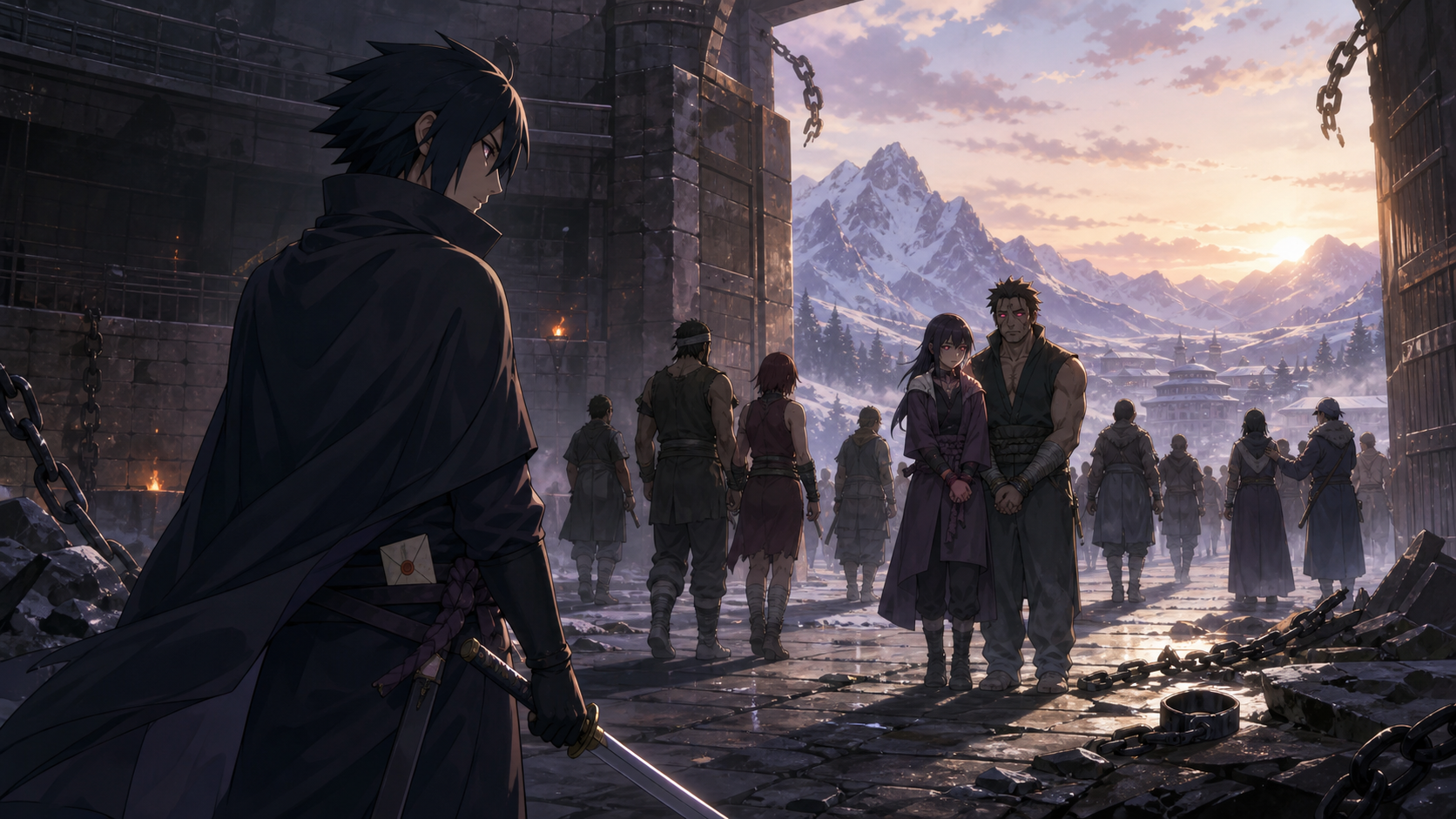
The Last One
Chino chooses Fushin’s life over revenge, and Sasuke proves that atonement must leave other people freer than he found them.
Bottom line
“The Last One” ends Chino's revenge campaign by refusing both execution and easy absolution. Chino planned to turn Sasuke and Konoha into targets because the Uchiha enforced her clan's exile, yet meeting Sasuke ruined the simple enemy she needed. He answers her accusation without denying his own history: friends pulled him away from collective punishment, so changed conduct now carries their trust. When wounded Fushin arrives ready to die protecting her, Chino finally sees that revenge will consume the one relationship she still has. She surrenders because she wants him alive and wants to see whether a different world can exist. Sakura and Hinata remove the foreign chakra from surviving victims, making recovery as essential as the confrontation. Mei offers Chino, Fushin, and Karyu supervised work for Kirigakure as lifelong atonement, although any credible arrangement must include consent, oversight, and protection from renewed exploitation. Sasuke returns to the Coliseum and defeats every owned fighter to win their freedom, accepting Chino's earlier challenge. Naruto's letter then compares his unseen protection to the Uchiha police dream Sasuke held before massacre. Atonement becomes neither punishment theater nor disappearance. Sasuke uses his power to leave other people freer.
Episode 488 concludes the Sasuke Shinden adaptation
Episode 488 is titled “The Last One.” The episode aired in Japan on January 5, 2017, and completes the five-episode adaptation of Shin Towada's *Sasuke Shinden: Book of Sunrise*.
The anime adds or rearranges several closing scenes while retaining surrender, reintegration, and Sasuke's renewed direction.
Chino names Sasuke as the intended target
Konoha was part of the campaign, but the last Uchiha carried special symbolic value. She wanted the surviving clan member to absorb consequence for an exile ordered generations before his birth.
Inherited identity becomes a target again.
Her grievance reaches beyond one man
The Uchiha enforced the Chinoike banishment, while hidden villages later exploited, hunted, or abandoned bloodline users. Chino sees Sasuke as the visible center of a larger system.
Symbols cannot substitute for responsible institutions.
Sasuke does not deny Uchiha involvement
He has no honest basis for pretending his clan's victimhood erased harm done to another clan. Listening without denial prevents the confrontation from becoming historical competition.
Truth can hold more than one injury.
Chino questions his loyalty to Konoha
The village discriminated against the Uchiha, concealed massacre, used Itachi, and later treated Sasuke as an international criminal. Defending Konoha looks irrational from her perspective.
Belonging after state harm needs explanation.
Sasuke recognizes his former reasoning
He once planned collective destruction because leadership crimes felt inseparable from the village that benefited from silence. Chino's argument repeats a path he followed willingly.
Recognition removes moral distance.
He speaks about friends who stopped him
Naruto refused abandonment, Sakura continued caring, Kakashi offered guidance, and others challenged Sasuke's isolation. Their actions created alternatives revenge alone could not imagine.
Connection changed available choices.
Friendship did not prove Konoha innocent
Naruto's loyalty never resolved the Uchiha massacre or Danzō's crimes. Bonds gave Sasuke a reason to seek reform without annihilating people who did not order the harm.
Care changes method, not historical fact.
Sasuke now protects an imperfect peace
He does not claim that the postwar world has become just. Protection means defending the possibility of continued change against cycles that would produce new mass victims.
Peace is a condition for repair, not proof of completion.
Chino attacks through the Ketsuryugan
Her dojutsu turns blood and perception into weapons, forcing Sasuke to confront both physical danger and genjutsu. The ability embodies a clan history reduced to feared power.
Technique carries trauma without choosing morality.
She wounds Sasuke deliberately
Blood contact gives Chino access to the mechanism used for exploding humans. She wants him to experience the same stolen bodily control imposed on previous victims.
Revenge reproduces the defining violation.
Sasuke appears to become unstable
Chino shows him a future where his own body swells toward detonation. The vision tests whether superior dojutsu can protect him from the technique's psychological force.
Threat enters through expectation as well as chakra.
The Sharingan contests the illusion
Sasuke has survived Tsukuyomi, Infinite Tsukuyomi, and repeated visual manipulation. Experience lets him distinguish imposed perception from bodily reality.
Past harm becomes defensive knowledge.
He refuses to kill Chino
Sasuke possesses the power and tactical justification for a lethal end, but execution would silence the history he claims to understand. Capture preserves both life and accountability.
Restraint is the argument made physical.
Fushin arrives badly wounded
His earlier fight left him barely able to move or form seals. He returns because Chino matters more than recovery or escape.
Chosen family draws him back into danger.
Fushin offers his life for hers
He tells Sasuke that reaching Chino requires killing him first. The gesture mirrors shinobi traditions that treat self-sacrifice as the purest proof of care.
Love again risks becoming a death sentence.
Sasuke asks Chino to look at him
Fushin's condition makes the cost of her path visible through the person she most wants to protect. Sasuke does not need an abstract peace speech when the consequence stands between them.
Relationship becomes immediate evidence.
Chino tells Fushin to stop
She cannot bear losing the last person who shared captivity, escape, service, betrayal, and exile with her. Revenge loses authority when continuation requires his death.
Care creates a boundary hatred could not.
She wishes she had never met Sasuke
The statement means his changed behavior disrupted the enemy image sustaining her plan. Hatred was easier before the target saved her and listened to her history.
Contact complicates collective judgment.
Sasuke's mercy does not demand gratitude
Chino owes accountability for victims regardless of whether she appreciates him. His choice to spare her should not become a personal debt replacing public consequence.
Mercy must leave autonomy intact.
Chino wants to see the world he described
Hope appears cautiously rather than as instant belief. She is willing to test whether cooperation and repair can offer more than another betrayal.
Surrender becomes an experiment in living.
Fushin follows her decision
He does not force the fight after Chino withdraws consent from their revenge plan. Loyalty shifts from dying for her anger toward surviving beside her accountability.
Protection can mean accepting a changed course.
Karyu is apprehended too
The former Lightning Group member participated in deception and violence connected to the campaign. His role requires individual assessment rather than automatic transfer of Chino's motives.
Group membership cannot replace personal evidence.
Sakura continues treating infected victims
The central confrontation does not instantly remove foreign chakra already embedded in people's bodies. Medical work remains necessary after the controller surrenders.
Ending violence is not the same as healing damage.
Hinata guides the extraction
Her Byakugan maps chakra networks while Sakura performs the precise intervention. Their combined skill protects patients whom ordinary treatment could not safely reach.
Women lead the recovery without Sasuke present.
Sakura's expertise makes survival possible
Training under Tsunade and years of clinical practice matter as much as combat victory. The arc's victims need a physician who understands chakra and tissue together.
Care is a form of high-level power.
Some victims could not be saved
Successful treatment does not erase deaths from Konoha, the Coliseum, or other attacks. Chino's surrender arrives after permanent loss.
Hope must remain accountable to graves.
Sakura asks whether Sasuke returned
She expected the investigator to accompany the prisoners or report in person. His absence revives the familiar experience of waiting without clear communication.
Atonement still leaves relational work unfinished.
The captives enter Konoha custody
Chino, Fushin, and Karyu face detention rather than disappearing through Sasuke's private judgment. Formal authority now has responsibility for a transparent disposition.
Capture transfers rather than completes accountability.
Chino claims primary responsibility
She asks Kakashi to show leniency toward the other two because she directed the campaign. Taking leadership responsibility matters, but companions retain agency for their own actions.
Protection should not erase individual review.
Fushin rejects being treated as innocent
He chose to support Chino and wants responsibility shared. Their bond does not require one person to absorb every consequence alone.
Solidarity includes owning participation.
Kakashi announces Kirigakure's request
The Mist wants custody because Chino and Fushin's history intersects with bloodline persecution and betrayal tied to the village. Jurisdiction follows more than the location of capture.
The harmed institution seeks a reparative role.
Mei acknowledges Bloody Mist history
The former Mizukage understands that Kirigakure helped create the conditions surrounding hunted kekkei genkai users. She does not frame Chino's violence as emerging without institutional cause.
State accountability belongs inside sentencing.
Mei offers work as lifelong atonement
Chino and the others may use their abilities for Kirigakure rather than remain indefinitely imprisoned. The proposal gives survival a social purpose and avoids execution.
Reintegration can be stronger than disposal.
The offer still needs safeguards
People trafficked for bloodline abilities could experience compulsory village service as another form of ownership. Consent, review, compensation, freedom from experimentation, and a route beyond permanent control are essential.
Rehabilitation must not rename exploitation.
Naruto meets Chino
His presence confirms that Sasuke's account of friendship refers to a real person rather than a rhetorical device. Naruto recognizes another survivor shaped by isolation and public fear.
Shared pain opens conversation without flattening history.
Naruto speaks well of Sasuke
He describes the unseen protection Sasuke now provides beyond village boundaries. Advocacy continues, but Naruto's faith does not replace evidence of changed conduct.
This mission supplies that evidence.
Sasuke returns to the Coliseum
He remembers Chino challenging him for watching owned fighters while pursuing his own lead. The urgent case has ended, so the ignored injustice becomes his next responsibility.
Accountability revisits what convenience postponed.
He challenges every fighter
Coliseum rules allow victories to transfer ownership. Sasuke uses the abusive structure against itself long enough to remove people from patrons.
Tactical participation becomes organized liberation.
Sasuke defeats them without killing them
The gauntlet demonstrates overwhelming power disciplined toward freedom rather than personal glory. Each opponent survives the contest designed to consume owned bodies.
Victory changes custody instead of ending life.
He refuses to keep the fighters
Winning legal ownership cannot make ownership legitimate. Sasuke releases the people rather than becoming a more benevolent collector.
Freedom is not a prize granted conditionally.
The Coliseum's patrons face consequences
Authorities raid the operation and the wealthy network loses its protected arena. Ending one venue does not guarantee that bloodline trafficking disappears elsewhere.
Markets migrate unless enforcement reaches demand.
En Oyashiro escapes
The collector avoids capture despite helping reveal parts of the case. His survival keeps unresolved questions about Chino, the clan's destruction, and private trafficking outside formal judgment.
Information did not purchase innocence, but escape prevents review.
Sasuke and the Raikage reach an understanding
Their relationship began with Killer B's apparent abduction and Sasuke's attack at the Five Kage Summit. Postwar cooperation acknowledges change without pretending the earlier conflict never happened.
Political trust is rebuilt through action.
Naruto sends Sasuke a letter
Written communication crosses the distance Sasuke continues to maintain. The message carries friendship without demanding immediate return.
Connection adapts to separation.
The letter invokes the Konoha police dream
Naruto reports Sakura's comparison between Sasuke's protective work and the Uchiha Police Force role he admired as a child. The reference reaches an identity that existed before revenge.
A lost future gains a new form.
Sasuke remembers Itachi again
His brother embodied protection distorted through secrecy, sacrifice, and state manipulation. Sasuke now works from the shadows while trying not to repeat total concealment.
Inherited purpose needs revised methods.
Shadow protection cannot mean no accountability
Unseen service may help remote communities, but secrecy also enabled Konoha's worst abuses. Reports, trusted contact, and eventual public truth remain necessary.
Distance should not become another unreviewable office.
Sasuke considers returning home
The letter makes Konoha feel less like a court waiting to judge him and more like a place where people understand his current work. Return becomes possible without ending the journey.
Home can be visited before every wound is repaired.
Chino surrenders for a living relationship
Fushin’s willingness to die forces revenge out of abstraction. Chino can keep pursuing symbolic punishment, or she can protect the person who shared captivity, escape, service, rejection, and survival with her. Choosing his life does not mean the institutions suddenly deserve trust. It means their bond creates a limit on what anger may consume.
That choice gives Fushin room to change too. Loyalty no longer has to mean helping Chino continue every plan. He can follow her decision to stop, accept his own participation, and imagine protection as staying alive through consequence rather than dying between her and accountability.
Surrender opens work instead of closing the record
Chino’s decision cannot restore people killed by the exploding-human campaign or remove foreign chakra already embedded in survivors. Sakura and Hinata make that truth visible. The fight ends, then medical labor begins. Victory depends on diagnosis, precise extraction, observation, and care that receives none of the confrontation’s spectacle.
Some patients cannot be saved. Their deaths must remain part of sentencing, public history, and restitution. Hope becomes honest when it faces graves without using them to demand execution as the only serious consequence.
Mei’s offer needs voluntary structure
Kirigakure acknowledging its connection to bloodline persecution matters. Offering supervised work may create a route back into community and let Chino, Fushin, and Karyu use their abilities without disappearance or permanent imprisonment. The danger is obvious: people once trafficked for rare power could be assigned lifelong service and told the new owner is rehabilitation.
Consent, compensation, independent oversight, medical support, review, freedom from experimentation, and a path to ordinary civilian life are not details. They determine whether atonement is reintegration or coerced labor. State accountability cannot be proven by finding a more useful place for the same bodies.
Liberating the Coliseum is necessary and incomplete
Sasuke returns because Chino was right to challenge his spectatorship. He defeats the fighters, uses the arena’s rules to break immediate ownership, and refuses to keep anyone as winnings. That sequence turns extraordinary power toward freedom rather than collection.
The released fighters still need housing, treatment, income, identity protection, and safety from owners who may pursue them. Patrons, brokers, and demand networks require investigation beyond one island. Opening a gate is liberation’s first image, not its complete infrastructure.
Shadow work must remain reviewable
Naruto’s letter gives Sasuke’s mission a generous connection to the police role he imagined as a child. Protecting communities outside Konoha can honor that impulse. It can also reproduce Itachi’s isolation if secrecy becomes proof that nobody else should question the work.
Sasuke reports, shares evidence, accepts cooperation, and considers returning. Those habits matter more than romantic language about one solitary protector. Peace needs him connected enough that service never becomes another private authority operating beyond consent.
I want the ending to remember that Sasuke cannot own the freedom he creates. The Coliseum fighters do not become proof of his goodness or supporting characters in an atonement legend. They are people whose next choices should belong to them. Some may want village protection. Others may distrust every military institution after being traded through a market built around shinobi power. Both responses are reasonable. Assistance should follow their stated needs instead of forcing gratitude or enlistment. The same standard applies to Chino. Sparing her is not permission to design her future without her participation. Accountability can include limits, supervision, testimony, and service while still recognizing bodily autonomy and a route toward changed status. That balance is harder than prison or pardon because it requires institutions to keep listening after attention moves elsewhere. Sasuke’s arc succeeds when his strength creates space rather than dependence. He opens gates, interrupts killing, shares intelligence, and leaves people with more authority over their lives. If his protection ever requires silence, personal loyalty, or unquestioned access, it will have repeated the politics he claims to reject. Sunrise is therefore not the moment everybody forgives. It is the first light under which repair can be fully observed, revised, and made answerable to the people who paid for the darkness.
Final verdict
“The Last One” completes Sasuke's first postwar arc by making repair visible in choices rather than declarations. He listens to Chino's history, rejects collective punishment without denying Uchiha responsibility, and refuses to kill either her or Fushin. Chino surrenders when revenge threatens the chosen family she still possesses, not because one speech makes every institution trustworthy. Sakura and Hinata then perform the difficult medical work that keeps surviving victims alive. Mei's reintegration offer recognizes Kirigakure's role in bloodline persecution, although meaningful atonement cannot become compulsory ownership under a kinder name. Sasuke answers the Coliseum's exploitation by returning after the urgent mission, defeating every fighter, and releasing them rather than accepting people as winnings. Naruto's letter finally gives that conduct a childhood name: Sasuke once wanted to protect Konoha through the Uchiha police. He now protects a wider peace from the shadows, with the harder obligation to remain connected, reviewable, and responsible to the people whose freedom defines success.
Sources and watch notes
- Naruto Official episode guide for the official series record.
- Crunchyroll for the licensed episode route where available.
What I am carrying forward
Episode 489 begins Shikamaru’s postwar story. I am carrying forward the liberated fighters’ material needs, Chino and Fushin’s supervised future, the victims Sakura and Hinata could not save, En Oyashiro’s escape, and Sasuke’s obligation to make shadow protection accountable rather than another inherited form of secrecy.