
RaeRae Reacts · One Piece Episode 148
Cricket Fights an Inherited Lie
One Piece Episode 148 introduces Cricket, Noland’s logbook, decompression illness, and the evidence that turns Sky Island from a joke into an investigation.
The Merry carries Shoujou’s attack into the next morning
Episode 148 opens with Usopp repairing damage from Havoc Sonar while the crew circles Jaya. The fight ended, but loose boards, broken fittings, and strained seams remain aboard.
Usopp understands the ship as a gift from Kaya and a member of the crew. Casual talk about replacement lands as grief before anyone else recognizes a loss.
Luffy tries to defend the Merry and then opens another hole through careless movement. Affection cannot substitute for weight limits, repair discipline, or honest assessment.
Nami should record every damaged section before the next voyage. Usopp needs help, materials, and permission to say when a repair exceeds his training.
The crew discusses whether the Merry can continue, and Usopp answers with anger. His reaction grows from loyalty, responsibility, and fear that practical language can erase shared history.
No one should promise permanent safety for a vessel already taking repeated damage. False reassurance would leave Usopp alone with both the labor and the eventual failure.
A better conversation separates love from seaworthiness. The crew can honor the Merry while documenting repairs, consulting specialists, and establishing conditions that would stop a departure.
Usopp also deserves recognition for unpaid technical work. Treating him as the automatic repair department hides the strain until every discussion becomes personal.
The grand house is a stage front hiding a smaller life
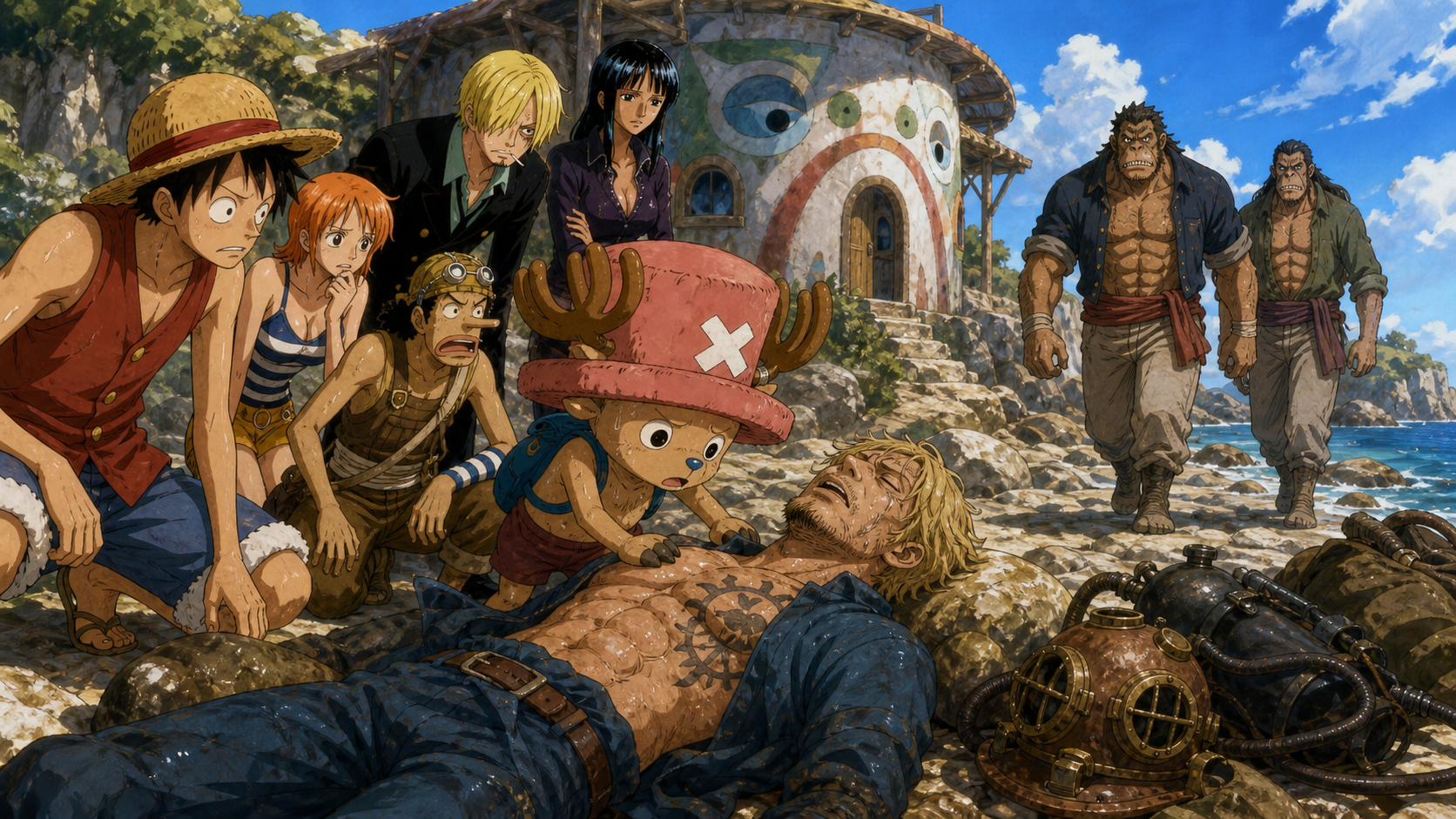
The Straw Hats reach Cricket’s shoreline and see a bright, oversized palace. The impressive facade turns out to be a painted cutout standing before a modest house.
The visual joke introduces a man already living inside other people’s stories. Outsiders see gold, disgrace, eccentricity, or spectacle before meeting the person behind the image.
Robin suspects Cricket was pushed from Mock Town because he spoke about gold. Nami hears treasure and immediately turns the visit into a search.
The crew came to request knowledge about Sky Island. Entering a home and digging around the property without consent converts curiosity into intrusion.
Nami assigns Chopper a treasure hunt on someone else’s land
Nami orders Chopper to dig after hearing that Cricket may possess gold. Excitement makes the property feel unoccupied, although absence does not create permission.
Chopper should refuse excavation without the resident’s agreement. A medical crewmate also should not be diverted from checking Luffy and Zoro after the Mock Town assault.
If the crew finds an artifact, location and condition should be documented before movement. Treasure rumors can draw Bellamy, damage evidence, and expose Cricket to theft.
Nami’s financial instincts often protect the crew, but a budget need cannot turn another person’s home into a salvage claim. The ethical route begins with a conversation.
Noland the Liar turns public memory into a children’s lesson
Inside the house, Nami finds a North Blue picture book called Noland the Liar. Sanji recognizes the tale from childhood and reveals that he was born in North Blue.
The book presents an explorer who reported a mountain of gold, led a king back across a deadly sea, found only jungle, and was executed for deception.
A simplified moral survives for four centuries because children can repeat a liar’s punishment more easily than adults can preserve uncertainty, evidence, and political responsibility.
Noland’s last claim says the gold must have sunk beneath the sea. The court treats a failed expedition as proof of fraud without investigating geological change or missing land.
The king’s expedition makes Noland carry every death
The story says two thousand soldiers began the journey and only one hundred reached Jaya with the king and Noland. Such loss demands scrutiny beyond one explorer’s testimony.
A ruler chose the force size, departure terms, navigation, and acceptable danger. Executing Noland concentrates institutional failure in the person with the least power at sentencing.
The king also arrived years after the original report. Evidence can change between observation and verification, especially across seas shaped by currents, storms, and unstable islands.
A fair inquiry would preserve Noland’s logs, question surviving crew, compare charts, and examine the island. Public punishment destroys the witness while protecting royal judgment.
Cricket attacks before learning why the crew came
Bubbles appear offshore before a large diver erupts from the water, grabs Luffy, and drags him below. Sanji intervenes while Usopp works to recover their captain.
Cricket believes strangers have come for gold. That fear has context, but a preemptive underwater attack risks drowning someone before identity or intent can be established.
The Straw Hats also created the misunderstanding by entering his home and digging. Both sides need to stop, separate, count injuries, and state what happened in order.
Cricket’s gun should be secured during the conversation. The crew should remain outside his personal space unless he invites them back inside.
Chopper recognizes decompression illness instead of weakness
Cricket collapses after surfacing, and Chopper identifies the danger associated with repeated deep dives and rapid ascent. The episode frames his condition as occupational injury.
Symptoms after pressure exposure require rest, monitoring, and professional treatment, not another dive. A person feeling better briefly may still face neurological or respiratory danger.
Chopper should document depth, dive duration, ascent speed, prior episodes, pain, dizziness, breathing changes, and loss of consciousness. Cricket’s solo routine leaves no reliable dive partner.
The crew treats him rather than retaliating. Care does not erase the attack, but medical need should not become leverage for information or access to his discoveries.
Cricket apologizes without pretending the gunshot was harmless
After waking, Cricket acknowledges that he assumed the crew wanted his gold. An apology matters because the first encounter included drowning risk, a fight, and gunfire.
Repair also requires changed procedure. Cricket needs a surface signal, a protected meeting point, and a way to challenge visitors without attacking first.
The Straw Hats should acknowledge their trespass and digging. Mutual accountability avoids the shallow comfort of deciding that only the first person who struck caused the conflict.
No one owes instant trust after receiving treatment or offering an apology. Cooperation can begin with limited information and clear boundaries.
Cricket inherited ridicule before choosing the search
Cricket confirms that Mont Blanc Noland was his ancestor. The family name exposed descendants to mockery long after every witness and ruler from the original case had died.
He describes a childhood shaped by a public story he did not write. Collective punishment survives through jokes, lessons, and assumptions that genealogy reveals character.
Cricket ran away and became a pirate to escape the name. Reaching Jaya by chance forced him to confront the same history from another shore.
Family reputation should never function as evidence. Schools and communities owe descendants room to define themselves without demanding defense of an ancestor.
The search is a duel Cricket never consented to begin
Cricket rejects the idea that filial duty brought him to the seabed. He describes the search as a duel with the man whose legacy made his life unbearable.
That distinction protects his anger. A descendant can seek historical truth without forgiving the harm carried by a famous family name.
The duel has no living opponent and no clear finish line. Gold might vindicate Noland publicly, yet another artifact may never repay Cricket’s lost years or damaged health.
Cricket needs stopping rules: maximum dive exposure, medical thresholds, independent witnesses, preservation methods, and a definition of evidence strong enough to end the search.
His former crew chose departure over an inherited obsession
Cricket explains that his pirate crew would not remain for an indefinite search. Their departure can feel like betrayal while still reflecting a boundary they were allowed to set.
A captain cannot convert a voyage into permanent archaeological labor without renewed consent. Crew members need risk information, pay, supplies, and a route home.
Leaving Cricket alone increased danger, but staying under undefined terms could also trap everyone in his duel. A responsible separation would arrange contacts and emergency support.
The episode refuses to make devotion simple. Cricket’s persistence has dignity, and the cost imposed on bodies, relationships, and time remains real.
Masira and Shoujou found family through the storybook
The Saruyama brothers return and reveal why they follow Cricket. They loved the Noland story, believed the city of gold existed, and built a salvage alliance around that belief.
Their chosen family gives Cricket support his bloodline could not provide. Shared conviction becomes practical through ships, diving crews, food, repairs, and daily presence.
Belief still needs safety rules. Shoujou’s sonar damaged vessels, Masira claimed wrecks through force, and Cricket dives past medical limits.
Loyalty should make intervention easier. The brothers must be able to stop a dangerous dive and hear Cricket’s anger without treating every boundary as doubt.
Luffy asks about Sky Island with no patience for uncertainty
Luffy presses Cricket for a route to the sky. Cricket laughs because no reliable map or confirmed path can satisfy the demand.
Wanting a destination does not create evidence. Nami needs observations, dates, weather patterns, currents, witnesses, and equipment requirements before risking the Merry.
Cricket does not claim certainty. His honesty distinguishes a working theory from Bellamy’s ridicule and from the king’s demand for a simple verdict.
Luffy can keep the dream while accepting procedural caution. Courage becomes more useful when the navigator controls departure conditions.
Noland’s logbook survives where the official verdict failed
Cricket gives Nami Noland’s four-hundred-year-old logbook. The primary record contains observations that the children’s book reduced to a joke.
Nami reads about unusual fish associated with the sky, giving the crew a second category of evidence beyond falling ships and the Log Pose.
The logbook should be handled as a fragile archive. Dry hands, limited exposure, copied pages, secure storage, and source notes matter before a sea voyage threatens the original.
One document cannot prove every conclusion, but a dated field record can restore questions that propaganda tried to close.
Skyfish change the argument from belief to investigation
The crew reacts with excitement when Nami reads the skyfish entry. The detail connects biological observation to their impossible upward Log Pose.
A responsible plan would compare the specimen that fell aboard, Noland’s description, local weather, and Cricket’s salvage findings. Independent clues gain strength through convergence.
The crew should avoid claiming proof before identifying a route. Evidence for an elevated ecosystem does not automatically explain altitude, access, pressure, or safe return.
Robin can preserve translations and historical context while Nami builds the navigation case. Dividing work keeps excitement from flattening every clue into confirmation.
Cricket chooses to help without surrendering his own search
Cricket asks Masira and Shoujou to help the Straw Hats pursue Sky Island. Support becomes an exchange of knowledge and labor rather than a sale of certainty.
The alliance needs a clear scope: repair the Merry, explain known conditions, gather required equipment, and disclose which parts remain dangerous guesses.
The Straw Hats should contribute supplies and work. Cricket’s expertise is not free merely because he shares their interest in proving impossible places can exist.
Helping Luffy may also produce observations relevant to Noland’s case. Any new evidence should return to Cricket with attribution rather than becoming pirate property.
New bounties turn the crew into distant information
The closing sequence shows Mihawk examining updated bounty notices for Luffy and Zoro. Their actions now travel through institutions and rivals faster than their own explanations.
A bounty poster compresses a person into image, number, and threat category just as the storybook compressed Noland into a liar.
The comparison does not make every accusation false. The episode asks who controls the record, what evidence survives, and how strangers act after reading a state-approved summary.
Luffy and Zoro cannot manage every audience, but the crew should anticipate recognition, opportunistic attacks, and consequences for people who shelter them.
Episode 148 makes evidence a form of care
Cricket lives between obsession and disciplined witness. His body carries years of searching, while Noland’s logbook carries details that public memory refused to keep.
The Straw Hats arrive carelessly, provide medical help, listen to the family history, and leave with a responsibility to handle both the man and his evidence more carefully.
RaeRae’s verdict: keep this one. Episode 148 turns a funny picture book into an account of state power, inherited stigma, dangerous labor, and chosen family.
Sky Island remains unconfirmed, yet the question has changed. The crew no longer asks whether dreams deserve laughter. They ask what records, bodies, and relationships can support the journey toward an answer.