
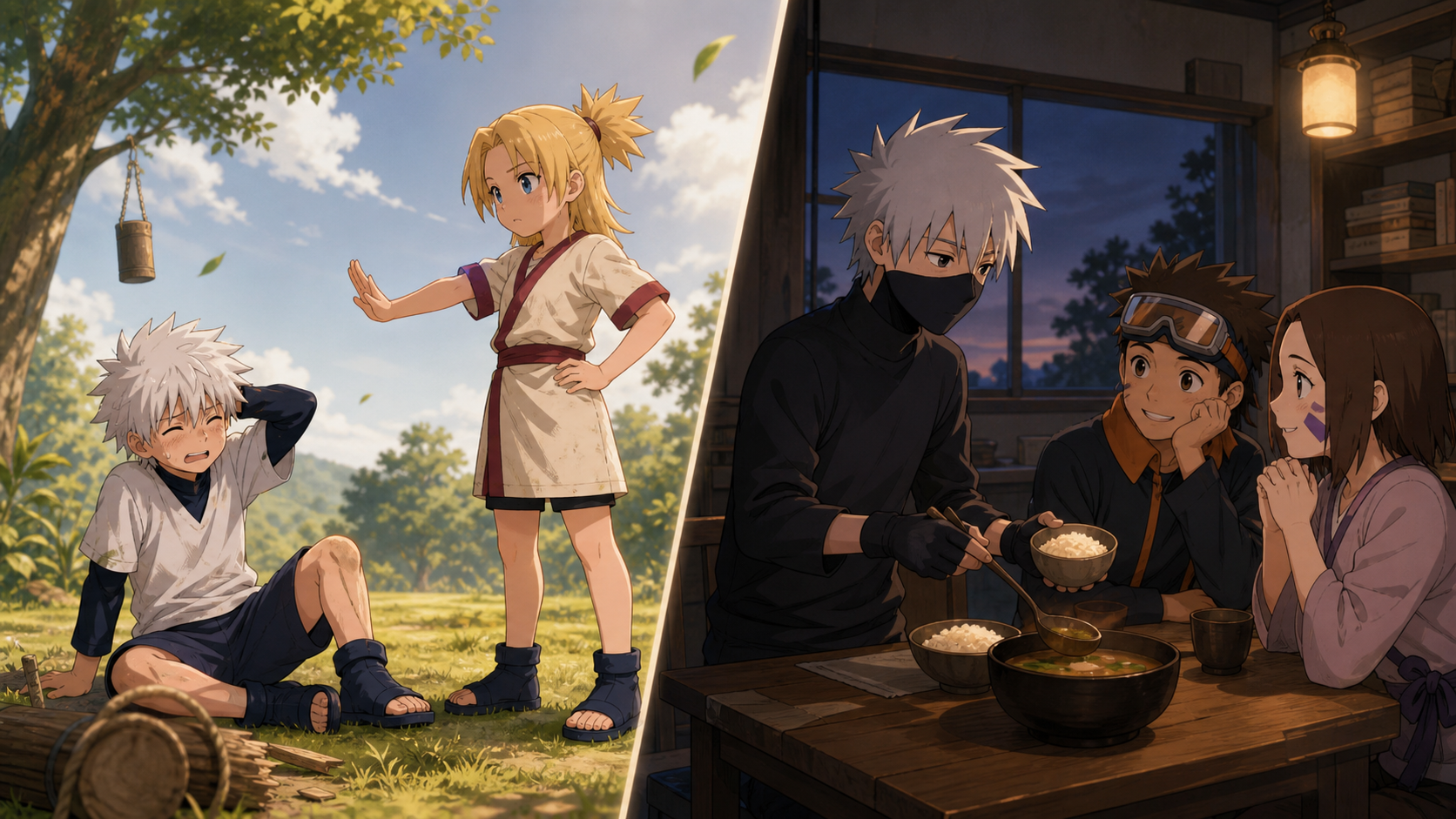
Jiraiya and Kakashi
Attention gained through spectacle cannot replace relationships built through respect, truthful correction and ordinary care.
Bottom line
“Jiraiya and Kakashi” closes the Childhood arc with two boys whose public personas hide opposite kinds of need. Young Jiraiya turns loneliness and insecurity into spectacle, spying on women, staging a false rescue, and demanding Tsunade's attention through conduct that deserves correction rather than indulgent nostalgia. Young Kakashi turns grief into flawless self-sufficiency after Sakumo's suicide, cooking, training, cleaning, and minimizing every achievement so nobody can see how empty his home has become. Orochimaru refuses Jiraiya's schemes without offering connection. Obito and Rin refuse Kakashi's distance by following him, sharing food, thanking him, and cheering during Guy's challenges. The episode is uneven because sexual harassment is repeatedly treated as a comic personality trait while Kakashi's isolation receives gentler observation. Still, both halves reveal a central Naruto argument: attention gained through performance cannot replace relationships built through respect. Jiraiya eventually learns to place faith in students and accept Tsunade's boundaries. Kakashi eventually learns that rules cannot outrank comrades and that competence does not make grief disappear. Their childhood flaws become meaningful only because adulthood brings revision, responsibility, and care.
Episode 483 concludes the anime-original Childhood arc
Episode 483 is titled “Jiraiya and Kakashi.” The episode aired in Japan on November 10, 2016, and divides its runtime between two generations of Konoha shinobi.
The story is anime-original rather than a direct manga chapter adaptation.
Young Jiraiya begins with misconduct
He invites Orochimaru to spy on women bathing. The act violates privacy regardless of the episode's comic framing.
Humor does not create consent.
Orochimaru refuses to participate
The young prodigy finds the plan uninteresting and leaves. His refusal is correct, although emotional detachment rather than respect appears to motivate the decision.
Good conduct can come from incomplete reasons.
Jiraiya proceeds alone
He treats rejection as a challenge rather than a signal to reconsider the behavior. The pattern anticipates an adult persona the series often excuses as eccentricity.
Persistence becomes harmful without boundaries.
An older woman catches him
The intended target recognizes the intrusion and responds directly. Jiraiya loses control of the scene he designed around one-sided observation.
Being discovered restores the other person's agency.
Hot water ends the attempt
Physical comedy supplies immediate consequence, but pain alone does not teach why the conduct was wrong. The episode laughs at failure more clearly than violation.
Punishment needs an ethical lesson.
The behavior should not be romanticized
Jiraiya later becomes a beloved teacher, writer, spy, and wartime intelligence source. Those contributions do not turn harassment into harmless charm.
Affection for a character can include criticism.
Time advances to the teenage Sannin
Jiraiya, Orochimaru, and Tsunade have grown into capable students under Hiruzen. Their personalities are recognizable before war gives them a legendary name.
Ability develops faster than maturity.
Jiraiya wants Tsunade's attention
His attraction is sincere, but sincerity does not entitle him to romantic interest. He seeks a shortcut because direct vulnerability risks rejection.
Performance protects him from honest exposure.
He recruits Orochimaru for a staged attack
The plan asks Orochimaru to threaten Tsunade so Jiraiya can appear heroic. Manufactured danger treats her as an audience and prize rather than a teammate.
Deception cannot create genuine trust.
Orochimaru becomes the false villain
Jiraiya assumes roles can be controlled once assigned. He underestimates both teammates because neither exists merely to support his fantasy.
Other people resist scripted identity.
Tsunade does not need rescue
Her strength makes the premise absurd before execution. More importantly, competence does not determine whether manipulation is wrong.
Autonomy matters whether someone can fight back or not.
The plan collapses
Jiraiya fails to impress her and receives another humiliating consequence. Comedy again handles the surface while the underlying problem remains avoidance of honest communication.
Spectacle cannot force affection.
Tsunade's boundaries remain valid
Her repeated refusals do not make her cold, cruel, or secretly obligated to reward persistence. Jiraiya's later love carries dignity when he stops treating endurance as a claim on her.
No is a complete answer.
Orochimaru watches from emotional distance
His detachment makes him an effective contrast to Jiraiya's noisy longing. Neither boy yet knows how loss, ambition, and war will pull their team apart.
Childhood comedy sits beside approaching tragedy.
Hiruzen's students begin as mismatched peers
Jiraiya seeks attention, Tsunade asserts strength, and Orochimaru values mastery. Their later legend grows from cooperation nobody would predict from these schemes.
Team identity is built rather than discovered fully formed.
Jiraiya uses foolishness as protection
Making himself the joke lets him control ridicule before anyone can name insecurity. Loud behavior can hide fear of being overlooked beside two gifted teammates.
Comedy becomes emotional armor.
His later teaching revises the pattern
Jiraiya invests years in Minato, Nagato, Konan, Yahiko, and Naruto. Mentorship teaches him to direct attention outward and believe in futures he may never witness.
Growth means changing how need becomes action.
The prophecy gives him a larger role
He spends much of adulthood trying to identify a student who can transform the shinobi world. Purpose does not erase his flaws, but service expands beyond self-display.
Legacy develops through people he supports.
His death will test that legacy
Jiraiya enters Amegakure knowing intelligence may cost his life and leaves Naruto the evidence needed to confront Pain. The irresponsible child becomes an adult capable of deliberate sacrifice.
Change makes remembrance honest.
Kakashi's half changes the emotional register
The episode moves from noisy schemes to a quiet house occupied by one child. Silence replaces comedy as the sign of unmet need.
Isolation can look perfectly organized.
Sakumo is already dead
Kakashi lives after his father's suicide, which followed public condemnation for saving comrades over mission completion. The village turned one disputed decision into social destruction.
Collective judgment enters the son's home.
Kakashi manages the household alone
Cooking, cleaning, shopping, and scheduling show extraordinary competence. No child should need competence as proof that adult care is unnecessary.
Self-sufficiency can be a grief response.
He excels at the Academy
Kakashi's skill places him far ahead of classmates and draws Hiruzen's attention. Achievement gives adults something easy to praise while private loss remains harder to address.
Performance conceals need efficiently.
Kakashi spars with the Third Hokage
The exercise demonstrates speed, observation, and discipline beyond his age. Hiruzen recognizes talent within a child carrying the consequence of village cruelty.
Training does not replace pastoral responsibility.
Rin and Obito watch him
Both classmates are curious about someone who appears unreachable. Their interest is not yet the loyalty later tested during war.
Attention begins at a distance.
Kakashi minimizes his practice
He claims that reading a few books explains his ability. Downplaying effort prevents praise from becoming intimacy or expectation.
Detachment controls how much others can ask.
Obito follows him after class
Curiosity crosses into persistence as Obito tries to learn what Kakashi does alone. The intrusion differs from Jiraiya's voyeurism because the story moves toward companionship, though privacy still deserves respect.
Concern needs boundaries too.
Kakashi practices fishing
The prodigy applies focus to an ordinary survival skill. Fishing is practical because nobody else reliably prepares his meals.
Daily life becomes another training ground.
Rin joins the observation
She and Obito share fascination with Kakashi's hidden routine. Their presence begins to populate a world he has arranged around solitude.
Peers approach the empty space.
Kakashi knows they are hiding
His awareness exceeds their stealth, but he does not expose them immediately. The choice gives him control without ending the possibility of connection.
Distance starts to soften.
He invites them to eat
Kakashi turns surveillance into hospitality and shares the fish he prepared. The action resembles young Naruto sharing food with Hiruzen in Episode 480.
Cooking becomes a quiet language of care.
The meal changes his home
Obito's noise and Rin's warmth interrupt an environment organized for one person. Nobody asks Kakashi to confess grief before accepting food.
Companionship arrives through routine.
Kakashi downplays the cooking too
He treats another developed skill as accidental or unimportant. Praise threatens the guarded identity built around needing nobody.
Modesty can conceal fear of attachment.
Obito thanks him afterward
The gratitude continues beyond the meal and proves that a small act registered. Recognition does not demand public achievement.
Ordinary care creates memory.
Kakashi continues doing chores
The next day still requires work, showing that one shared dinner does not solve his living arrangement. Friendship can ease isolation without replacing missing guardianship.
Support should not excuse institutional absence.
Guy challenges Kakashi
The energetic classmate approaches through rivalry, speaking a language Kakashi understands better than sympathy. Competition offers contact without requiring emotional disclosure.
Challenge becomes an invitation.
Kakashi accepts without enthusiasm
His aloof response protects status and distance, but participation means Guy has reached him. The rivalry will endure because both return repeatedly.
Consistency builds a bond underneath style.
Guy lasts longer with each attempt
Progress matters more than immediate victory. Kakashi encounters someone who refuses to treat his genius as a reason to stay away.
Persistence becomes respectful through self-improvement.
Obito and Rin cheer
Their support turns solitary excellence into a shared event. Kakashi's ability no longer exists only for evaluation by superiors.
Peers create a different audience.
Kakashi visits Sakumo's grave
He speaks to the father whose choice and death shape his strict devotion to rules. The grave is the only place where the organized child can admit relationship directly.
Grief continues beneath routine.
He tells Sakumo about his friends
Naming Obito, Rin, and Guy marks a change from mere classmates to people entering his private life. Kakashi offers his father evidence that the house is no longer his entire world.
Connection becomes something worth reporting.
Sakumo's story distorts Kakashi's ethics
Public disgrace teaches the boy that mission rules must outrank comrades. Later, Obito will reverse that lesson at Kannabi Bridge.
Trauma can masquerade as professional principle.
Friendship does not prevent future catastrophe
Obito is crushed, Rin dies by Kakashi's hand, and Kakashi enters years of guilt and ANBU service. Early warmth cannot protect them from war and manipulation.
Connection matters even without guaranteeing safety.
Kakashi eventually carries their values
Obito's rule about comrades, Rin's care, Guy's persistence, and Sakumo's disputed choice all influence the teacher Team 7 receives. He becomes a living archive of relationships lost and maintained.
Mentorship turns memory into conduct.
Jiraiya and Kakashi both teach Naruto
One develops Naruto's power, broader outlook, and search for peace. The other teaches teamwork, tactical judgment, and responsibility during missions.
Their revised childhood flaws become part of his education.
Both adults remain imperfect mentors
Jiraiya leaves gaps in Naruto's practical care and continues sexual misconduct. Kakashi arrives late, withholds parts of himself, and sometimes relies on students to survive danger beyond their age.
Growth should not be confused with flawlessness.
The episode pairs spectacle with silence
Jiraiya demands attention through escalating antics. Kakashi avoids attention through effortless performance and emotional understatement.
Opposite strategies protect the same fear of rejection.
Jiraiya’s loneliness does not excuse harassment
I understand the emotional engine beneath the antics. Jiraiya is insecure beside gifted teammates, afraid of direct rejection, and desperate to control how other people see him. Turning himself into the joke lets him receive attention before anyone can decide to overlook him. None of that gives him permission to watch women without consent or manufacture danger around Tsunade.
The distinction matters because beloved characters deserve honest criticism. Jiraiya becomes a teacher who invests in students, an intelligence operative who risks himself, and a person capable of accepting that Tsunade does not owe him romance. Those later choices show growth. They should not be used to repaint the earlier violation as charming destiny.
Tsunade’s refusal is not flirtation
She does not need rescue, and her strength is not the reason the scheme is wrong. A physically vulnerable girl would have the same right to reject manipulation. Tsunade’s no remains complete whether Jiraiya feels sincere, waits for years, becomes heroic, or makes the audience laugh. Persistence creates no debt.
The healthier part of their adult relationship is that Jiraiya eventually loves her without requiring possession. He can hope, grieve, tease, listen, and still leave her choices intact. That maturity is more moving when we admit how far it sits from the boy scripting her into a false attack.
Kakashi’s perfect house is an alarm
A child cooking, cleaning, shopping, training, and excelling may look impressive to adults who benefit from not intervening. Kakashi’s competence makes neglect easy to overlook. The organized room does not mean grief has been processed or care is unnecessary. It means he learned that needing nobody felt safer after public cruelty helped drive his father to suicide.
Hiruzen can recognize talent and still fail to provide enough support. A sparring session with the Hokage is not bereavement care. Praise for skill cannot substitute for a stable adult checking the refrigerator, sitting through silence, explaining that Sakumo’s death was not Kakashi’s fault, and challenging the village narrative that turned one mission decision into total disgrace.
Food becomes permission to enter
Kakashi inviting Obito and Rin to eat is small and enormous. He does not confess everything. They do not demand access to grief before accepting hospitality. A meal changes the house from proof of solitary survival into a place where other voices can exist. Connection enters through routine rather than dramatic rescue.
That does not solve his living arrangement. Friendship cannot replace guardianship, and children should not be assigned the job of healing another child alone. Obito and Rin offer companionship within their capacity. Adults remain responsible for the care their presence cannot supply.
Guy’s rivalry respects Kakashi’s language
Guy approaches through challenge because direct sympathy might make Kakashi retreat. He keeps returning, improves himself, celebrates effort, and does not demand that Kakashi become emotionally available on command. The rivalry works as relationship because Guy accepts a boundary while maintaining contact.
That consistency becomes one of Kakashi’s longest surviving bonds. Guy refuses the idea that genius makes Kakashi unreachable, yet he also brings his own purpose rather than existing as a caretaker. Their competition leaves both men room to grow.
Mentorship carries revised failure forward
Jiraiya and Kakashi later teach Naruto partly through what their own childhoods failed to provide. Jiraiya offers a wider world and faith in a student’s future. Kakashi insists that comrades matter more than rules after learning the cost of the opposite belief. Neither mentor becomes flawless. Revision is not perfection.
That is the canon standard I want here: love them enough to keep the full record. The spying, the sacrifice, the late arrivals, the lifesaving lessons, the emotional gaps, and the ordinary meals all belong. Fandom gets richer when affection can survive truth.
The episode’s two halves also show how easily a village mistakes visibility for need. Jiraiya is loud, disruptive, and impossible to ignore, so adults can respond to the behavior without asking what attention would look like if it were offered consistently. Kakashi is quiet, productive, and nearly self-maintaining, so adults can praise the result and overlook the empty house producing it. Both children need guidance, but not the same intervention. Jiraiya needs boundaries that explain consent, consequences that do not become humiliation alone, and adults willing to value him when he is not performing. Kakashi needs grief care, reliable companionship, practical support, and permission to be less capable without losing respect. Treating every child fairly does not mean giving every child the identical response. It means taking each need seriously while preserving other people’s safety and autonomy. That principle follows both men into teaching. Naruto does not need Jiraiya to become a replacement father only during training trips; he needs consistent care alongside technique. Team 7 does not need Kakashi to reward flawless mission behavior; they need a teacher who notices fear, rivalry, trauma, and the danger of sending children into adult conflicts. Their mentors improve because relationships expose what the personas conceal. The lesson is not that wounded boys inevitably become wise teachers. It is that growth requires other people, honest feedback, and repeated choices that interrupt the harm survival once made familiar. A village that celebrates their adult sacrifice should ask why boys needed performance and perfection before anyone fully recognized the enduring loneliness underneath their talent.
Final verdict
“Jiraiya and Kakashi” is strongest when viewers refuse to let affection blur accountability. Young Jiraiya's spying and staged rescue are not harmless signs of future charm. They violate privacy and reduce Tsunade to an audience for a fantasy she never chose. His adult importance becomes richer when understood as growth beyond self-centered performance, not evidence that the behavior was acceptable all along. Kakashi's half offers the sharper portrait. A bereaved child runs a perfect household, excels against adults, feeds classmates, and minimizes every skill because competence keeps questions away. Obito, Rin, and Guy do not cure his grief. They give him repeated, ordinary reasons to let other people enter. By ending at Sakumo's grave, the episode shows friendship becoming part of what Kakashi can tell his father. The Childhood arc closes on a quiet truth: children need room to fail, truthful correction, stable care, and relationships that do not demand a performance first.
Sources and watch notes
- Naruto Official episode guide for the official series record.
- Crunchyroll for the licensed episode route where available.
What I am carrying forward
Episode 484 begins Sasuke Shinden. I am carrying forward Tsunade’s complete boundary, Kakashi’s quiet house, Sakumo’s public disgrace, food as ordinary care, Guy’s respectful persistence, and the refusal to confuse later heroism with retroactive innocence. Growth matters because the earlier harm remains true.