
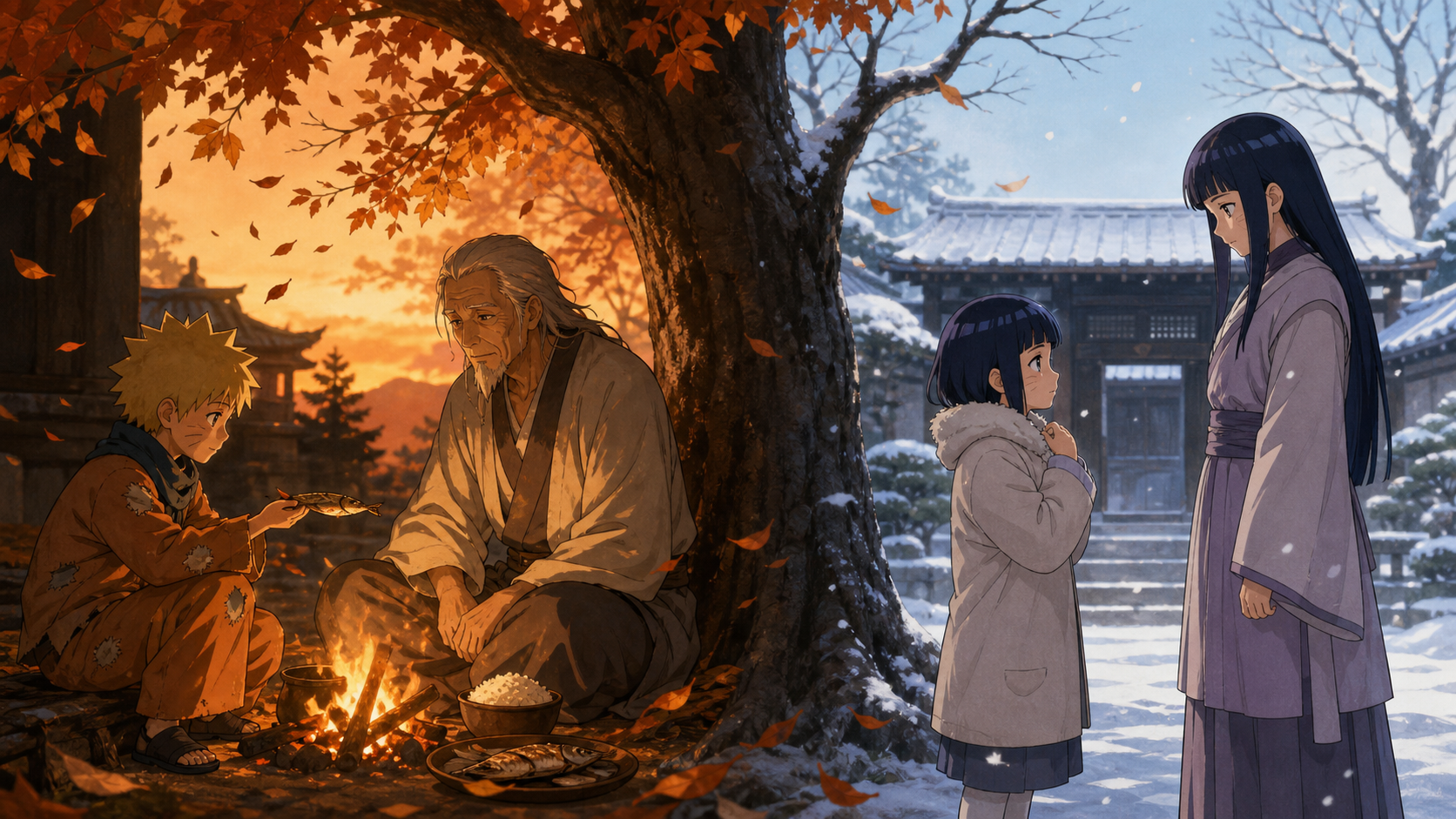
Naruto and Hinata
Two generous children endure different forms of abandonment under adult systems that should have provided food, safety and gentleness.
Bottom line
“Naruto and Hinata” pairs two lonely childhoods without pretending their loneliness had the same cause. Naruto goes hungry while adults reject him for a seal placed in his body as an infant. Hinata grows inside a powerful household where protection, succession, and sacrifice turn a small child into clan property. Naruto meets Hiruzen beside a fire and shares the meal he gathered alone, revealing generosity long before the village recognizes him. Hinata meets Neji before the Hyuga system marks his forehead and before grief hardens his understanding of fate. She later encounters Naruto after Hizashi's funeral, and his blunt companionship helps her return home. The episode gains power from those quiet meetings, but the adult systems deserve sharper judgment than nostalgia often allows. Hiruzen offers perspective while leaving Naruto materially neglected. Hiashi teaches duty after a branch-family death protects the main house. Naruto and Hinata both learn endurance, yet children should never have needed extraordinary endurance to receive food, safety, or gentleness.
Episode 480 begins the anime-original Childhood arc
Episode 480 is titled “Naruto and Hinata.” The episode aired in Japan on October 20, 2016, and divides its runtime between memories from Naruto's and Hinata's early lives.
The story is anime-original rather than a direct manga chapter adaptation.
The episode returns after the war
Following the central conflict's conclusion, the series looks backward instead of moving immediately into another threat. Childhood becomes a measure of what peace should protect.
Memory asks whether survival was ever enough.
Young Naruto stands above Konoha
He watches the village from the Hokage Monument while remaining socially outside the community below. The Fourth Hokage's face holds an unknown connection to the child standing overhead.
Family history is visible but unavailable.
Villagers avoid him openly
Adults pull away, whisper, and teach fear through repeated behavior. Naruto receives punishment for Kurama's attack despite having had no choice in becoming a jinchuriki.
Prejudice turns a victim into a public suspect.
The adults blame him for Minato's death
Their accusation confuses the sealed fox with the infant used to contain the fox. Sasuke overhears the cruelty while carrying a different approaching catastrophe.
Konoha's silence allows false guilt to circulate.
Naruto is hungry
The detail matters more than any later speech about resilience. A child with housing but insufficient food still faces neglect.
Heroic destiny does not make hunger acceptable.
Ichiraku remains beyond his money
Naruto wants a warm meal and cannot afford one. Ramen later becomes a symbol of belonging partly because ordinary access once felt uncertain.
Comfort gains meaning through earlier scarcity.
He returns to an empty apartment
No parent checks whether he ate, cleans a wound, hears about his day, or explains the hostility outside. Independence has been imposed rather than chosen.
Solitude fills every domestic routine.
Naruto leaves to train
Practice offers a task he can control when social rejection cannot be solved. He throws stones in place of proper tools and keeps moving through frustration.
Training becomes emotional regulation.
Determination does not excuse neglect
The village later benefits from the survival skills Naruto built alone. That outcome cannot retroactively justify adults failing to provide stable care.
Resilience is evidence of need, not proof that harm helped.
The forest gives him temporary privacy
Trees do not stare, whisper, or remove children from his path. Outside the village center, Naruto can exist without constant interpretation.
Nature offers relief from community judgment.
He gathers mushrooms
Naruto relies on whatever food he can identify while hungry. The scene frames self-sufficiency as necessity rather than a charming wilderness adventure.
Resourcefulness carries an avoidable cost.
He catches fish
Success creates dinner through patience and physical effort. The child who has little still prepares more than a single portion.
Scarcity has not destroyed generosity.
Hiruzen approaches the fire
The Third Hokage meets Naruto without announcing his office. Their conversation therefore begins between a hungry child and an older stranger rather than ruler and ward.
Disguise removes ceremony but also responsibility.
Naruto hears Hiruzen's stomach
The sound gives him an immediate need he understands. He responds without demanding status, repayment, or proof of deserving help.
Empathy begins through recognition of hunger.
Naruto shares his meal
He offers fish even though nobody guaranteed his next breakfast. The choice reveals a communal instinct the village repeatedly refuses to see in him.
Generosity belongs to Naruto before praise does.
Hiruzen accepts the invitation
Eating beside Naruto provides companionship for one evening. The scene is warm because the child receives attention without fear.
Warmth should not shield the Hokage from evaluation.
The Hokage knew Naruto's circumstances
Hiruzen held political authority and knew the truth of the seal, Minato, Kushina, and the village's hostility. A private meal cannot replace reliable guardianship and material support.
Kindness without structural follow-through remains limited.
They look toward the stars
Hiruzen explains that the world is far larger than any one person. The thought gives Naruto distance from villagers who behave as though their judgment defines his entire existence.
Scale weakens the prison of local hatred.
Naruto carries the idea forward
He returns to the monument with a wider imagination of possibility. Konoha remains his desired home, but the village no longer represents every available horizon.
Perspective creates emotional breathing room.
The lesson fits his later diplomacy
Naruto eventually builds relationships across nations, species, generations, and former enemy lines. The child by the fire has already practiced sharing before institutions teach alliance.
His politics grow from lived need.
Hinata's story begins with Neji
The second half moves from public exclusion toward pressure inside one family. Neji trains with Hizashi before loss and the caged-bird seal shape his later anger.
The episode shows affection before fracture.
Hizashi trains his son personally
Their sparring contains discipline alongside parental attention. Neji wants to continue, eager to master movement and earn approval.
Training still has room for care.
Hizashi knows the branch-family boundary
His son possesses exceptional talent while belonging to a line required to protect the main house. Ability cannot free Neji from rules assigned at birth.
Clan hierarchy converts kinship into rank.
Neji asks about his cousin
Hinata is one year younger and positioned as the main-family heir. Before resentment hardens, curiosity guides his interest.
Their relationship begins without hatred.
Hinata and Neji meet as children
The two cousins face one another before political roles fully dominate their understanding. Their small bodies carry expectations created generations earlier.
Clan history enters the room with them.
They practice Gentle Fist
Taijutsu becomes both family language and succession test. Hinata's hesitation is read against a system that expects combat aptitude from the designated heir.
Childhood play has been replaced by evaluation.
Hinata says she dislikes fighting
Her discomfort is not proof of moral weakness or incapacity. A child can reject violence while still possessing courage, perception, and discipline.
Temperament should not determine human worth.
Neji explains her assigned importance
He repeats the clan's view that the heiress has a special role. The statement sounds respectful before experience teaches him how his own body is priced beneath hers.
Duty enters their bond before either can consent.
Hinata notices his closeness with Hizashi
She sees warmth between father and son while her own relationship with Hiashi is shaped by formal expectations. Main-family privilege does not guarantee emotional security.
Power and affection do not distribute together.
Hizashi's death changes the family
His body is given to protect Hiashi and prevent conflict with Kumogakure after the attempted kidnapping of Hinata. The official solution makes a branch twin pay for a crisis directed at the main house.
Peace is purchased through unequal sacrifice.
The funeral overwhelms Hinata
She recognizes Neji's loss without having language for the system surrounding the death. Grief, guilt, and confusion become attached to her status as heiress.
A child inherits consequence without agency.
Neji loses both father and trust
Later bitterness does not appear from nowhere. Adults conceal parts of Hizashi's choice while the visible hierarchy gives Neji every reason to see fate as imprisonment.
Resentment grows inside managed truth.
Hinata wanders away
Leaving the funeral space gives her temporary escape from adults, ceremony, and the meaning assigned to her existence. She is too young to process a death connected to her clan position.
Movement replaces words she does not have.
Naruto encounters her alone
He does not know the clan politics or funeral history. The meeting joins two children through immediate sadness rather than a complete understanding of each other's lives.
Connection can begin before explanation.
Naruto walks Hinata home
His help is practical and direct. He offers company through the village rather than demanding that she describe every feeling.
Care can take the form of staying nearby.
He speaks from his own loneliness
Naruto says he has nobody, so he does not have anyone to cry over. The claim sounds protective because admitting longing would expose how deeply absence hurts.
Bravado covers deprivation.
Hinata sees courage mixed with pain
Naruto does not appear as a polished future hero. He is another child carrying loneliness while still noticing someone else in distress.
Her admiration begins with recognizable struggle.
Their childhoods are not interchangeable
Naruto lacks family care and faces village hatred. Hinata has a household, status, and material security while enduring rigid expectations and emotional pressure.
Comparison should preserve those differences.
Hiashi receives Hinata at home
Her father returns the discussion toward clan obligation and the lives sacrificed around the heiress. Protection becomes a debt she is expected to repay through performance.
Duty lands on a child already grieving.
The Hyuga system harms both houses
Branch members live under a coercive seal, while main-family children learn that relatives may die for their assigned safety. Rank damages relationships on every side without distributing harm equally.
Reform must address the institution, not only personal kindness.
Hinata's gentleness survives pressure
She does not become cruel to satisfy the model of an heir. Her empathy later supports courage during Pain's attack and the war.
Softness and bravery coexist.
Naruto's generosity survives rejection
The boy who shares fish later shares chakra across an alliance and seeks freedom for the tailed beasts. Scale changes while the ethical instinct remains recognizable.
He gives what isolation taught him to value.
The pairing points toward future family
Naruto and Hinata eventually build a home together, but this episode should not reduce childhood suffering to romantic preparation. Each story deserves meaning beyond eventual marriage.
Love does not justify the wounds that preceded love.
Nostalgia needs accountability
Gentle music, snow, firelight, and small gestures make the memories emotionally inviting. The visual warmth can coexist with clear judgment of adults and institutions.
Beautiful presentation does not make neglect harmless.
Naruto should never have been hungry
I cannot watch this child catch his own dinner and let the scene become a cute origin story for resourcefulness. Naruto lives in a village with an elected leader, military payroll, clan compounds, markets, teachers, and adults who know exactly why Kurama is sealed inside him. Food insecurity here is not an accident of wilderness. It is a political failure inside a community that later celebrates the traits he developed to survive it.
His generosity makes the failure sharper. Naruto has one fish and still notices another person’s hunger. The village keeps insisting he is dangerous while the child in front of them is already practicing mutual care. He should not have needed to prove goodness before receiving dinner, supervision, and a home where somebody expected him back.
Hiruzen’s kindness is not enough
The firelight scene is tender. I understand why Naruto remembers it. Hiruzen talks to him without disgust, accepts what he offers, and gives him a horizon wider than local hatred. A lonely child can carry one respectful conversation for years. That emotional truth does not excuse the Hokage’s institutional responsibility.
Hiruzen had authority, information, and access. If secrecy around Naruto’s parentage limited what could be said publicly, it did not require leaving him materially or emotionally unsupported. A guardian, regular meals, protected schooling, counseling, and consequences for adult harassment were all possible without announcing Minato’s son to every enemy. Private warmth cannot replace public duty.
Hinata is privileged and still harmed
Hinata’s home has status, wealth, training, and protection Naruto never receives. Naming that privilege does not mean the Hyuga system treats her well. She is assessed as an heir before she is allowed to understand herself as a child. Her gentleness becomes a performance problem. Her cousin’s life is ranked beneath hers. Grief arrives with the message that other people may die because her assigned position must survive.
The harm is not evenly shared. Neji carries the caged-bird seal and loses his father within a branch-family structure built for main-house control. Hinata does not experience that coercion. She experiences the moral injury of being placed above relatives and told the arrangement is duty. Honest comparison can hold both realities without pretending rank hurts everyone in the same way.
Hizashi’s choice exists inside coercion
Later explanations emphasize that Hizashi chose to die for Hiashi, and his agency matters. So does the system shaping the available choices. He lived with a seal that could punish or destroy him, inside a family order where branch bodies existed to protect the main line. Calling the final sacrifice voluntary cannot wash that history out of the room.
Neji receives fragments of the truth after grief has already hardened into fate. Hinata is too young to understand why her uncle’s funeral feels connected to her. Hiashi survives with authority intact. Every child inherits emotional consequences from a decision the adults present as settled. That is not peace. It is managed pain.
Naruto walking Hinata home is enough
He does not fix the Hyuga clan on the road. He does not make Hinata perform gratitude or explain a family tragedy he knows nothing about. He notices that she is alone and stays near her until she reaches safety. The gesture is small, which is why it works. Care responds to the need available in the moment.
Hinata’s later love should not be used to turn this scene into romantic destiny. She sees a child who is hurting and still capable of kindness. He sees another lonely child without knowing what future she will occupy. Their eventual relationship can grow from that recognition, but neither childhood existed to prepare a marriage plot.
Peace should be measured by childhood
After a war fought by teenagers and resurrected adults, the anime looks backward at the people those fighters were before anyone called them heroes. That choice creates a standard for Naruto’s future. A peaceful village is not merely one without enemy armies. It is one where children eat, ask for comfort, reject violence, grieve safely, and remain people before becoming vessels, heirs, soldiers, or symbols.
If the postwar system praises Naruto and Hinata’s endurance while reproducing the conditions that demanded it, then survival has become propaganda. Their lives deserve a better conclusion: care organized before catastrophe, not applause delivered afterward.
The episode reminds me that children notice systems before adults give them language for those systems. Naruto knows people recoil from him, even when nobody explains the seal honestly. Hinata knows a funeral feels connected to her place in the main family, even when clan duty is presented as natural order. Neji knows his father’s body was valued differently, even before he receives the story. Silence does not protect them from political reality. It leaves them alone to invent explanations, and children usually place the blame inside themselves. That is why truthful, age-appropriate care matters. Adults do not need to hand a child every classified detail in order to say: this harm was not your fault; you deserve food; grief is allowed; your life is not a debt; another person’s sacrifice does not make you guilty for existing. Those sentences could have changed the emotional landscape long before any dramatic battle did. Naruto and Hinata build meaning from what they survived, but survival should not be the village’s care plan. If their future household offers anything different, I hope it begins there: needs spoken plainly, affection not tied to performance, and children never required to become extraordinary before adults believe they are worth protecting.
Final verdict
“Naruto and Hinata” works best as a study of children who remain generous under conditions adults should have changed. Naruto feeds himself, trains alone, and shares dinner with a stranger while Konoha treats him as a danger. Hiruzen's companionship gives him a wider view of the world, but the Hokage's gentle lesson cannot answer why a known orphan was left hungry and isolated. Hinata's half reveals another kind of abandonment inside an intact family. Her role as heiress makes Hizashi's death, Neji's grief, and Hiashi's instruction part of a system that converts kinship into obligation. Naruto walking her home matters because neither child demands a performance from the other. Their future bond grows from recognition, not matching biographies. The episode honors their endurance most honestly when viewers refuse to romanticize the conditions that required such endurance.
Sources and watch notes
- Naruto Official episode guide for the official series record.
- Crunchyroll for the licensed episode route where available.
What I am carrying forward
Episode 481 shifts to Sasuke and Sakura. I am carrying forward Naruto’s hunger, Hiruzen’s limited kindness, Hinata’s burden as heir, Neji’s unequal loss, and the difference between resilience and protection. The Childhood arc should keep asking what adults owed these children before celebrating what they became.