
RaeRae Reacts · One Piece Episode 136
Zenny of Goat Island
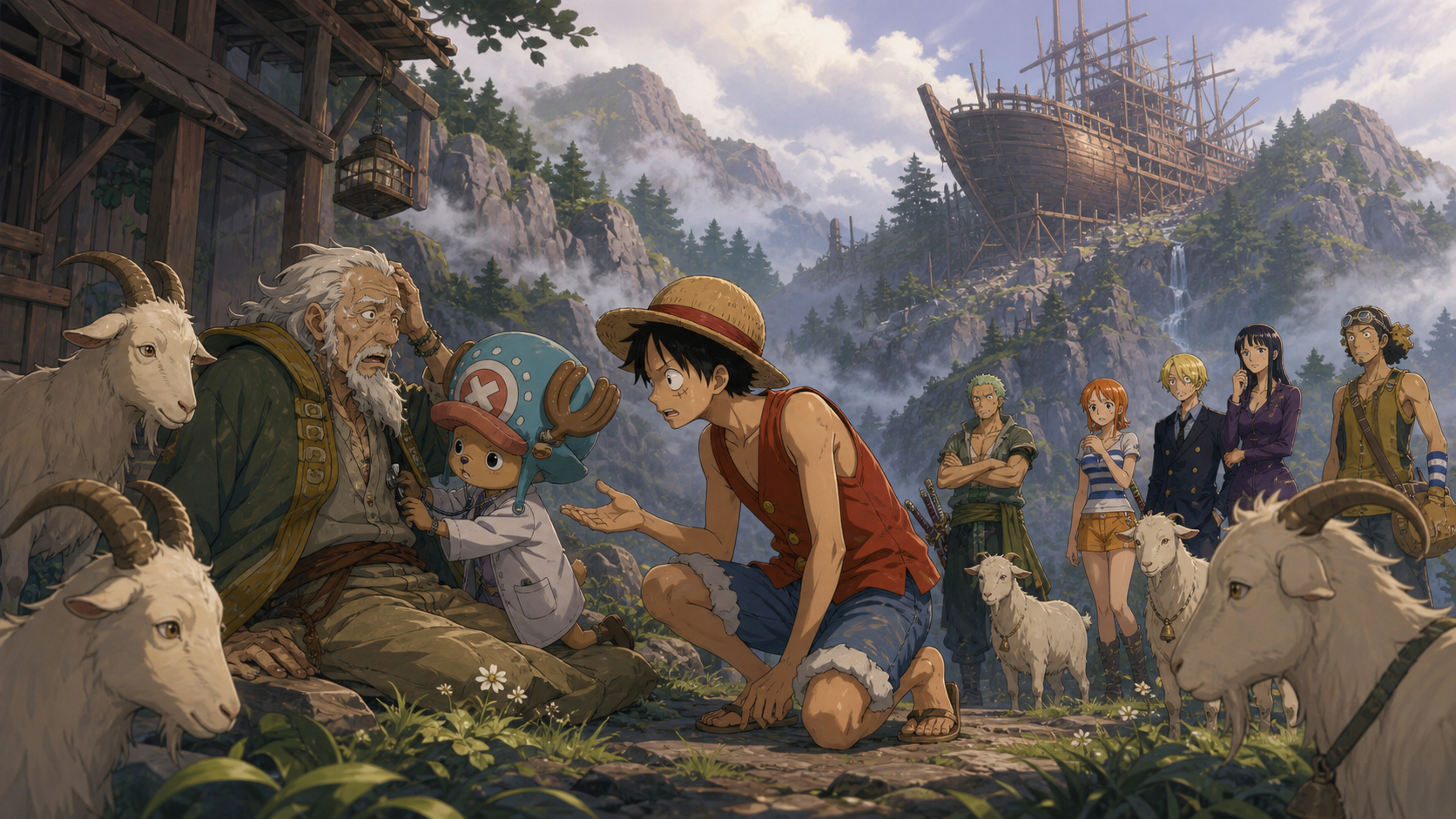
One Piece Episode 136 brings the Straw Hats to Goat Island, where Zenny’s heart condition turns an argument about pirates and chores into a duty-of-care crisis.
The Marines turn hunger into a navigation problem
Episode 136 opens with the Going Merry under pursuit while the crew is already hungry. A faster military vessel and an empty pantry create two emergencies at once. Escaping capture does not solve the need for food, water, rest, or safe bearings.
A responsible ship should carry reserve rations, protected drinking water, medical supplies, and an inventory that reflects weather delays or pursuit. Crew members need assigned duties during escape so nobody abandons lookout, steering, sail handling, or injury checks to search for food.
The Marines also owe proportional enforcement. Pursuit around fog and unknown coastlines can endanger crews, officers, and unrelated residents. Capture goals do not excuse creating a shipwreck.
Fog makes Goat Island refuge and hazard together
The crew clears heavy fog and finds an island where food may be available. Relief arrives before anyone knows whether the land is inhabited, protected, or safe to approach.
Before landing, navigators should check depth, current, rocks, tide, wind, anchor holding, and possible escape routes. A lookout should listen for animals, workers, bells, or other signs of ownership. Hunger can explain urgency without canceling consent.
The island gives the crew cover from pursuit, but isolation means emergency support may be far away. Every shore party should carry water, first aid, signaling equipment, and a return time.
A goat is not emergency food merely because Luffy is hungry
Luffy sees a goat and immediately thinks about meat. The impulse fits his appetite, but an animal on unfamiliar land may belong to someone, protect young, carry disease, or support a fragile local ecosystem.
Food collection requires permission or a genuine survival necessity. The crew still has a working ship and enough capacity to ask, forage carefully, fish, or move onward. Convenience does not create ownership over a living animal.
Sanji and Chopper stop the rush toward slaughter. Their objection recognizes both animal welfare and the possibility that the goat has relationships the newcomers cannot see.
The herd responds as a community defense system
The first goat leads the crew into an ambush by the larger herd. What looked like a passive food source becomes a coordinated group capable of redirecting attacks and surrounding intruders.
The pirates should retreat, lower weapons, reduce noise, and avoid trapping individual animals. Striking a herd can trigger panic, falls, trampling, and separation of young goats from caregivers.
Zoro shows restraint because Chopper says the animals are not acting from cruelty. Chopper’s translation supplies context that physical power alone cannot provide. Expertise changes the safest response.
Zenny orders the attack from a place of fear
An elderly man named Zenny has directed the goats because he believes pirates will rob or kill him. Twenty years of isolation have made the herd his warning network, companions, and first line of defense.
Fear does not make an indiscriminate animal attack safe, especially when visitors have not threatened him. Zenny needs graduated warnings, visible boundaries, a safe shelter, and a way to communicate before conflict begins.
The crew also needs to recognize the power imbalance. Several armed adults have entered the home of one frightened elder. Their claim that they only need supplies will sound weak unless their behavior confirms restraint.
Getting stuck in a tree turns panic into a medical crisis
Zenny tries to flee, becomes caught in low branches, and panics when Zoro brings him down. His heart stops, transforming a tense misunderstanding into an immediate medical emergency.
Rescuers should stabilize the scene, avoid sudden movement, assess breathing and circulation, and follow the ship doctor’s instructions. Crowding, shouting, blame, and threats can worsen distress or delay care.
Zoro did not intend harm, but intent cannot finish the response. The crew must help because their arrival and handling contributed to the event. Accountability begins with preserving life before arguing about fault.
Chopper treats a patient who distrusts pirates
Chopper identifies himself as a doctor and asks the goats to lead everyone to Zenny’s home. Medical competence matters because the patient has lost consciousness and cannot participate fully in the first decisions.
Emergency consent permits necessary stabilization when delay threatens life, but authority remains limited to urgent care. Once Zenny wakes, Chopper should explain findings, proposed treatment, risks, uncertainty, and alternatives in language the elder understands.
Zenny’s fear of pirates may make him reject help or conceal symptoms. Chopper can acknowledge that fear without abandoning clinical boundaries or promising an outcome he cannot guarantee.
Zenny’s home reveals two decades without human support
The goats explain that Zenny is the island’s only human resident and has lived there for twenty years after becoming stranded. Long isolation raises questions beyond his immediate heart condition.
A full assessment should consider nutrition, medication access, vision, hearing, mobility, memory, sanitation, housing safety, and emergency evacuation. Social isolation can increase vulnerability even when daily routines appear functional.
The goats provide genuine companionship and practical help, yet animal care cannot replace specialist medicine, informed legal planning, or human contact chosen by Zenny. Support should expand his options without treating solitude as proof of incapacity.
The fifty-million-berry demand mixes injury with leverage
After waking, Zenny demands fifty million berries in compensation and claims he can no longer cut wood or draw water. The demand begins from a real harm but quickly becomes bargaining theater.
Compensation should reflect documented medical costs, lost labor, property damage, and future care rather than whatever number frightens visitors. Chopper’s emergency treatment may offset some expense, though nobody should price lifesaving care as a weapon against a patient.
Both sides need a calm account of what happened. Zenny ordered the goat attack, the crew entered without permission, and the rescue triggered a medical episode. Shared responsibility requires evidence, not shouting.
Apology work should have boundaries
Luffy agrees that the crew will cut wood, draw water, feed goats, repair clothing, clean, cook, and provide massages. Practical help can repair trust, especially when Zenny’s health limits strenuous work.
An apology does not create unlimited labor. The crew should agree on tasks, duration, safety conditions, and an end point. Zenny should not add work solely to keep frightened strangers under control.
The arrangement becomes more ethical when assistance responds to actual needs. Water, fuel, food, and animal care preserve health. Humiliation and arbitrary repetition would serve power instead.
Wood cutting and water hauling expose hidden infrastructure
Zenny’s ordinary chores demand strength, time, tools, and reliable weather. A weak heart makes each trip a potential emergency, especially when no second adult can call for help.
The crew could reduce future risk by repairing carts, improving paths, installing safer storage, moving frequently used supplies closer, and creating a gravity-fed or pulley-assisted water system. One generous day cannot replace durable access.
Any improvement needs Zenny’s consent. Visitors should not redesign his home around assumptions about age. Accessibility works best when the resident chooses priorities.
Fuel work also needs basic controls. Axes require maintained handles, clear swing zones, eye protection, stable chopping blocks, and dry storage. Water containers should remain clean, covered, and light enough for safe lifting. If Zenny cannot manage the old routine, smaller loads and more frequent trips may protect independence better than waiting for another emergency.
The goats are caregivers as well as dependents
The herd warns Zenny, guides Chopper, finds food sources, and communicates information about his past. Zenny also feeds, shelters, and organizes them. Their relationship runs in both directions.
Planning for Zenny’s illness must include the goats. Somebody needs authority and resources for food, veterinary care, shelter, population control, and protection if he becomes unable to provide daily care.
The crew should avoid separating animals casually or assuming ownership after helping. The herd is not hidden treasure waiting for a new claimant. Their welfare belongs in every medical and evacuation decision.
Zoro refuses to confuse servitude with care
Zoro leaves to find food after recognizing that Zenny may not share supplies. He also sees how the elder keeps expanding the crew’s obligations. His skepticism protects against manipulation, though bluntness can miss genuine frailty.
Healthy caregiving permits questions, rest, and disagreement. A person can deserve help while behaving unfairly. Setting a boundary does not erase compassion.
Zoro’s independent food search also reduces conflict around Zenny’s pantry. The safer version includes telling the navigator where he is going, carrying a signal, and returning before poor visibility makes rescue difficult.
A pirate ship in the mountains changes the story
Zoro discovers a damaged pirate ship high in the mountains. The placement makes ordinary wreck explanations unlikely and connects Zenny to a larger unfinished history.
The crew should inspect from a distance before climbing aboard. Rot, unstable supports, loose rigging, insects, sharp metal, and stored fuel can turn an abandoned structure into a collapse hazard.
The pirate flag suggests identity, not current seaworthiness. Nobody should launch the vessel until qualified builders examine the hull, mast, steering, fasteners, sail plan, weight distribution, and route to water.
Chopper’s prognosis carries devastating uncertainty
Chopper concludes that Zenny’s underlying illness may leave him only three days to live. The judgment shifts the crew from annoyed workers to people trying to make an elder’s remaining time comfortable.
Prognoses should be communicated privately, carefully, and directly to the patient whenever he has decision-making capacity. Telling companions first can strip Zenny of control over his own final days.
Chopper should explain uncertainty rather than presenting a clock as certainty. Symptoms, examination limits, unavailable tests, response to medicine, and emergency warning signs all affect the estimate. Honest uncertainty can coexist with urgent planning.
Comfort care cannot become cheerful deception
The Straw Hats decide to care for Zenny because they believe his death is near. Breakfast, chores, conversation, and companionship may offer real comfort, but kindness should not depend on hiding the diagnosis.
Zenny deserves a chance to name goals, contacts, unfinished business, preferred treatment, and what should happen to the goats and ship. He may choose comfort, travel, repair work, or a second medical opinion.
The crew should not perform constant cheerfulness around grief. Listening, silence, pain control, practical planning, and permission to express anger can be more respectful than pretending every meal solves the fear.
A written plan would help people act consistently if Zenny loses consciousness again. The document should identify who may make decisions, where medicine is stored, what symptoms require evacuation, which possessions carry special meaning, and who will care for the herd. Chopper should revisit the plan whenever the patient’s wishes or condition change.
An unfinished ship may be evidence of a sustained dream
The mountain vessel shows that Zenny has spent years building toward piracy even while stranded. The ship may never have reached water, yet the labor has already shaped his routines, skills, and relationship with the goats.
A dream does not become meaningless because age, illness, or circumstances delay completion. The ethical question is how to support Zenny’s agency without turning a fragile body into the price of a dramatic launch.
Repair planning should begin with his priorities. Documentation, a model, a ceremonial captaincy, supervised construction, or a safe voyage may each carry value. Outsiders should not choose the ending because one option looks better on a story page.
Episode 136 makes care a negotiation rather than a rescue pose
The Straw Hats arrive hungry, frighten a frightened man, save his life, become his workforce, and then learn that he may be dying. Nobody occupies a single clean role. Zenny is patient, host, manipulator, survivor, employer, and dreamer. The pirates are intruders, rescuers, debtors, caregivers, and witnesses.
That complexity makes the episode stronger than a simple detour. Care requires consent and boundaries. Accountability requires more than guilt. Medical truth belongs first to the person whose future has changed.
RaeRae’s verdict: keep this one. Episode 136 lets a comic argument about chores open into a serious question about how people respond when an isolated elder’s time appears short. The right answer is not to take over his life. The right answer is to return choices, reduce danger, protect the goats, and ask what the unfinished ship means to the person who kept building.