
RaeRae Reacts · One Piece Episode 135
Zoro Meets Johnny and Yosaku
One Piece Episode 135 reveals how Zoro met Johnny and Yosaku through a village defense that challenges his solitary pirate-hunter reputation.
Zoro’s reputation arrives before his name can explain him
Episode 135 returns to the years before the Straw Hats and finds Zoro already carrying the label that strangers will repeat across the East Blue. People call him a pirate hunter because bounty posters, tavern gossip, and frightened witnesses need a simple category. Zoro’s actual life is less tidy. He hunts nobody as a profession. He collects a bounty when hunger leaves him without another practical option, then keeps moving toward Mihawk.
Reputation can create access, fear, and danger long before a person controls the story. A feared name may deter violence, but a violent legend can also attract challengers, retaliation, and official suspicion. Communities should assess conduct and evidence instead of treating rumor as a complete identity.
Zoro protects Wado Ichimonji and his promise more fiercely than he protects the public version of himself. That difference becomes the episode’s foundation. A label describes what observers think they saw. A value explains why someone chooses the next action.
Hunger turns bounty work into an emergency income system
Zoro enters a tavern exhausted, broke, and focused on food. He has captured the wanted pirate Billy, whose five-million-berry reward can buy a meal and fund the next stretch of travel. The scene treats bounty collection as survival work rather than a heroic calling.
A system that relies on private fighters to capture suspects transfers public risk to whoever needs money badly enough to accept danger. Desperation weakens meaningful choice. Hungry people may take cases beyond their ability, use excessive force, or trust unreliable notices because refusing means going without food.
Government authorities should verify identity, preserve evidence, document injuries, provide a safe surrender process, and pay valid claims promptly. A wanted poster cannot replace a fair hearing. The reward concerns capture and lawful transfer, not permission for punishment.
Billy’s bounty still requires proof and due process
Johnny and Yosaku recognize Billy and announce that they found him first. Their claim introduces an immediate dispute over information, labor, and reward ownership. Zoro completed the dangerous capture, while the pair supplied the identification and location.
A reliable bounty office would publish clear rules for shared tips, joint captures, disputed claims, and payment splits. Witness statements, time records, condition at surrender, and independent confirmation would protect all parties. Tavern intimidation should never decide who receives public funds.
Billy also remains a person accused or convicted under whatever legal system issued the notice. Zoro cannot interrogate, humiliate, or execute him for convenience. Turning a suspect over alive preserves evidence and keeps sentencing outside the captor’s hands.
Zoro gives away money because the meal matters more
Zoro offers Johnny and Yosaku the bounty if they cover his food. The bargain surprises them because the feared hunter seems uninterested in profit. His immediate need is narrow: eat, recover, and continue searching for Mihawk.
The exchange may be generous, but informal deals made during conflict can be misunderstood. Everyone should state the amount, payment method, and whether the restaurant bill settles the whole claim. A written receipt would prevent a later accusation that somebody stole the reward.
Zoro’s choice also reveals how little stability sits beneath his strength. Physical ability does not guarantee housing, nutrition, medical care, or secure travel. Admiring a wandering warrior should not romanticize food insecurity.
The search for Mihawk gives wandering a dangerous purpose
Zoro tells the pair that he seeks Dracule Mihawk, the world’s greatest swordsman. Every detour, bounty, and temporary alliance sits beneath that long-term promise. The ambition gives him direction but offers no map, sponsor, or safety net.
Training toward elite combat needs more than determination. A responsible path would include competent instruction, controlled practice, medical recovery, equipment inspection, and clear consent from sparring partners. Reputation-driven duels can become lethal performances with no public benefit.
Zoro’s dream remains his own. Johnny and Yosaku may admire the goal, but admiration does not make them responsible for financing, following, or risking their lives for his ambition. Partnership must be chosen repeatedly.
Johnny remembers why strength once mattered
Johnny recalls wanting enough power to defend a poor village from pirates. His original dream centers on vulnerable people rather than status. Repeated defeat and daily survival have pushed that purpose under swagger, but the village crisis brings the memory back.
Communities facing raids should not have to depend on two wandering fighters. Local government owes residents secure storage, trained responders, warning systems, evacuation plans, and recovery support. Volunteers can help, yet public safety cannot rest entirely on personal bravery.
Johnny’s instinct has value because he notices who bears the cost when violent groups take food and supplies. Protection should follow community needs, not the chance to build a dramatic reputation.
The Dick Bandits attack the town’s survival
The Dick Bandits raid a storehouse on the town’s outskirts. Their target is not abstract treasure. The building holds supplies that families need, making the assault a direct threat to food security and local stability.
Storehouses should use controlled access, inventory records, lighting, alarms, fire protection, and multiple smaller reserves so one raid cannot empty the community. Workers need a silent way to summon help without confronting armed attackers.
Afterward, officials should count losses, preserve physical evidence, distribute emergency supplies, and prioritize households with children, elders, disabilities, or medical needs. Recovery cannot wait for the bandits’ criminal case to finish.
A ten-million-berry name does not authorize collective fear
Dick carries a ten-million-berry bounty and identifies Billy as his younger brother. The connection explains his anger, but family relation does not transfer guilt in either direction. Billy’s alleged crimes do not excuse Dick’s raid, and Dick’s violence cannot increase Billy’s culpability.
Officials should avoid collective punishment, retaliatory detention, or assumptions that relatives share a criminal organization. Evidence must connect each person to specific conduct. Family ties may inform an investigation but cannot complete one.
Dick uses his bounty as a threat because the number tells frightened people how dangerous authorities believe him to be. Public notices should communicate safety information without turning reward totals into celebrity rankings.
Harry’s courage needs adults to protect his childhood
A child named Harry tries to resist the raiders while adults and supplies remain in danger. His impulse is brave, but bravery cannot make armed confrontation appropriate for a child.
Adults should move Harry behind solid cover, identify a trusted caregiver, and give him a safe task such as alerting responders from a protected location. Telling a child to be brave without reducing exposure turns praise into pressure.
After the attack, Harry may need medical assessment, a truthful age-appropriate explanation, predictable routines, and space to discuss fear. Children can feel responsible for outcomes they never controlled. Caregivers must say clearly that the adults and attackers owned the dangerous decisions.
Johnny and Yosaku choose defense without enough support
Johnny and Yosaku step between the bandits and the town. Their decision restores the protective purpose Johnny once imagined, but the pair face a stronger group and suffer serious injuries.
Good intent does not remove tactical limits. Defenders should warn residents, create distance, use cover, coordinate escape routes, and seek reinforcements rather than beginning an exposed fight. Preserving life matters more than proving courage in direct combat.
The community owes them rapid first aid and safe transport after the attack. Head injuries, internal bleeding, fractures, and shock may be hidden beneath dramatic bruises. Nobody should ask injured volunteers to keep fighting for the sake of morale.
Repairing Wado Ichimonji shows disciplined attachment
Zoro retrieves Wado Ichimonji after a swordsmith completes repairs. The blade carries Kuina’s memory and Zoro’s promise, so maintenance becomes both practical care and emotional stewardship.
Weapons need inspection for cracks, loose fittings, corrosion, damaged grips, and unsafe edges before use. A repair professional should explain limitations, document work, and refuse a return when a blade remains structurally unsafe.
Zoro’s careful handling contrasts with the reckless reputation surrounding him. He does not treat every sword as disposable. Respect for a weapon should also include secure storage, separation from children, and restraint about when drawing the blade is necessary.
Zoro asks Harry to find an action within his reach
When Harry wants to help, Zoro directs him to think about what he can actually do. The advice recognizes agency without pretending that a child should match an armed adult in combat.
A safe assignment must remain specific, supervised, and distant from the line of fire. Adults should confirm that a child understands the route and has permission to abandon the task if conditions change. No contribution is worth a child’s life.
The strongest part of Zoro’s guidance is the refusal to call helplessness shameful. Useful action can mean warning someone, bringing information, guiding neighbors away, or staying safely hidden.
Borrowed swords require consent and accountability
Zoro enters the fight and borrows Johnny and Yosaku’s swords. The choice lets him use Three Sword Style while protecting his repaired keepsake. Borrowing a weapon during an emergency still creates duties to the owners and bystanders.
Whenever possible, consent should be explicit. Zoro should inspect the blades, understand their condition, avoid unnecessary damage, and return them safely. The owners should disclose defects that might cause breakage under stress.
Emergency use may justify acting before a formal agreement, especially when people face imminent harm. That exception should remain narrow. Zoro’s superior skill does not give him permanent authority over another person’s property.
Stopping the bandits is defense rather than punishment
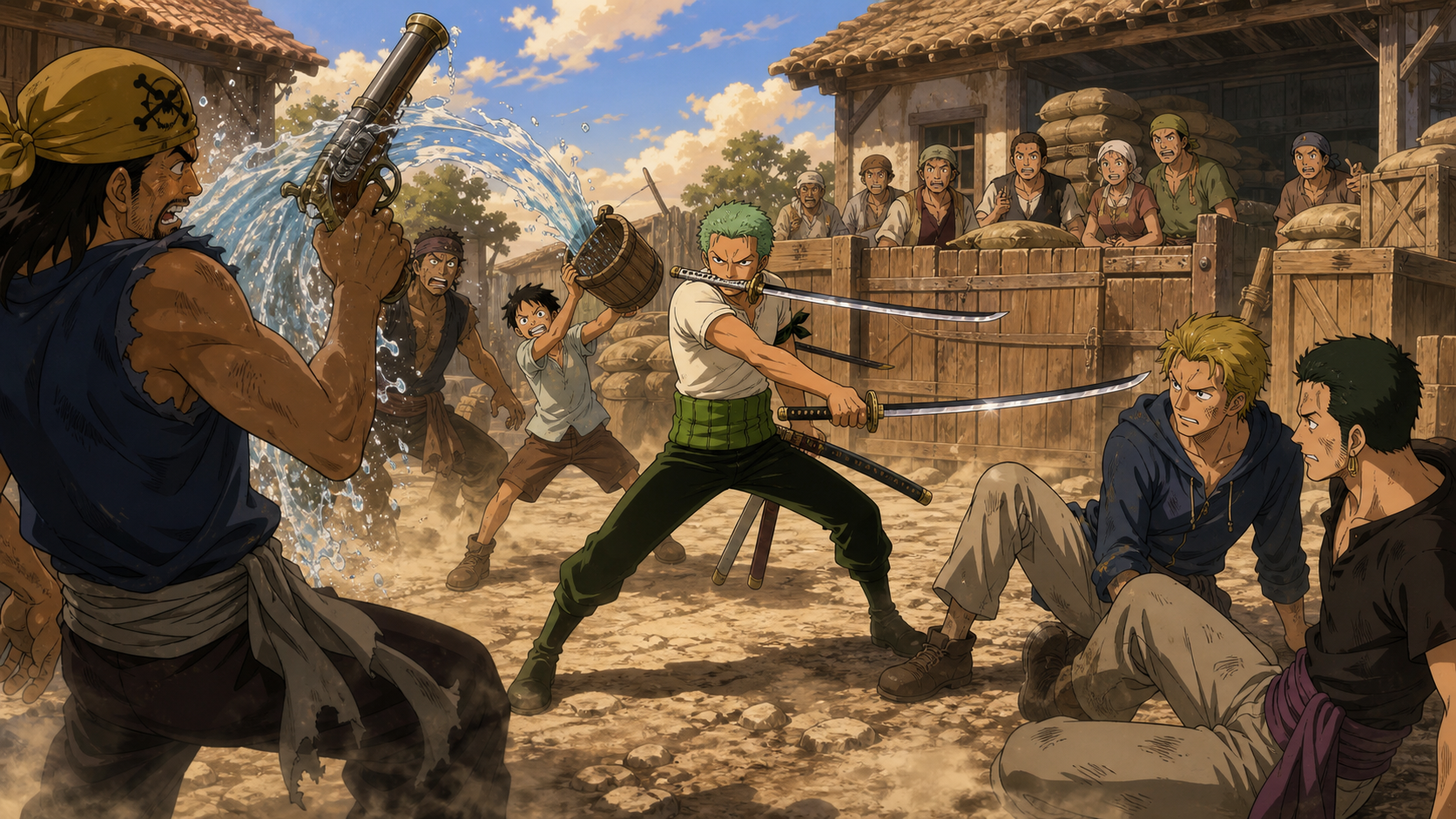
Zoro defeats the group because the raid is active and residents remain threatened. The legitimate purpose is stopping harm, disarming attackers, and creating safety. Revenge for Johnny and Yosaku cannot justify force after the danger ends.
Force should remain proportionate to the immediate threat. Surrendering, unconscious, or restrained people require medical assessment and lawful custody. Defenders should preserve weapons and witness accounts rather than staging a public beating.
Zoro’s efficiency matters because prolonged fighting increases risk to residents. The episode makes him frightening, but his best decision is not the number of opponents he can cut down. His best decision is placing skill between armed raiders and people who cannot safely resist.
Harry’s water bucket changes the final exchange
Harry throws water at the crucial moment and disrupts Dick’s gunshot, giving Zoro the opening to finish the fight. The contribution pays off the earlier lesson about finding an action within reach.
The result is emotionally satisfying, though the distance remains dangerous. A firearm can discharge unpredictably when struck, wet, dropped, or grabbed. Harry should have solid cover and an adult plan before approaching any armed scene.
Adults should praise his quick thinking without teaching that he must repeat the risk. Courage and luck are not safety systems. The town can honor his help while admitting that trained responders should have protected him sooner.
Johnny and Yosaku ask for partnership rather than ownership
After the fight, Johnny and Yosaku ask to travel with Zoro. They have seen both his power and the values underneath his distance. Their request begins the partnership that later brings them into the Straw Hats’ orbit.
Joining a wandering fighter requires informed consent about danger, travel, money, food, medical care, decision-making, and the right to leave. Gratitude after rescue can create pressure, so Zoro should make clear that repayment is not required.
Their bond works best when each person keeps agency. Calling Zoro a brother or leader cannot erase disagreement. Loyalty should make honest warnings easier, not silence them.
Robin’s jacket offer meets Zoro’s guarded history
In the present-day framing, Robin offers Zoro a jacket and the crew’s conversation brushes against his past. Zoro protects Wado Ichimonji and refuses the neat identity others assign him. He says that he never named himself the pirate hunter.
Robin’s offer is small, but care often arrives through ordinary practical gestures rather than interrogation. Zoro can accept or decline without owing a personal disclosure. Friendship does not create unlimited access to somebody’s history.
The crew should let him decide when to explain old wounds, old partners, and the origin of a public label. Curiosity becomes respectful when no remains a complete answer.
Episode 135 retires the solitary-warrior myth
Zoro begins the flashback hungry and alone, yet every meaningful outcome depends on relationship. Johnny and Yosaku find Billy, a swordsmith repairs Wado, villagers preserve supplies, Harry creates an opening, and Zoro brings the skill that stops the raid.
The wandering-swordsman image survives because Zoro does not advertise his needs. The episode quietly shows those needs anyway. He needs food, repair work, information, witnesses, and people willing to stand beside him.
RaeRae’s verdict: keep this one. Episode 135 gives Zoro’s famous label a necessary correction, lets Johnny and Yosaku recover the protective purpose beneath their swagger, and makes community defense more important than bounty money. The best swordsman in the yard is not the person who looks most alone. He is the person who knows exactly where to stand when armed power moves toward vulnerable people.