
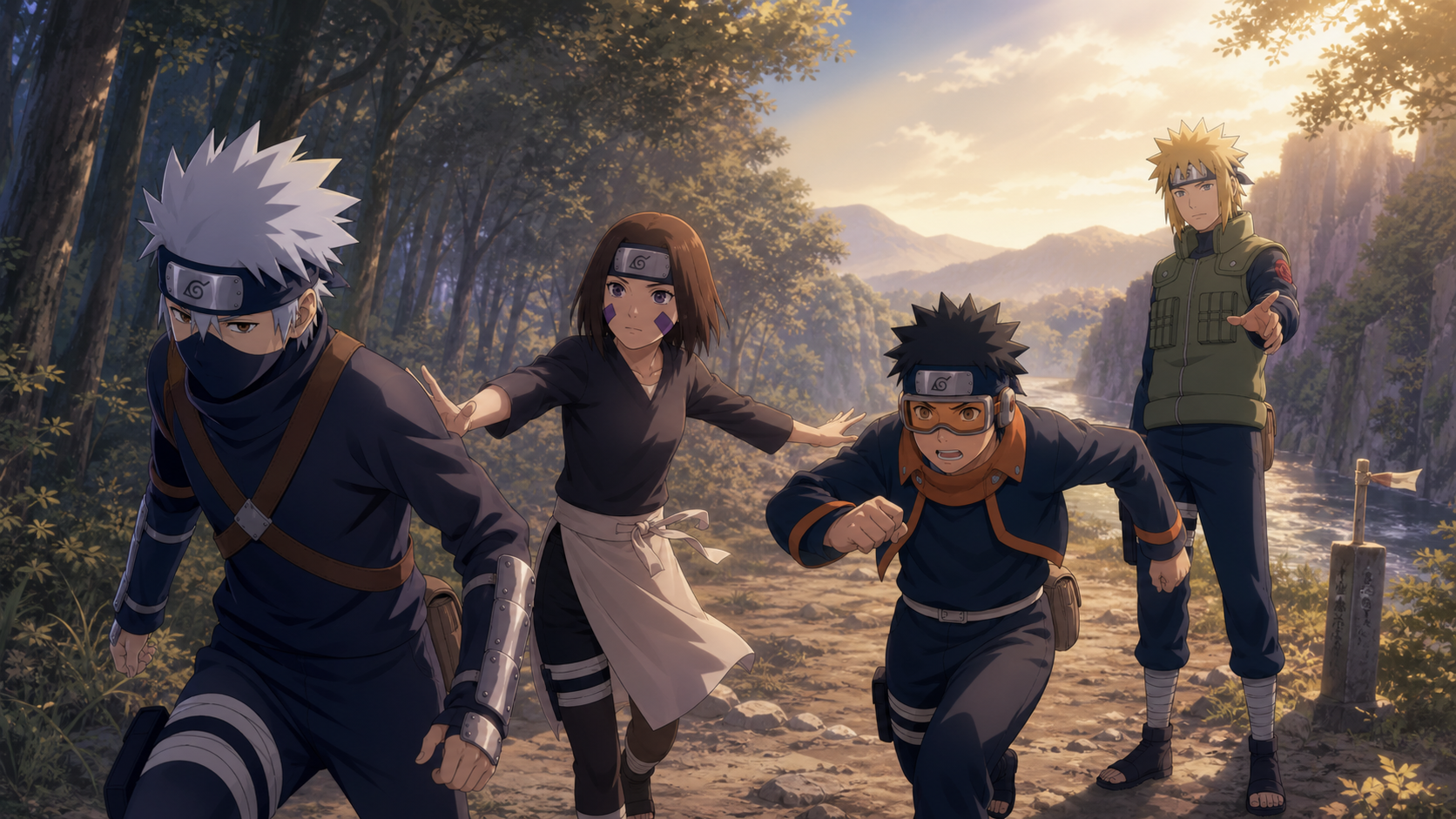
The Formation of Team Minato
Minato inherits three talented children who do not yet function as a family, and their first mission exposes how shallow the bell test’s cooperation remains.
Bottom line
“The Formation of Team Minato” returns to the children behind the photograph without pretending they began as a family. Hiruzen assigns Minato a specific problem: Kakashi is brilliant, disciplined, and increasingly willing to leave teammates behind if mission completion demands that choice. Obito already distrusts that reputation. Rin understands both boys better than either understands the other. Minato’s bell test gets them through one exercise, but the team’s first serious escort mission exposes how shallow that cooperation remains. Kakashi treats people as pieces in the fastest route to the objective. Obito rushes into danger without the skill to protect himself. Rin is repeatedly expected to keep moving while the boys define success around her. The episode is anime-original, yet the material belongs beside Episode 415 because adult Kakashi and Obito have just coordinated their paired Mangekyō to save Naruto. Their present teamwork did not come from instant compatibility. The flashback shows Minato trying to build trust before war, grief, and manipulation tear the team apart.
Episode 416 stays inside the Team Minato flashback
Episode 415 shifted from the Fourth Shinobi World War into Obito’s childhood near its closing section. Episode 416 continues that memory rather than returning to Naruto’s emergency.
The chronological pause should be explicit in publication.
This episode is anime-original
The team formation, bell test expansion, village errands, and escort mission are not a direct manga chapter adaptation. The story expands relationships established in manga canon.
Anime-original does not mean continuity-free.
Obito hears shinobi complain about Kakashi
Older ninja describe missions where Kakashi pursued the objective without protecting the people beside him. Their warning gives Obito a reason to distrust him before they share a team.
Reputation arrives before direct experience.
Kakashi’s efficiency has a human cost
His decisions look professionally correct when the mission is the only measurement. Teammates experience the same choices as abandonment.
Competence can still make a group unsafe.
Obito notices the contradiction
Kakashi speaks about rules and proper conduct, yet other shinobi describe a partner who will not slow down for anyone. Obito reads that gap as hypocrisy.
He does not yet know the grief underneath Kakashi’s rigidity.
Rin listens to Obito’s concern
She does not mock his anxiety or automatically defend the prodigy. Her attention gives Obito space to explain why the assignment worries him.
Rin performs emotional work before the team officially exists.
Obito attempts a conversation with Kakashi
The exchange fails because Kakashi offers reassurance without real access. Telling Obito not to worry does not address the fear that Kakashi may abandon a teammate.
Distance remains intact beneath polite words.
Obito trains in the rain
He wants enough skill to stand beside Kakashi without becoming disposable. The effort mixes rivalry, insecurity, and a sincere desire to improve.
His lateness should not be confused with lack of commitment.
Rin encourages the work nobody applauds
She sees Obito training when public results still favor Kakashi. Her support recognizes persistence without inventing success.
Encouragement does not erase the ability gap.
Hiruzen identifies Kakashi’s isolation as a leadership problem
The Third Hokage respects Kakashi’s talent but sees that technical excellence alone will not produce a healthy shinobi. A child who completes every assignment while losing every bond is not prepared to lead.
The village has responsibility for more than rankings.
Hiruzen asks Minato to teach Kakashi humanity
The assignment makes team composition intentional. Minato is not only distributing missions. He is expected to create conditions where Kakashi learns to value people alongside objectives.
Mentorship becomes part of operational readiness.
Kakashi’s behavior follows Sakumo’s death
Kakashi watched the village condemn his father for saving comrades at the cost of a mission. Sakumo’s suicide taught him that attachment could destroy a respected shinobi.
Rules become armor against the same judgment.
The episode should not diagnose a child as heartless
Kakashi’s cold decisions are harmful, but they grow from bereavement, fear, and institutional pressure. Explanation does not excuse abandonment.
Accurate criticism can hold both truths.
Obito misses his graduation ceremony
His habitual lateness undercuts an occasion he desperately wanted to reach. The failure is embarrassing because recognition matters so much to him.
Good intentions do not control the clock.
Rin recreates the ceremony for him
She brings Obito into the empty room, presents the certificate, and gives the milestone an audience. The gesture refuses to let one missed moment erase his achievement.
Care restores meaning without rewriting what happened.
Rin reveals that they share a team
Her news turns private encouragement into an ongoing partnership. Obito gains the person he trusts most, but he also gains the rival he fears.
Team Minato begins with unequal comfort.
Minato meets three students with different needs
Kakashi needs connection without being punished for grief. Obito needs discipline without losing generosity. Rin needs room to be a shinobi rather than only the mediator between boys.
A single lesson cannot serve all three identically.
The bell test introduces a familiar rule
Minato holds two bells for three students, creating apparent scarcity. Individual competition is the surface challenge.
Cooperation is the actual requirement.
Kakashi recognizes the test’s structure
He understands that nobody can take a bell from Minato alone. That tactical insight is real and useful.
Knowing teamwork is required is not the same as valuing teammates.
Kakashi uses Rin and Obito instrumentally
He coordinates their actions to create his own opening. The team reaches the goal, but his method still treats the other two as means rather than partners.
Successful tactics can conceal an unfinished lesson.
Minato passes the team
All three contributed to the outcome, so the formation survives its first test. Minato accepts the evidence of cooperation while continuing to watch how that cooperation functions.
Passing is a beginning, not certification of trust.
The bell test echoes Team 7
Kakashi later gives Naruto, Sasuke, and Sakura the same apparent choice between individual success and collective loyalty. His version carries memories of Minato’s lesson and his own failures.
Teaching becomes inherited experience.
The team begins with D-rank work
Their early assignments involve ordinary village needs rather than battlefield glory. Small tasks reveal patience, reliability, and relationships with civilians.
Rank does not determine whether character is visible.
Obito already helps elderly villagers
His familiarity with people he has assisted allows the team to complete errands efficiently. The habit that makes him late also creates local trust and knowledge.
Kindness has practical value.
Minato notices Obito’s community ties
He sees a strength that test scores and combat comparisons miss. Obito’s instinct to stop for another person is part of the Hokage ideal he wants to embody.
Leadership begins before authority.
Obito’s kindness still needs discipline
Helping people does not automatically make missed deadlines harmless. A shinobi responsible for several lives has to combine compassion with communication and timing.
The episode should not romanticize unreliability.
Team Minato exhausts the available D-rank missions
Their pace earns a more demanding assignment. The move into C-rank work tests whether success in controlled conditions can survive uncertainty.
Routine teamwork now meets real danger.
The C-rank mission is an escort
They must protect foreign shinobi carrying a missive. The objective includes both delivery and human safety.
Those duties soon appear to pull in different directions.
The escorted group contains hidden risk
Not everyone traveling under protection shares the same allegiance. Traitors inside the formation make simple perimeter defense insufficient.
Trust cannot be assigned by costume or paperwork.
Minato detects the surrounding enemies
His awareness prevents the first ambush from closing around the entire group. He divides the team so movement can continue while the pursuit is delayed.
Leadership becomes triage under incomplete information.
Minato keeps Obito with him
The choice gives Obito direct support against attackers and lets Minato observe how he responds under pressure. Kakashi and Rin continue with the escort.
The split is also a teaching decision.
Obito rushes beyond his control
His desire to prove usefulness pushes him into an attack he cannot safely finish. Courage without judgment increases the burden on everyone nearby.
Good motives still produce tactical danger.
Minato saves Obito from the counterattack
The rescue protects his student while demonstrating the gap between confidence and battlefield readiness. Minato does not humiliate him for needing help.
Correction arrives through survival.
Kakashi and Rin face a second pursuit
The division does not isolate all enemies with Minato. Another group catches the forward party and forces Kakashi to make the kind of decision Hiruzen feared.
The mission becomes a direct test of priorities.
Kakashi orders Rin to continue
He stays behind to delay attackers while sending Rin and the escorted shinobi toward the destination. The choice can protect the mission and reduce the number of exposed people.
Leadership depends on what he does when someone falls.
One escort is struck on the bridge
The wounded shinobi falls into the river during the attack. Recovering him would cost time and could expose the remaining group.
The human consequence of Kakashi’s doctrine becomes immediate.
Kakashi keeps the objective moving
His instinct favors the missive and destination over retrieving the fallen escort. The decision matches the reputation Obito heard at the beginning.
The episode turns rumor into observed behavior.
Rin has to carry the consequence forward
She cannot remain untouched by a teammate or escort disappearing behind her. Following orders may preserve the mission while leaving moral injury unresolved.
Obedience does not remove grief.
The apparent survivors near the destination are not all allies
Two members of the escorted party reveal themselves as traitors. Their plan depended on the protectors focusing on external pursuit.
The threat was traveling inside the objective.
The traitors attack their own comrade
They turn on the loyal messenger once isolation favors them. The missive and its carrier were never equally valuable to everyone in the group.
Mission language can hide incompatible intentions.
Rin and Kakashi are left without Minato’s immediate protection
The enemies believe distance has removed the Yellow Flash from the calculation. Kakashi’s earlier choices now meet a threat that cannot be solved by simply advancing faster.
The cliffhanger punishes overconfidence in control.
Kakashi has not yet learned Obito’s later rule
At Kannabi Bridge, Obito will insist that those who abandon comrades are worse than those who break rules. Episode 416 shows the behavior that makes that argument necessary.
The anime-original mission prepares a canon moral collision.
Rin should not be reduced to the team’s emotional service
She encourages Obito and understands Kakashi, but she is also a trained shinobi placed inside an armed escort crisis. Her judgment and vulnerability belong to the mission itself.
Editorial framing must keep her personhood visible.
Minato’s teaching is compassionate but incomplete
He recognizes each child’s pressure and builds exercises around teamwork. He cannot remove the village culture, war conditions, or private grief shaping them.
A good teacher still operates inside a damaging system.
The episode reframes adult Kakashi and Obito’s Kamui
Episode 415 showed perfect technical alignment under a survival deadline. Episode 416 reveals how unlikely that cooperation once seemed.
The present achievement gains weight from the failed beginnings.
The title describes construction rather than destiny
Putting names on a roster creates an assigned unit. Shared risk, correction, trust, and accountability create a functioning team.
Formation remains unfinished at the closing attack.
The final React should label the continuity honestly
Episode 416 is anime-original expansion within established Team Minato history. The article can discuss how the new mission supports later canon without claiming a manga chapter source.
Specific labeling protects reader trust.
The final React should not excuse Kakashi through tragedy
Sakumo’s death explains why rules feel safer than people. The escort’s fall still matters, and teammates still experience abandonment.
Context deepens responsibility rather than deleting responsibility.
Japanese performance requires direct listening
Any judgment about young Obito’s insecurity, Rin’s warmth, Kakashi’s detachment, Minato’s patience, or the traitors’ confidence requires lawful scene-level Japanese listening.
No invented vocal analysis belongs in publication.
Minato inherits a team already carrying adult failures
Kakashi arrives shaped by Sakumo’s death and a village culture that punished compassion. Obito arrives eager to prove himself while relying on impulsive rescue. Rin arrives expected to connect them.
Team formation cannot mean placing wounded children together and hoping proximity becomes healing. Minato owns responsibility for structure, boundaries, and follow-up.
Kakashi’s rule obedience is a survival strategy
He treats people instrumentally because rules promise predictability after grief made attachment feel dangerous and public judgment destroyed his father. That history explains the armor without excusing its consequences.
Teaching humanity requires more than telling Kakashi to care. Adults must show that care will not be punished again.
Obito’s kindness needs planning beside courage
He notices abandoned people, helps elders, and refuses indifference. Those instincts matter, but charging beyond Minato’s protection forces others to absorb preventable risk.
Compassion becomes reliable when Obito communicates, waits for formation, and chooses a rescue method the team can support.
Rin cannot be assigned permanent emotional mediation
She listens to Obito, encourages training, recreates his ceremony, treats injuries, and keeps responding to Kakashi’s distance. The team benefits from her relational skill before it names that labor.
Rin deserves her own goals, frustration, authority, and protection. Connection should be shared work rather than her gendered assignment.
The recreated graduation ceremony is community repair
Obito misses an institutional milestone, so Rin creates recognition outside the official room. She cannot restore every opportunity, but she refuses to let absence become proof that he did not belong.
The gesture matters because it answers neglect with witness. It should not make Rin solely responsible for repairing village systems.
The bell test exposes instrumental teamwork
Kakashi understands the mechanics and uses Rin and Obito as pieces in his route to success. Passing the stated objective does not prove the relationship is healthy.
Minato needs to explain why shared decision-making matters, then test whether each child can challenge a plan rather than merely occupy a role.
The escort mission reveals incompatible definitions of success
Kakashi prioritizes forward movement after an escort is struck, while Obito would likely stop and Rin must carry the consequence between them. Neither instinct can become automatic command.
A mission plan should establish protection thresholds, regrouping rules, medical authority, and what evidence permits abandoning the route.
Minato’s compassion remains incomplete without intervention
He sees Obito’s community ties and understands Kakashi’s isolation, yet insight alone does not redistribute the emotional burden. Rin continues absorbing conflict while both boys escalate familiar patterns.
A good teacher must make expectations explicit, practice repair after mistakes, and protect every student from becoming another’s lesson.
RaeRae’s verdict
“The Formation of Team Minato” works when read as an episode about incomplete teaching. Minato’s bell test proves that Kakashi, Obito, and Rin can coordinate. The D-rank assignments prove that Obito’s generosity has value beyond sentiment. Neither lesson guarantees that the children understand one another once an escort falls, attackers multiply, and hidden traitors reveal themselves. Teamwork is not the presence of three techniques in one plan. Teamwork is the decision that the people executing the plan remain part of the objective.
The episode also gives adult Obito’s declaration in Episode 415 a firmer foundation. The boy who wanted to become Hokage was inconsistent, late, reckless, kind, and willing to work until the rain covered him. Kakashi was not born emotionally unreachable. He was a grieving child praised for the same ruthless efficiency that frightened his peers. Rin was not a symbol waiting for tragedy. She was already holding space for two boys who could not name what they needed. Their team begins here, but the cliffhanger refuses a sentimental portrait. Formation means learning how not to leave one another behind, and this group has not learned that yet.
RaeRae’s call
Team Minato is formed from three children carrying needs that do not fit one bell-test speech. Kakashi uses rules to survive grief and public punishment. Obito turns care into action before he learns how to coordinate it. Rin performs the listening, encouragement, medicine, and community repair that keep both boys connected. Minato recognizes much of this, but recognition has to become adult intervention. Rin cannot remain the permanent mediator. Kakashi needs evidence that compassion will not be punished, and Obito needs a rescue practice that does not transfer risk. A team is not destiny created by assignment. It is shared authority, explicit boundaries, and repair repeated until nobody exists only to hold the others together.
Episode details and viewing routes
- Official episode reference: Naruto Official episode guide
- Licensed episode route: Crunchyroll season page exposing Episode 416
The tragedy makes these choices painful, but tragedy should not flatten the children into foreshadowing. Rin is a shinobi with judgment. Obito is woven into village life. Kakashi is a grieving child whose competence cannot substitute for care. Minato has time to build something better than the habits students brought into the room. Formation is not when names enter a roster. It is the decision to make each member safer, heard, and accountable.
What I am carrying forward
Hiruzen assigned Minato to lead Kakashi, Obito, and Rin partly because Kakashi’s mission-first behavior had begun alienating teammates. Minato used a bell test to teach cooperation, and the team passed even though Kakashi still treated the others instrumentally. Obito’s relationships with elderly villagers helped them complete their D-rank assignments, revealing practical strength in his kindness.
Their first C-rank escort mission split the team. Minato and Obito stayed behind against pursuers while Kakashi and Rin moved forward with foreign shinobi carrying a missive. One escort fell from a bridge, and Kakashi continued the objective. Near the destination, two apparent escorts revealed themselves as traitors and attacked their loyal companion, leaving Kakashi and Rin facing an internal threat. Episode 417 continues the anime-original mission before returning to the Fourth Shinobi World War.