
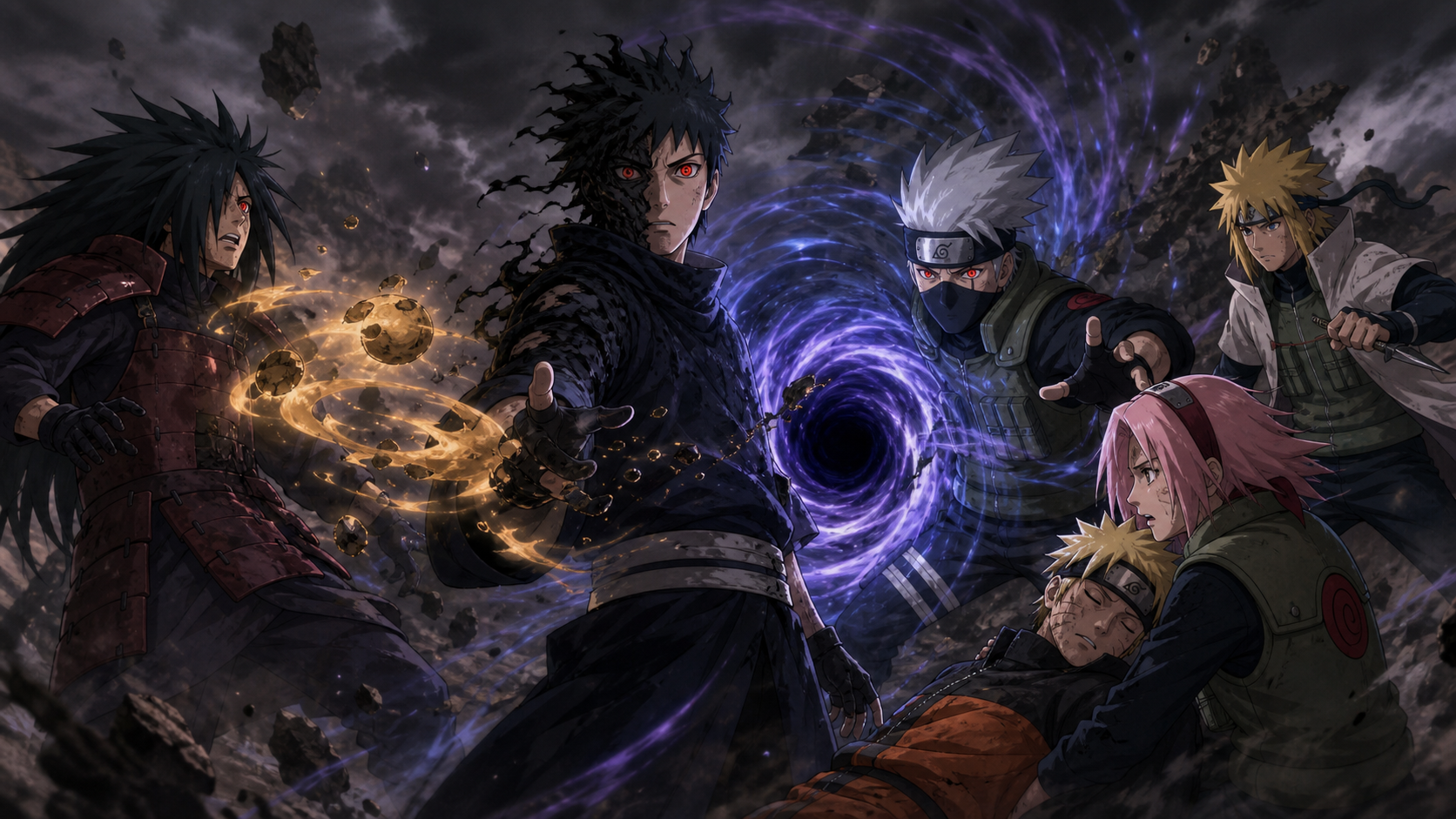
The Two Mangekyō
Obito refuses to disappear inside Madara’s name, then joins Kakashi’s matching eye to open the only space where Naruto’s rescue can continue.
Bottom line
“The Two Mangekyō” gives Obito one last chance to decide whether Madara’s name will swallow his own. Black Zetsu has intercepted Minato’s Yin half of Kurama, Naruto is still dying, and Madara expects Obito to surrender both the stolen chakra and the left Rinnegan. Obito appears to obey, but the approach is a feint. He drives his hand into Madara, pulls free fragments of the One-Tail and Eight-Tails’ chakra, and declares himself Obito Uchiha again: the boy who wanted to become Hokage, not the disposable extension Madara designed. Kakashi and Obito then use their paired Mangekyō Sharingan to accelerate Kamui, opening the only space where Sakura can receive the chakra Naruto needs without Madara immediately taking that power back. The episode’s manga-canon rescue reaches its turning point before the final section shifts into an anime-original Team Minato memory. That transition matters. The present does not pause for nostalgia. Obito’s recovered identity makes the past newly relevant, because Kakashi is fighting beside the teammate he lost rather than the mask that replaced him.
The crisis begins at the failed transfer
Episode 414 ended with Black Zetsu intercepting Yin-Kurama before Minato could seal that chakra into Naruto. Sakura has kept Naruto’s body viable, but the intended cure is now attached to Obito’s failing body.
The rescue has lost its cleanest route.
Black Zetsu believes Madara has already won
With its creator standing nearby, Black Zetsu expects to detach from Obito and deliver two prizes: Yin-Kurama and the left Rinnegan. Both would strengthen Madara while making Naruto’s survival less likely.
Obito is being treated as packaging for stolen power.
Obito prevents Black Zetsu from leaving
His body is nearly spent, yet his will still interrupts the parasite’s movement. The resistance does not remove Black Zetsu or restore full control.
His resistance creates a small delay inside a lethal process.
Obito asks Madara what he means to him
The question forces their relationship into plain language. Madara recruited, manipulated, and remade him after Rin’s death, but never regarded Obito as an equal successor.
The answer will determine whether any identity remains behind the mask.
Madara says Obito is Madara
Anyone who adopts the Eye of the Moon Plan can carry Madara’s identity, because the individual person is useful only as a vehicle for the same design. The claim sounds like inheritance while erasing the heir.
Obito is offered importance on the condition that he stop being himself.
The Eye of the Moon Plan cancels ordinary choice
Madara describes Infinite Tsukuyomi as an end to conflict, suffering, and the failed world created through chakra. His peace requires every person to accept a dream chosen from outside.
The promise removes disagreement by removing waking life.
Madara turns ninshū into an argument for control
The Sage of Six Paths intended chakra to connect people’s spiritual energy and help them understand one another. Madara points to ninjutsu and warfare as proof that humanity corrupted that inheritance.
His diagnosis of violence becomes permission for domination.
Understanding without freedom is not understanding
Infinite Tsukuyomi can simulate comfort, but its subjects cannot answer, reject, repair, or change the world together. Connection becomes a private illusion administered by one ruler.
The plan solves conflict by abolishing relationship.
Obito appears to approach Madara
He moves forward as though the speech has restored his loyalty. Black Zetsu remains attached, and the stolen Nine-Tails chakra seems close enough for Madara to claim.
The performance turns Madara’s certainty into an opening.
Minato attacks before the handoff
He uses a Rasengan in a desperate attempt to stop Madara and recover the chakra meant for Naruto. The attack comes from a father, a Hokage, and the shinobi responsible for the original Nine-Tails division.
Every part of Minato’s history enters the same motion.
Madara removes Minato’s remaining arm
The Ten-Tails’ jinchūriki overwhelms him and leaves the reanimated Fourth Hokage without either arm. Edo Tensei regeneration does not make the immediate loss tactically harmless.
Minato cannot perform the planned transfer by simply trying again.
Kakashi and Gaara cannot overpower Madara
Their coordinated intervention is necessary, but ordinary attack timing cannot match the power Madara now controls. Gaara also has to protect Naruto’s transport while Kakashi calculates around Kamui.
The battlefield gives each rescuer more than one impossible responsibility.
Obito remembers Naruto’s challenge
Naruto confronted the gap between the person Obito claimed to be and the Hokage he once wanted to become. Those words matter now because Madara offers the opposite answer: discard the self and resume the assigned role.
Identity becomes a choice expressed through action.
The Hokage does not walk over abandoned comrades
Obito recognizes that the path he followed treated Rin, Minato, Kakashi, Nagato, Konan, and countless shinobi as material for a future dream. Leadership cannot be built from bodies dismissed as necessary losses.
The correction arrives too late to erase harm, but not too late to oppose more harm.
Obito turns his hand against Madara
Instead of completing the delivery, he thrusts his arm into Madara’s body. The apparent surrender was a method for reaching the source of the tailed-beast power at close range.
His weakest physical position conceals his strongest decision.
Madara loses control of the encounter
He expected obedience because he believed Obito’s despair had become permanent. The rebellion exposes the flaw in reducing a person to a programmed continuation.
A tool with memory can refuse its intended use.
Obito extracts tailed-beast chakra fragments
He pulls a small amount of the One-Tail and Eight-Tails’ chakra from Madara. Naruto already carried traces from other tailed beasts, so these missing portions matter to the rescue and to what follows.
The fragments are small, but their completeness is strategically enormous.
Shukaku and Gyūki remain part of Naruto’s survival path
The One-Tail and Eight-Tails are not interchangeable batteries. Their chakra completes a wider network formed through Naruto’s earlier relationships with the tailed beasts.
What Madara hoards as power, Naruto receives through recognition.
Obito declares his own name
He identifies himself as Obito Uchiha, the person who wanted to become Hokage. The statement does not restore innocence or cancel responsibility for the war.
The declaration restores authorship over his next choice.
Redemption is not the same as absolution
Helping Naruto cannot repay every life damaged by Obito’s decisions. The episode is stronger when his turn is read as accountable action taken after catastrophic wrongdoing.
Repair begins without pretending the debt has disappeared.
Black Zetsu remains a danger inside Obito
The parasite still holds Yin-Kurama and can exploit any weakness in its host. Obito’s resistance is active work, not a permanent cure.
Every rescue step occurs under internal sabotage.
Madara attacks the moment Obito breaks away
He has no reason to preserve a subordinate who has rejected the assigned identity. The fight changes from retrieval to elimination.
Obito has made himself a target in order to become useful to Naruto.
Kamui becomes the necessary operating room
Naruto and Sakura cannot remain exposed beside Madara. The separate dimension offers a controlled space where Obito can transfer the captured chakra while Sakura continues treatment.
Space-time ninjutsu becomes medical logistics.
Kakashi targets Naruto and Sakura with Kamui
He must move both patient and medic together. Sending Naruto alone would interrupt the manual support keeping his body alive.
The transport plan respects the treatment chain.
Obito uses Kamui from the other eye
Kakashi carries Obito’s left Mangekyō, while Obito retains the right. Their techniques are parts of the same ocular ability and can work in coordination.
The title belongs to a shared system separated across two people.
The paired Mangekyō accelerate the transfer
Using both eyes on the same objective makes Kamui’s dimensional movement faster. Speed matters because Madara can interrupt a slow warp and because Naruto has almost no physiological time left.
The advantage is measured in survival seconds.
Kakashi and Obito cooperate without resolving everything
Their teamwork does not erase Rin’s death, Obito’s attack on Konoha, the Nine-Tails disaster, or the war. They align around the immediate fact that Naruto must live.
Shared action can precede a complete reckoning.
Sakura enters the Kamui dimension with Naruto
She remains beside the open-chest patient as the dimensional transfer completes. Her role is not passive cargo.
The entire operation exists to preserve her access to Naruto.
Obito follows with the chakra Naruto needs
He carries Yin-Kurama through Black Zetsu and holds the fragments taken from Madara. Reaching the dimension creates an opportunity to complete what Minato could not.
The cure is still a procedure, not a guarantee.
Gaara’s transport remains essential
Kamui could only become the next step because Gaara brought Naruto and Sakura to the correct battlefield position. His contribution does not end when another technique takes over.
Rescue chains should credit every handoff.
Minato has to trust his former students
Without his arms and with the original transfer interrupted, he cannot control the final route. Kakashi and Obito now carry the dimensional solution while Sakura carries Naruto’s body through the emergency.
The teacher’s greatest remaining act is trust.
The present-day section adapts chapters 665–666
The confrontation with Madara, Obito’s refusal, the chakra extraction, and the paired Kamui material come from “The Current Me” and “Two Mangekyō.” These chapters provide the episode’s manga-canon spine.
The publication should identify chapter coverage precisely.
Episode 415 is mixed canon and anime-original material
The main war sequence runs through roughly the first thirteen minutes after the opening material. The closing section begins an expanded Team Minato memory that is not a direct continuation of chapters 665–666.
Calling the whole episode canon would hide the adaptation boundary.
The flashback begins after Obito reclaims his identity
The structural placement is deliberate. Once the adult Obito names the child he used to be, the anime returns to that child’s rivalry, hope, and place on Minato’s team.
Memory answers a present-tense declaration.
Young Obito wants to become Hokage
His ambition predates the mask and Madara’s plan. He wants recognition, leadership, and Rin’s attention, often with more confidence than discipline.
The dream was sincere even when the young shinobi was immature.
Kakashi is Obito’s rival before he is his partner
Kakashi’s talent, rule-bound conduct, and early promotions make him the standard Obito resents. Their clashes expose insecurity on both sides.
Competition is the first language of a relationship that later defines Kamui.
Rin holds the team’s emotional center
She recognizes Obito’s effort and responds to Kakashi’s isolation without reducing either boy to a problem. Her presence shapes how they see one another.
The memory must not treat her only as a prize between rivals.
Sakumo’s death changes Kakashi’s position
Kakashi’s father died after choosing comrades over mission rules and being condemned for the failure that followed. Kakashi responds by clinging more tightly to procedure.
His coldness grows from grief and fear rather than effortless superiority.
Obito does not yet understand Kakashi’s rules
He sees arrogance and emotional distance without knowing the complete wound underneath them. The rivalry contains two children misreading each other’s survival strategies.
Their eventual teamwork requires more than becoming stronger.
Minato inherits a team already divided
He must guide a gifted prodigy, an impulsive latecomer, and a thoughtful mediator while war shapes their expectations. Assigning them together does not automatically create trust.
Team formation is a process rather than a photograph.
The flashback continues into Episode 416
Episode 415 opens the Team Minato recollection but does not complete its anime-original mission material. “The Formation of Team Minato” expands the group’s early attempts to work together.
The ending should be presented as a bridge, not a self-contained detour.
The title joins the past and present
The two Mangekyō exist because Obito gave Kakashi his eye after the Kannabi Bridge collapse. In the present, those separated eyes finally cooperate under their original owners’ shared intention.
The technique carries the team’s history inside every use.
Kakashi’s eye is never merely borrowed equipment
Obito’s gift shaped Kakashi’s fighting style, reputation, and understanding of comradeship. Coordinated Kamui turns that inheritance back into direct collaboration.
Power and relationship cannot be separated here.
Obito’s change answers Madara’s definition of inheritance
Madara treats succession as replacement: Obito matters by becoming another Madara. Kakashi carries Obito’s eye without becoming Obito.
One model erases the giver, while the other preserves connection between distinct people.
Naruto remains the reason the opening exists
The philosophical confrontation can dominate attention, but the immediate objective never changes. Naruto is dying inside Sakura’s hands.
Every speech and technique is measured against that clock.
Sakura’s medical work continues off the battlefield
Entering Kamui does not end cardiac support or replace the missing Nine-Tails chakra. She has gained protection from Madara, not a completed recovery.
The article should not announce Naruto as saved too early.
Obito has only a narrow chance to complete the transfer
Black Zetsu remains attached, his body is failing, and Madara controls overwhelming power outside the dimension. Delivering chakra demands sustained control under all three pressures.
Choosing correctly does not make execution easy.
Madara’s certainty is the episode’s tactical weakness
He correctly understands his superiority in force but misunderstands Obito’s remaining capacity to choose. That error gives the allied side the opening raw power could not create.
Contempt makes him briefly predictable.
The final React should keep the sequence exact
Black Zetsu intercepts Yin-Kurama first. Obito restrains the parasite, questions Madara, approaches under false surrender, extracts the One-Tail and Eight-Tails fragments, and coordinates Kamui with Kakashi to move Naruto and Sakura.
Reordering those beats would blur the rescue logic.
The final React should separate interpretation from fact
Obito’s rejection of identity erasure is supported by his question, declaration, and attack. Broader claims about redemption, inherited will, or leadership belong in analysis after the scene evidence.
RaeRae editorial voice stays strongest when judgment has receipts.
Japanese performance requires direct listening
Any claim about Madara’s contempt, Obito’s hesitation, Kakashi’s recognition, Minato’s panic, or Sakura’s exhaustion needs lawful scene-level Japanese listening. Plot summaries cannot establish vocal texture.
No invented performance analysis belongs in publication.
Reclaiming a name rejects Madara’s ownership claim
Madara tells Obito that identity belongs to the plan and its architect. Obito answers by declaring himself and redirecting the hand that appeared ready to submit.
The choice restores agency in the present. It does not erase the people harmed by earlier choices made under manipulation and belief.
Taking chakra back creates a rescue obligation
Obito extracts fragments connected to Shukaku and Gyūki because Naruto needs tailed-beast chakra to survive. The act matters through what he does next, not merely because it defies Madara.
Redemption becomes measurable when reclaimed power reaches the person whose life depends on it.
The paired Mangekyō form a route, not absolution
Kakashi and Obito combine Kamui across eyes separated by war, grief, and manipulation. Their synchronization accelerates access to the dimension where Sakura can continue treatment.
Cooperation proves they can act toward the same rescue objective. It does not settle responsibility, forgiveness, or the ownership history carried by Kakashi’s eye.
Every participant protects the handoff
Gaara delivers Naruto and Sakura, Minato creates the transfer opening, Kakashi targets the dimension, Obito carries needed chakra, and Sakura maintains life support. No single Mangekyō produces survival.
The rescue works as infrastructure assembled under attack. Each transition remains vulnerable to Madara and Black Zetsu.
RaeRae’s verdict
“The Two Mangekyō” succeeds because Obito’s refusal is both philosophical and operational. Saying his own name would mean little without immediately using that identity to oppose Madara, recover the missing tailed-beast chakra, and create a protected route for Naruto’s treatment. The episode does not ask us to forget what Obito has done. The story asks whether a person responsible for terrible choices still has an obligation to choose differently when one chance remains. His answer is action.
The paired Kamui gives that action emotional precision. Madara’s version of inheritance turns followers into copies, but Obito’s eye made Kakashi more fully himself. When the two Mangekyō work together, neither man disappears into the other. Their shared technique depends on separate people aligning around Naruto’s life. The anime-original flashback then earns its placement by returning to the unfinished formation of that bond. Episode 415 does not finish the rescue or the memory. Both become possible when Obito stops being Madara.
RaeRae’s call
Obito’s most important act is not simply turning on Madara. He rejects the claim that Madara owns his name, takes back tailed-beast chakra, and accepts the narrow responsibility of getting it to Naruto. Kakashi’s paired Kamui turns that choice into a rescue route while Sakura keeps the patient alive and Gaara’s transport remains part of the chain. Shared eyes do not produce automatic forgiveness. They carry Rin, violence, manipulation, trust, and years of consequences. Present cooperation matters because it protects a life now. Accountability still remains after the portal opens. Redemption is work performed toward repair, not a word that deletes the record.
Episode details and viewing routes
- Official episode reference: Naruto Official episode guide
- Licensed episode route: Crunchyroll licensed episode page
Two eyes open a route, while their owners retain histories, choices, and debts.
What I am carrying forward
Black Zetsu intercepted Minato’s Yin-Kurama and tried to deliver both that chakra and Obito’s left Rinnegan to Madara. Obito resisted, questioned what he meant to Madara, and rejected the answer that he existed only as another carrier of Madara’s identity and plan.
Obito pretended to approach in surrender, struck Madara, and recovered small portions of the One-Tail and Eight-Tails’ chakra. He declared himself Obito Uchiha again. Kakashi and Obito used their paired Mangekyō Sharingan to accelerate Kamui, moving Naruto and Sakura into the Kamui dimension so the chakra transfer could continue. The manga-canon material from chapters 665–666 gives way near the episode’s final section to an anime-original Team Minato flashback that continues in Episode 416.