
You’ll Be My Backup
The past proves a mission can be a decoy, while the present proves backup is the person who keeps the people beside that mission alive.
Bottom line
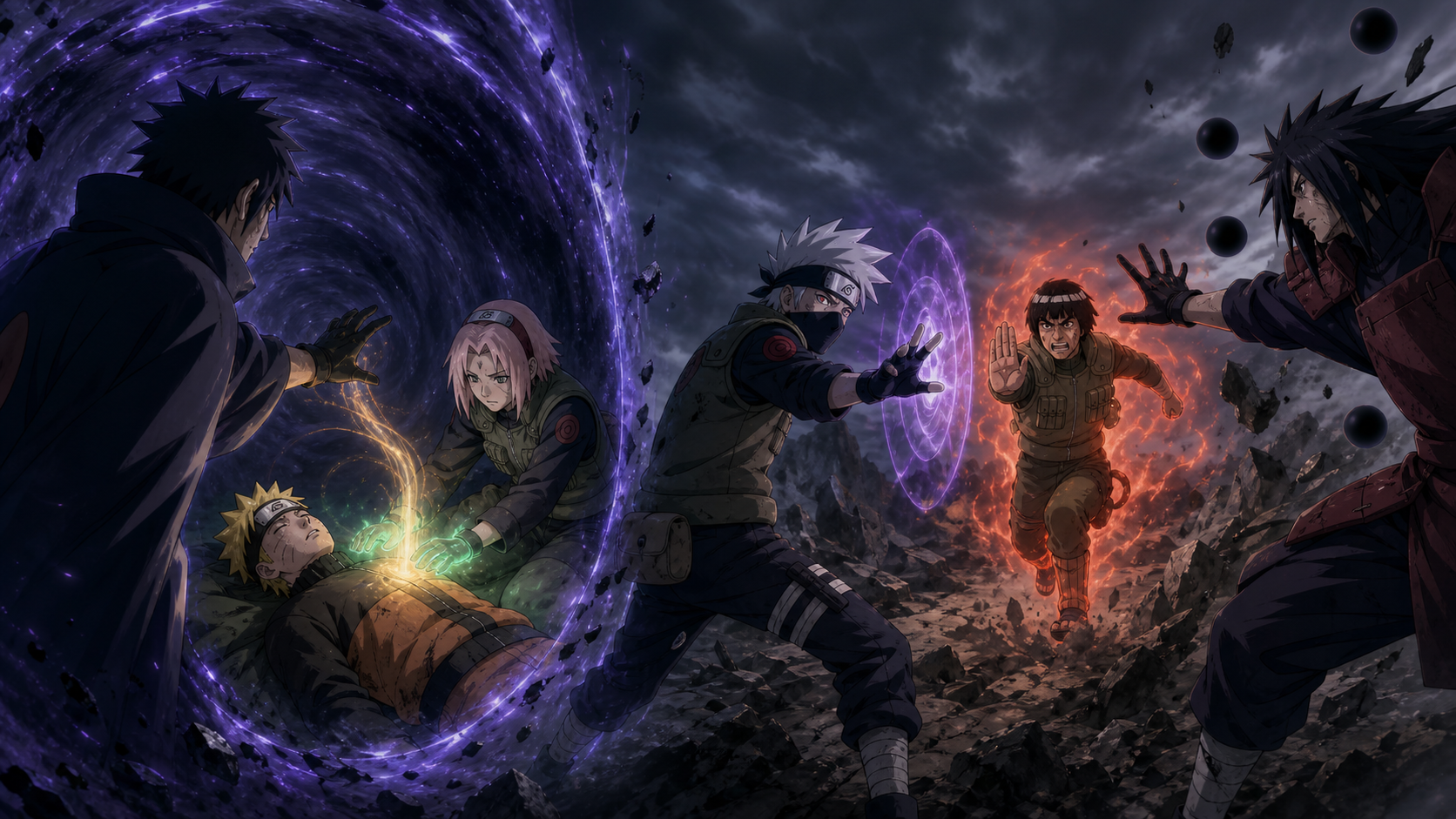
“You’ll Be My Backup” finishes the anime-original Team Minato mission by exposing the trap beneath its mission-first logic, then returns to chapter 666 and turns that lesson into Naruto’s survival route. Young Kakashi chases a stolen scroll because completing the assignment has become his nindō. Obito refuses to let him make that choice alone, signals Minato, and helps create the backup Kakashi never planned to need. The mission’s final revelation is merciless: Team Minato was a decoy, and every scroll they risked their lives to recover was fake. Protecting the people beside them was never secondary to the real objective because they never possessed the real objective. In the present, Madara attacks Kakashi and Obito with Truth-Seeking Balls. The paired Mangekyō lets Obito reach the Kamui dimension, where Sakura must decide whether the man responsible for the war can be trusted beside a dying Naruto. Obito does not ask for forgiveness. He begins transferring the tailed-beast chakra Naruto needs. Outside, Might Guy arrives as Kakashi’s backup and opens the next stage of the battle. The title crosses both timelines: backup is not lesser work. Backup is the person who keeps a mission from becoming a grave.
The episode begins inside the escort mission
Episode 416 ended after two members of the foreign escort party revealed themselves as traitors. Kakashi and Rin were isolated near the destination while Minato and Obito fought pursuers elsewhere.
The flashback resumes without returning to the war first.
Episode 417 has two continuity sources
Most of the runtime completes the anime-original Team Minato story. The closing present-day sequence returns to manga chapter 666.
The publication must label the episode mixed rather than forcing one status over the whole runtime.
Minato and Obito reach Kakashi and Rin
Their arrival prevents the traitors from controlling the immediate confrontation. Minato’s earlier division of the team did not become abandonment because he returned when the forward group needed support.
Backup closes the distance created by command.
One traitor escapes the first clash
The rescue does not settle the mission. An enemy remains mobile with knowledge of the team, the route, and the scroll arrangement.
Partial control can create false relief.
The surviving loyal escort questions the scroll
He knows that two scrolls were distributed because leadership suspected betrayal inside the group. The document carried forward may not contain the real information.
Security through uncertainty also confuses the protectors.
The first scroll is a decoy
Checking the document reveals no valuable intelligence. Kakashi’s decision to keep that scroll moving protected an object designed to attract attack.
Mission certainty collapses under one inspection.
The fallen escort may have carried the other scroll
The person left behind at the bridge becomes central again. If his scroll contains the data, saving him and recovering the objective point in the same direction.
The split between people and mission was built on incomplete information.
Obito leaves to find the missing escort
His first priority is the person who fell. He does not wait for proof that the scroll is genuine before treating the injured shinobi as worth recovering.
Compassion moves faster than certainty.
The others follow Obito’s decision
Minato, Rin, and Kakashi join the search even though the route changes and the mission’s structure remains unclear. Obito’s instinct becomes the team’s direction.
The least accomplished member can still identify the correct priority.
Enemy shinobi find the injured messenger first
The fall did not remove him from danger. Wounded and separated, he becomes an easy target for pursuers who believe he holds valuable information.
Leaving someone behind does not freeze that person outside the story.
Obito and Kakashi reach him in time
The two rivals intervene together before the attackers can finish the kill. Their cooperation protects the person whom the previous mission logic had written off.
Rescue becomes the first corrected objective.
The scroll is taken during the struggle
An enemy seizes the document and retreats. Saving the messenger does not automatically preserve the material they were assigned to guard.
The episode refuses an easy reward for making the humane choice.
Kakashi pursues the stolen scroll alone
He breaks from the group and follows the enemy because completion remains his personal code. The decision recreates the same isolation Hiruzen asked Minato to address.
Kakashi turns responsibility into solitude.
Kakashi calls mission completion his nindō
The word usually signals a chosen way of life, not a temporary tactic. For Kakashi, rules and objectives have become protection from the fate that consumed Sakumo.
His doctrine is grief made operational.
A child should not have to carry the mission alone
Kakashi’s talent makes adults and peers expect impossible self-sufficiency. His ability to act independently does not mean independence is safe.
Competence can hide a need for rescue.
Obito refuses to let Kakashi disappear
He does not agree with the solo pursuit, but disagreement does not become permission to abandon his teammate. Obito treats Kakashi as part of the mission even when Kakashi does not return the same trust.
Backup begins with refusal.
Obito signals Minato
Rather than charging after Kakashi without a plan, he alerts the strongest and most experienced person available. The choice shows growth from his reckless attack in Episode 416.
Calling for help is tactical judgment.
Minato reaches Kakashi before the trap closes
The Flying Thunder God allows him to cross the distance and intervene at the decisive moment. Speed succeeds because Obito supplied information and timing.
The rescue belongs to the signal as much as the arrival.
Minato defeats the pursuing group
His power resolves a fight the children could not safely finish. The intervention protects Kakashi without validating the choice to go alone.
Survival gives the lesson another chance.
Team Minato recovers the scroll
They return the document and believe the mission has reached its objective. People and material have both survived the immediate pursuit.
The apparent success still contains another withheld fact.
Both escorted scrolls were fake
Village leadership used Team Minato and the foreign group as visible decoys. A separate team carried the genuine intelligence by another route.
The children nearly died for an object designed to be stolen.
The decoy plan changes the moral accounting
Kakashi treated the scroll as more important than an injured person, yet leadership never entrusted him with the actual message. The only irreplaceable things in his custody were lives.
Mission-first thinking failed to identify the real stakes.
Deception may protect the intelligence without protecting the decoys
The security plan succeeds only by concentrating danger around people denied full information. Strategic effectiveness and ethical responsibility are separate questions.
The episode leaves that institutional cost visible.
Obito’s instinct was right for reasons he could not prove
He chose the fallen escort before learning that both scrolls were false. The later reveal confirms the value of his choice without turning compassion into a calculation.
People mattered before the evidence arrived.
Kakashi learns why backup matters
His solo pursuit would have ended in capture or death without Obito’s signal and Minato’s intervention. The objective survives because other people refuse his definition of self-reliance.
Dependence is not failure.
The title belongs first to young Obito
He cannot match Kakashi’s technique or Minato’s speed, but he can notice the danger, summon support, and refuse to leave. Backup describes responsibility rather than rank.
The role fits his Hokage instinct.
The flashback contains a Chidori continuity problem
Kakashi uses Chidori during this anime-original mission, although the manga establishes the team learning about that technique around the later Kannabi Bridge operation. The timing does not align cleanly.
The final React should acknowledge the inconsistency instead of inventing a repair.
The story returns to the Fourth Shinobi World War
After the decoy mission resolves, the episode cuts back to adult Kakashi, Obito, Madara, and Naruto’s rescue. This return occurs near the final portion of the runtime.
The transition ends the two-episode anime-original expansion.
Madara attacks with two Truth-Seeking Balls
He targets Kakashi and Obito while trying to reclaim the left Rinnegan and Yin-Kurama. The black orbs can erase ordinary defenses and destroy reanimated bodies beyond normal regeneration.
The rescue window is closing under Six Paths power.
Kakashi and Obito coordinate Kamui again
Their paired Mangekyō accelerate dimensional movement. The childhood mission showed Obito calling for backup; the present shows both men executing the same principle at the level of space-time ninjutsu.
Old intent becomes exact technique.
Obito reaches the Kamui dimension
Kakashi’s assistance gets him away from Madara and beside Sakura and Naruto. Crossing dimensions protects the transfer site but leaves Kakashi exposed outside.
One rescue creates another vulnerable position.
Sakura sees the architect of the war approach Naruto
She has every reason to distrust Obito. He attacked Konoha, manipulated the Akatsuki, helped start the war, and fought the Allied Shinobi Forces.
Urgency does not make suspicion irrational.
Obito asks for trust through a specific action
He does not offer a speech that erases history. He explains that he carries chakra Naruto needs and begins the transfer under Sakura’s watch.
Credibility has to come from verifiable help.
Sakura keeps control of the patient
Naruto remains under her direct medical care inside Kamui. Trusting Obito’s contribution does not require surrendering judgment or leaving Naruto unattended.
Cooperation can include safeguards.
Yin-Kurama is part of the transfer
Black Zetsu intercepted the Nine-Tails half Minato meant for Naruto, but Obito’s resistance keeps that chakra within reach. Delivering the complementary half can reverse the fatal extraction crisis.
The failed plan gains a new carrier.
The One-Tail and Eight-Tails fragments also matter
Obito extracted portions of Shukaku and Gyūki’s chakra from Madara in Episode 415. Naruto had already connected with the other tailed beasts.
The missing links complete a larger chakra network.
Obito begins transferring the tailed-beast chakra
The procedure moves the rescue beyond transport and temporary cardiac support. Naruto finally starts receiving the power his body needs to survive.
The episode ends before recovery can be taken for granted.
Black Zetsu remains attached during the rescue
Obito has not removed the parasitic will controlling part of his body. Every moment of the transfer requires continued resistance from a dying host.
The rescuer and the threat occupy the same body.
Obito’s help does not erase Sakura’s work
Sakura kept Naruto’s circulation and respiration going long enough for Gaara to reach Minato and for Kamui to create a protected space. The chakra transfer is possible because that earlier care never stopped.
Rescue remains a chain rather than a single miracle.
Gaara and Minato remain part of the same chain
Gaara identified Yin-Kurama as the survival route and transported Naruto. Minato attempted the first transfer and fought to protect the opening.
Later success does not replace earlier contribution.
Kakashi is left outside with Madara
Helping Obito enter Kamui separates the paired eyes and removes Kakashi’s nearest partner from the physical battlefield. Madara immediately exploits that exposure.
Backup has carried the patient away while the supporter remains behind.
Might Guy arrives before Madara can finish Kakashi
Guy intercepts the attack and places himself between his lifelong rival and the Ten-Tails’ jinchūriki. The entrance repeats the title in another relationship.
Kakashi’s backup has been running beside him for years.
Guy does not need Kakashi to ask
Their rivalry includes constant challenges and comic competition, but Guy understands the battlefield without requiring a confession of need. He arrives because Kakashi’s life is already part of his responsibility.
Recognition precedes permission.
The episode hands the battle to taijutsu
Madara’s Truth-Seeking Balls and Six Paths abilities neutralize many conventional ninjutsu options. Guy brings physical combat refined beyond ordinary human limits.
The next confrontation will measure the cost of opening every gate.
Episode 418 begins with the Blue Beast
Guy’s intervention is not a complete fight inside Episode 417. The closing beat establishes his decision to confront Six Paths Madara and protects Kakashi long enough for that battle to begin.
The publication should preserve the cliffhanger.
Chapter 666 supplies the present-day core
The coordinated Kamui, Obito’s entry into the dimension, the chakra transfer setup, and Guy’s arrival continue “Two Mangekyō.” The episode uses only part of that chapter after extensive anime-original material.
Chapter credit should be precise rather than broad.
The mixed structure is thematic, not random
Young Obito becomes Kakashi’s backup during a mission built on deception. Adult Kakashi becomes Obito’s backup during a rescue built on earned, limited trust. Guy then becomes Kakashi’s backup against Madara.
The same obligation crosses three relationships.
Backup does not mean staying behind
The title could sound like a secondary assignment. Every decisive turn comes from someone outside the apparent lead position: Obito signals Minato, Kakashi accelerates Kamui, Sakura maintains Naruto, and Guy intercepts Madara.
Support changes the outcome.
The decoy scroll exposes the danger of abstract objectives
Kakashi nearly sacrifices himself and another person for a mission symbol whose actual content is blank. Institutions can make objectives feel sacred while withholding the information needed to judge them.
Rules require moral interpretation.
Adult Kakashi has learned the lesson he once resisted
He does not demand proof that Obito deserves redemption before helping him reach Naruto. Kakashi evaluates the immediate action, coordinates the technique, and accepts personal exposure.
Trust becomes specific rather than naive.
Adult Obito has learned to request support
The child sent a signal after Kakashi ran ahead. The adult explicitly depends on Kakashi’s eye to complete the dimensional escape before Madara’s attack lands.
Cooperation replaces the mask’s solitary control.
Sakura’s trust should not be framed as instant forgiveness
She permits a necessary transfer while monitoring Naruto and Obito. Nothing in the scene resolves the deaths, manipulation, or war Obito caused.
Emergency cooperation and absolution are different acts.
The final React should preserve the episode order
The fake-scroll reveal completes the childhood thesis before the present-day attack begins. Kamui moves Obito first, the transfer begins inside the dimension, and Guy rescues Kakashi outside.
Sequence is the argument.
The final React should keep Rin active in the mission
Rin heals, assesses, follows command, and remains with the injured escort while the others pursue danger. She is not merely the person who inspires rivalry.
Medical and stabilizing labor belong in the account.
Japanese performance requires direct listening
Any claim about young Kakashi’s resolve, Obito’s urgency, Minato’s concern, Sakura’s suspicion, Obito’s remorse, or Guy’s confidence requires lawful scene-level Japanese listening.
No invented vocal analysis belongs in publication.
Backup is a relationship, not a position behind the hero
Young Obito refuses to let Kakashi disappear into solitary mission logic, signals Minato, and helps create a route back. Adult Kakashi then holds Kamui while Obito enters the dimension, Sakura maintains Naruto, and Guy interrupts Madara outside.
Each person protects work another person cannot complete alone. Backup is authored action with judgment.
Sakura grants operational trust, not instant forgiveness
Obito asks for access through a specific rescue action and carries chakra Naruto needs. Sakura can evaluate that request while retaining control of the patient and remembering the war he helped create.
Trust can be conditional and necessary. Cooperation now does not rewrite responsibility later.
RaeRae’s verdict
“You’ll Be My Backup” makes its anime-original mission earn the return to canon. The fake-scroll reveal is not a trick ending pasted onto a childhood adventure. The revelation destroys the assumption that mission material automatically outranks human life. Kakashi risked himself and nearly abandoned an injured escort for an object leadership had deliberately emptied. Obito could not prove the scroll was false. He only knew that leaving people behind was wrong, and his signal gave Minato enough information to save Kakashi from his own doctrine.
The present-day section turns that lesson into structure. Kakashi backs Obito’s Kamui escape. Sakura allows a monitored chakra transfer without pretending Obito’s history has vanished. Obito carries the power Naruto needs while fighting Black Zetsu from inside his own body. Guy arrives when Kakashi has spent his advantage on someone else’s rescue. Nobody stands at the center of every solution. That is the episode’s cleanest answer to Madara, whose plan reduces every person to an object inside one controlling dream. Real teamwork remains difficult because other people keep their own judgment, their own wounds, and their own right to answer back.
RaeRae’s call
Backup is the episode’s real nindō. Young Obito follows Kakashi, signals Minato, and refuses to let mission language turn a child into a disposable instrument. In the present, Obito carries Yin-Kurama and tailed-beast fragments into Kamui while Sakura protects Naruto’s body, Kakashi holds the route, and Guy keeps Madara from ending the chain outside. None of them is secondary. Sakura’s conditional trust enables one action without forgiving a war. Obito’s help matters without erasing responsibility. A rescue succeeds because people accept specific duties, communicate the handoff, and remain available when the person in front cannot see what is coming behind them.
Episode details and viewing routes
- Official episode reference: Naruto Official episode guide
- Licensed episode route: Crunchyroll licensed episode page
What I am carrying forward
Team Minato learned that both scrolls in their escort mission were decoys and another group carried the genuine intelligence. Obito chose to rescue the fallen messenger, then signaled Minato when Kakashi pursued a stolen scroll alone. Minato saved Kakashi and defeated the enemy group. The mission clarified that people, not the decoy objective, were the irreplaceable responsibility.
In the present, Madara attacked Kakashi and Obito with Truth-Seeking Balls. Their paired Mangekyō accelerated Kamui so Obito could enter the separate dimension. Sakura accepted his specific help while continuing to guard Naruto, and Obito began transferring Yin-Kurama plus the One-Tail and Eight-Tails chakra fragments. Outside Kamui, Might Guy arrived in time to protect Kakashi from Madara. Episode 418 begins Guy’s direct challenge against the Ten-Tails’ jinchūriki.