
The Hidden Plot Set Into Motion
Fūgi weaponizes the exam’s blind spot and Gaara’s responsibility, while Fū follows the same instinct to enter danger for people she barely knows.
Bottom line
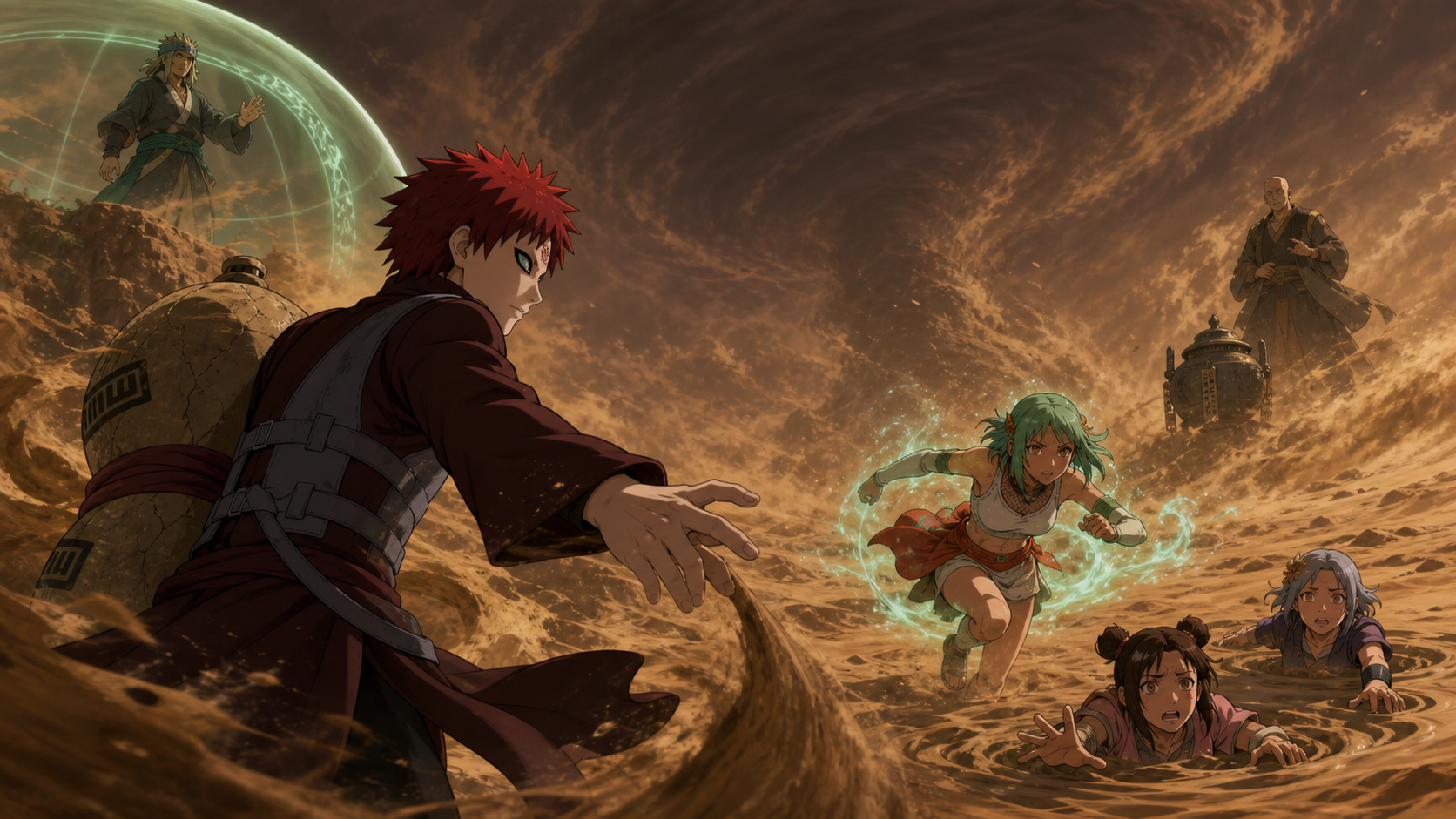
“The Hidden Plot Set Into Motion” turns Gaara’s best quality as Kazekage into the opening Fūgi and Hōichi need. The exam’s official sensing network should detect a dangerous desert event before candidates become trapped, but Fūgi overwrites that protection with a barrier and creates a massive sandstorm. Headquarters sees the disaster only after the normal warning system has already failed. Gaara can remain protected, delegate rescue, and preserve the village’s chain of command. He does the opposite because Matsuri, Yukata, Mikoshi, and dozens of other genin are his responsibility. Fūgi planned around that answer. Hōichi waits in the storm with a sealing method designed to extract Shukaku into a tea kettle, killing Gaara while disguising the assassination as an exam casualty. Fū provides the episode’s moral counterweight. Her desire to make friends frustrates Yōrō and Kegon because their team already has both scrolls, yet that same instinct pulls her toward endangered strangers instead of the tower. Two jinchūriki move into danger for other people while adults around them treat their tailed beasts as village property. The plot works because the conspirators understand institutional duty but fail to understand solidarity between people who know what being used feels like.
Gaara watches through the Third Eye
The Kazekage uses a remote sand eye to observe candidates across the Demon Desert. His supervision supplements the official exam network.
Personal vigilance exists because systems can miss human danger.
The exam is also Gaara’s political project
Joint participation with Konoha is meant to strengthen alliances and expose threats inside the Sand. Success matters beyond promotion results.
The test carries village-level consequences.
Fū’s team already has both scrolls
Fū, Yōrō, and Kegon can head directly to the central building. Their qualification path is open.
Every delay now adds risk without adding an exam requirement.
Yōrō and Kegon want the tower
They remember their mission to bring recognition to the Hidden Waterfall and want a strong completion time. Their priorities are disciplined and understandable.
Team success can still conflict with one member’s emotional need.
Fū wants to make friends first
She treats the Chūnin Exams as a rare gathering of peers rather than only a competitive filter. The chance for connection matters more than a record.
Loneliness changes how opportunity is measured.
Her teammates invoke Shibuki
Mentioning the Waterfall leader redirects Fū toward village duty. She cares about disappointing the person who trusted the team.
Belonging can motivate more effectively than command.
Fū remains difficult to steer
Agreement does not erase her curiosity or social impulse. Yōrō and Kegon can remind her of the mission but cannot turn her into a purely obedient candidate.
Her unpredictability is personality, not incompetence.
Gaara notices Matsuri’s team
Matsuri, Yukata, and Mikoshi are moving through the desert toward the tower. Gaara’s attention carries a personal layer because Matsuri trained under him.
Leadership does not require emotional distance.
Mikoshi proposes a scroll plan
The Sand trio still needs the compatible objective and considers how to obtain one during the final approach. Exam pressure remains active before the larger emergency begins.
Ordinary strategy continues beneath the conspiracy.
Matsuri’s training shapes her restraint
She has learned from Gaara that strength and rank require judgment. Taking a scroll should come through a defensible encounter, not panic or exploitation.
Mentorship travels into decisions the teacher cannot hear.
Hōichi observes the candidates
The monk or priest operates inside the desert as part of the assassination plan. Matsuri’s group becomes useful bait because Gaara is watching.
Candidate vulnerability is converted into political leverage.
Fūgi enters the Demon Desert covertly
The Sand jōnin bypasses the safeguards surrounding the exam area. His rank and local knowledge make infiltration easier than an outsider attack.
Institutional threats often carry valid credentials.
The episode remains anime-original
Fūgi, Hōichi, the Shukaku tea-kettle plot, and this second Chūnin Exam conspiracy belong to adaptation-only material. The final React must label that status.
Continuity accuracy prevents invented manga history.
Fūgi opposes Gaara’s leadership
He represents a faction that distrusts or rejects the young Fifth Kazekage. Political resistance hardens into a plan for murder.
Disagreement becomes treason when removal requires a staged death.
Hōichi supplies the extraction method
His sealing practice can pull Shukaku from Gaara and bind the tailed beast elsewhere. Fūgi provides access and institutional sabotage.
The conspiracy combines insider reach with specialist technique.
The tea kettle recalls Shukaku’s history
The One-Tail has previously been sealed in a vessel associated with Sand tradition. The plan treats an old method as proof that Gaara can be replaced.
Historical precedent becomes a weapon against a living host.
Extraction requires Gaara’s death
Removing a tailed beast from a jinchūriki is not a clean transfer. The conspirators accept Gaara’s death as the price of reclaiming Shukaku.
Village utility is placed above the Kazekage’s personhood.
The exam offers plausible deniability
The Demon Desert already contains lethal terrain, dangerous creatures, and unsupervised combat. A death inside a sandstorm can be presented as an accident.
Known risk provides cover for engineered risk.
Fūgi attacks the sensing system first
He does not begin by confronting Gaara. He creates a barrier that interferes with or overwrites the Sand’s long-range surveillance.
Blinding responders is the first stage of isolation.
The village barrier accepts false normality
Headquarters fails to detect the building storm at the expected distance. The protection layer reports absence rather than warning.
Compromised monitoring is more dangerous than no monitoring when confidence remains.
The massive sandstorm forms rapidly
Wind and sand grow beyond ordinary exam conditions. Visibility, breathing, navigation, and stable footing collapse across the field.
One technique transforms the entire second stage.
Candidates cannot distinguish sabotage from weather
Most genin know the Demon Desert is naturally deadly. The storm’s plausible environmental form delays recognition of an attacker.
Camouflage can operate at disaster scale.
Headquarters notices too late
Sensors and officials recognize the storm after the threat is already developed. Their confusion reveals that the expected early-warning process failed.
Detection without lead time is damage reporting.
Kankurō and Temari mobilize
Gaara’s siblings move to protect candidates and restore control. Their response expands beyond family concern because they hold village responsibility.
Emergency leadership needs more than the Kazekage.
The second exam is postponed
Officials suspend competitive objectives and direct participants toward shelters. Survival supersedes scroll collection and completion time.
Rules must change when organizers lose environmental control.
Rescue orders face communication failure
The same storm and barrier that created the emergency also disrupt messages, location data, and safe routes. Declaring evacuation does not guarantee candidates receive help.
Operational orders need delivery channels.
Matsuri’s team enters the worst zone
Their route places them near unstable sand as the storm intensifies. The conspirators gain the vulnerable group most likely to draw Gaara out.
Bait works because the danger is real.
Quicksand captures the three genin
Matsuri, Yukata, and Mikoshi lose stable footing and begin sinking. Struggling against wind and sand makes self-extraction harder.
Terrain becomes the assassination plan’s restraint system.
Fū encounters the trapped team
Her social detour brings her near candidates who need immediate aid. The choice that looked inefficient now creates a rescue opportunity.
Human curiosity defeats the safest route for the right reason.
Fū tries to help before negotiating
She does not demand a scroll or alliance in exchange for rescue. The endangered people become potential friends because they are people first.
Connection begins through action.
Fū offers a scroll
Her team has both required objectives, yet she is willing to give one away to build friendship or help another team. The offer horrifies teammates focused on qualification.
Generosity can become irresponsible when shared resources are not hers alone.
Matsuri refuses the gift
She does not accept promotion progress without earning the scroll under the exam’s terms. Gaara’s training shapes her answer.
Integrity survives desperation.
The refusal earns Fū’s respect
Fū wants friends who meet her openly, and Matsuri’s boundary gives the relationship a stronger foundation than a purchased alliance.
Saying no can establish trust.
Gaara sees the danger
His Third Eye or surveillance awareness reveals Matsuri’s team inside the storm. Candidate rescue becomes immediate rather than abstract.
Personal observation defeats part of the blinded network.
Advisers warn Gaara not to leave
The Kazekage is the most valuable target in the village and should not enter an unexplained barrier alone. Delegation would preserve command continuity.
Security doctrine has legitimate reasons.
Gaara cannot ignore trapped candidates
He helped design and oversee the exam. Remaining safe while genin die inside a compromised system would violate his understanding of leadership.
Responsibility pulls him toward the field.
Matsuri makes the duty personal
Gaara trained her, knows her character, and sees the specific person behind the generic category of participant. That bond accelerates his decision.
Institutions become real through names.
Fūgi predicted Gaara’s response
The conspirator understands that Gaara will choose rescue over self-protection. The trap depends on moral consistency, not careless stupidity.
Good character can be modeled by an enemy.
Gaara enters the storm
He leaves the safer command position and moves toward Matsuri’s team. The action narrows distance between Hōichi and the intended target.
Rescue and ambush now occupy the same route.
Fū and Gaara share jinchūriki experience
Both carry tailed beasts and village expectations, though neither has yet developed the later relationship readers know. Their meeting creates recognition without requiring immediate disclosure.
Parallel isolation makes rapid understanding plausible.
Gaara has changed how he uses power
The child who once treated others as proof of his existence now deploys sand to protect candidates under his authority. Leadership has redirected the same ability.
Growth appears in who receives protection.
Fū’s friendliness is also resistance
Villages may define jinchūriki by strategic value, but Fū keeps insisting on ordinary peer connection. Her behavior rejects the isolation that makes hosts easier to use.
Joy can oppose institutional control.
Hōichi waits for isolation
The sealing specialist does not need to defeat the Sand’s full defense force. He needs Gaara separated inside the barrier long enough to establish the chain.
The storm is a delivery mechanism for the target.
The sensing failure raises governance questions
An exam advertised as supervised relies on one barrier vulnerable to an insider override. Independent verification and local patrols should have detected inconsistent storm data sooner.
Safety systems need different failure modes.
Gaara’s personal surveillance is not enough
The Third Eye can observe selected areas, but one leader cannot watch every candidate across a vast desert. Heroic vigilance cannot replace resilient infrastructure.
Centralized attention creates blind spots.
Temari and Kankurō need authority to act independently
If Gaara enters the field, remaining leaders must manage evacuation, investigation, and village defense without waiting for new orders.
Succession planning matters during rescue.
Fūgi abuses trust from inside
His knowledge of sensors, barriers, terrain, and Gaara’s habits comes from service to the Sand. The attack uses institutional intimacy against the institution.
Insider security requires behavioral accountability.
The tea-kettle plan repeats objectification
Gaara is treated as a container to be emptied, while Shukaku is treated as a weapon to be reassigned. Neither consciousness matters to the conspirators.
Sealing language can hide violence against two beings.
The final React should separate the two storms
Team Saya’s localized sandstorm in Episode 409 and Fūgi’s massive barrier-driven disaster are different techniques with different purposes and scale.
Accurate continuity needs caster and scope.
The final React should protect future chronology
Fū and Gaara’s later fates are relevant to readers but not knowledge held by these characters during the exam. Future context should be clearly marked and spoiler-aware.
Retrospective analysis must not rewrite present motives.
Japanese performance requires direct evidence
Claims about Fū’s playfulness, Matsuri’s resolve, Gaara’s urgency, Temari’s alarm, Kankurō’s command, or Fūgi’s calculation require lawful scene-level Japanese listening.
No invented vocal analysis belongs in publication.
Fūgi attacks governance before he attacks Gaara
He exploits trusted access, falsifies normal conditions, and shapes a disaster that appears environmental. The assassination plan depends on institutions accepting their own instruments without independent verification.
Insider sabotage succeeds when authority and information remain concentrated. Suna needs checks that do not collapse because one official understands the system.
The exam is Gaara’s project and the village’s duty
Gaara created the joint exam to build cooperation, but responsibility cannot rest on his personal Third Eye. Organizers, medics, sensory teams, proctors, and commanders share obligations to every candidate.
A public institution should keep protecting people when its leader becomes the target.
The false storm weaponizes plausible deniability
Candidates expect severe desert weather, so sabotage can hide inside ordinary danger. By the time headquarters recognizes the pattern, teams have already interpreted it as another obstacle they must survive alone.
Emergency protocols need thresholds based on impact, not certainty about cause. Rescue should begin before investigators prove intent.
Postponement requires communication that reaches the field
Declaring the exam paused at headquarters does not protect candidates who cannot hear the order. The storm breaks routes, visibility, and sensing while young shinobi continue pursuing scrolls.
Redundant signals, shelters, mapped extraction zones, and roaming response teams should carry the decision beyond the command room.
Temari and Kankurō need delegated authority
They recognize danger and mobilize, but a resilient system should not make them wait for Gaara to approve every response. His likely isolation was part of Fūgi’s design.
Clear succession and emergency powers let siblings act as officers rather than anxious witnesses to a leader’s personal risk.
Gaara’s rescue instinct is predictable because it is ethical
Fūgi knows Gaara will not leave trapped genin inside a manufactured storm. Exploiting that duty does not make the duty foolish.
The answer is escort, shared surveillance, and coordinated rescue capacity. Leaders should not have to choose between abandoning people and entering a trap alone.
Fū’s friendliness refuses the role assigned to her
Her teammates want the tower, while Fū wants contact with other candidates. That desire may be impulsive, yet it also rejects the isolation imposed on jinchūriki.
She seeks relationships before institutions can reduce everyone to village assets and scroll competitors. Friendship becomes resistance to managed loneliness.
The scroll offer reveals generosity and uneven judgment
Fū offers Matsuri’s team what they need because rescue and connection matter more to her than advantage. Matsuri refuses because accepting would compromise her own team’s path.
Both choices can carry dignity. Consent lets generosity remain a gift rather than pressure disguised as kindness.
The tea kettle repeats the oldest objectification
Hōichi’s vessel and extraction method treat tailed beasts as transferable power and their hosts as disposable containers. Gaara’s death is not collateral; it is built into the plan.
Fū faces the same logic even when conspirators describe her differently. Their personhood disappears beneath resource language.
Personal surveillance cannot replace accountable systems
Gaara’s Third Eye lets him notice Matsuri, but it cannot cover every candidate, verify every signal, or protect the watcher from manipulation. Exceptional power creates reach without institutional resilience.
The village must document decisions, distribute information, and allow independent challenge when normal readings contradict visible harm.
RaeRae’s verdict
“The Hidden Plot Set Into Motion” succeeds because the conspiracy attacks trust before attacking Gaara. Fūgi corrupts the sensing barrier, allowing headquarters to believe the desert remains observable until the storm is already overwhelming candidates. Hōichi’s extraction method then waits behind the rescue emergency. The plot does not depend on Gaara forgetting security. The plot depends on him refusing to let genin die for his protection.
Fū complicates that manipulation in the best way. Her refusal to rush toward the tower frustrates her teammates, and offering away a shared scroll is hardly disciplined strategy. Yet her hunger for friendship places another jinchūriki beside Matsuri’s team when the official system fails. Matsuri’s refusal to accept an unearned scroll turns the encounter into mutual respect rather than charity. By the time Gaara enters the storm, the conspirators have isolated their target, but they have also brought together people who resist the logic behind the plan: no person should be reduced to the beast or resource carried inside.
RaeRae’s call
Fūgi’s plot works because it attacks Suna’s trust in its own systems, then exploits the certainty that Gaara will rescue endangered genin. That rescue duty is not the flaw. Concentrating surveillance, authority, and moral risk in Gaara is. Temari and Kankurō need independent emergency power, candidates need redundant warnings, and intervention must begin before sabotage is proven. Fū and Gaara meet inside another plan that treats jinchūriki as containers whose lives can be traded for power. Their answer is not identical, but both insist on relationship and duty where conspirators see assets. Protect the candidates, isolate the insider threat, and stop making Gaara’s decency the only functioning safety system.
Episode details and viewing routes
- Official episode reference: Naruto Official episode guide
- Licensed episode route: Crunchyroll licensed episode page
The trap exposes the cost of admiration without infrastructure. Gaara will act, so his courage replaces planning. A village would honor that courage by making it unnecessary for him to enter alone. Rescue teams should be moving, authority should be distributed, and every candidate should have a route toward help.
What I am carrying forward
Fū, Yōrō, and Kegon possess both scrolls, but Fū delayed their tower run because she wanted friends. She encountered Matsuri, Yukata, and Mikoshi as their team became trapped in quicksand and tried to help them. Matsuri refused Fū’s offer of a scroll she had not earned.
Fūgi infiltrated the Demon Desert, overwrote the Sand’s sensing barrier, and created a massive sandstorm. He and Hōichi intend to isolate Gaara, extract Shukaku into a tea kettle, and disguise Gaara’s death as an exam casualty. Headquarters postponed the exam and began evacuation. Gaara ignored warnings to remain protected and entered the storm to rescue Matsuri’s team. Episode 411 begins Hōichi’s direct attack.