
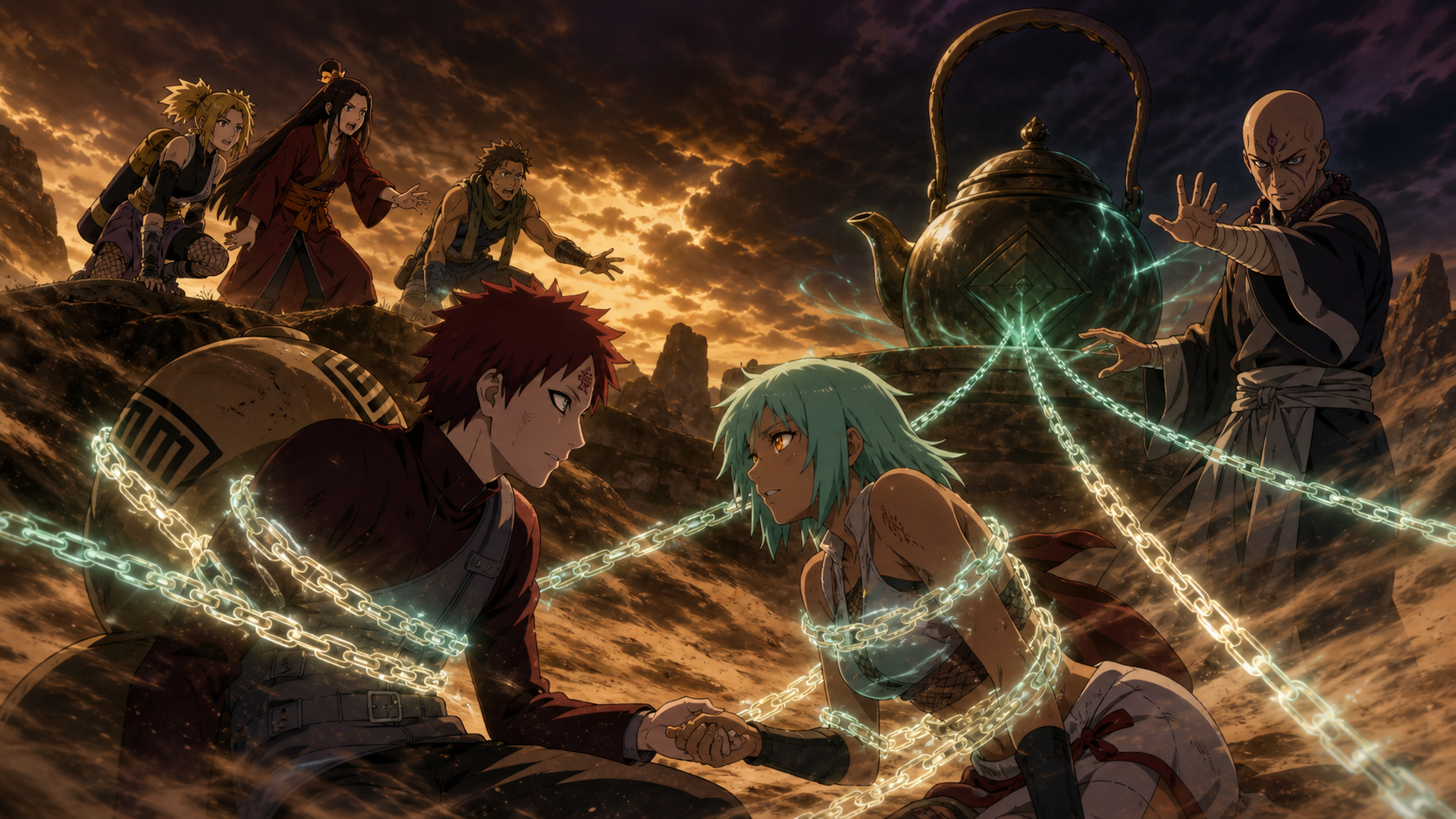
The Targeted Tailed Beast
Fū meets the Kazekage Naruto helped create before Hōichi’s sealing system tries to erase both jinchūriki as people and keep only their beasts.
Bottom line
“The Targeted Tailed Beast” lets Fū meet the person Gaara became before Hōichi tries to erase both of them as people. Fū abandons exam speed to pull Matsuri, Yukata, and Mikoshi from quicksand, treats their injuries, and offers connection without demanding anything back. Gaara recognizes Naruto in her almost immediately: the loud openness, the hunger for friends, and the willingness to run toward strangers in danger. That comparison matters because Naruto helped Gaara imagine a life beyond being a weapon. Hōichi’s sealing chain represents the old definition returning with force. Gaara is not the Kazekage, a teacher, or the man who came to rescue his students. He is the container holding Shukaku. Fū is not the genin who just saved three people. She is the container holding Chōmei. When Fū senses Gaara’s extraction and runs back to help, Hōichi captures her too. The same empathy that brings two jinchūriki together also gives the extractor a second target. Their rescue now depends on people who can see past the beasts: Matsuri seeking help, Team Guy answering, and Neji preparing to read a sealing system designed to turn two lives into village assets.
The massive sandstorm continues
Fūgi’s barrier-driven storm still blocks visibility, navigation, and long-range sensing across the Demon Desert. Candidates and rescuers operate with incomplete information.
The conspiracy keeps every response fragmented.
Exam officials accept the postponement
Asuma, Kurenai, Guy, and Sand personnel recognize that ordinary competition cannot continue. Shelter and recovery replace scroll rules.
Suspending the exam is the minimum responsible decision.
Kankurō and Temari rescue candidates
Gaara’s siblings lead field operations while Sand teams search for stranded genin. Their work prevents the Kazekage’s absence from becoming total command failure.
Distributed leadership saves lives.
Many teams collapse from exhaustion
The storm punishes candidates already depleted by fights, heat, and limited supplies. Strong techniques cannot compensate for an empty body.
The exam’s accumulated costs become emergency variables.
Team Guy creates shelter
Neji, Lee, and Tenten use their different abilities to protect themselves from wind and sand. Their formation preserves enough strength for the later rescue.
Survival begins before heroic intervention.
Matsuri’s team remains trapped
Mikoshi falls into quicksand, and Matsuri and Yukata are pulled into danger while trying to help. Their loyalty prevents abandonment but expands the number needing rescue.
Uncoordinated aid can spread the emergency.
Fū hears their calls
Her detour in search of friends places her within range. She responds before knowing whether the Sand candidates can benefit her exam.
Connection begins with attention.
Shibuki’s example returns to Fū
She remembers the leader who gave her trust and belonging in the Hidden Waterfall. That relationship shapes how she responds to strangers.
Received care becomes care offered forward.
Fū uses Blue Joro Spider
Her technique creates a means to catch or pull the sinking candidates from the quicksand. The jutsu turns chakra into rescue infrastructure.
Utility matters more than spectacle in unstable terrain.
She saves all three Sand genin
Matsuri, Yukata, and Mikoshi reach stable ground because Fū refuses the tower route. The socially inefficient choice becomes the life-saving choice.
Qualification speed is not the highest measure of judgment.
Fū treats their injuries
Her abilities include healing or restorative support after extraction. Rescue continues beyond pulling bodies from immediate danger.
Aftercare distinguishes recovery from relocation.
Fū’s friendliness is direct
She treats saved candidates as possible friends without performing emotional distance. The approach can overwhelm people accustomed to exam suspicion.
Openness carries risk and clarity together.
Matsuri maintains her boundary
She appreciates the rescue without accepting an unearned scroll. Gratitude does not require surrendering the standard Gaara taught her.
Friendship can begin with a principled no.
The episode remains anime-original
Fū’s exam rescue, Hōichi’s dual extraction, and this second Chūnin Exam conspiracy belong to adaptation-only material. The final React must identify that status.
Accurate labels keep character analysis trustworthy.
Gaara reaches the rescue site
He enters the storm despite warnings and finds Matsuri’s team alive with Fū. The result confirms both the danger and the value of another candidate’s intervention.
Leadership arrives after peer rescue has already worked.
Gaara sees more than a Waterfall genin
Fū’s energy, impulsive warmth, and desire for friends remind him of Naruto. The resemblance is behavioral before any formal jinchūriki discussion.
Recognition can begin through values.
Naruto changed Gaara’s direction
Their Part I fight exposed similar loneliness and different responses to pain. Naruto’s insistence on bonds gave Gaara a model for rebuilding his life.
The comparison carries personal history, not casual resemblance.
Gaara tells Fū about Naruto
He offers the name of someone who might understand her and match her openness. The information gives Fū a future social possibility beyond the exam.
Introducing people can be a form of care.
Fū wants to meet him
Naruto becomes an immediate object of curiosity because Gaara describes a person like her. The prospect validates traits her own teammates often struggle to manage.
Being told that someone similar exists can reduce isolation.
Two jinchūriki meet without hostility
Neither host treats the other as a weapon, rival asset, or threat. Their first meaningful exchange grows from a rescue.
Shared condition does not require staged combat.
Hōichi observes the connection
The conspirator has waited for Gaara to enter the isolated zone. Fū’s presence adds unexpected value to the target area.
The rescue site becomes an extraction site.
Hōichi attacks through shadows
Dharma Power: Silhouette animates or manipulates the genin’s shadows, constricting Matsuri, Yukata, and Mikoshi. Their bodies become leverage against Gaara.
The technique weaponizes the light cast by its victims.
The students are used as bait again
Hōichi does not need to defeat Gaara’s sense of duty. He only needs to place people Gaara protects under immediate threat.
Compassion remains the trap’s mechanism.
Gaara moves to protect them
He cannot ignore the strangling candidates. Responding brings him within the range and timing of Hōichi’s prepared seal.
The correct moral choice carries designed tactical cost.
Dharma Power chains bind Gaara
The sealing technique attaches to his chakra and restricts movement. Sand defense alone cannot treat the attack as an ordinary projectile.
Spiritual or chakra binding bypasses familiar armor logic.
Hōichi targets Shukaku
The chain begins pulling the One-Tail’s chakra or essence from Gaara. Extraction threatens the host’s life.
The attack separates strategic property from human container by force.
The tea-kettle plan moves from theory to violence
Fūgi’s earlier discussion framed Shukaku’s transfer as village restoration. Gaara’s suffering reveals the human meaning hidden by that language.
Policy euphemism ends at the body.
Gaara’s office cannot protect him here
Kazekage authority means little inside a sabotaged barrier against a specialist supported by an insider. Rank cannot command a seal to release.
Institutions fail when enforcement has been isolated.
The storm begins to subside elsewhere
Rescuers believe the main environmental danger is easing, yet the targeted extraction continues inside the obscured zone. Visible improvement can hide a concentrated crisis.
Disaster response needs missing-person accountability.
Panic grows over Gaara’s location
Headquarters and Sand leaders cannot confirm the Kazekage’s condition. The person who entered to rescue candidates now requires rescue himself.
Untracked leadership movement creates strategic uncertainty.
Fū senses Gaara’s distress
Her connection to Chōmei and awareness of unusual chakra let her recognize that another host is being attacked. She could continue toward safety.
Recognition creates a choice.
Fū abandons the exam objective
She turns away from qualification and goes back for Gaara. Both scrolls and Waterfall prestige become secondary to a person in immediate danger.
The action demonstrates Chūnin judgment even if the exam never records the result.
Yōrō and Kegon cannot stop her
Her teammates understand the risk and their village mission, but Fū’s decision is already made. The team’s cohesion strains around her rescue instinct.
Leadership without consensus still has consequences.
Fū confronts Hōichi
She reaches the extraction site and tries to help Gaara. Her presence prevents the attack from remaining completely hidden.
Witness and resistance enter together.
Hōichi recognizes Chōmei
What Fū sees as kinship, Hōichi sees as a second tailed beast available for capture. Her rescue attempt expands the extraction target.
Objectification converts solidarity into inventory.
A second chain binds Fū
Hōichi attaches the sealing system to her and begins drawing out Chōmei while continuing to drain Shukaku. The technique now manages two hosts at once.
Scale increases without moral hesitation.
Dual extraction threatens both lives
Jinchūriki survival is tied to the beast remaining sealed. Pulling out both tailed beasts can kill Gaara and Fū even if Hōichi succeeds technically.
Successful extraction would still be double murder.
Fū’s rescue instinct creates the second capture
The episode does not punish kindness as foolishness. Hōichi exploits predictable solidarity, just as Fūgi exploited Gaara’s duty.
The villain is the person designing consequences around care.
Gaara cannot simply release Shukaku
The relationship between host and beast is not yet cooperative enough for a clean joint response. The extraction chain controls the interface.
Shared imprisonment does not guarantee shared strategy.
Fū has more mobility but no safe opening
Her insect-like abilities and Chōmei’s chakra would normally offer aerial options. Once the chain is established, movement alone cannot break the seal.
Counterplay must address the technique, not distance.
Matsuri escapes to seek help
Her role changes from victim to messenger. She carries the location and nature of the attack toward candidates capable of intervention.
Information becomes the first rescue tool.
Team Guy receives the warning
Matsuri tells Neji, Lee, and Tenten that Gaara and Fū are being drained. The trio has survived the storm with enough capacity to move.
Prepared survival becomes rescue readiness.
Neji is the critical analyst
The Byakugan can inspect chakra pathways, chain connections, and barrier structure. Hōichi’s technique requires precision rather than a blind assault.
Vision may find the reversal ordinary strength cannot.
Lee supplies pressure
His speed and taijutsu can test the barrier, distract Hōichi, and protect others while Neji studies the seal. Direct force remains useful even when force is not the final answer.
Analysis needs time purchased by action.
Tenten supplies tools
Her stored arsenal and chakra-capable weapons can reach or cut components that hands cannot safely touch. The rescue may require exactly the versatility Episodes 404 and 405 established.
Preparation returns at the arc’s central crisis.
Matsuri brings personal knowledge
She knows Gaara’s position, condition, and likely behavior. Her determination prevents the rescue group from treating the Kazekage as an abstract asset.
Students can protect teachers through information.
The adults are still catching up
Guy, Asuma, Kurenai, Temari, Kankurō, and Sand units face distance and disrupted sensing. Genin nearer the site become the immediate response team.
Emergencies rarely wait for ideal rank structure.
Hōichi’s barrier changes the attack problem
Approaching the chains may trigger counterforce or redirect extraction. Rescue cannot consist of striking the caster as hard as possible without understanding the seal.
Some systems punish interruption.
The final React should distinguish Chōmei’s spelling
The Seven-Tails is Chōmei, and Fū is the jinchūriki. Metadata, headings, alt text, and schema should preserve the correct names and diacritics where supported.
Small naming accuracy supports larger trust.
The final React should not erase Shukaku
Gaara’s danger is personal, but the One-Tail is also being forcibly extracted and confined. Treating Shukaku as a prize repeats Hōichi’s framing.
Two consciousnesses are subjected to the seal.
Japanese performance requires direct evidence
Claims about Fū’s warmth, Gaara’s recognition, Matsuri’s fear, Hōichi’s conviction, or the rescuers’ urgency require lawful scene-level Japanese listening.
No invented vocal analysis belongs in publication.
Gaara and Fū meet as people before they meet as assets
Gaara recognizes another jinchūriki without suspicion, and Fū responds with curiosity rather than rivalry. Their conversation begins with rescue, friendship, and Naruto, not comparative power.
That ordinary recognition is politically radical in a world trained to discuss hosts as village weapons.
Naming Shukaku and Chōmei preserves relationship
Hōichi speaks as though he is extracting resources from containers. Gaara and Fū carry distinct histories with Shukaku and Chōmei that cannot be reduced to chakra volume.
The tailed beasts are also thinking beings targeted by the ritual. Rescue must protect host and beast rather than treating one as cargo inside the other.
Fū’s rescue work proves medical and tactical judgment
She locates Matsuri’s team, uses Blue Joro Spider, extracts all three genin, and treats their injuries. Friendliness does not replace competence; it directs her competence toward people outside her village.
The exam gains legitimacy from that conduct even when its scoring system may not record it.
Matsuri’s boundary remains valid after rescue
She can appreciate Fū, accept life-saving help, and still decline an offered scroll. Gratitude does not create an obligation to merge objectives or accept every gift.
Fū’s generosity stays ethical because Matsuri can refuse without punishment.
Hōichi turns endangered students into bait
Gaara moves because candidates need protection, and the attack is timed around that predictable duty. The conspirators transfer risk onto children to isolate their political target.
That choice compounds the assassination plot. Students are not scenery surrounding an attack on the Kazekage.
Fū’s second rescue exposes the same structural trap
She senses Gaara’s distress and leaves the exam objective because a reachable person may die. Hōichi anticipates compassion again and binds her through Chōmei.
The pattern does not prove rescuers are naive. It proves the response system failed to give them coordinated backup.
Extraction is lethal bodily invasion
The chains penetrate an existing seal, seize chakra, and threaten the lives of both hosts. No political claim to a tailed beast can authorize that violation.
Consent is absent at every level. The ritual treats bodies, relationships, and survival as obstacles to resource transfer.
Hōichi remains responsible inside institutional manipulation
Fūgi recruited knowledge, grievance, and sealing skill for an assassination, but following an order does not erase Hōichi’s choices. He watches the victims and continues extraction.
Accountability should include the superior who designed the mission and the operative who performs its violence.
Matsuri transforms rescue received into rescue organized
She escapes, carries accurate information, and reaches Team Guy. Her role is not passive gratitude toward Gaara or Fū.
She converts personal knowledge into an actionable warning, preserving the chain that may save both captives. Reporting is part of the rescue.
Team Guy brings complementary tools to a sealing problem
Neji can analyze chakra flow and barrier structure, Tenten can create distance and deploy equipment, and Lee can apply controlled pressure. None should attack blindly while extraction is connected to two bodies.
The plan must break the system without accelerating the harm it is trying to stop.
The adults arriving late is a governance failure
Temari and Kankurō rescue candidates while headquarters searches for Gaara, yet genin remain the fastest route to his location. Fūgi designed the isolation, but weak redundancy made it possible.
After rescue, Suna must investigate authorization, sensing, communications, and insider access rather than calling survival proof that safeguards worked.
RaeRae’s verdict
“The Targeted Tailed Beast” makes Fū and Gaara’s meeting brief but meaningful. Fū saves Matsuri’s team before Gaara arrives, so his comparison to Naruto grows from observed behavior rather than a checklist of shared jinchūriki traits. She runs toward people, pushes for connection, and treats isolation as a problem that can be challenged through friendship. Gaara knows what that force changed in him.
Hōichi answers by reducing both hosts to beasts that can be removed. The cruelty is sharper because the extraction interrupts Gaara and Fū acting as people outside that role. Gaara is protecting students. Fū is returning for someone she has just met. Their capture proves why social bonds matter: a seal can isolate bodies, but Matsuri carries the truth out, and Team Guy brings a different set of eyes, fists, and tools back in. Episode 412 now has to solve the technique without accepting Hōichi’s premise that saving the beasts and saving the people are separate jobs.
RaeRae’s call
Gaara and Fū recognize each other before Hōichi’s chains reduce them to Shukaku and Chōmei. That is the episode’s moral line. They are people whose rescue instincts, friendships, offices, teams, and futures matter independently of the power sealed inside them. The tailed beasts are not objects either. Hōichi and Fūgi violate both relationships through an extraction designed to kill hosts and transfer village assets. Matsuri becomes crucial because she turns rescue received into information delivered. Team Guy must break the sealing system without worsening it. Afterward, Suna owes more than gratitude. It owes an investigation into the institutions that let compassion become an isolation mechanism twice.
Episode details and viewing routes
- Official episode reference: Naruto Official episode guide
- Licensed episode route: Crunchyroll season page exposing Episode 411
What matters is that neither rescue can end by returning Gaara to the Kazekage’s office and Fū to her village as if the chains threatened property. Both were targeted through the isolation built around jinchūriki. Recovery must include medical care, seal assessment, testimony, privacy, and the right to decide who receives details about their bodies. Shukaku and Chōmei deserve acknowledgment as captives of the ritual. A system that protects only chakra will repeat the violence through language. The rescue succeeds when every person bound by those chains is treated as someone with a future.
What I am carrying forward
Fū rescued Matsuri, Yukata, and Mikoshi from quicksand and treated them. Gaara reached the group, recognized Fū’s resemblance to Naruto, and told her about him. Hōichi then used shadow manipulation to endanger the Sand genin and draw Gaara into range.
Hōichi bound Gaara with Dharma Power chains and began extracting Shukaku. Fū sensed the attack, abandoned the exam route, and returned to help, but Hōichi captured her and began extracting Chōmei simultaneously. Matsuri reached Team Guy with the warning. Neji, Lee, and Tenten are heading toward the seal as Episode 412 begins.