
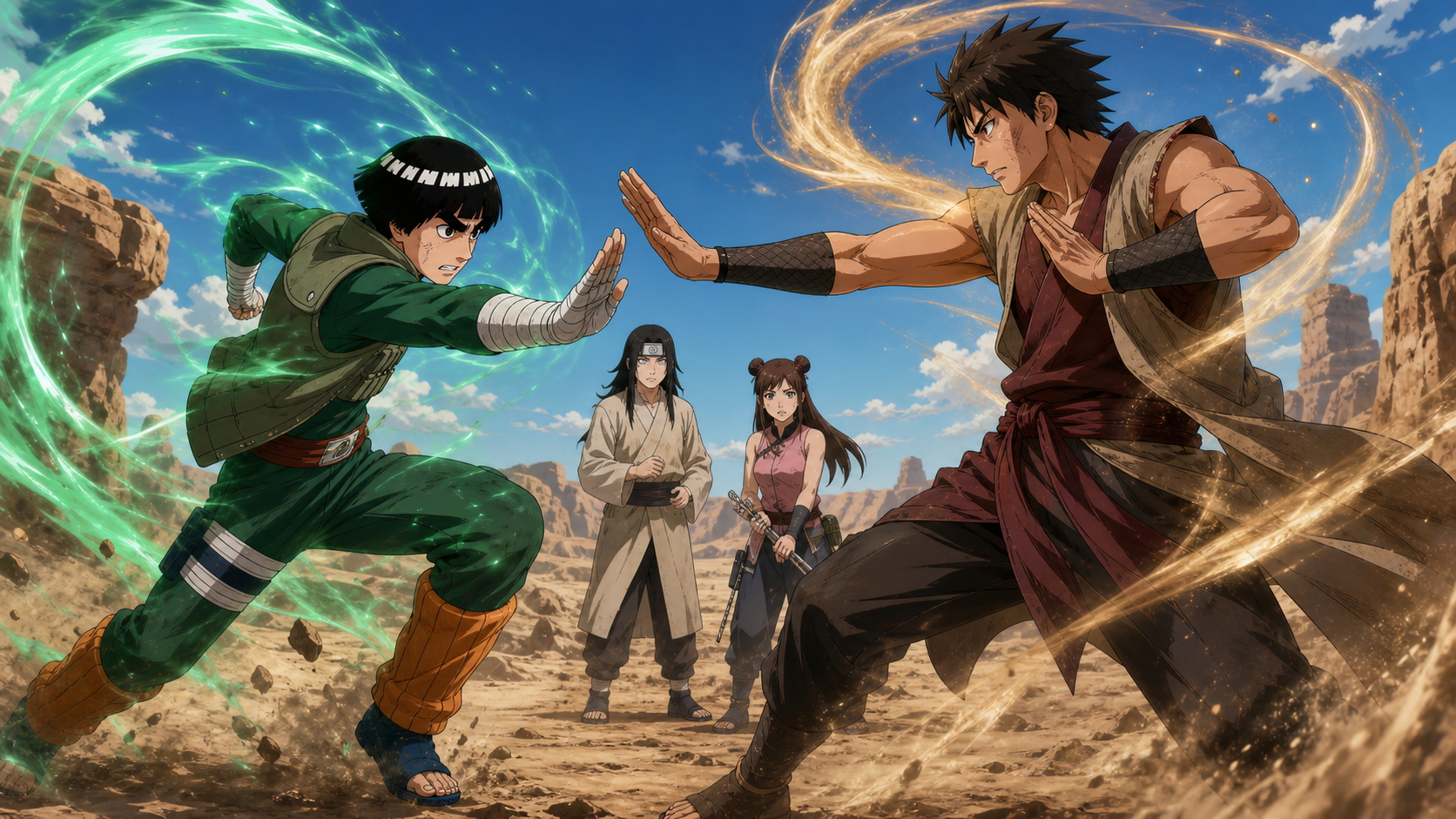
The Ultimate
Lee and Shira compare two systems built after exclusion, but their best result is mutual recognition rather than another institution deciding whose body counts.
Bottom line
“The Ultimate” gives Lee and Shira a fight built from two different answers to the same exclusion. Lee uses the Eight Gates, a brutal method that removes the body’s safety limits. Shira uses pressure-point strikes, a silent style, and the Seven Heavens Breathing Method he created to expand his lungs and drive more oxygen through his body. Neither man copied the other. Both turned restricted access into specialized knowledge. The fight gets silly when “hard work has no limits” starts sounding like bodies have no limits. Bodies absolutely have limits. Lee’s gates injure him. Shira enters the duel already hurt and strains a breathing method whose long-term cost remains unclear. Respecting effort means respecting recovery, informed risk, and the right to stop. Lee wins after forcing access to higher gates, but the useful outcome is mutual recognition rather than a universal ranking of taijutsu. Two excluded people meet without asking the institution to declare one valid and the other obsolete.
That distinction keeps the duel from becoming a punishment disguised as inspiration. Lee and Shira choose the exchange, watch each other closely, and stop with knowledge neither possessed at the beginning. The episode works when discipline includes consent, observation, recovery, and restraint, not only the spectacular moment when somebody forces an injured body past another limit.
Shira accepts Lee’s challenge
The fight begins as a voluntary contest between specialists rather than an ambush for a scroll. Both want to understand the other’s method.
Consent changes combat from punishment into exchange.
The duel follows an actual rescue
Team Guy helped Shira’s group survive betrayal and quicksand. Their relationship has already moved beyond anonymous rivalry.
Trust makes a serious spar possible while the exam still continues.
Lee wants comparison through movement
Technical language can explain stance and training, but direct exchange reveals timing, distance, balance, and reaction under pressure.
For taijutsu users, conversation often happens through the body.
Their speed begins near even
Both fighters answer rapid combinations without immediate collapse. The opening establishes Shira as a peer rather than a novelty created for Lee to defeat quickly.
Parity gives later adjustments meaning.
Shira’s larger frame changes impact
Comparable speed does not produce identical force when body mass, reach, and leverage differ. Lee begins absorbing damage despite matching the number of attacks.
Technique interacts with anatomy rather than floating above anatomy.
Lee cannot solve every mismatch through pace
His speed is exceptional, but Shira reads the rhythm and makes close contact costly. Familiar strengths meet an opponent prepared for them.
Growth begins when the favorite tool stops being sufficient.
Shira uses a silent striking style
Removing obvious sound and telegraphing makes the attacks harder to read. Lee cannot depend on familiar auditory cues.
Sensory discipline matters inside close-range combat.
Guy’s training helps Lee adapt
Past practice taught him to read body position, air movement, and intent rather than waiting for impact noise. The memory becomes usable technique.
Mentorship survives through trained attention.
Shira targets pressure points
His strikes interfere with Lee’s chakra pathway and the internal access needed for the Eight Gates. The tactic attacks the opponent’s escalation route before escalation begins.
Specialized knowledge can neutralize a famous power without overpowering every muscle.
Lee cannot open even the First Gate
The failure shocks him because the technique normally belongs to his own body and training. Shira has made internal access externally vulnerable.
Ownership of a skill does not guarantee uninterrupted use.
The counter rewards observation
Shira needed to understand how Lee gathers power and where to strike. The method is more interesting than generic resistance to a stronger attack.
Tactics should reshape a fight before spectacle takes over.
Pressure-point combat carries serious risk
Interfering with chakra and bodily regulation can cause consequences beyond a friendly match. Both fighters need control and a stopping threshold.
Respectful combat still requires safety boundaries.
Lee forces his way past the restriction
He uses training, will, and bodily control to reopen access. The moment demonstrates mastery while raising the question of what damage he ignores.
Breaking through a safeguard is not automatically healthy.
The Eight Gates remove internal limits
Each gate releases restrictions the body uses to prevent catastrophic exertion. Power rises because protective mechanisms are overridden.
The technique borrows from future physical function.
Lee reaches the Fifth Gate
His speed and force increase enough to reverse Shira’s advantage. The escalation connects to established training under Guy.
Continuity gives the power a history and known cost.
Shira answers with his own invention
The Seven Heavens Breathing Method increases lung capacity and oxygen intake, producing a bodily boost comparable in purpose to the gates. Shira created the approach outside accepted training.
Exclusion pushed innovation without justifying exclusion.
The breathing method reflects available knowledge
Shira develops power through breath, circulation, and physical conditioning rather than a clan technique. His body becomes a laboratory because formal systems denied him another route.
Self-invention can be brilliant and medically precarious.
Several activation stages increase output
Like the Eight Gates, the method offers escalating states rather than one fixed transformation. Each stage changes the body’s performance.
Progressive control gives Shira choices under pressure.
The long-term cost remains uncertain
The episode shows strain without establishing a complete medical record for the technique. Analysis should not claim safety merely because the damage looks less famous than the gates.
Unknown cost is not zero cost.
Shira enters the duel already injured
The previous assault and quicksand crisis affect his condition. Comparing final output without that context would misread the result.
Fair analysis includes the body that arrived, not an imaginary rested version.
Lee also carries accumulated damage
Shira’s earlier strikes and pressure-point attacks have already affected him before the gates open. Both competitors escalate from compromised baselines.
The duel tests resilience as much as clean technique.
“Ultimate” should not mean self-destruction
Battle anime often treats the willingness to ruin a body as proof of purity. That equation rewards unsafe training and makes survival look emotionally lesser.
Mastery includes knowing when further output stops serving the goal.
Their methods reveal different philosophies
Lee breaks internal restraints through gates taught by Guy. Shira builds controlled breathing activations through independent experimentation.
Similar exclusion produced distinct technical languages.
Neither path is universally superior
The gates offer explosive established escalation with severe known danger. The breathing method offers another performance route with uncertain limits and counters.
Context should decide which tool fits, not fandom ranking alone.
Lee gains the advantage
Higher-gate speed and force overwhelm Shira after an extended exchange. The result proves Lee’s current combat edge under these conditions.
One result does not erase Shira’s skill, injury, or invention.
Shira loses without being invalidated
The person who challenged Suna’s exclusion still demonstrates elite control and a technique Lee had never encountered. Defeat produces information rather than restoring the old hierarchy.
Recognition should survive the score.
Lee wins without proving effort has no limit
Effort expands capacity through practice, adaptation, recovery, instruction, and time. Biological limits remain real.
The healthier lesson is that institutions misjudged where his limits actually were.
“No limits” can become cruel advice
People with injuries, disabilities, fewer resources, or unsafe training conditions may work relentlessly without reaching the same outcome. Telling them effort solves everything relocates structural failure into the body.
Motivation needs honesty about access and cost.
Guy’s mentorship included belief and technique
He did not merely shout encouragement. He taught gates, conditioning, observation, recovery expectations, and a path tailored to Lee’s strengths.
Material support makes belief useful.
Gaara’s recognition gave Shira institutional access
The Kazekage changed formal status and created an instructor role. Shira’s self-developed mastery finally entered the village’s acknowledged knowledge system.
Recognition matters most when resources follow.
The duel becomes peer review
Each fighter exposes gaps in the other’s method. Shira blocks the gates, while Lee tests how the breathing activations withstand higher-speed pressure.
Respect grows through specific correction.
Medical observation should follow this fight
Pressure-point disruption, oxygen loading, repeated blunt impact, and Fifth Gate activation create risks that cannot be evaluated through whether both fighters remain standing. A medic should check circulation, breathing, internal injury, and delayed muscular damage.
Post-fight care belongs inside serious martial training. Walking away while smiling is not a diagnostic test.
Shira’s invention deserves documentation
An instructor should record activation stages, contraindications, recovery time, failure signs, and the conditions under which students may practice. Otherwise, admiration can turn an experimental technique into another unsafe tradition.
Knowledge becomes teachable when somebody preserves more than the impressive result.
Neji can learn from Shira’s pressure-point work
The Hyūga approach and Shira’s strikes share interest in internal disruption while using different training traditions. Cross-village observation could expand both systems.
Knowledge exchange is a better diplomatic result than one stolen scroll.
Tenten can study equipment and range gaps
Watching two close-range specialists shows where tools, distance, and terrain could control either fighter. Her perspective should add more than applause.
Team analysis improves when every specialization speaks.
The exam objective remains unfinished
Both teams still need scrolls, water, travel time, and safe arrival. A beautiful duel consumes resources the rules do not refund.
Mutual respect should end the fight before vanity ruins both attempts.
Stopping matters as much as starting
The competitors reach a point where further escalation could create lasting injury. Choosing to end preserves the learning and the people.
Control after adrenaline is part of mastery.
Anime-original technique needs clear labeling
The Seven Heavens Breathing Method belongs to this adaptation-only arc and related game appearances. The final article should not present Shira’s method as manga-established history.
Continuity precision protects useful invention.
The animation has to carry technical difference
Silent strikes, pressure-point targeting, gate escalation, breathing stages, reach, and weight need distinct movement. Generic speed lines would flatten the entire reason for the duel.
Craft analysis should follow visible staging after lawful viewing.
Japanese performance remains an evidence gate
The final publication should verify Japanese cast and staff credits. Claims about Lee’s exhilaration, Shira’s control, Neji’s concern, or Tenten’s response require direct listening.
No imagined delivery should fill the production section.
Consent makes this duel different from the attack
Shira was ambushed by people protecting an old hierarchy. Lee approaches him as a peer and receives agreement before the exchange begins. That distinction matters more than the animation’s biggest impact frame.
Voluntary combat can still become unsafe, but it gives both fighters a voice in purpose, intensity, and stopping. Respect begins before the first strike rather than appearing only after someone wins.
Mutual recognition is the actual prize
No official rank can give Lee and Shira what they offer each other here. Each sees a discipline built under dismissal and immediately understands how much unseen labor sits behind the visible technique.
The fight becomes testimony through movement. Neither needs pity, and neither must shrink so the other can feel exceptional.
Two adaptations grew from different environments
Lee had Guy’s instruction, Konoha facilities, teammates, and a formal path after early rejection. Shira created methods outside Suna’s accepted curriculum before Gaara changed his status.
Calling both stories hard work is true but incomplete. Resources, mentorship, institutional access, and the freedom to recover shape what effort can become.
The Seven Heavens method belongs to Shira’s intellectual labor
He did not simply train harder inside an established system. He observed breathing, oxygen, movement, and output closely enough to build a method suited to his own body and goals.
Suna should document his authorship, compensate his teaching, and prevent others from presenting the technique as village property detached from its creator.
Documentation must not become appropriation
Recording the method could preserve knowledge and help future students, yet institutions have a habit of celebrating an innovation after dismissing the innovator. Shira should control how instruction is shared.
Consent, credit, safety notes, training prerequisites, and limits belong beside every technical description. Access should expand without erasing ownership.
The Eight Gates are not a motivational slogan
They remove restraints the body uses to prevent catastrophic injury. The spectacle can make each opened gate look like a moral upgrade, as though greater willingness to suffer proves greater worth.
Lee’s courage is real. So is the danger. A responsible teacher must separate informed tactical risk from a culture that praises children for ignoring pain.
Injury changes the ethics of comparison
Shira begins after betrayal, entrapment, rescue, and accumulated strain. Lee carries his own history of damage and recovery. Their bodies do not enter a laboratory under equal conditions.
The result tells us who prevailed in this encounter, not whose discipline is universally superior. Context keeps victory from becoming false science.
Stopping rules should be spoken before escalation
Mutual enthusiasm is not enough once breathing changes, pressure points are struck, and internal limiters open. Teammates need authority to pause the duel when judgment becomes impaired.
A clear signal, medical threshold, and recovery plan would protect both fighters without insulting their skill. Boundaries let competition remain chosen.
Neji is more than an impressed spectator
Shira’s pressure-point work sits near Neji’s own technical world while reaching it through another route. Neji can observe similarities without claiming Hyūga ownership over every precise strike.
His Byakugan could also monitor internal stress and identify when the duel crosses from demanding into medically reckless. Expertise creates responsibility alongside curiosity.
Tenten sees the whole field around the specialists
While Lee and Shira narrow their attention to timing and impact, somebody must track the exam, supplies, hostile teams, injuries, and the route forward. Tenten’s awareness protects the conditions that allow their exchange.
That labor is not less exciting because it prevents disaster instead of producing a finishing blow. Operational care is part of combat excellence.
Winning cannot become proof that Lee was always right
Lee’s victory does not validate every reckless chase, every forced gate, or every belief about limitless effort. A person can reach the better result after making choices that still deserve criticism.
Good fandom analysis holds both truths. Lee is extraordinary, and his friends are right to challenge the way he spends his body and transfers risk to them.
Losing cannot return Shira to the margin
If one defeat were enough to invalidate his method, then recognition would still depend on permanent perfection. No instructor, fighter, or innovator can live under that standard.
Shira remains a legitimate shinobi because of demonstrated knowledge, judgment, and craft. Lee’s advantage in one duel should create questions for the next training session, not revoke belonging.
Recovery is where respect becomes measurable
Compliments after combat are easy. Water, treatment, rest, follow-up, and honest discussion show whether both men value the person who produced the spectacle.
Team Guy and Shira’s teammates should treat recovery as part of the encounter rather than dead time before the exam resumes. Bodies remember what inspirational speeches omit.
RaeRae’s verdict
“The Ultimate” is strongest when Lee and Shira stop representing abstract hard work and start showing specific craft. Shira attacks the pressure points Lee needs for the Eight Gates. Lee adapts to silent strikes. Shira answers the Fifth Gate with a breathing method he invented because Suna refused him a normal training path. That is actual mastery, not a poster quote.
The episode’s “effort has no limits” message needs side-eye. Bodies have limits, and both men enter dangerous territory by treating pain as a technical inconvenience. Their institutions failed because they mistook missing ninjutsu for missing potential. The correction is not pretending every person can overcome every barrier through punishment. The correction is building training systems that recognize specialization, provide support, protect recovery, and let two talented fighters meet as peers instead of begging gatekeepers for legitimacy.
RaeRae’s call
Lee and Shira do not need this duel to decide which taijutsu user deserves to exist. They need it because each finally meets somebody who understands specialized mastery without treating it as compensation for a missing skill. The exchange works when consent, observation, and mutual curiosity lead. It becomes dangerous when opened gates and strained breathing turn self-destruction into proof of sincerity. Lee wins this round. Shira keeps his authorship, dignity, and future. The ultimate achievement is not a body pushed past every warning. It is knowledge shared without one excluded person being asked to erase another.
Episode details and viewing routes
- Official episode reference: Naruto Official episode guide
- Licensed episode route: Crunchyroll licensed episode page
What I carry from the duel is not a ranking. It is a model for meeting another person’s expertise without asking them to audition for humanity. Lee pays attention. Shira answers in the language he built. Both adjust when assumptions fail. That exchange deserves more room. If Suna values Shira’s future, the village must give his method resources without taking ownership, give his students options without making them copies, and give his body recovery without calling rest weakness. If Konoha values Lee, his friends must keep celebrating his courage while refusing the idea that love means watching him break. Neji and Tenten matter because they hold the truth when the specialists become consumed by the test. Skill can be fierce without becoming disposable. Competition can reveal knowledge without deciding belonging. A loss can teach without humiliating, and a win can matter without becoming permission to ignore each clear physical warning the body gave along the way.
What I am carrying forward
Lee and Shira fought a voluntary taijutsu duel. Shira used silent strikes and pressure-point attacks to block Lee’s access to the Eight Gates, forcing Lee to adapt and reopen them before reaching the Fifth Gate.
Shira answered with the anime-original Seven Heavens Breathing Method, which increases lung capacity and physical output through staged activation. Lee ultimately gained the advantage, and the fight ended with mutual respect rather than renewed exclusion. Episode 402 moves to Team 8’s pursuit after Hidden Grass candidates steal their scroll.