
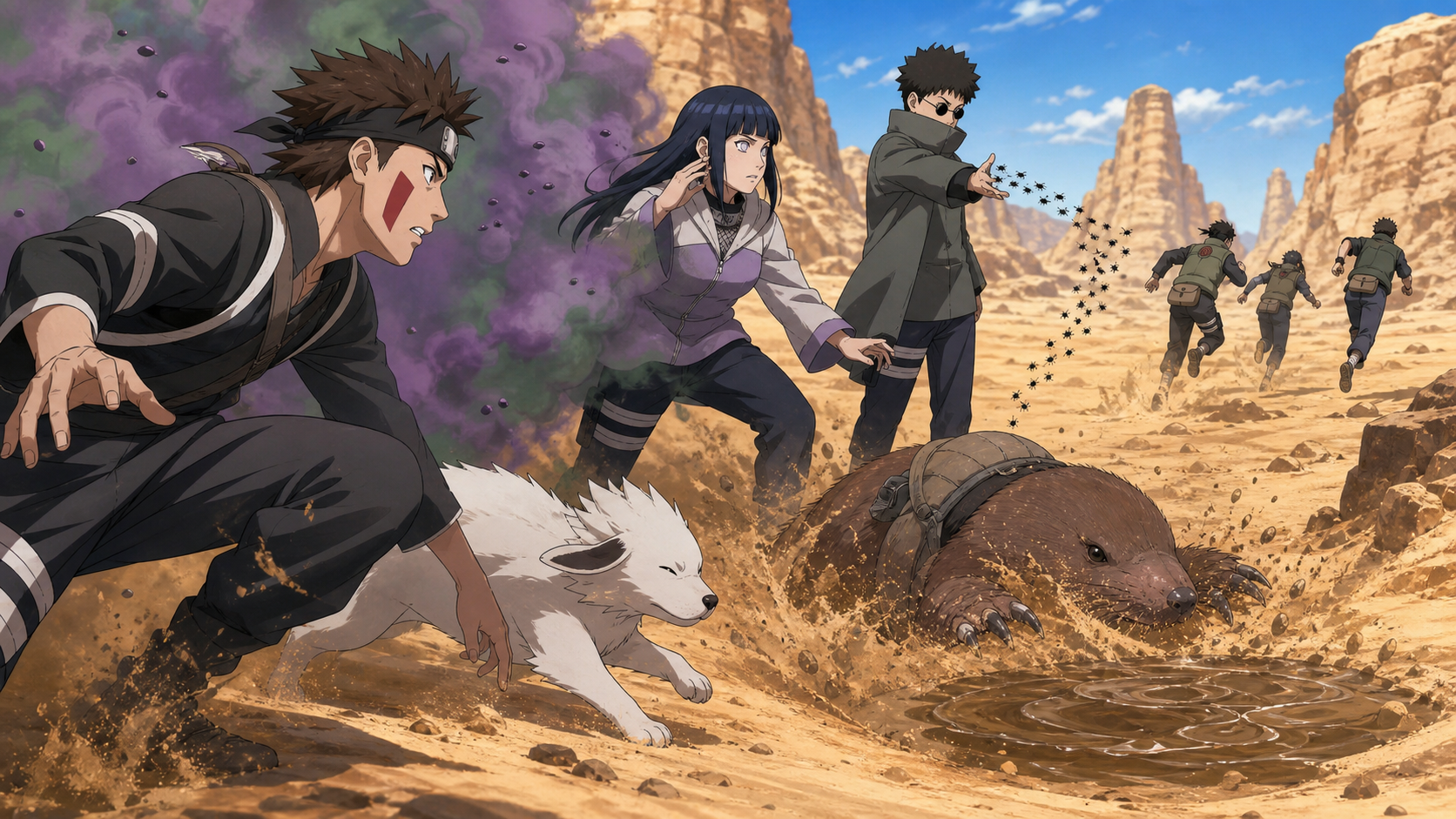
Escape vs. Pursuit
Team 8 has three famous tracking systems, but the Hidden Grass team wins ground by attacking each channel and turning confidence into a route toward prepared terrain.
Bottom line
“Escape vs. Pursuit” finally gives Team 8 an opponent designed to embarrass their reputation. Kiba, Hinata, Shino, and Akamaru are elite trackers by genin standards, so the Hidden Grass team does not try to outrun them in a straight line. Burami floods Kiba’s nose with an overwhelming smell. The thieves travel beneath the sand to break ordinary trails and avoid Shino’s visible insect net. They let Hinata’s Byakugan keep the Leaf team committed to pursuit, then guide everyone into bottomless quicksand. That is good counter-scouting. The Grass shinobi studied what Team 8 relies on and attacked the sensing chain instead of each fighter separately. Team 8’s problem is not lack of talent. Their confidence makes three tracking methods feel like guaranteed truth when each method has a known channel and counter. Shino’s quieter contingency, marking the underground transport animal with an insect, preserves a route for recovery. Redundancy only works when teammates question what each signal can and cannot prove.
The episode also understands that a tracker can be technically correct and operationally wrong. A scent, sightline, or insect trail proves only what that channel can observe. Good intelligence work compares signals, preserves uncertainty, and leaves a recovery route before confidence turns a pursuit into somebody else’s prepared terrain.
Team 8 carries the Heaven Scroll
They need an Earth Scroll and safe arrival at the central base. The possession makes them both hunters and targets.
Every movement must protect information about the scroll’s location.
Hidden Grass carries the Earth Scroll
Each team has exactly what the other needs. Conflict begins from compatible objectives rather than personal hostility.
The exam turns mutual need into forced competition.
Kiba commits to direct pursuit
His confidence grows from years of scent work with Akamaru. In open terrain, he expects escape routes to remain legible.
Skill can become assumption when success feels routine.
The Grass team plans around Team 8’s reputation
They know Kiba tracks by smell, Hinata sees across distance and through obstacles, and Shino uses insects for surveillance. Their strategy attacks those systems deliberately.
Preparation turns an apparent mismatch into an opportunity.
Burami weaponizes smell
He produces an odor strong enough to overwhelm Kiba’s heightened nose. The technique converts sensory advantage into vulnerability.
Greater sensitivity means greater exposure to saturation.
Kiba loses his cleanest trail
Once the target scent disappears beneath a stronger signal, speed no longer tells him where to run. His preferred tracking channel becomes noisy.
Moving faster in the wrong direction only wastes water.
Akamaru faces the same disruption
The ninken partnership expands Kiba’s sensing ability without creating a wholly independent modality. Both depend heavily on smell.
Two noses are not full redundancy when one counter affects both.
The technique is humiliating on purpose
Body-odor comedy makes Kiba angry and encourages impulsive reaction. The Grass team gains tactical advantage and emotional control at once.
Embarrassment becomes another tracking counter.
Shino deploys insects
His kikaichū can spread, search, and identify movement beyond ordinary sight. The swarm offers another channel after scent fails.
Team 8 remains dangerous because specialization overlaps.
Underground travel breaks the expected pattern
The Grass shinobi use a giant mole and move beneath the sand. They avoid surface tracks and reduce direct exposure to insects.
Terrain knowledge turns escape into concealment.
Sand behaves differently from forest soil
Loose ground can erase prints, shift after passage, and collapse around tunnels. Konoha tracking habits need adjustment.
Familiar techniques require local interpretation.
Shino does not assume visible failure means total failure
He quietly marks the transport animal with an insect. The contingency creates a trace the Grass team does not know to remove.
Good tracking often depends on the signal an opponent never noticed.
Concealing the contingency protects the route
Announcing every measure would let enemies adapt if they remain within hearing or observation. Shino stores information until the team can use the information safely.
Silence becomes tactical rather than social distance.
Hinata uses the Byakugan
Her vision can penetrate sand and maintain awareness of underground movement. The dōjutsu restores contact after smell and surface insects fail.
The Grass team expects that recovery.
Seeing a target does not reveal the target’s plan
Hinata can identify bodies and direction without knowing why the escape route was chosen. Visual truth can still sit inside strategic deception.
Accurate information needs interpretation.
The Grass team controls the chase path
They do not merely flee from Team 8. They select terrain and pace so the pursuers move toward a prepared hazard.
Escape becomes offensive positioning.
Kiba mistakes contact for control
Once Hinata sees the targets, he treats pursuit as restored. The team does not stop long enough to ask whether the route looks too convenient.
Reacquired signal can create more confidence than the evidence deserves.
The stolen scroll increases urgency
Every minute gives the Grass team more distance and threatens Team 8’s exam. That pressure makes cautious analysis feel like surrender.
Thieves benefit when a valuable loss controls the victim’s tempo.
Bottomless quicksand becomes the trap
The Leaf team enters unstable ground and loses mobility. Struggling can worsen descent while the enemy remains free to escape.
The desert punishes momentum without environmental awareness.
Tracking skill does not equal terrain skill
Team 8 can find people across forests and missions, but the Demon Desert introduces hazards outside their ordinary experience. Local candidates understand which surfaces lie.
Specialization still needs regional preparation.
Hinata’s vision should have identified the hazard
The Byakugan can see subsurface structure, yet attention remained fixed on moving targets. Perception narrows when the mission object dominates thought.
Seeing widely requires deciding where to look.
Shino’s insects may detect ground changes
A distributed swarm can test surfaces and movement, but deployment takes attention and insects may struggle in heat or loose sand. No tool offers automatic warning.
The team needs explicit hazard-scanning roles.
Kiba’s leadership needs a pause command
His drive keeps the team moving, but somebody must be authorized to stop pursuit when two sensing channels fail. A chase without a reset point becomes enemy-controlled.
Leadership includes knowing when speed has stopped helping.
Hinata should be able to challenge the route
Her Byakugan supplies crucial information, and her judgment should shape the plan rather than serve as a directional feed for Kiba. Quiet delivery does not reduce authority.
Trackers need conversation, not one commander and several sensors.
Shino protects options through patience
He often appears slower because he waits for enough information. The insect marker shows that restraint can create a stronger pursuit route than immediate attack.
Methodical work becomes visible after louder plans fail.
The Grass team attacks systems, not egos
They neutralize scent, avoid insects, exploit dōjutsu attention, use underground transport, and prepare terrain. The operation treats Team 8 as an integrated network.
That strategic respect makes the ambush effective.
Their escape specialization is legitimate ninja skill
The Chūnin Exams often glorify direct fighting. Concealment, counter-tracking, misdirection, transport, and controlled withdrawal matter on real missions.
Avoiding a duel can demonstrate higher competence than winning one.
Theft within the rules remains fair competition
Teams must obtain the opposite scroll, so taking Team 8’s Heaven Scroll serves the stated objective. The problem is not that Grass refuses a sporting duel.
The Leaf team has to defend against tactics the rules permit.
The quicksand hazard raises organizer responsibility
Candidates can drown in terrain while proctors allow independent survival. A serious exam needs rescue surveillance that does not advertise every safety measure.
Testing danger cannot become abandonment.
Team 8 has to escape before pursuing
The stolen scroll no longer deserves first priority once everyone is trapped. Immediate survival must replace chase urgency.
Mission objectives change when the team’s physical condition changes.
The scroll should have had layered protection
Carrying the objective in one accessible pouch creates a single point of failure. Team 8 could use decoys, rotation between carriers, insect surveillance around the container, or sealed placement known only to the team.
Defending information starts before an enemy reaches grabbing distance.
Recovery planning should assume another ambush
The Grass team knows Team 8 will pursue if they escape. Following Shino’s marker along the obvious route may lead into a second prepared position.
The team needs parallel scouting, controlled pace, and an exit route before converting the hidden marker into action.
Panicked movement makes extraction harder
Forceful kicking and grabbing can destabilize the sand. Coordinated weight distribution and a secure anchor offer better odds.
Physical power needs environmental technique.
Insects may provide distributed lift or anchoring
Shino’s swarm can support creative escape if the heat and load remain manageable. The team should use every specialty toward the new problem.
Tools change roles when the mission changes.
Akamaru needs protection during the trap
The ninken is a teammate, not an accessory attached to Kiba’s technique. Escape planning must account for his body and stress.
Animal partners deserve the same survival floor.
Losing the scroll is not final failure
Shino’s marker preserves a path to the thieves, and seventy-two hours leave time for recovery. Team 8 can regroup after escaping.
The exam punishes panic more than one temporary setback.
Redundancy needs independence
Scent, insects, and vision appear to offer three backups. The Grass strategy shows that correlated assumptions can make several channels fail inside one trap.
True redundancy includes different data and different interpretations.
Team 8’s interpersonal growth matters
Kiba tends toward loud initiative, Hinata toward careful observation, and Shino toward quiet contingency. Success requires each style to correct the others.
No single temperament should define the team.
The episode gives trackers a real opponent
Too many stories let Team 8 locate the target and then hand combat to somebody else. Episode 402 makes tracking itself the battlefield.
Counter-sensing provides the action rather than serving as setup.
Anime-original techniques need continuity labels
Burami’s smell counter, underground escape combination, and associated team tactics belong to this adaptation-only exam arc. The final React should identify that status.
Useful invention does not need false manga authority.
Japanese performance requires direct evidence
The final publication should verify Japanese cast and staff credits. Claims about Kiba’s frustration, Hinata’s focus, Shino’s restraint, or the Grass team’s confidence require lawful scene-level listening.
No invented vocal analysis belongs in the post.
A famous specialty gives opponents a planning document
Team 8’s reputation creates deterrence, but it also tells prepared rivals which systems must be disrupted. Kiba’s nose, Hinata’s eyes, and Shino’s insects are not secrets inside the exam.
Leadership should assume that visible strengths will attract counters. The answer is not hiding every ability. It is practicing what happens after each familiar advantage fails.
Multiple sensors do not automatically create independent confirmation
Kiba and Akamaru both smell the world with extraordinary precision, yet Burami’s interference affects the same channel. Two skilled observers can still share one point of failure.
True redundancy mixes modalities and methods. Scent, vision, insect contact, terrain reading, timing, and human judgment must be compared rather than counted as interchangeable votes.
Information needs confidence labels
Hinata can locate bodies, but sight does not explain whether the visible route is bait. Shino can detect an insect’s position, but that signal may mark transport rather than every enemy.
A team should say what it knows, how it knows, and what remains uncertain. That language creates room to slow down before a clue becomes an order.
Kiba’s urgency is understandable and still dangerous
The stolen scroll threatens the team’s exam future, so immediate pursuit feels responsible. Delay could widen the gap or let the Grass team reach safety.
Urgency does not erase terrain, hydration, formation, or the possibility of a prepared trap. A brief tactical pause can save more time than a rescue from quicksand.
Hinata deserves operational authority over what she sees
Byakugan intelligence should not become raw material that another teammate automatically converts into movement. Hinata needs space to describe depth, obstructions, ground changes, and the limits of her view.
Her quiet delivery is not weaker evidence. A healthy team builds procedures that prevent volume and momentum from overruling the person doing the observation.
Shino’s contingency succeeds because it stays separate
The hidden insect marker survives precisely because the Grass team believes it defeated the visible swarm. Shino preserves an option without advertising it or tying it to the same disrupted method.
Quiet preparation is not secrecy for ego. It becomes valuable when teammates understand that a fallback exists and can use it after immediate danger passes.
The Grass team earns credit for counterintelligence
They study opponents, manipulate sensory input, conceal travel, and shape the chase toward chosen ground. None of that is lesser combat because it avoids a straightforward exchange of blows.
Ninja work includes making the other team spend energy on false certainty. Their plan deserves analysis without pretending every consequence of the exam environment is ethically acceptable.
Comedy can conceal sensory assault
Burami’s odor is presented as humiliating and funny, especially because Kiba reacts so visibly. For a tracker with heightened smell, saturation is also pain, disorientation, and loss of a primary working sense.
Teammates should treat the exposure as an injury condition rather than mockery. Recovery requires clean air, time, water, and a check that Akamaru is safe to continue.
Akamaru is a partner, not spare equipment
He shares Kiba’s sensory burden and enters the same unstable terrain. Any pursuit plan must account for his consent signals, breathing, footing, and extraction.
The team cannot celebrate the Inuzuka partnership while treating the ninken’s risk as invisible. Care for Akamaru belongs inside mission planning, not after it.
Quicksand exposes the exam’s rescue gap again
A trap designed by candidates may still become lethal beyond what any scroll contest should permit. Proctors need reliable surveillance, intervention thresholds, medical access, and accountability for environmental hazards.
Watching young shinobi sink until they produce an entertaining solution is not neutral evaluation. Officials selected the arena and therefore own its predictable risks.
Escape begins by stopping the chase mentality
Once Team 8 enters the sand, the Grass team and stolen scroll must become secondary. Thrashing, shouting conflicting instructions, or reaching without anchors could pull everyone deeper.
Kiba needs to accept a temporary loss of control. Hinata and Shino need room to assess, while every movement serves extraction rather than wounded pride.
The scroll should never have depended on one layer
Carrying it close may reduce casual theft, but a prepared opponent can still exploit distraction and proximity. Team 8 needed decoys, rotation, sealed storage, and a response phrase for sudden separation.
Security is a system rather than one person’s grip. Layered protection gives the team choices after the first defense fails.
Recovery should include a fresh threat model
Escaping the trap does not restore the conditions that existed before pursuit. The Grass team now knows how Team 8 responds, and Team 8 knows its sensory chain can be manipulated.
Before following Shino’s marker, they should redistribute supplies, check injuries, choose approach distance, and decide what evidence would trigger withdrawal. Learning must alter the next move.
RaeRae’s verdict
“Escape vs. Pursuit” works because Team 8 loses to preparation, not sudden stupidity. The Grass shinobi know who they are facing. Burami overloads Kiba and Akamaru’s scent tracking. Underground travel reduces Shino’s visible options. Hinata reacquires the targets, but the pursuit route leads directly into quicksand. Every famous ability still functions according to a channel that can be attacked.
Shino’s insect marker keeps the setback from becoming a total collapse. His choice is quiet, specific, and exactly what the team needs after the louder chase fails. Team 8 should leave this encounter with more than a recovered scroll. They need a rule for stopping pursuit, independent terrain checks, and a team culture where Hinata and Shino can challenge Kiba’s tempo before an opponent chooses the destination for them.
RaeRae’s call
The Hidden Grass team wins this phase because it treats Team 8’s celebrated tracking as a system with identifiable channels. Odor breaks scent, underground travel disrupts surface assumptions, visible movement keeps Hinata focused, and quicksand converts pursuit into rescue. Kiba’s confidence is earned, but confidence is not confirmation. Hinata must have authority over the limits of what she sees. Shino’s concealed marker matters because it preserves an independent route. Akamaru’s safety belongs in every decision. Team 8 does not need stronger senses next. It needs a slower conversation about what each signal proves before somebody else chooses the ground again.
Episode details and viewing routes
- Official episode reference: Naruto Official episode guide
- Licensed episode route: Crunchyroll licensed episode page
Nobody can solve this episode by announcing Team 8 has three trackers and therefore cannot lose a trail. The Grass team understands that every sense has conditions. Smell can be flooded. Sight can be guided toward bait. Insects can be avoided, noticed, or carried somewhere misleading. It is disciplined comparison. Kiba should name when urgency is shaping his judgment. Hinata should state what the Byakugan cannot establish, not merely what it reveals. Shino should explain the purpose and limits of his marker once secrecy no longer protects it. Akamaru should be treated as a partner recovering from the same sensory attack. When those pieces meet, pursuit becomes a team decision instead of momentum wearing Kiba’s voice. Losing the scroll hurts, but the deeper failure would be repeating the exact chase after rescue. Intelligence becomes leadership only when new evidence itself changes the route, the pace, and the definition of success.
What I am carrying forward
Hidden Grass shinobi stole Team 8’s Heaven Scroll and escaped with the Earth Scroll they already carried. Burami overwhelmed Kiba and Akamaru’s scent tracking, while underground travel disrupted Shino’s insects.
Hinata used the Byakugan to continue pursuit, but the Grass team led Kiba, Hinata, Shino, and Akamaru into bottomless quicksand. Shino secretly marked the transport animal with an insect, preserving a route for renewed pursuit after escape. Episode 403 follows Team 8’s recovery and determination to reclaim the scroll.