
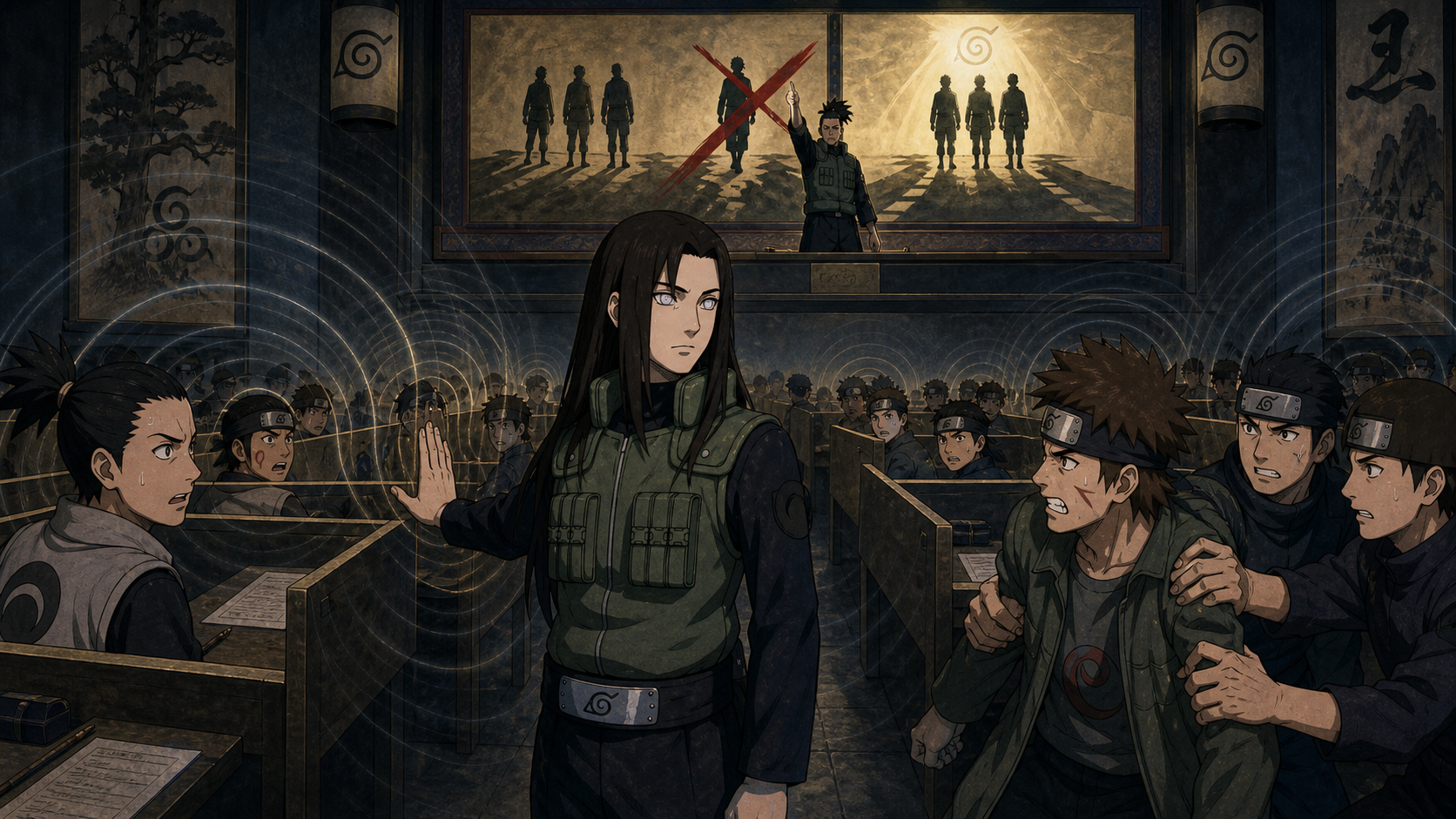
One Worthy as a Leader
Neji uses clarity to steady competitors and refuses the premise that command begins by deciding which teammate matters least.
Bottom line
“One Worthy as a Leader” gives Neji the kind of authority the Hyūga once denied him by birth. He recognizes the written test’s team-scoring trap, sends coded vibrations through the walls, and risks helping competitors because isolated success will not solve a collective communication problem. Some candidates resent taking orders from him and nearly start a fight. Neji keeps the room focused anyway. Then Shikamaru delivers the real leadership question: name the teammate you would sacrifice as bait so the other two can escape. The correct answer is refusing to name anyone. That principle lands because the shinobi system has spent generations treating comrades, branch relatives, jinchūriki, and children as acceptable losses. The rule also needs nuance. A field leader may face a situation where someone voluntarily covers a retreat. Refusing disposable logic does not mean refusing every sacrifice freely chosen under emergency conditions. The best leader protects options, shares risk, and never begins by deciding whose life matters least.
That standard should also guide the exam’s debrief. Candidates need to hear that leadership is measured through preserved choices, consent, and shared exposure, not through theatrical willingness to nominate somebody else for death.
Panic spreads across the rooms
Candidates understand that personal answers feed team totals, but direct communication remains blocked. Time keeps moving while nobody can confirm a shared distribution.
Uncertainty becomes more dangerous when everyone reacts separately.
Neji announces that he has a solution
He speaks openly to candidates who are also competitors. The decision risks his own team’s advantage in order to stabilize the room.
Leadership begins before anybody grants him the title.
Some candidates resent his authority
They hear confidence as arrogance and dislike being directed by another genin. Competition makes cooperation feel like submission.
People often reject useful information because they dislike who delivered the information.
A fight nearly breaks out
Angry candidates move toward physical confrontation rather than testing Neji’s logic. The exam rules prohibit combat during the written stage.
Threatening violence over wounded pride is excellent evidence against promotion.
Fear of disqualification restores order
Some participants cooperate reluctantly because attacking Neji would end their exam. External rules control behavior before internal judgment catches up.
Compliance can create enough time for understanding to develop.
Neji uses vibrations through the walls
He sends a simple physical signal across the separated rooms. The method does not require a clan secret, written message, or direct conversation.
He turns the building itself into a communication channel.
The signal assigns question values
Teams can coordinate who selects 30, 40, or 50 points by reading repeated vibrations. A shared code solves the distribution problem.
The clever part is not knowing the sum. The clever part is making the sum possible across barriers.
Neji helps more than his own team
Other candidates can use the system once they understand the signal. His intervention changes the room from isolated competitors into temporary collaborators.
Leadership can improve the field without guaranteeing personal reward.
Shared help does not erase competition
Passing Round One sends teams into later stages where they will oppose each other directly. Cooperation now protects the exam’s purpose rather than cancelling rivalry.
Good competitors still need rules worth competing under.
Neji’s growth is visible through conduct
During the earlier exam, he carried fatalism, anger, and contempt toward people labeled failures. Here he notices group panic and creates a route others can use.
Changed belief becomes credible through changed behavior.
The branch-family child becomes the room’s leader
Hyūga hierarchy marked Neji for service while main-family birth controlled formal authority. The exam room follows competence rather than lineage.
The contrast exposes how much talent hereditary systems waste.
His authority remains accountable to results
Candidates do not need to admire him. They can judge whether the proposed code explains the scoring problem and works across rooms.
Evidence supports leadership better than inherited status.
Sakura reaches the same structural insight
Her academic skill and tactical reasoning help her understand the team-total requirement. She contributes through analysis while Neji supplies a broader signaling method.
Several forms of intelligence can reach compatible conclusions.
Temporary Team Ino-Shika-Cho must trust Sakura
Ino and Chōji cannot know exactly how she will read the point values. Their new formation depends on confidence built quickly rather than years of routine.
Adaptability becomes part of the test before the proctor names adaptability.
The thirty minutes end
Candidates submit choices after coordination, uncertainty, and conflict. Completion does not guarantee that Shikamaru has finished evaluating them.
The obvious test closes before the real moral pressure begins.
Shikamaru adds a three-minute question
The compressed limit prevents teams from building a comfortable public answer. Each candidate must decide under immediate pressure.
Short clocks reveal instinct while also increasing the risk of shallow judgment.
The scenario asks for a sacrificial decoy
Each person must write which teammate should serve as bait if the squad becomes surrounded. Naming one member would allow the other two to escape in the hypothetical.
The prompt converts friendship into resource allocation.
Team answers are compared
A candidate cannot quietly select another person without consequences. The proctors can see whether teammates agree, choose themselves, or refuse the premise.
Private hierarchy becomes visible on paper.
Sajin’s team names Mijin
The choice identifies one teammate as expendable so the remaining members can advance. Whether based on perceived weakness or group agreement, the answer accepts disposable-person logic.
The team fails because leadership cannot begin from that ranking.
The correct answer is no name
Candidates worthy of promotion should refuse to surrender a teammate as the predetermined solution. Blank space becomes a commitment to search for another route.
Not answering can contain more judgment than following the prompt.
The principle challenges shinobi history
Villages praise sacrifice, send children into war, seal beasts into hosts, and maintain clan systems that assign some relatives to protect others. The exam suddenly declares expendability incompatible with leadership.
That standard is better than much of the institution administering the test.
Shikamaru has personal reasons to reject sacrifice
He led the Sasuke Retrieval team and watched friends suffer severe injuries under his command. The mission taught him that bringing everyone home is not sentimental decoration.
Leadership responsibility remained after the operation ended.
His own father modeled difficult command
Shikaku coordinated forces and accepted enormous strategic burdens while treating information and lives seriously. Later war experience will deepen that inheritance.
The younger Nara’s test grows from more than abstract cleverness.
Refusal cannot guarantee zero casualties
Real missions may leave no route that protects everyone. A leader who promises impossible safety can become as dangerous as one who treats people as disposable.
The ethical duty is exhausting alternatives before accepting loss.
Voluntary sacrifice complicates the rule
A teammate may choose to hold a position so others can escape. That choice differs from a leader assigning the least-valued member without consent.
Agency changes the moral structure even when the outcome remains tragic.
Leaders should not romanticize volunteers
Shinobi culture trains people to offer their lives, so a volunteered sacrifice may still come from coercive expectations. Commanders must question whether the choice is informed and necessary.
Hero language can hide institutional convenience.
The exam rewards solidarity
Teams pass by refusing to fracture under a scenario designed to make survival competitive. The answer shows whether members think as a unit.
Solidarity matters because isolation makes people easier to use.
The test also rewards moral performance
Candidates familiar with exam tricks may leave the page blank because they predict the preferred answer, not because they would act that way in battle.
Written ethics remain weaker than observed conduct.
Neji’s earlier action provides better evidence
He helped competitors when hoarding information could have protected his relative advantage. That choice occurred before he knew the final leadership question.
Behavior under uncertainty reveals more than a slogan after instructions.
The hostile candidates reveal another failure
People who tried to attack Neji because he offered a solution show poor emotional control. Passing a later blank-answer test should not erase that conduct.
Evaluation must include the whole process.
Shikamaru needs more than one moral gate
Leadership includes planning, communication, technical knowledge, accountability, adaptability, and care for teammates. Refusing sacrifice is necessary but insufficient.
One correct principle cannot certify complete readiness.
The title applies to several people
Neji leads the room. Shikamaru designs and administers the test. Sakura interprets the structure. Teammates who refuse to name a decoy protect group integrity.
Leadership appears through choices rather than one formal role.
Temari observes Konoha’s evaluation style
As Suna’s representative, she sees how Shikamaru tests coordination and loyalty. Her perspective matters because the exam is jointly hosted.
Alliance standards should be negotiated rather than exported by one village.
Passing teams prepare for Round Two
The written stage filters candidates before survival conditions in the Demon Desert. Academic and moral puzzles give way to resource management, navigation, and direct conflict.
Principles will face harder evidence outside the classroom.
The first round teaches useful distrust of prompts
Candidates learn that an order may contain a false premise. Future chūnin must interpret intent rather than obey wording blindly.
Military discipline without judgment creates efficient wrongdoing.
A good subordinate may need to challenge command
The decoy question quietly tests whether candidates will obey a superior who frames one teammate’s death as the only solution. A future chūnin should ask what information is missing, what retreat route remains, and who authorized the assumption.
Respect for rank cannot become permission to stop thinking when a life is at stake.
The lesson reaches beyond exams
Obito followed Madara’s framework because he accepted the claim that reality offered only despair or illusion. Neji once accepted the clan’s claim that destiny could not change.
Refusing a forced binary is a recurring Naruto skill.
Anime-original material earns value through character consequence
The exam does not change manga outcomes, but the episode gives Neji a leadership moment and Sakura a competence beat during Naruto’s absence. Those additions fit established development.
Expansion works when characters remain recognizable.
Japanese performance analysis requires direct evidence
The final publication should verify Japanese cast and staff credits. Claims about Neji’s authority, Shikamaru’s restraint, candidate hostility, or Sakura’s confidence require lawful scene-level listening.
No invented delivery belongs in the React.
Neji earns attention before claiming authority
He reads the room, identifies panic, understands the scoring structure, and proposes a communication method. The announcement follows evidence rather than demanding obedience because of clan status or confidence.
That order matters. Leadership becomes credible when people can see the problem being solved and question the method without being treated as disloyal.
Hostility reveals how competition damages cooperation
Some candidates hear shared information as a threat to relative advantage. The exam asks future field leaders to coordinate while its scoring structure teaches them that another team’s success may reduce their own.
Officials cannot praise solidarity without examining incentives. People adapt to the institution they are actually given, not the values printed on its opening speech.
Fear of punishment stops violence but builds no trust
The threat of disqualification restores order because candidates value advancement. That is useful immediate containment and weak long-term leadership education.
A debrief should address why conflict escalated, whose safety was threatened, and how disagreement could have moved through procedure. Compliance under threat is not the same as durable cooperation.
Neji shares a solution beyond his team
His vibration signal helps competitors who may later oppose him. The act recognizes that preventing a chaotic room from collapsing matters more than hoarding every advantage.
Generosity alone does not define leadership, but the choice creates a public good. Evaluators should credit who improves collective conditions, not only who preserves private rank.
Branch-family experience sharpens his refusal of disposability
Neji grew inside a system that assigned his body to protect the main house and marked him for punishment. A question asking which teammate should become a decoy is not abstract to him.
He knows institutions can rename coerced sacrifice duty, then praise the person harmed for loyalty. His answer carries political memory as well as tactical judgment.
The correct answer should not become a slogan
Refusing to name a disposable teammate establishes a vital presumption: leaders must not begin planning by ranking human worth. Real missions may still produce terrible choices under time, terrain, and enemy pressure.
Ethical command requires exploring alternatives, sharing risk, explaining necessity, and preserving rescue routes before accepting a loss as inevitable.
Voluntary sacrifice requires more questions
A teammate may offer to stay behind, but consent under fear, hierarchy, guilt, or clan obligation can be badly compromised. Leaders should not accept the first brave statement because it makes the plan easier.
They must test capacity, alternatives, reversibility, and whether authority has pressured one person to perform heroism for everyone else.
Triage is not a declaration of lesser worth
Medical and battlefield leaders sometimes allocate limited resources toward people most likely to survive. That judgment can look like choosing one person over another and still differ from treating anyone as expendable.
Transparent criteria, updated information, consultation, and continued comfort for those who cannot be saved keep necessity from becoming indifference.
Shikamaru’s scenario reflects his own moral history
He has led rescue missions, watched Chōji take a dangerous pill, depended on Neji to hold a rear position, and lived with outcomes he could not fully control. The test grows from real discomfort.
That experience gives him insight and bias. Multiple evaluators should challenge whether his preferred answer captures all credible leadership responses.
Sakura’s structural insight belongs beside Neji’s
She recognizes the team logic without access to his Byakugan or original squad rhythm. Her reasoning demonstrates adaptability inside a temporary formation.
The episode should not let one visible male leader absorb every smart decision. Sakura, Ino, and Chōji perform separate acts of trust that make their shared answer possible.
Temporary teams expose leadership without inherited roles
Ino, Chōji, and Sakura cannot rely entirely on the habits or hierarchies of their original units. They must negotiate who interprets information, who commits first, and how disagreement is handled.
That unsettled structure may reveal more than a familiar team where one person has always been allowed to lead by default.
The named decoy answer deserves investigation, not mockery
Sajin’s team naming Mijin may reveal cruelty, panic, a misunderstood relationship, prior agreement, or a belief about specific tactical capacity. The answer is concerning and incomplete evidence.
Good evaluation asks why before assigning a permanent moral label. The team needs review, and Mijin needs a private opportunity to describe whether pressure or fear shaped the choice.
Leadership includes challenging the test itself
A worthy candidate may identify that the scenario lacks crucial information and refuse the forced binary. Asking about injuries, terrain, mission priority, escape routes, and enemy numbers is not evasion.
Institutions should reward people who expose a bad premise. Obedient answers to flawed questions can produce catastrophic field decisions.
Temari provides a necessary second institutional view
She has commanded, fought beside siblings, represented the Sand, and watched Gaara carry village expectations. Her evaluation may notice risks Shikamaru’s design normalizes.
Joint administration becomes meaningful when she can contest scoring and procedure, not merely observe Konoha applying its preferred philosophy.
The leader title should remain provisional
Neji acts with clarity, shares information, and steadies the room. One exam sequence cannot prove how he will handle civilians, dissent, prolonged uncertainty, or authority over people with less power.
Promotion should recognize demonstrated capacity and require continued learning. Worthiness is a practice that must survive beyond the moment everyone applauds the correct answer.
A leader should know when to stop the exam. If panic, violence, danger, or a rule makes the result unreliable, continuing for appearance protects the institution instead of the candidates. Halting a test is not failure when conditions no longer measure the skill. The proctor’s responsibility includes preserving evidence, explaining the interruption, and rescheduling without punishing participants for mistakes.
RaeRae’s verdict
“One Worthy as a Leader” gives Neji the best answer before Shikamaru asks the final question. He sees a room full of panicking competitors and shares the communication method anyway. The branch-family prodigy becomes the person everyone follows because his plan works, not because birth assigned obedience. That choice is stronger evidence than any title.
The sacrificial-decoy question lands because shinobi institutions routinely decide whose body can be spent. Refusing to name a teammate should be the baseline for leadership. The episode becomes too tidy if that blank answer means a commander will never face unavoidable loss. Real responsibility lives in the harder middle: reject disposable-person logic, search every alternative, respect voluntary agency, and do not use hero language to make a preventable death look noble.
RaeRae’s call
Neji looks worthy because he improves the room before asking anyone to follow him. He sees the system, shares a solution, absorbs hostility, and refuses to begin command by naming a disposable teammate. The final answer is a principle, not a magic rule. Leaders still face triage, voluntary sacrifice, incomplete information, and impossible timing. What matters is whether they challenge the premise, seek alternatives, share risk, protect consent, and remain accountable afterward. One correct sentence can pass an exam. Leadership is everything required when the sentence meets a real body.
Episode details and viewing routes
- Official episode reference: Naruto Official episode guide
- Licensed episode route: Crunchyroll licensed episode page
What I am carrying forward
Neji used vibrations through the classroom walls to coordinate question choices across separated teams. His solution helped competitors complete the written portion despite resistance from candidates who disliked his authority.
Shikamaru then gave everyone three minutes to name a teammate they would sacrifice as bait. Teams that selected somebody failed, while candidates who refused the premise advanced. Episode 398 follows the successful entrants on the night before the Demon Desert survival exam.