
The Three Questions
Shikamaru replaces a school quiz with a field problem, forcing separated teammates to coordinate while incomplete rules test both judgment and institutional fairness.
Bottom line
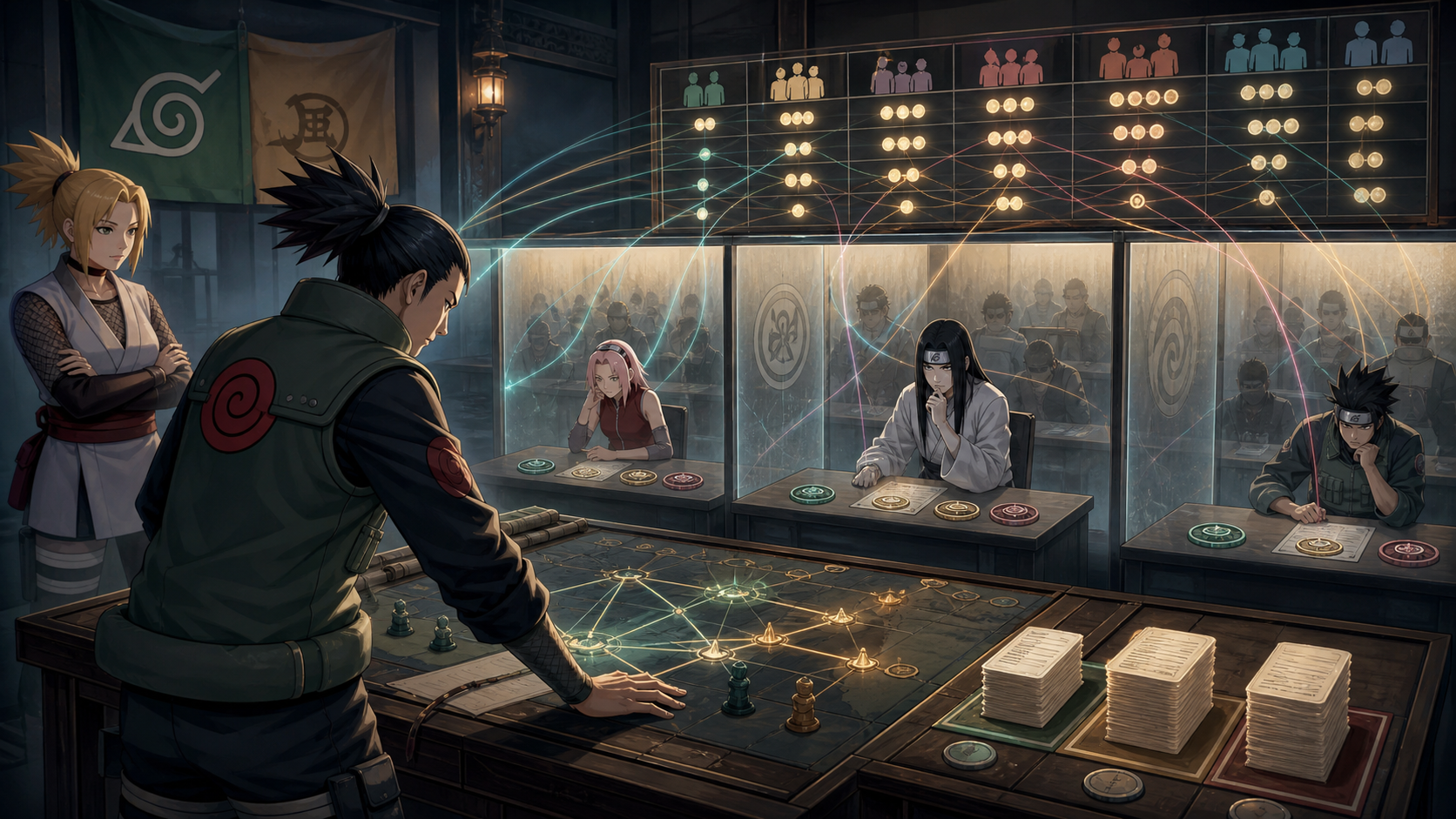
“The Three Questions” lets Shikamaru design a written exam that behaves like a field problem instead of a school quiz. Each three-person team is split across separate rooms. Every candidate must choose one question worth 30, 40, or 50 points. The team has to coordinate toward the required combined result without speaking directly, and the broader scoring rule punishes groups that solve only their own paper while ignoring everyone else. Sakura and Neji realize that knowledge is not the real bottleneck. Communication under separation is. The concept fits chūnin leadership because missions routinely leave teammates with incomplete information, different positions, and no clean channel. The episode also exposes a flaw: hidden rules can test inference, but unclear evaluation can become adult smugness dressed as rigor. Candidates should face difficult judgment. They should also know what skill the institution intends to measure after the test ends. Shikamaru’s puzzle works because teamwork creates the answer, not because confusion is automatically profound.
That distinction matters for every future mission report. A fair debrief should identify the tested skill, explain why a team’s inference succeeded or failed, and turn uncertainty into training rather than preserving mystery as proof of the proctor’s intelligence.
The candidates finally enter Round One
Teams from several villages gather after political negotiations, travel, and registration. The first scored stage begins under Konoha and Suna oversight.
The exam turns diplomatic planning into individual pressure.
Shikamaru serves as proctor
He was the only Konoha candidate promoted during the previous Chūnin Exams. Now he stands on the administrative side while his former peers try again.
One promotion has changed his relationship to the whole cohort.
Temari supports the joint administration
Her presence connects Suna’s authority to the test and keeps the event from looking like a Konoha exam held elsewhere. She also knows Shikamaru’s tactical habits.
Their cooperation gives the alliance a practical face.
Teammates are placed in separate rooms
The candidates cannot rely on normal eye contact, whispered plans, or familiar formation cues. Separation creates the first problem before anyone reads a question.
Communication becomes a resource the proctors deliberately remove.
The test lasts thirty minutes
Time pressure prevents endless analysis and forces candidates to decide with incomplete certainty. A chūnin may have to act before every fact becomes available.
Urgency is useful only when the scenario still allows reasoned choice.
Each candidate chooses one question
The three options carry values of 30, 40, and 50 points. A person can answer only one, so individual performance affects a team total.
The real decision begins with assignment rather than content.
The first question tests protective formation
Candidates must identify the safest general placement for a protected person. The tactical answer depends on controlling exposure and surrounding the target with capable defenders.
Basic doctrine establishes the low-value option.
The second question tests chakra-nature knowledge
Candidates compare elemental advantages against fire and lightning. The problem asks for applied technical understanding rather than memorized terminology alone.
Field leadership requires knowing what a teammate’s technique can counter.
The third question tests terrain analysis
Candidates must explain advantages and disadvantages of attacking from high ground. A complete response needs range, visibility, mobility, exposure, and route awareness.
The highest-value question demands developed judgment rather than one selection.
No single room can coordinate normally
Even a candidate who recognizes the point values cannot tell teammates which question to choose. The sealed rooms turn a simple sum into a communication problem.
Knowledge without shared intent can make a team fail.
The total must satisfy a hidden team logic
Three independent high scores can exceed the allowed ceiling, while timid choices can fall below the comparative floor. Candidates have to think beyond personal correctness.
Individual excellence can damage collective performance when nobody coordinates roles.
Sakura recognizes the structure
Her academic strength helps her read both question content and scoring design. She understands that answering the hardest question is not automatically the best contribution.
Intelligence appears through restraint as well as recall.
Her new team makes the problem harder
Sakura, Ino, and Chōji do not have years of identical exam habits as one permanent cell. They must infer how the others will reason under separation.
Temporary teamwork is tested at the exact point where familiarity would help most.
Ino offers a possible communication advantage
Her clan techniques specialize in mind transfer and coordinated information, but exam restrictions and room separation complicate access. The team cannot assume one signature ability solves every condition.
Rules force them to think about limits rather than labels.
Chōji has to trust the others’ judgment
His role often centers physical power and emotional loyalty. A written puzzle demands patience with information he cannot confirm.
Trust becomes cognitive rather than muscular.
Neji also identifies the real test
His Byakugan, tactical experience, and memory of the previous exam help him question the obvious academic frame. Naruto once passed Ibiki’s test with a blank paper.
Past institutional experience becomes useful evidence.
Naruto’s blank paper remains instructive
He did not demonstrate written knowledge, but he refused to abandon the team under the tenth-question threat. Ibiki was testing resolve and information pressure.
The memory tells Neji to inspect purpose behind format.
Referencing Naruto does not solve the puzzle
Neji still has to analyze current scoring, team separation, and available communication. Inspiration supplies a question rather than a finished answer.
Good influence sharpens judgment instead of replacing judgment.
Neji begins signaling physically
He moves and attracts attention inside the room, attempting to create information through shared observation. The action risks suspicion while testing whether candidates recognize a pattern.
Leadership sometimes means making a plan legible without explanation.
Other teams watch and adapt
The room contains competitors, but information cannot remain private once a signal becomes visible. One candidate’s insight may help rivals.
Collective testing complicates the boundary between leadership and competitive advantage.
The scoring rule creates interdependence across teams
Falling below the average can eliminate a team even if nobody exceeds the ceiling. Every group’s choices affect the benchmark.
Relative evaluation turns strangers into part of the same calculation.
Relative scoring can reward gaming
Candidates may focus on manipulating the average rather than demonstrating field competence. Competitive systems often produce behavior optimized for metrics.
The institution should ask whether the score still measures the intended skill.
Shikamaru designed for indirect communication
He expects candidates to recognize that teammates need coordinated values and to invent a signal across barriers. The puzzle reflects his own habit of seeing structure behind visible problems.
A clever proctor tends to build an exam in his own image.
That design may privilege certain minds
Analytical candidates such as Sakura and Neji can decode hidden rules quickly. Strong field leaders with different processing styles may lose time because the exam rewards puzzle recognition.
One test cannot capture every form of leadership.
Separating teams has operational value
Missions can scatter shinobi through terrain, barriers, ambushes, or conflicting objectives. A leader must maintain shared intent when direct orders fail.
The scenario has a credible field analogue.
Written questions still test useful knowledge
Formation, elemental interaction, and terrain analysis matter even though the scoring puzzle dominates. A chūnin should understand the substance rather than treating answers as tokens.
Meta-reasoning cannot replace technical competence.
The terrain question deserves the highest value
High ground can improve visibility, range, defensive positioning, and control over an approach. The same position can expose silhouettes, limit retreat routes, and become useless against an enemy who controls airspace or underground movement.
A strong answer names conditions instead of repeating the easy slogan that higher ground always wins.
The candidates must allocate risk
Someone may take the 50-point analysis while teammates choose lower values. The choice depends on confidence in unseen partners.
Teamwork includes deciding who carries the hardest burden.
No one can confirm the others’ choices
Even a strong shared plan remains uncertain after separation. Candidates must act from knowledge of teammates’ habits and priorities.
Trust means moving without constant reassurance.
The exam reveals team culture
Some groups assume the strongest member should take the highest value. Others distribute by subject expertise or attempt a signal before answering.
The same rule exposes different ideas about leadership.
Konohamaru tries to enter through disguise
He wants Naruto present and fears missing the route toward chūnin rank. Impersonation turns admiration into an attempt to skip eligibility.
Wanting growth does not authorize fraud.
Neji responds with perspective
He recognizes Konohamaru’s anxiety and helps redirect the disappointment rather than humiliating him. The response shows leadership outside the scored room.
How a candidate treats a younger child may reveal more than a written answer.
Promotion is not a race against Naruto
Konohamaru does not need Naruto physically present for his own future rank to remain possible. Their paths overlap without sharing one schedule.
Admiration should support patience and preparation.
The episode turns exam nostalgia into revision
The first series used cheating, surveillance, and the tenth question. This version keeps hidden-purpose testing while changing the communication problem.
Repetition becomes useful when the institution tries a different lens.
Shikamaru now represents adult authority
He once sat under an intimidating proctor and had to interpret opaque rules. Now he creates opacity for others.
Crossing the desk should make him question which pressures were useful and which were merely cruel.
A debrief would make the test better
Candidates deserve an explanation of the measured skills, failed assumptions, and ethical limits after results are known. Learning should continue even for eliminated teams.
Assessment without feedback wastes the information candidates produced.
The episode values communication over brilliance
Sakura can answer the questions. Neji can analyze the system. Neither can pass a team alone under the scoring structure.
Leadership begins when intelligence becomes shareable.
The pacing suits the smaller arc
After Madara’s battlefield domination, a thirty-minute written test feels almost domestic. The episode creates tension through clocks, sealed rooms, and incomplete knowledge.
Scale changes while consequence remains personal.
Japanese performance claims remain bounded
The final publication should verify Japanese cast and staff credits. Descriptions of Shikamaru’s delivery, Sakura’s concentration, Neji’s realization, or Konohamaru’s frustration require lawful direct listening.
Observed detail belongs where generic praise does not.
The test measures coordination through artificial silence
Separating teammates removes the ordinary communication they would use in a mission and forces them to identify indirect routes. That can reveal trust, pattern recognition, and assumptions about one another.
It also changes the skill being measured. A team that coordinates well through speech may perform poorly under a constraint unrelated to most field conditions.
Hidden rules create insight and fairness problems
Candidates know the questions and time limit but must infer the team-level scoring structure. Discovery may demonstrate judgment under incomplete information, which Chūnin genuinely need.
Evaluators still must ask whether failure came from leadership weakness or from a puzzle whose intended logic depended on cultural knowledge, proctor habits, or luck.
Clan techniques can become unequal communication access
Byakugan, mind transmission, insects, shadows, sensory range, and trained signals may offer different routes across separated rooms. Variety is part of shinobi teams, but the exam should decide which abilities it intends to test.
If some communication is secretly acceptable and other communication is punished, candidates deserve a clear operational boundary rather than selective enforcement after the fact.
Sakura solves structure while rebuilding team trust
Her intelligence lets her recognize that individual correctness cannot be the whole task. She is also working with Ino and Chōji instead of the familiar rhythms of Team 7.
That makes the judgment more demanding. She must predict how new teammates reason without treating either person as a replacement for Naruto or Sasuke.
Ino’s communication skill needs an ethical boundary
Her clan technique could transmit information powerfully, but entering minds or using hidden contact may violate exam rules and personal consent depending on method.
Leadership includes deciding not only what is possible but what is authorized. A clever solution becomes poor judgment if it wins by ignoring another person’s bodily boundary.
Chōji’s trust is active work
He may not control the information network or solve the academic question first, yet he has to choose, commit, and trust that Sakura and Ino will make compatible decisions.
That role is not passive. Teams collapse when members refuse responsibility until the smartest person guarantees an outcome nobody can guarantee.
Neji reads systems because systems shaped him
His Byakugan and tactical intelligence help him observe the rooms, but his history under Hyūga rules also trained him to notice hidden structures controlling individual choices.
The skill has value beyond raw eyesight. Neji understands that a visible question can sit inside a second test whose authority remains unstated.
Physical signaling creates a public resource
Once Neji finds an indirect method, other teams can observe and adapt. His solution changes the room rather than benefiting only his unit.
That spillover may demonstrate leadership, yet relative scoring can punish the person who shared useful information if rivals exploit it more efficiently. Evaluation should recognize contribution to collective function.
Relative scoring encourages strategic sabotage
When one team’s success depends partly on how others answer, candidates may benefit from misinformation, copying, or manipulating visible signals. Those behaviors can reveal tactical awareness and undermine the cooperation the joint exam supposedly promotes.
Designers need to decide whether they are testing leadership or manufacturing incentives that reward distrust between future allies.
The terrain question values planning under uncertainty
Route choice, visibility, cover, resource access, enemy movement, evacuation, and team composition all shape a field decision. No universally correct answer exists outside context.
That makes the question useful if graders reward stated reasoning rather than a preferred conclusion. Chūnin need to explain tradeoffs, not guess what an authority wants.
Written knowledge and field judgment should connect
Chakra nature and formation questions test information that can protect lives. Memorization alone does not show whether a candidate recognizes when the rule applies or when local evidence requires adaptation.
A strong exam pairs concepts with reasons, consequences, and opportunities to revise after new information arrives.
Shikamaru’s authority needs transparency
He understands indirect strategy and designed a test shaped by his strengths. That may produce a smart challenge while privileging candidates who think like him.
Good proctoring requires multiple evaluators, documented criteria, accommodations, and review. Personal brilliance should not become an invisible standard everyone else must imitate.
Temari’s role adds cross-village accountability
She can challenge Leaf assumptions, explain Sand expectations, and observe whether candidates from different systems receive comparable treatment. Her presence should be more than administrative support.
A joint exam gains legitimacy when each host has real authority to question design and halt a process that becomes unsafe or biased.
Konohamaru’s disguise exposes access pressure
He wants advancement and sees older peers moving ahead, but eligibility rules exist for developmental and safety reasons. Sneaking in does not prove readiness.
Adults should explain the pathway and hear his frustration rather than turning the incident into pure comedy. Gatekeeping becomes healthier when criteria are understandable and appeal is possible.
A debrief would convert performance into learning
Candidates need to hear what the questions measured, which communications were allowed, how scoring worked, and why particular choices succeeded or failed. Without that explanation, the institution collects judgment while withholding education.
Promotion matters, but every participant should leave better able to protect a future team, including those who do not pass.
Accessibility belongs inside that fairness review too. A candidate with limited vision, hearing, mobility, reading speed, trauma responses, or a communication disability may understand leadership while being blocked by the room’s chosen format. Accommodations do not reveal answers or lower the standard. They remove barriers unrelated to the skill being judged. The exam should document what aid is allowed, protect medical privacy, and train proctors to distinguish adaptation from cheating. Otherwise the village will promote whoever best fits one narrow testing body and then call the result merit in the real field today.
RaeRae’s verdict
“The Three Questions” gives Shikamaru a smart exam because the written answers are only half the job. A future chūnin needs tactical knowledge, but a leader also needs to understand what teammates know, what they cannot hear, and how to coordinate without ideal conditions. Separating every team turns 30, 40, and 50 points into a trust problem.
The puzzle still carries adult-exam nonsense. Hidden rules can reward insight, yet institutions should not confuse surprise with depth. Sakura and Neji recognize that chasing the hardest personal score could destroy the team result. That lesson works. A candidate who misses Shikamaru’s preferred trick may still become an excellent leader through other skills. The best version of the exam includes a real debrief and treats failure as information, not proof that a teenager lacks worth.
RaeRae’s call
The three questions are smarter than a trivia quiz because the real problem is distributed judgment. Sakura, Ino, Chōji, Neji, and every team must act without confirmation. The exam still owes them fairness. Hidden rules, clan-technique advantages, relative scoring, and a design built around Shikamaru’s mind can measure the puzzle more than leadership. A proper debrief is not optional decoration. If the institution wants better field leaders, it must explain what it learned, hear challenges, and give every candidate knowledge they can use after the score is posted.
Episode details and viewing routes
- Official episode reference: Naruto Official episode guide
- Licensed episode route: Crunchyroll licensed episode page
What I am carrying forward
Shikamaru and Temari separated teammates into three rooms for a thirty-minute written test. Candidates chose among questions worth 30, 40, and 50 points while team totals and the overall average controlled elimination.
Sakura and Neji began recognizing that the true challenge involved coordination without direct communication. Neji used the previous exam and Naruto’s blank-paper success to question the obvious academic frame. Episode 397 completes the written round with a leadership decision that tests whether teams will sacrifice one member.