
RaeRae Reacts · One Piece Episode 124
Thirty Seconds to Stop the Cannon
One Piece Episode 124 gives Luffy a blood-based counter to Crocodile while the clock tower reveals its cannon with thirty seconds left.
Quick reaction
One Piece Episode 124 takes away Luffy’s water, gives Crocodile a poison blade, starts dropping the ceiling, shoots Pell out of the sky, and then opens the clock face with thirty seconds left. Subtlety has evacuated Alubarna.
Luffy solves Crocodile’s intangibility with blood on his fists and feet. Aboveground, Tashigi brings Marines into the cannon search, the remaining Straw Hats converge on the clock tower, and Mr. 7 with Miss Father’s Day reveal the weapon at the final possible moment.
RaeRae’s bottom line: every solution now has a body attached. Luffy uses his own blood, Pell pays for reconnaissance, and the search team reaches the answer with almost no time left to survive that answer.
The episode also refuses to pause one emergency while another receives attention. Nobody aboveground knows exactly how Luffy is surviving below. Luffy cannot see the clock face open. Pell cannot guarantee that anyone understood where he was shot. Tashigi has to support pirates without a formal command agreement. Shared purpose exists, but shared information remains incomplete. Every group acts from a partial picture and trusts that somebody else is covering the missing half.
Blood becomes Luffy’s last access point
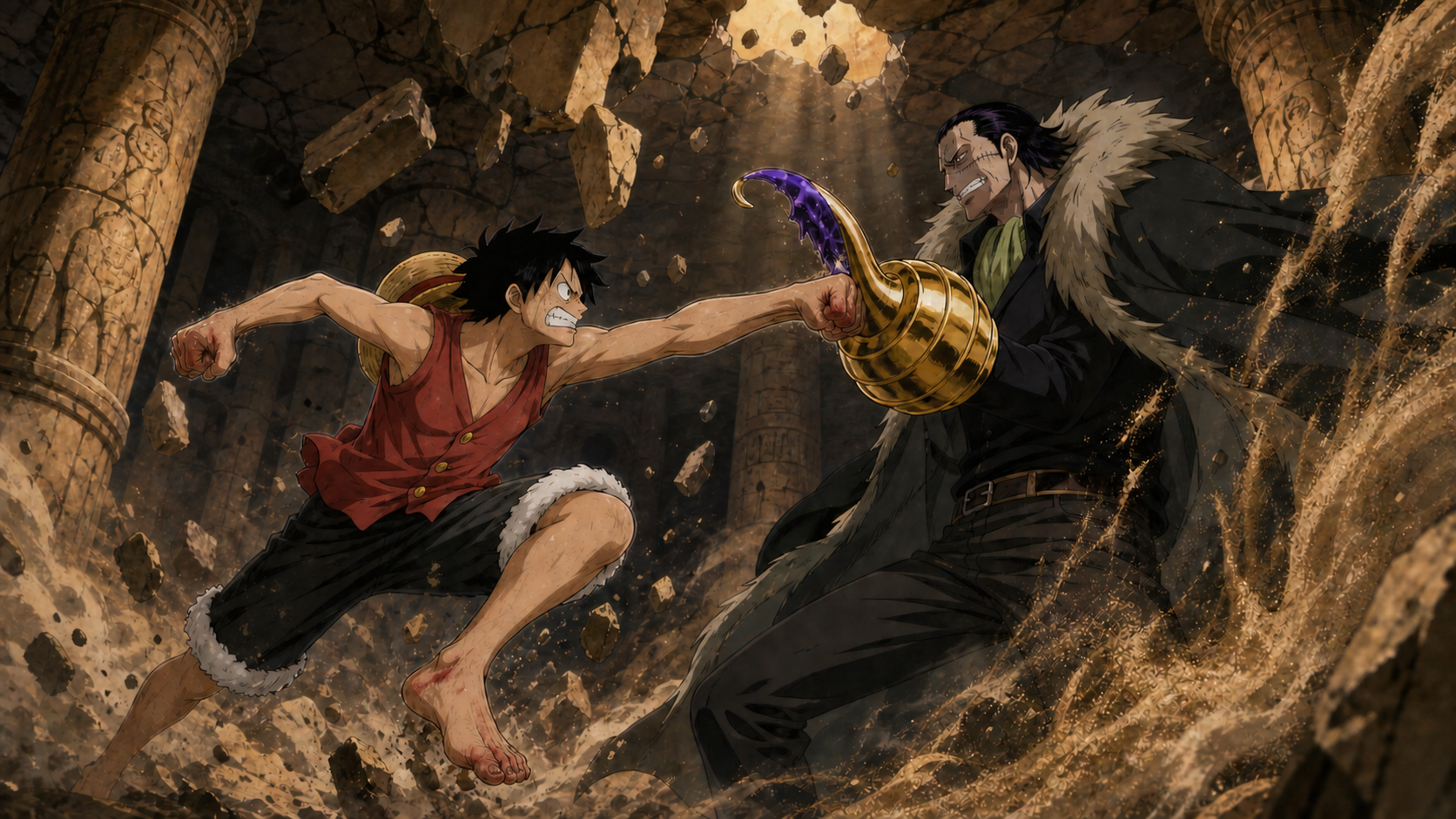
Luffy no longer has enough water to keep Crocodile wet, so he uses blood from his own injuries. Moisture on his fists and feet prevents the sand body from dispersing cleanly, allowing strikes to land.
The tactic follows the same evidence as Water Luffy while adapting to scarcity. Crocodile’s weakness is not a branded substance. Moisture changes the material conditions of sand, and Luffy uses the only available source.
This is clever, desperate, and costly at once. Every attack depends on an injury that also reduces strength, increases infection risk, and may become harder to control during exertion. Tactical access does not make blood loss harmless.
Luffy also has to keep the smear in the correct place. Blood on an arm does nothing if the dry fist passes through sand. Blood lost onto the floor spends the resource without creating contact. Crocodile can target already injured limbs, force distance, or wait for clotting to reduce coverage. The countermeasure therefore demands accuracy under pain, falling debris, and poison threat. Improvisation has become a maintenance problem.
A body should not become an unlimited supply
Stories often frame self-sacrifice as proof of commitment. Episode 124 makes the physical cost visible enough that commitment cannot erase the danger.
Luffy’s body is not spare equipment. Using blood as a combat tool consumes a resource required for oxygen transport, temperature regulation, healing, and consciousness. Continued bleeding can turn a winning tactic into delayed collapse.
The crew would never approve a plan based on unlimited blood loss, but Luffy fights underground without medical backup or safer materials. The scene works as emergency improvisation, not a general recommendation for leadership through bodily destruction.
Crocodile reveals the poison spike
Crocodile’s golden hook contains a concealed poison blade. The weapon adds another countdown inside a room already collapsing.
A poisoned puncture can keep causing harm after contact ends. Luffy may need an antidote, toxin identification, wound cleaning, and rapid extraction even if Crocodile falls. Winning the duel would not stop poison already circulating.
The concealed spike also reveals how Crocodile defines combat. He does not rely only on Devil Fruit power or physical skill. He layers sand, dehydration, a heavy hook, hidden mechanisms, and toxin so that surviving one system exposes the opponent to another.
The collapsing sanctuary removes safe distance
Cobra’s mechanism destabilizes the underground chamber while Luffy and Crocodile fight. Falling stone narrows movement, interrupts sight lines, and turns every surface into a possible impact hazard.
Neither fighter controls the collapse schedule. Crocodile may believe experience gives him an advantage, but sand movement cannot guarantee protection from every blocked route or buried air pocket. Luffy’s elasticity does not prevent crushing, suffocation, or isolation.
The duel now needs an exit plan. Cobra and Robin also remain below, and rescue becomes harder with every broken corridor. A final punch must leave enough time and strength to reach them.
Pell finds the clock tower and gets shot
Pell’s aerial search brings him close to the hidden firing position, but Miss Father’s Day shoots him. The attack confirms that the gunner has prepared defense as well as concealment.
A reconnaissance asset becomes vulnerable at the moment the asset approaches useful information. Pell may see the threat without having time to report coordinates, weapon type, or access route.
Search plans need a missed-check-in protocol. If the aerial scout disappears near one sector, ground teams should treat that silence as evidence and converge. Communication failure can carry location data when the team knows where the last contact occurred.
Pell’s injury needs more than admiration
Falling after a gunshot can combine penetrating trauma, impact injury, and disorientation. A rescuer should control bleeding, protect the spine when possible, assess breathing, and move him away from the weapon’s line of fire.
Praising courage should never replace care. Pell’s information and survival both matter.
Tashigi turns Marine presence into practical support
Tashigi directs Marines to assist the search rather than treating pirates as the only immediate problem. That choice puts civilian protection ahead of institutional rivalry.
Uniformed personnel can establish search sectors, relay sightings, protect evacuation lanes, and bring more eyes to the city’s upper structures. They can also become targets for Baroque Works agents who benefit from confusing authority.
Tashigi needs clear rules of engagement so Marines do not fire into crowded routes or detain allies carrying urgent information. Cooperation does not require ignoring future accountability. Cooperation requires ranking the cannon above lower-priority arrests for the next few minutes.
The Straw Hats converge on the clock tower
Everyone except the wounded Pell reaches the clock tower with Marine support. Convergence proves that Vivi’s clue traveled through the network and changed each team’s route.
The tower makes sense as a firing position because height, structural strength, visibility, and civic familiarity all hide in one landmark. Residents see a clock, not a weapons platform. The same public object that coordinates daily time conceals the deadline for mass death.
Reaching the tower is only the beginning. The team still needs to locate the chamber, gain vertical access, defeat the operators, secure the explosive, and move civilians before detonation.
Hidden architecture defeats an obvious search
The cannon remains invisible because the clock face functions as a door. Searchers looking only for an exposed barrel can clear the tower and still miss the weapon.
Concealment uses expectation. People assume a clock face displays time, a wall supports a room, and a landmark belongs to public life. Baroque Works turns those assumptions into camouflage.
Effective searches must inspect moving panels, hollow spaces, recent modifications, ammunition routes, ventilation, and unusual structural loads. A weapon large enough to strike the plaza cannot exist without support systems, even when the muzzle stays hidden.
Mr. 7 and Miss Father’s Day are not decorative guards
The two agents operate the cannon and defend the position. Their assignment requires timing, marksmanship, knowledge of the mechanism, and willingness to kill thousands from a protected distance.
Distance does not reduce responsibility. The operators understand the crowded target and the planned outcome. Following Crocodile’s order does not transform mass violence into neutral technical work.
The search team must assume both agents have traps, firing lanes, and a final-action procedure. Disarming the visible operator may not stop an automatic fuse or a second trigger.
Thirty seconds changes every acceptable choice
The clock face opens with thirty seconds remaining. Investigation ends. Immediate intervention begins.
The team cannot safely study every wire, interview the operators, or calculate a perfect disposal route. They need the fastest credible action: interrupt firing, separate the payload from the barrel, redirect the muzzle, disable ignition, or move the explosive away from the plaza.
Each option carries risk. A rushed strike may trigger detonation. Moving the shell may expose the carrier. Redirecting the barrel may transfer danger to another neighborhood. The correct choice depends on mechanism details the team has seconds to observe.
Clear role assignment still matters inside thirty seconds. One fighter should engage the operators, one should inspect the firing system, one should secure the payload, and one should relay evacuation status. Everyone striking the same target may look decisive while leaving the fuse untouched. Urgency rewards coordination more than volume.
The clock tower turns time into a weapon
A civic clock normally creates shared time. Baroque Works uses that trust to conceal private timing for catastrophe.
The public can see the hands without knowing that the structure contains another countdown. That asymmetry mirrors Crocodile’s political operation: citizens see institutions and symbols while hidden agents control the lethal mechanism inside.
Reclaiming the tower therefore means more than stopping one shot. Alabasta will need to inspect public infrastructure, document alterations, and restore trust through transparent repair.
Two battlefields depend on moisture and time
Underground, Luffy needs blood moisture to strike Crocodile before poison or collapse ends the fight. Aboveground, the team needs seconds to stop a cannon before the plaza disappears.
Both conflicts punish delay, but speed alone can create new harm. Luffy cannot trade every drop of blood for one more punch. The tower team cannot hit every mechanism without identifying the explosive path.
The episode pairs bodily scarcity with temporal scarcity. Every character acts with less than enough of the resource required.
The civil war remains inside the blast zone
Even after the cannon appears, soldiers and rebels continue fighting below. Most do not know the weapon exists or that allies are racing above them.
Stopping the shell protects people who may never see the intervention. That invisibility does not reduce the value of rescue. Effective emergency work often succeeds by preventing an event the public never experiences.
If possible, Marines and royal messengers should broadcast evacuation and ceasefire signals immediately. The search team cannot assume successful disarmament until somebody confirms the weapon is safe.
Production choices make parallel danger legible
Michiru Shimada’s script connects Luffy’s blood tactic, Crocodile’s poison, Pell’s injury, Tashigi’s support, the clock-tower convergence, and the final reveal without losing the relationship between the two locations.
Yuji Endo’s direction uses the collapsing sanctuary for close pressure and the tower search for expanding movement, then compresses both through the countdown.
Takayuki Shimura’s animation direction keeps blood-wet impacts, the poison hook, aerial gunfire, and opening clock panels distinct. Miyuki Sato and Michiyo Kawasaki contrast underground stone weight with the exposed height of Alubarna’s tower.
What Episode 124 changes
Luffy uses blood on his fists and feet to make Crocodile’s sand body tangible during the underground fight.
Crocodile reveals a poison spike inside his hook while the royal sanctuary continues collapsing.
Miss Father’s Day shoots Pell, but Tashigi and the Marines help the remaining search teams converge on the clock tower.
With thirty seconds left, the clock face opens and reveals the cannon, Mr. 7, and Miss Father’s Day.
Episode details
Japanese title: 悪夢の時迫る!ここは砂砂団秘密基地
English title: The Nightmare Draws Near! The Sand-Sand Clan’s Secret Base
Japanese broadcast: September 1, 2002
Saga: Alabasta
Material: Manga-canon adaptation
Script: Michiru Shimada
Episode direction: Yuji Endo
Animation direction: Takayuki Shimura
Art: Miyuki Sato and Michiyo Kawasaki
The official One Piece guide confirms Luffy fighting with blood-wet fists and feet, Crocodile using the poison spike, Miss Father’s Day shooting Pell, Tashigi supporting the search with Marines, the teams gathering at the clock tower, and the clock face opening to reveal the cannon and its operators thirty seconds before firing. The medical, search, infrastructure, labor, emergency-response, verification, and accountability analysis is RaeRae’s reading of those events.
Final verdict
Episode 124 earns a 9.8 out of 10. The blood tactic makes Luffy’s adaptation visceral without pretending sacrifice is free.
Tashigi demonstrates that justice can mean helping people before sorting alliances. Pell finds the danger and pays for proximity. Vivi’s clue brings everyone to the right structure, but the structure waits until thirty seconds remain before revealing the actual problem.
Alabasta has reached the stage where every hidden system becomes visible at once: poison inside a hook, a cannon inside a clock, agents inside public life, and a countdown inside a civil war. The heroes finally know where the nightmare lives. Knowledge arrives with half a minute attached.