
RaeRae Reacts · One Piece Episode 123
Run to the Royal Tomb
One Piece Episode 123 revives Luffy with a lucky splash while Crocodile betrays Robin and Cobra starts the royal tomb collapse.
Quick reaction
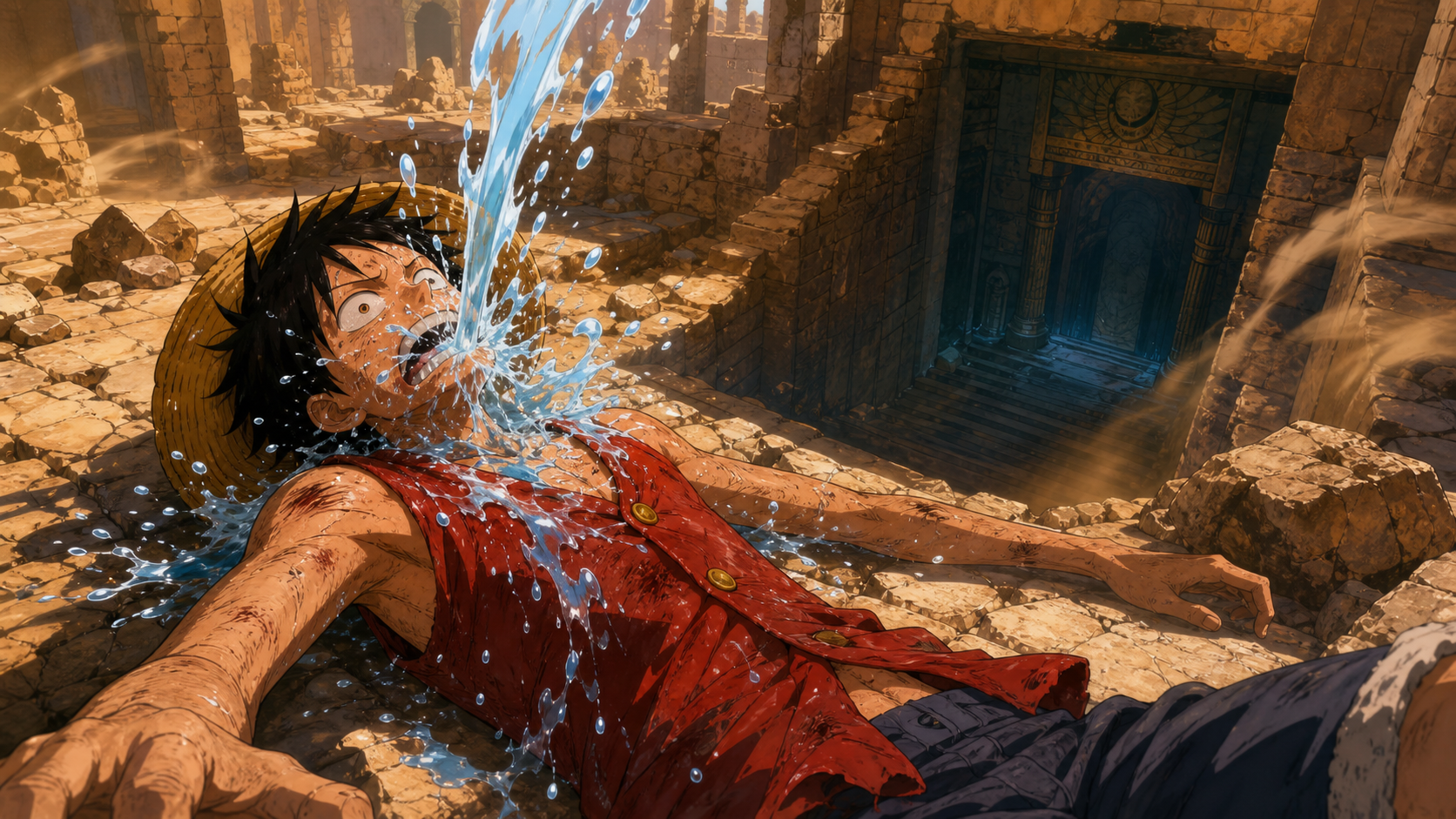
One Piece Episode 123 turns a missed attack into life support, exposes the fault line between Crocodile and Robin, and finally gives Vivi the clue that could locate the cannon. Luffy fires water, misses, gets dehydrated, and then survives because the same water falls back onto him. Physics has entered the group chat wearing a straw hat.
Below Alubarna, Robin reads the poneglyph and says Pluton is not recorded there. Crocodile answers by stabbing the partner who gave him access. Cobra activates the royal tomb’s collapse mechanism. Aboveground, Vivi realizes the cannon may be hidden where the search teams were not looking. Luffy takes a nap, wakes, and runs toward the underground sanctuary.
RaeRae’s bottom line: luck saves Luffy’s body, but choices reveal everybody else.
The episode also understands that a crisis can become more dangerous after the villain leaves the visible battlefield. Crocodile walking underground does not reduce his control. His cannon still has a schedule, his agents still occupy hidden positions, and his knowledge hunt moves into a chamber where outside witnesses cannot intervene. The heroes have to follow separate evidence trails without losing the shared goal of keeping Alabasta alive.
Luffy’s missed water becomes an emergency reserve
Luffy loses his stored water during the fight, and Crocodile drains the remaining moisture from his body. The result looks final because dehydration removes movement, volume, and the ability to keep fighting.
The water Luffy launched earlier falls back across him by chance. His rubber body absorbs enough moisture to recover shape and consciousness. The same failed shot becomes a delayed rescue resource.
Luck deserves the correct label. Luffy did not schedule the splash or calculate the arc as a backup system. He created the possibility by bringing water, then survived because the environment returned part of that supply. Preparation and accident can occupy the same scene without turning accident into strategy.
Dehydration is not a comedy-only injury
Crocodile’s power removes water rapidly enough to deform a living body. Luffy’s rubber physiology makes the visual exaggerated, but the underlying danger remains severe.
Restoring fluid does not automatically repair shock, tissue stress, fatigue, or impaired judgment. A revived fighter may still need time, shade, electrolytes, and medical observation. Luffy receives almost none of those protections because the national emergency continues.
Fans can laugh at the flattened shape and still recognize that Crocodile uses environmental control as bodily violence. The joke belongs to Luffy’s impossible recovery, not to the harm itself.
The nap is absurd and medically understandable
Luffy falls asleep after recovering. The timing looks outrageous beside a cannon countdown, yet extreme exertion and dehydration can produce sudden exhaustion.
His body has survived impalement, burial, a second duel, moisture loss, and rapid rehydration. A short shutdown becomes the least surprising part of that sequence. The problem is not that rest happens. The problem is that nobody can guarantee how long rest will last.
Emergency teams normally protect an unconscious person, monitor breathing, and control the environment. Luffy has no formal team nearby, so his recovery depends on luck again. Heroic endurance should never be confused with adequate care.
Survival does not finish the rematch
Luffy’s revival prevents Crocodile from winning by abandonment, but Crocodile has already moved toward the underground sanctuary. The duel changes locations rather than ending.
Chasing immediately would waste the recovery if Luffy collapses before reaching the tomb. Waiting too long gives Crocodile time with Cobra, Robin, and the poneglyph. The nap creates a tradeoff between physical readiness and mission urgency.
When Luffy wakes, the best available move is pursuit. Crocodile’s destination concentrates the people and information most at risk. The cannon remains another team’s responsibility because no one fighter can cover every front.
The poneglyph carries more than one audience
Robin reads the stone as a historian searching for forbidden truth. Crocodile listens as a military actor searching for Pluton’s location. Cobra hears both as a king responsible for protecting Alabasta’s archive.
One record can hold different meanings depending on who controls interpretation. Historical text may preserve memory, expose state violence, guide scholarship, or become a weapon map. The stone does not choose among those uses.
Access therefore needs ethical context, not only technical ability. Robin can read the script, but Crocodile controls the room through force. Cobra knows the site, but captivity removes his control over disclosure.
Robin says Pluton is absent
Robin tells Crocodile that the poneglyph does not contain the information he wants. Her statement creates an immediate verification problem because he cannot read the text himself.
He has built years of planning around a translator whose interests he never fully understood. The moment her answer blocks his goal, he treats the dependency as betrayal.
Whether Robin reports every inscription or withholds part of the record, Crocodile created the conditions for distrust. A partnership based on coercion, secrecy, and disposable labor cannot produce reliable collaboration.
Crocodile attacks the person who made access possible
Crocodile drives his hook through Robin after hearing that Pluton is not recorded on the stone. The violence reveals the true contract behind Baroque Works. Expertise has value only while expertise serves him.
Robin recruited agents, managed operations, reached the royal tomb, and supplied the literacy he lacked. None of that labor creates safety once her answer disappoints him.
Calling the attack a business disagreement would erase coercive power. Crocodile controls the weapon, the location, and the escape route. Robin faces retaliation for delivering information the client does not want to hear.
Expert testimony needs protection from the client
Translators, researchers, analysts, and archivists need freedom to report findings without pressure to manufacture a preferred answer. Otherwise every negative result becomes dangerous.
Independent review, preserved notes, and multiple qualified readers can reduce that risk. Alabasta’s forbidden script and Crocodile’s secrecy remove those safeguards, leaving Robin as the only readable interface between stone and ambition.
Robin’s choices still carry accountability
Crocodile’s betrayal does not erase Robin’s role in Baroque Works. She helped an organization engineer civil conflict, recruit agents, and pursue protected state knowledge through violence.
Victimization and responsibility can coexist. Naming the attack against her does not require pretending earlier harm never happened. Naming earlier harm does not make the attack deserved.
The episode gains moral complexity by refusing a clean category. Robin is neither a loyal henchwoman nor an innocent visitor. She is a knowledgeable actor whose alliance collapses under the same disposability imposed on everyone beneath Crocodile.
Cobra activates the tomb’s collapse mechanism
Cobra triggers a system designed to bring down the underground sanctuary. His decision aims to deny Crocodile escape and protect the kingdom from whatever comes next.
Structural collapse is a last-resort containment measure with enormous risk. Cobra, Robin, Crocodile, and anyone entering the tomb may be trapped or crushed. Dust, blocked air, unstable stone, and secondary failures can continue after the first impact.
The mechanism also shows that the royal family anticipated an intrusion serious enough to justify destroying its own sacred site. Defensive architecture preserves secrecy by making the archive and its guardians expendable together.
Scorched-earth security has a human cost
Destroying an archive can deny an enemy access, but destruction also removes cultural heritage, future scholarship, and evidence that may belong to the public.
Cobra makes the choice under captivity, time pressure, and national threat. Those conditions explain the decision without making every consequence disappear.
A safer security design would separate the protected text from occupied chambers, create controlled evacuation routes, and allow partial containment. Alabasta’s mechanism offers a binary choice because ancient builders prioritized denial over recovery.
Vivi finds the clue by changing the question
Search teams have checked obvious elevated firing positions without finding the cannon. Vivi’s breakthrough comes when she reconsiders the assumption that the weapon must look like a visible rooftop emplacement.
When a search fails, repeating the same route faster rarely solves the underlying model error. The team needs to ask where sound, range, concealment, structural support, and access intersect. A hidden position may exploit a clock tower, internal chamber, or disguised architectural feature.
Vivi’s local knowledge matters because she understands which structures command the plaza and which spaces outsiders might overlook. The clue belongs to someone who knows the city as lived geography rather than a battlefield map.
The cannon search needs immediate convergence
Once Vivi forms a likely location, every searcher needs the update. Separate teams should stop clearing low-probability sectors and converge without creating crowding or blocking evacuation.
A confirmation team can approach the suspected weapon while a second team warns the plaza and a third prepares casualty response. If one group carries every responsibility, a trap at the cannon can prevent the warning from spreading.
The remaining minutes demand concise communication: location, route, threat, required skills, and fallback signal. Dramatic realization becomes useful only when other people can act on the realization.
Luffy runs toward a collapsing underground site
After waking, Luffy heads for the royal tomb. He knows Crocodile moved below, though he may not know every detail about the collapse mechanism or Robin’s injury.
Underground pursuit changes combat conditions. Narrow passages reduce maneuvering space, falling stone can interrupt attacks, and dust makes breathing and visibility worse. Water access may also be limited.
Luffy’s goal should include extraction, not only victory. Cobra and Robin may need rescue, and defeating Crocodile means little if the sanctuary buries everyone before they can leave.
Three clocks now govern the episode
The cannon has a countdown. The tomb has a collapse sequence. Luffy’s body has a recovery limit. Each clock operates independently.
Stopping one does not pause the others. Vivi can locate the gunner while stone falls underground. Luffy can reach Crocodile while armies remain inside the blast zone. Cobra can trigger containment while allies are still approaching.
The structure creates tension through coordination rather than mystery alone. Viewers understand the tasks and fear that success will arrive in the wrong place at the wrong second.
Production choices turn coincidence into momentum
Michiru Shimada’s script connects Luffy’s missed water, Robin’s report, Crocodile’s betrayal, Cobra’s collapse mechanism, Vivi’s clue, and Luffy’s pursuit as consequences rather than isolated twists.
Junji Shimizu’s direction gives Luffy’s revival comic timing without allowing the underground violence to feel light. The tonal shift stays readable because each location keeps its own immediate danger.
Kenji Yokoyama’s animation direction makes the water splash, dehydrated body, hook attack, and destabilizing stone visually distinct. Miyuki Sato and Fumihiro Uchikawa contrast sunlit ruins with the tomb’s enclosed historical weight.
What Episode 123 changes
Water from Luffy’s missed attack falls back and revives him after Crocodile dehydrates his body.
Robin tells Crocodile that the poneglyph does not record Pluton’s location, and Crocodile attacks her with his hook.
Cobra activates the royal tomb’s collapse mechanism while Vivi identifies a new clue about the cannon’s hiding place.
Luffy wakes from a brief recovery sleep and heads toward the underground sanctuary.
Episode details
Japanese title: ワニっぽい!王家の墓へ走れルフィ!
English title: That Looks Croc-ish! Luffy, Run to the Royal Tomb
Japanese broadcast: August 25, 2002
Saga: Alabasta
Material: Manga-canon adaptation
Script: Michiru Shimada
Episode direction: Junji Shimizu
Animation direction: Kenji Yokoyama
Art: Miyuki Sato and Fumihiro Uchikawa
The official One Piece guide confirms Luffy reviving when water from his missed attack falls onto him, Robin saying the poneglyph lacks Pluton information, Crocodile stabbing Robin, Cobra starting the underground sanctuary collapse, Vivi realizing where the cannon may be hidden, and Luffy heading below after a nap. The medical, archival, labor, security, search, verification, emergency-management, and accountability analysis is RaeRae’s reading of those events.
Final verdict
Episode 123 earns a 9.6 out of 10. A falling splash saves Luffy, but coincidence never saves the larger mission.
Robin’s knowledge cannot protect her from a partner who values answers more than people. Cobra’s security mechanism cannot distinguish invader from captive. Vivi’s realization cannot stop the cannon until the team reaches the weapon. Luffy’s recovery cannot defeat Crocodile until he enters the collapsing tomb.
Every solution arrives with another obligation attached. That pattern keeps the episode from feeling convenient even when literal water falls from the sky at exactly the right moment. Luffy receives one accidental second chance. The rest of Alabasta still needs deliberate action before three clocks reach zero.