
An Opening
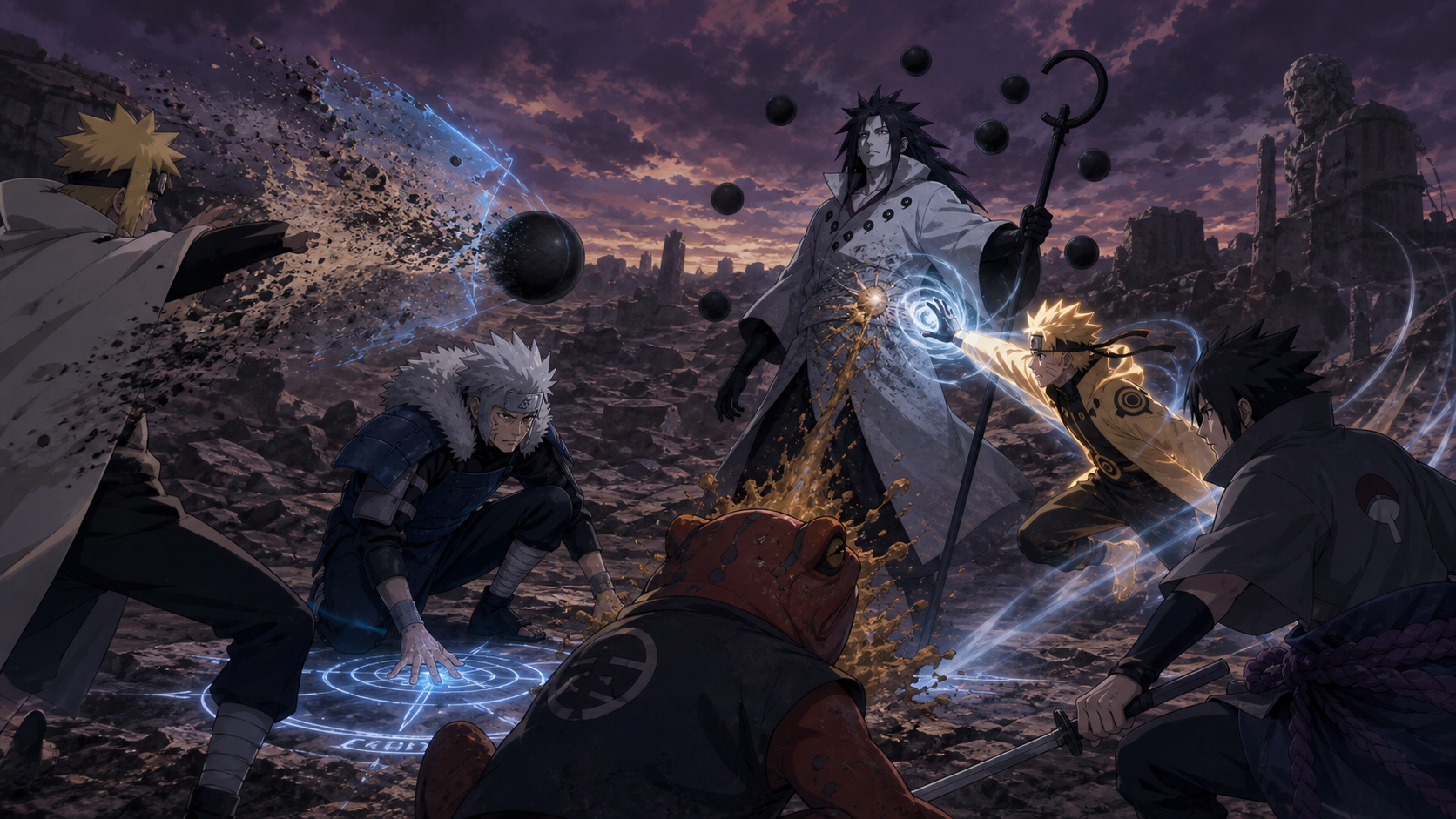
Every failed attack narrows the rule until Minato’s injury, Tobirama’s analysis and Gamakichi’s natural energy give Sage Mode Naruto one usable opening.
Bottom line
“An Opening” makes the alliance earn one usable fact at a time against a body that invalidates familiar rules. Obito’s black spheres sever Minato’s arm and prevent the reanimated limb from returning. Tobirama infers that Yin–Yang Release is canceling ninjutsu, which means the Hokage cannot rely on endless regeneration. Naruto and Sasuke combine attacks, Minato and Tobirama exchange marks and positions, and every failed attempt narrows the problem. Gamakichi’s natural-energy attack leaves a visible effect where ordinary ninjutsu vanished. Naruto recognizes the difference, enters Sage Mode, and lands a Rasengan with Tobirama’s teleportation support. The breakthrough belongs to observation and shared technique, not a random new power. Obito mocks Minato as a failed teacher and Hokage. Naruto answers best by using what Jiraiya taught him and what Tobirama notices to protect people Minato cannot reach alone.
Obito now controls the transformed body
The unstable movements from the previous episode give way to deliberate speed, targeting, and technique. His recovered identity makes the Ten-Tails power tactically coherent.
The alliance is fighting a thinking host rather than a creature in crisis.
The black spheres alter every assumption
They shift shape between shields, projectiles, and weapons while neutralizing ninjutsu on contact. Familiar defenses can disappear instead of absorbing damage.
Versatility forces the alliance to observe each use rather than assign one simple category.
Minato loses an arm
Obito’s attack severs part of his reanimated body before the Fourth Hokage can escape cleanly. The injury shows that extraordinary reflexes are not enough against an unknown mechanism.
Speed still depends on correct information.
The scene also denies Minato the comfort of solving danger through reflex alone. His reputation was built on arriving before catastrophe, yet Obito now controls an attack whose governing rule remains unknown. Losing the arm turns legendary speed into evidence gathering for everyone else. The failure has value only because Tobirama reads the result and the team changes its assumptions.
The arm does not regenerate
Reanimation normally reconstructs damaged tissue. The missing limb remains absent after contact with the black sphere.
A visual failure in an expected process becomes the first major clue.
Tobirama notices the rule change
He compares the injury with known Reanimation Jutsu behavior and Obito’s comments. His analysis points toward Yin–Yang Release canceling ninjutsu rather than inflicting ordinary damage.
Good intelligence begins by naming the broken expectation.
The Hokage lose their renewable-body advantage
They entered the fight able to test lethal attacks because conventional destruction would reform. Obito’s power makes each contact potentially permanent.
The tactical budget changes immediately.
Reanimated status never meant invulnerability
Seals, soul effects, and specialized techniques have always threatened the dead fighters differently from ordinary wounds. Obito adds another mechanism.
Labels such as immortal become dangerous when treated literally.
A black sphere remains attached to Minato
The enemy turns injury into a delayed threat by leaving destructive material on the severed arm. Nearby fighters face danger even after the first strike ends.
Contamination can be more dangerous than impact.
Tobirama responds through transportation
He uses Flying Raijin to move the attached threat away from allies and return danger toward Obito. The technique solves placement rather than trying to overpower the sphere.
Spatial judgment becomes defense.
Shared technique creates unexpected teamwork
Minato developed the Flying Raijin from Tobirama’s earlier work. The two Hokage use compatible markings and rapid interpretation across generations.
Inheritance becomes most useful when successors adapt rather than merely imitate.
Tobirama’s combat mind stays unsentimental
He identifies a hazard, calculates timing, and acts without needing a long explanation. That decisiveness keeps Naruto and Sasuke alive during exchanges that leave almost no margin.
Clarity under pressure is a form of care.
Minato confronts Obito as a former student
Recognition makes every attack carry the history of Team Minato, Rin’s death, and the Nine-Tails assault on Konoha. Minato understands that the masked man who killed him and Kushina was once a child in his care.
The knowledge arrives during combat, not inside a safe reckoning.
Obito calls Minato a failure
He points to the teacher who did not reach him when the cave, Madara, and Rin’s death changed his life. The accusation lands because Minato was responsible for a team of children in wartime.
Responsibility deserves examination without granting a teacher omnipresence.
The shinobi system failed the whole team
Obito was crushed during a mission, Rin was made into a tailed-beast weapon, and Kakashi was forced into lethal choices before adulthood. Minato operated inside a structure that normalized those assignments.
Personal regret should include institutional criticism.
Obito uses failure as total condemnation
Because Minato could not prevent every tragedy, Obito treats the teacher’s ideals and the real world as worthless. The argument repeats his demand for perfect protection.
Human limitation does not prove that care was fraudulent.
Minato’s guilt can slow judgment
Seeing Obito may pull attention toward what should have happened years ago. The battlefield still requires him to protect Naruto and the alliance in the present.
Guilt becomes useful only when guilt informs action rather than paralysis.
Naruto rejects the attack on his father
He has his own complicated claim against Minato: the sealing, childhood loneliness, and a life shaped by Kurama. Naruto can hold that history while refusing Obito’s conclusion.
The son’s defense does not require calling every parental choice correct.
Naruto knows what inherited loneliness feels like
Obito and Naruto both grew up craving recognition and carrying losses. Naruto received relationships that helped him keep participating in reality.
Similarity gives him standing to challenge inevitability without making their conditions identical.
Sasuke cooperates without joining the family argument
His focus remains the immediate opponent and the combined assault. He brings Sharingan perception and controlled flame to a problem requiring precise timing.
Not every teammate needs the same emotional motive for cooperation.
Combined attacks test the defense
Naruto and Sasuke align techniques to increase pressure and force Obito to reveal responses. Even unsuccessful attacks provide data about speed, cancellation, and positioning.
Failure becomes useful when somebody records the mechanism.
Obito catches both attackers
His speed and reach allow him to seize Naruto and Sasuke before their confidence becomes a finishing move. The moment exposes how quickly coordinated offense can become paired vulnerability.
Standing together helps only when escape routes remain available.
Minato and Tobirama exchange positions
Their Flying Raijin coordination moves people through marked space and confuses Obito’s expectation. Rescue becomes a sequence of placements rather than a single dramatic block.
Technical teamwork saves the younger fighters.
Marking creates a spatial network
Each seal is a potential route, decoy, rescue point, or attack angle. Earlier contact continues affecting later options.
Preparation leaves infrastructure on the battlefield.
Obito’s speed still has decision points
He may move faster than most eyes can follow, but he still selects targets, shapes spheres, and responds to threats. Those choices create moments that can be manipulated.
No combat system is without sequence.
Gamakichi attacks from his own position
The summon launches a technique that appears small beside the godlike exchange. The attack does not receive immediate heroic framing.
Minor contributions can reveal the rule that spectacular attacks missed.
The residue remains on Obito
Where normal ninjutsu disappears, Gamakichi’s natural-energy technique leaves a visible effect. Naruto notices the inconsistency.
Observation converts a background detail into the battlefield’s best evidence.
Naruto connects the clue to Sage Mode
He understands natural energy through training at Mount Myoboku. The difference suggests that senjutsu can affect Obito despite ninjutsu cancellation.
Old learning becomes a new answer because the mechanism matches.
Jiraiya’s teaching reaches another war
Naruto’s Sage training grew from a relationship with Jiraiya and the toads. The mentor is absent, but the discipline remains usable under conditions nobody predicted.
Legacy survives through learned judgment.
Natural energy is not a random exception
Senjutsu combines environmental energy with the user’s physical and spiritual energy. Obito’s current state resembles a power connected to the Sage of Six Paths.
The matchup follows the story’s established energy logic.
Naruto enters Sage Mode under pressure
He has to gather and balance natural energy while the fight moves at lethal speed. Earlier training made the process more reliable, but concentration still matters.
Preparation shortens the distance between clue and action.
Tobirama trusts the hypothesis enough to assist
He does not need personal mastery of Sage Mode to understand Naruto’s reasoning. Teleportation supplies the position Naruto cannot reach alone.
Expert teams combine partial knowledge rather than waiting for one complete expert.
The Rasengan lands
Tobirama moves Naruto behind Obito, and the senjutsu attack causes visible damage. The strike confirms the opening rather than ending the battle.
One verified vulnerability is worth more than several impressive guesses.
Naruto earns the breakthrough through attention
His contribution is not only having Sage Mode available. He notices Gamakichi’s residue, connects the mechanism, changes energy type, and coordinates with Tobirama.
Battle intelligence belongs inside his growth.
Gamakichi deserves credit in the discovery
Without the smaller attack, the alliance may have kept feeding ordinary ninjutsu into cancellation. The summon supplied the experimental result.
The breakthrough is shared across species and generations.
Tobirama turns evidence into access
Naruto identifies the useful power type. Tobirama creates the delivery route. Neither contribution works as quickly without the other.
The title’s opening is a collaborative product.
Minato’s legacy appears through several people
Naruto carries the Rasengan and a life shaped by his father’s choices. Tobirama and Minato share transportation technique across history. Obito carries the wound of Minato’s failed team.
Legacy contains achievement and consequence at once.
The alliance now has a testable path
Senjutsu users and techniques can be prioritized while others support positioning, protection, and observation. The discovery does not make non-senjutsu fighters useless.
Strategy should organize different capacities around the vulnerability.
A weakness is not a guarantee
Obito remains faster, stronger, and able to adapt. Once he knows the alliance understands natural energy, he can defend differently.
Openings have to be created repeatedly.
The discovery should travel beyond the front line
Sensors and communicators need to carry the result to every unit quickly. Most fighters cannot produce senjutsu, but they can help protect the people who can, create movement lanes, identify Obito’s counters, and keep ordinary ninjutsu away from contact that would waste chakra.
Useful intelligence becomes stronger when the whole alliance knows what the discovery changes and what the discovery does not.
The opening begins with an injury nobody dismisses
Minato’s missing arm reveals that Obito’s new form can make damage permanent even against a reanimated body. The loss is not merely visual proof that the enemy is strong. It changes Minato’s movement, technique options, and role.
Tobirama treats the injury as urgent evidence while still recognizing the person who sustained it.
Minato’s body remains consequential after death
Edo Tensei often encourages fighters to spend reanimated bodies as renewable resources. Obito’s attack breaks that assumption. Minato cannot rely on automatic restoration to erase the cost.
The moment exposes the coercion beneath resurrection. A dead leader has been returned to combat and can still acquire new bodily loss.
Tobirama turns observation into shared protection
He notices what failed, what changed, and how Obito responds before proposing the next attack. Analysis becomes valuable because it reaches teammates quickly enough to alter risk.
Intelligence is not a private performance of genius. Tobirama translates evidence into a plan other people can use.
Failed attacks remain data rather than humiliation
The alliance cannot afford to treat each unsuccessful technique as proof that the user lacks value. Every attempt narrows the rules governing Obito’s defense.
A learning team records timing, substance, damage, and recovery. Failure becomes protective when information is shared instead of hidden to preserve reputation.
Gamakichi supplies the clue before anyone names it
His attack leaves an effect that Obito cannot erase in the same way as ordinary ninjutsu. The result matters even though Gamakichi did not arrive with a complete theory.
Supporting characters can produce decisive evidence through action. Recognition should follow the contribution, not only the person who explains it later.
Natural energy works because its rules differ
Senjutsu combines environmental energy with the user’s chakra, giving Naruto a mode that does not fit Obito’s blanket defense against standard techniques. Difference creates the route through.
The discovery rewards a broad toolkit. Systems become fragile when they assume every threat or solution belongs to one familiar category.
Naruto still needs someone to position the strike
Sage Mode gives him the usable attack, not guaranteed access to the target. Tobirama’s Flying Raijin timing converts potential into contact.
The hit belongs to coordination: Gamakichi reveals, Tobirama interprets and transports, Naruto prepares and commits. Removing any link changes the result.
Teleportation requires consent and trust
Tobirama moves Naruto into lethal proximity where hesitation could be fatal. Naruto accepts the plan because the objective and timing are clear enough for informed cooperation.
Speed should not erase agency. The technique is ethical teamwork when transported fighters understand the risk and retain purpose inside the maneuver.
Minato and Tobirama share a technique lineage
Both use Flying Raijin through different styles and generations. Their coordination shows knowledge surviving beyond one inventor while leaving room for adaptation.
Credit should preserve Tobirama’s creation and Minato’s mastery. Inheritance becomes richer when later excellence does not erase where the method began.
Sage Mode carries more than visible power
Naruto learned stillness, balance, environmental awareness, and the danger of taking in more natural energy than he could integrate. The successful strike rests on discipline developed away from this battlefield.
A sudden opening can only be used because preparation occurred long before anyone knew the exact problem.
Obito’s defense has limits without making him simple
Discovering one vulnerability does not turn the Ten-Tails’ jinchūriki into an ordinary target. He can adapt, retaliate, and use overwhelming force while the alliance has limited chances.
Accurate hope keeps the danger visible. Overconfidence would waste the very evidence the team worked to obtain.
The alliance needs the finding distributed immediately
If natural energy is effective, commanders, sensors, and fighters need to know who can generate, support, or safely interact with senjutsu. The clue should not remain inside one elite cluster.
Shared intelligence lets the wider force protect Naruto’s setup, identify alternatives, and avoid repeating attacks already proven ineffective.
Permanent damage changes the extraction plan
Obito’s ability threatens reanimated Hokage and living shinobi differently, but nobody can assume ordinary healing will restore every wound. Medical teams need updated triage information.
Sakura and Katsuyu’s network becomes even more important when the nature of damage changes faster than battlefield expectations.
An opening is a collective achievement
The title may point toward Naruto’s successful hit, yet the opening is created by observation, injury, experimentation, communication, transport, and trust.
That chain reflects the alliance at its best. People with distinct roles build a possibility no single fighter could manufacture through force alone.
The team tests reality instead of demanding certainty
Nobody receives a complete manual for Obito’s transformed body. They form a hypothesis from limited evidence and accept risk while remaining ready to revise again.
Judgment becomes responsible through transparent reasoning, proportional action, and attention to what the next result teaches.
Minato joins rather than leads
The episode gives Minato a kind of fatherhood moment. Naruto does not need him to produce the winning idea because Minato is his parent. Tobirama reads the field, Gamakichi generates the clue, and Naruto uses training earned through Jiraiya and the toads. Minato can contribute, receive information, and watch his son operate inside relationships that formed without him. That position can hurt, but it respects Naruto’s life. A parent returning should not reclaim authorship over the person the child became. Minato’s responsibility is to support the network, answer what he can answer, and protect without demanding centrality. His missing arm makes that support vulnerable and collaborative. He must accept help, technique, and reality that adults and peers have become essential to Naruto. Reunion works when pride makes room for grief and gratitude makes room for independence.
RaeRae’s verdict
“An Opening” is a strong tactical episode because the answer grows from accumulated evidence. Minato’s missing arm proves the black spheres cancel more than ordinary bodies. Tobirama identifies the likely Yin–Yang mechanism. Gamakichi’s attack leaves residue. Naruto recognizes natural energy as the difference, enters Sage Mode, and relies on Tobirama to place the Rasengan where Obito cannot avoid the test.
The emotional argument matters too. Obito calls Minato a failure because the teacher could not save Team Minato from war, manipulation, and death. Minato does carry responsibility, and the system that sent those children into battle carries more. Naruto refuses the leap from failure to meaninglessness. His best answer is not blind praise for his father. His best answer is using inherited teaching, another Hokage’s analysis, and a summon’s overlooked contribution to protect the people still alive.
RaeRae’s call
Naruto lands the hit, but Gamakichi creates the clue, Minato’s injury reveals the stakes, and Tobirama turns both into a usable plan. Sage Mode matters because difference breaks a defense built around familiar chakra. The opening belongs to the whole evidence chain. This is teamwork as applied judgment: observe, share, position, act, and keep revising before hope becomes overconfidence.
Episode details and viewing routes
- Official episode reference: Naruto Official episode guide
- Licensed episode route: Crunchyroll licensed episode page
What I am carrying forward
Obito’s black spheres severed Minato’s arm and prevented the reanimated limb from regenerating. Tobirama inferred that Yin–Yang Release was neutralizing ninjutsu, eliminating the Hokage’s assumed regeneration advantage.
Gamakichi’s natural-energy attack left a mark on Obito, allowing Naruto to identify senjutsu as a viable weakness. Tobirama teleported Sage Mode Naruto into position, and the Rasengan damaged Obito. Episode 380 continues the fight with the alliance trying to turn that confirmed opening into a sustainable attack plan.