
The Day Naruto Was Born
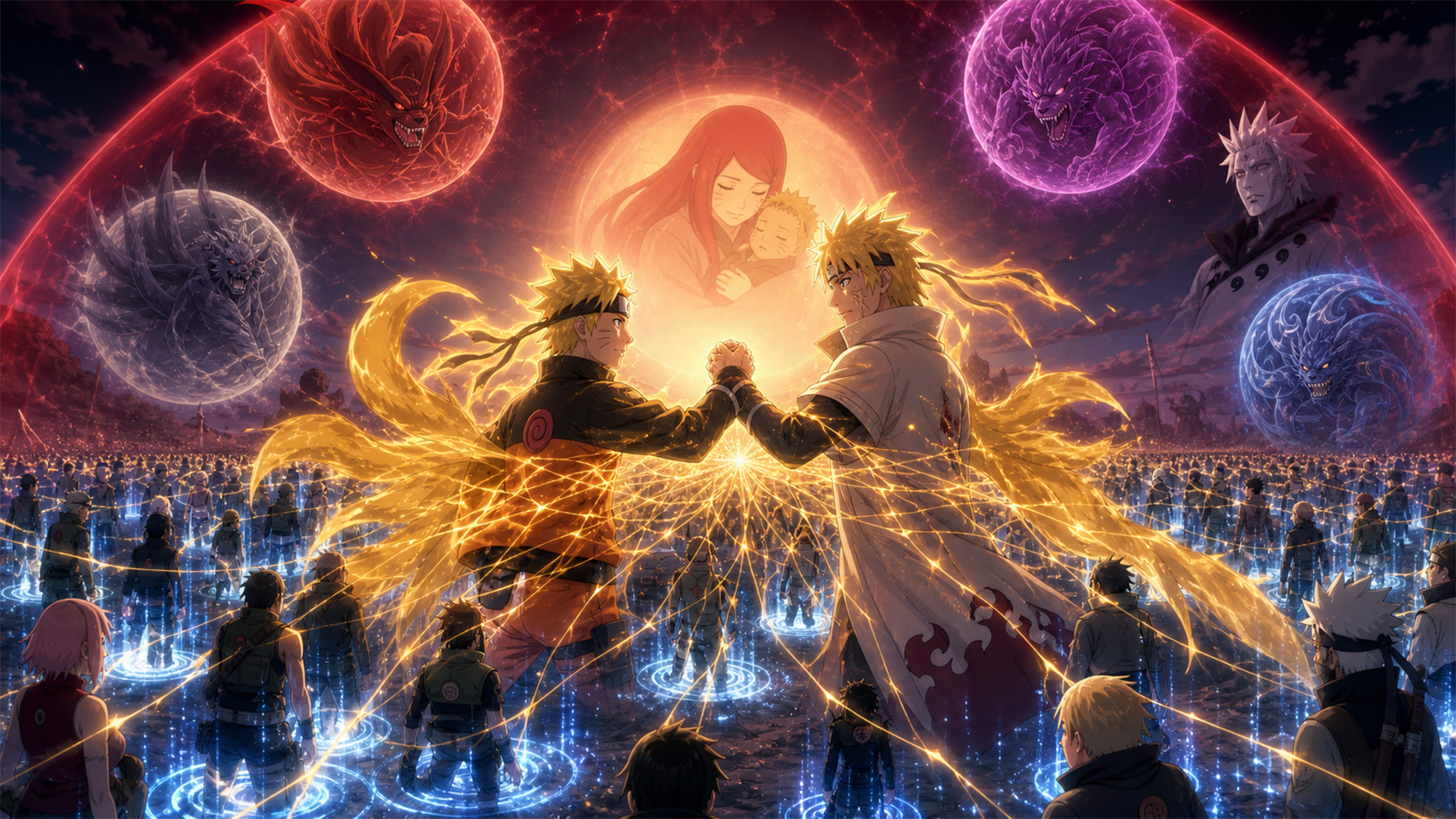
Naruto and Minato connect the entire alliance through shared chakra, then reclaim October 10 from Obito as a date holding birth, death, anger and continued life.
Bottom line
“The Day Naruto Was Born” refuses to let Obito own October 10 as a monument to death. Obito traps the Allied Shinobi Forces inside a barrier and prepares Tailed Beast Bombs large enough to erase everyone. Minato lacks the chakra to mark and transport thousands individually. Naruto realizes the chakra he already shared with the alliance can connect those fighters to Minato after father and son link their Kurama halves. The Fourth Hokage then teleports the entire force out of the kill zone. Obito reminds Minato that the next day marks the deaths of Minato and Kushina, framing the date as proof of failure. Naruto answers that October 10 is also his birthday. The response does not erase his parents’ deaths or the childhood their sacrifice forced him to endure. Naruto claims the whole date: birth, loss, anger, inheritance, and the life he kept building after adults decided his body would carry the village’s survival.
Senjutsu gives the alliance one confirmed tool
Naruto’s Sage Mode Rasengan damaged Obito where ordinary ninjutsu vanished. The result changes planning from helpless experimentation to targeted use of natural energy.
One vulnerability still has to reach a host faster and stronger than nearly everyone present.
Sasuke asks for the mechanism
He wants to understand what Naruto changed rather than merely admire the damage. That question lets the team distinguish Sage Mode from a stronger version of an ordinary attack.
Technical clarity supports cooperation.
Naruto explains natural energy plainly
Senjutsu mixes environmental energy with the user’s physical and spiritual energy. Obito’s current defenses do not cancel that combination in the same way.
The explanation gives allies a rule they can test.
A confirmed weakness changes Obito’s priorities
He now knows the alliance can harm him. Allowing Naruto, the Hokage, and the wider force more time would increase their ability to build attacks around senjutsu.
Obito escalates before the discovery spreads into a stable doctrine.
The Ten-Tails power reshapes the ground
Massive forms rise and create new launch points for destructive attacks. The battlefield stops being a contained target and becomes an execution structure controlled by the host.
Terrain itself enters the threat system.
Four Tailed Beast Bombs begin forming
Multiple projectiles remove the possibility of solving the crisis by redirecting one attack. Their placement covers escape routes and divides defensive attention.
Redundancy makes the kill plan harder to interrupt.
Obito builds a barrier around the alliance
The enclosure prevents ordinary retreat and turns thousands of fighters into a concentrated target. The barrier makes distance, speed, and formation irrelevant unless someone can cross space directly.
Containment becomes preparation for mass death.
The attack is deliberate extermination
Obito is no longer an unstable host lashing out. He creates the barrier, positions the weapons, and explains the hopelessness he wants everyone to feel.
Control makes responsibility unmistakable.
The alliance searches for exits
Different units test distance, walls, and available techniques while the bombs continue charging. Panic would waste the little time remaining.
Clear information matters when no ordinary route works.
Minato understands the transportation requirement
Flying Raijin can move targets connected to his markings or chakra contact. Transporting an entire army requires a network rather than a sequence of individual rescues.
The technique’s limit is logistical, not emotional.
He lacks enough chakra for a simple solution
Minato has already redirected a massive bomb, maintained combat, and lost an arm to Obito’s attack. Reanimation supplies a body without granting instant endless output.
Recognizing depletion prevents a heroic claim from becoming bad planning.
Naruto remembers the chakra network
He and Kurama previously shared chakra with the Allied Shinobi Forces. That energy still connects recipients through a distribution system already tested under attack.
Past support work becomes emergency infrastructure.
Father and son carry two halves of Kurama
Minato sealed one half inside Naruto and retained the other through the Reaper Death Seal. Their reunion places both chakra halves in contact during the war.
The division created on Naruto’s birth night now supports a joint rescue.
Kurama’s participation belongs in the plan
The chakra is not a neutral family inheritance passed between two men. Two halves of a sentient tailed beast contribute knowledge and power.
The rescue depends on Kurama as much as blood relation.
A fist bump completes the link
The familiar gesture allows chakra and intent to connect quickly. Physical contact carries tactical information without requiring a long family conversation.
Urgency gives intimacy a practical form.
The alliance becomes reachable through Naruto
Because Naruto already placed chakra around the fighters, Minato can treat the network as a connected target for transportation. Thousands of separate bodies become one coordinated rescue problem.
Distributed support creates access at scale.
Minato teleports everyone outside the barrier
The Tailed Beast Bombs detonate without consuming the Allied Shinobi Forces. The escape succeeds through Minato’s spatial technique, Naruto’s earlier chakra distribution, Kurama’s power, and the alliance maintaining connection.
No single person owns the save.
The plan rewards earlier generosity
Naruto shared chakra to strengthen and protect people without knowing the network would later enable evacuation. Support created an option no one could predict at the moment of giving.
Collective capacity often produces future resilience.
Transportation preserves the army rather than winning the war
The alliance survives the immediate execution attempt. Obito remains the Ten-Tails’ jinchūriki, and the natural-energy opening still requires delivery.
Survival is a complete achievement without being the final victory.
Obito turns to the calendar
He reminds Minato that October 10 marks the Nine-Tails attack and the deaths of Minato and Kushina. The date becomes another psychological weapon aimed at teacher and son.
He wants history to mean only failure.
Obito helped create that death anniversary
He attacked Kushina during childbirth, extracted Kurama, targeted newborn Naruto, and unleashed the beast on Konoha. His speech treats the deaths as proof about reality while hiding his own agency inside the event.
The calendar did not kill Naruto’s parents. People made choices.
Minato carries direct regret
He failed to identify and stop his former student before the assault reached his family and village. He then made sealing decisions under catastrophic time pressure.
Regret is appropriate without accepting Obito’s claim that the whole life afterward became meaningless.
Naruto reframes the date
October 10 is not only the day his parents died. October 10 is the day he was born.
The correction restores the living child to a story dominated by sacrifice.
Birth and death remain on the same day
Naruto does not need to choose one event as the true meaning. Celebration, grief, abandonment, gratitude, and anger can occupy the date together.
Human memory does not have to become a single slogan.
The birthday was never ordinary
Naruto grew up without parents, public truth, or a household that marked the date with family tradition. Konoha associated the day with the Nine-Tails disaster while hiding his connection to the attack.
The village left a child carrying communal trauma he did not cause.
Naming the birthday claims personhood
Obito describes the day through the deaths of legendary adults and the failure of a Hokage. Naruto names the baby whose life continued afterward.
The jinchūriki was a person before he was a vessel.
Minato hears what survival became
His son did more than remain alive. Naruto formed relationships, learned difficult techniques, changed Kurama’s relationship with him, and connected rival villages.
The outcome deserves pride without retroactively approving every cost.
Naruto already met Kushina
The chakra imprint inside his seal gave him a chance to hear his mother’s story and receive her love directly. He does not need Minato to recreate her message from scratch.
That earlier meeting lets this conversation avoid turning Kushina into a topic shared only by men.
A mother’s role exceeds the sealing night
Kushina had a childhood, ambitions, friendships, anger, humor, skill, and her own history as a jinchūriki. Remembering only her death beside Naruto would flatten her life.
Naruto’s birth story belongs to her body and choices too.
Naruto refuses a battlefield apology ritual
Minato has almost no time to explain every decision or express every regret. Naruto directs attention toward the fight and signals that he understands more than Minato expects.
Deferring the conversation under fire is practical, not emotional completion.
The son protects the father from collapse
Naruto sees Minato’s guilt and answers with life rather than allowing Obito to define the relationship. That support should not reverse responsibility permanently.
Children should not have to manage parents’ guilt as an ongoing family role.
Minato’s pride needs humility alongside joy
Naruto became extraordinary through effort and support from many people after Minato died. Iruka, Kakashi, Sakura, Sasuke, Jiraiya, Tsunade, Killer Bee, Kurama, and others helped shape him.
Fatherhood should recognize the community that raised the child.
Obito cannot turn loss into exclusive truth
He wants death to prove bonds fail and reality deserves replacement. Naruto points to a life born on the same date and still capable of choosing connection.
One date contains evidence against Obito’s total conclusion.
The title centers Naruto rather than the attack
The Nine-Tails assault has often been narrated through Minato’s sacrifice, Kushina’s death, Obito’s invasion, or Kurama’s destruction. “The Day Naruto Was Born” changes the subject.
History looks different when the surviving infant becomes the named person.
The rescue repeats that reframing at scale
Obito builds an event designed to become another mass death anniversary. Naruto and Minato use connection to preserve thousands of birthdays that can continue.
Saving lives denies the attacker control over the calendar.
Chakra functions as relationship infrastructure
Naruto’s network carries protection, location, and access for transportation. The story turns an internal energy system into a practical model of connection.
The metaphor works because the mechanics remain clear.
The alliance participates by staying connected
Recipients accepted Naruto and Kurama’s chakra earlier and maintained enough coherence for the network to function. Their survival is not passive rescue by distant legends.
Collective systems depend on every linked point.
Sasuke witnesses another leadership model
Naruto solves the crisis by sharing power widely and letting Minato use that network. The result contrasts with leadership built around one person absorbing all authority.
Anyone claiming the Hokage office should notice the difference.
Sakura’s medical network complements the escape
Transportation removes fighters from the blast. Katsuyu and medical units still need to stabilize injuries, communicate locations, and prevent post-teleport confusion.
Rescue ends one danger and creates immediate care work.
The opening remains usable after evacuation
Senjutsu can damage Obito, and the army now survives long enough to build on that knowledge. The episode connects emotional survival with tactical continuation.
Hope has a mechanism and a next job.
Naruto’s chakra network makes rescue collective
Minato can teleport people marked by his technique, and Naruto’s distributed chakra gives him a connection to the alliance at battlefield scale. Neither ability saves everyone alone.
The rescue works because power moves through relationships already built. Every fighter who accepted and carried Naruto’s chakra becomes part of the route out.
Minato contributes technique without owning the network
The spatial move belongs to his expertise, but access comes through bonds Naruto and Kurama formed with thousands of people. Father and son combine different histories into one solution.
Credit should follow both contributions and Kurama’s participation. Calling the moment Minato’s rescue alone would erase the social infrastructure Naruto created.
Kurama remains a partner in the family moment
The chakra being shared is not a neutral inheritance passed from father to son. Kurama chooses coordination after a lifetime of being sealed, transferred, and treated as village property.
The rescue honors Naruto’s birth only when the being sealed into him that night remains visible as a person with agency.
October 10 carries birth and catastrophic loss
Naruto’s birthday is also the night Kushina and Minato died, Kurama was divided, the village was attacked, and an infant received a burden adults would later hide from him.
Celebration does not have to erase mourning. A date can hold joy, death, anger, survival, and questions about decisions made around a newborn body.
Kushina belongs at the center of the day
She labored, protected Naruto after extraction, restrained Kurama while dying, and spoke hopes for the child she would not raise. The day is not only Minato’s sacrifice or Naruto’s origin.
Kushina’s bodily risk, jinchūriki history, expertise, and motherhood remain essential to any honest account of what Naruto inherited.
Minato receives the milestone after missing every year
He can finally see the teenager Naruto became, but he did not witness first words, academy failures, lonely meals, friendships, or daily growth. Death explains the absence without making its impact disappear.
The reunion gains honesty when Minato feels pride alongside grief for all the parenting Naruto needed and received elsewhere.
Naruto is allowed anger inside love
He can value his father, understand the sacrifice, and still feel the consequences of being left with a seal and a village that withheld the truth.
Gratitude should not function as a gag order. A child’s love becomes more real when disappointment and questions do not threaten belonging.
Other people helped raise the person Minato meets
Iruka, Team 7, Jiraiya, Tsunade, ramen-shop kindness, peers, rivals, and Kurama shaped Naruto after his parents died. Some adults failed him, and others created moments of care that accumulated.
Minato’s pride should include recognition of that network rather than reclaiming the result as bloodline destiny.
Obito cannot own the meaning of the date
He attacked the village on Naruto’s birth night and now uses remembered loss to argue that reality is empty. Naruto stands before him as evidence that the same date produced a life capable of connection.
That contrast does not make Naruto responsible for curing Obito. It prevents Obito from declaring one interpretation universal.
A birthday is proof of continued life, not moral superiority
Naruto’s survival does not mean people who collapse under grief are weaker or less worthy. His path depended on chance, helpers, power, and repeated decisions.
The episode should celebrate endurance without converting endurance into a test victims must pass before receiving care.
The alliance’s trust is operational evidence
Thousands allow Naruto’s chakra to surround them and Minato’s technique to move them. That acceptance reflects experience with Naruto’s conduct, not merely a speech about unity.
Trust becomes visible through coordinated vulnerability. People consent to a shared plan because the relationship has produced reasons to believe one another.
Teleportation preserves people rather than only territory
The battlefield can tempt leaders to prioritize barriers, positions, or symbolic ground. This maneuver treats living fighters as the objective worth moving first.
A village and alliance exist through people. Saving bodies preserves the possibility of later rebuilding, argument, mourning, and political repair.
Minato’s missing arm changes the reunion
He arrives powerful and visibly altered by Obito’s attack. Naruto sees a father who can save thousands and still be injured beyond expected repair.
The vulnerability keeps parenthood from becoming flawless legend. They work together through changed capacity rather than pretending resurrection restored everything.
The day can be reclaimed without being rewritten
Naruto does not need October 10 to become purely happy. He can add survival, connection, and collective rescue to a date already carrying death.
Reclamation expands the record. It does not delete Kushina, Minato, Kurama’s confinement, village casualties, or the lonely years that followed.
Father and son create one present-tense memory
They cannot manufacture the childhood they lost. They can coordinate now, protect people now, speak now, and let Naruto experience his father responding to the person in front of him.
The moment matters because it belongs to their current choices rather than an imagined restoration of the past.
The rescue gives the alliance a birthday gift Naruto never received as a child: public evidence that his existence protects rather than threatens the village. Recognition matters. It should not become a demand that he earn belonging through endless service. Naruto deserved care before saving anyone. The community’s responsibility is to remember him as a resident with ordinary needs, not only the emergency power who made everyone’s survival possible.
RaeRae’s verdict
“The Day Naruto Was Born” gives October 10 back to Naruto without cleaning up the blood on the date. Obito wants Minato to see only the death of his wife, his own death, and the failure to save a student. Naruto names the baby who survived the same night and spent years becoming more than Konoha’s container for Kurama.
The mass teleport makes that argument physical. Naruto’s earlier choice to share chakra creates a network. Minato’s technique moves that network. Kurama’s two halves supply power and connection. The alliance survives because support offered before the crisis becomes infrastructure during the crisis. Naruto does not defeat grief by calling the date happy. He refuses to let death become the only event worth naming.
RaeRae’s call
Naruto and Minato save the alliance together, but Kurama and every person carrying shared chakra belong in the credit. October 10 holds Naruto’s birth, Kushina’s labor, both parents’ deaths, Kurama’s confinement, and a childhood Minato missed. Reclaiming the day means adding collective survival without rewriting loss. Love becomes honest when pride leaves room for anger, grief, questions, and every relationship that raised Naruto.
Episode details and viewing routes
- Official episode reference: Naruto Official episode guide
- Licensed episode route: Crunchyroll licensed episode page
What I am carrying forward
Obito enclosed the Allied Shinobi Forces inside a barrier and prepared four Tailed Beast Bombs to destroy everyone at once. Minato lacked enough chakra to transport the army through individual markings.
Naruto linked the chakra already shared with the alliance to Minato and both halves of Kurama, allowing Flying Raijin to move the entire force outside the kill zone. Naruto answered Obito’s death-anniversary taunt by naming October 10 as his birthday. Episode 381 continues the battle as father and son use their linked chakra against Obito.