
The Ten Tails’ Jinchūriki
Obito breaks Madara’s immediate control, absorbs the Ten-Tails and becomes most dangerous when memories of the bonds he rejects help him recover his name.
Bottom line
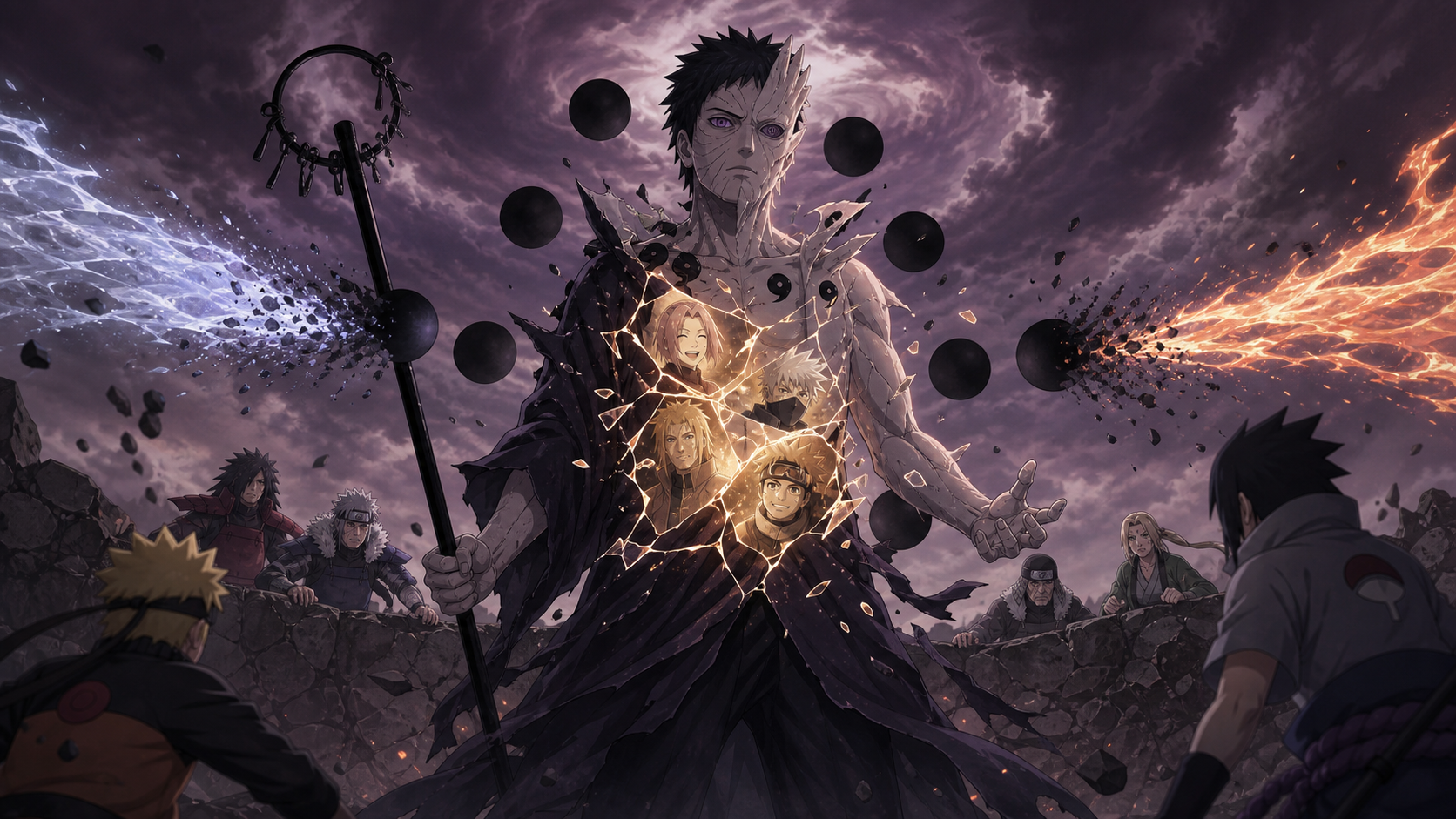
“The Ten Tails’ Jinchūriki” returns from the Mecha-Naruto detour with a transformation that makes every existing battle plan obsolete. Obito seals the Ten-Tails inside his body before Madara can use him for resurrection. The move frees Obito from one master’s immediate plan while giving him control over a power assembled through stolen tailed beasts and mass death. His new body distorts, attacks almost by reflex, and threatens the reanimated Hokage with black spheres that can cancel ninjutsu. For several moments, the Ten-Tails’ force appears to tear Obito’s identity apart. He regains control by gathering memories of Rin, Kakashi, Minato, and the boy he once was. Those bonds stabilize the person who claims bonds are worthless. Obito becomes more dangerous when he recovers his name, not when he becomes less human.
The war resumes after the special detour
Broadcast order returns viewers to the exact crisis paused after Episode 375. Obito has removed Madara’s control seal and moved against Madara’s preferred sequence.
The tonal snap proves why the two anime-original episodes belong in a clearly labeled extras lane.
Returning without an internal recap also asks viewers to recover the emotional temperature on their own. Kakashi and Obito’s private duel ended with a decision that altered the battlefield, while the special temporarily replaced that consequence with mechanical parody. Clear editorial labeling protects both experiences: the extras can remain silly on their own terms, and the war can resume without pretending the interruption carried canonical weight.
Obito absorbs the Ten-Tails completely
The enormous creature disappears into a single human host. Battlefield scale contracts without reducing destructive capacity.
Concentrated power becomes harder to contain because intelligence and mobility now direct the force from within one body.
Madara loses control of the timetable
He expected Obito to perform the Rinne Rebirth and restore Madara fully to life. Obito instead claims the Ten-Tails for himself.
The tool recognizes the creator’s betrayal and seizes the central asset.
Refusing Madara is not liberation for everyone else
Obito breaks one coercive relationship and immediately pursues a plan that will remove choice from the world. Personal autonomy does not excuse global domination.
Freedom measured only for the person holding power remains incomplete.
The jinchūriki system reaches its extreme form
Villages sealed tailed beasts into humans to create weapons and deterrence. Obito now takes the combined creature into himself to become the most concentrated military body in history.
The old structure scales up without becoming ethical.
The Ten-Tails did not choose partnership
Naruto and Kurama eventually built cooperation through recognition and negotiation. Obito’s transformation begins through control of a composite being assembled from captured chakra.
Shared embodiment does not automatically mean shared consent.
Obito’s body starts to break apart
The new form twists his proportions and disrupts stable movement. Power exceeds the host’s immediate ability to organize body and mind.
Transformation appears closer to violent occupation than triumphant upgrade.
Loss of language signals loss of control
Obito struggles to speak and identify his own purpose. The person who wanted absolute control over reality cannot initially control his mouth, limbs, or thoughts.
Power without integration reduces agency.
The alliance cannot read the new threat yet
Sensors, commanders, and experienced fighters have no established model for a Ten-Tails host. Techniques effective against the beast or a masked shinobi may fail against the combined state.
Immediate observation becomes more important than confident labels.
Hashirama recognizes the danger quickly
His experience with Madara, tailed beasts, and extraordinary chakra gives him a useful comparison point. Even his scale of power does not make the new host ordinary.
Expertise can identify escalation without supplying a finished solution.
The Hokage become early test targets
Reanimated bodies allow them to engage a lethal unknown without risking ordinary human death in the same way. They can gather information while the alliance remains behind the barrier.
Using their regeneration advantage is tactically responsible.
Reanimation still has limits
The Hokage may reform after conventional damage, but Obito’s new black spheres interact with ninjutsu and constructed bodies differently. Their assumed safety becomes uncertain.
Every advantage depends on the enemy’s mechanism.
Obito attacks with unstable force
His movements appear abrupt and partly instinctive. Lack of grace does not reduce lethality when each strike carries Ten-Tails power.
An uncontrolled weapon can be more difficult to predict than a deliberate one.
Hiruzen faces erasure-level damage
The Third Hokage’s reanimated body is struck by an attack that threatens more than ordinary physical destruction. His experience cannot prevent first contact with a new rule.
Information often arrives through somebody paying the cost.
The black spheres change the technique economy
They can alter shape, attack, defend, and neutralize ninjutsu upon contact. Familiar elemental exchanges become dangerous because the defense may simply cancel the incoming structure.
The alliance needs natural energy, physical tactics, or another mechanism not yet fully understood.
Visual simplicity hides technical danger
Smooth black forms look less elaborate than giant beasts and flaming armor. Their threat comes from function rather than ornament.
Minimal design makes every movement easy to read and hard to answer.
Tobirama tests the new body
His analytical instinct pushes toward direct information gathering and rapid adaptation. He observes speed, response, and the interaction with marked targets.
The same decisiveness that once hardened Uchiha policy becomes useful against an immediate unknown.
Minato searches for the masked student
He has learned that Obito survived, attacked Konoha, helped kill Minato and Kushina, and shaped Naruto’s life through the Nine-Tails assault. Recognition carries professional and parental consequence.
The enemy is both a former child under his care and an architect of his family’s destruction.
A teacher’s guilt enters the battlefield
Minato was not present when Madara found Obito or when Rin died. His team operated inside a war system that repeatedly isolated children in lethal missions.
Personal guilt should lead toward responsibility without claiming control over every event.
Naruto sees another kind of host
He knows what overwhelming tailed-beast chakra can do to body and identity. His relationship with Kurama offers a direct contrast to Obito’s forced concentration.
The difference lies in consent and cooperation, not only skill.
Kurama understands the scale from within
The tailed beast can evaluate chakra and recognize the danger created by the Ten-Tails. His knowledge belongs to a being whose fragments were used in the transformation.
Kurama is witness, strategist, and affected party.
Madara watches a rival controller emerge
He does not mourn Obito’s instability as a mentor worried about a student. He calculates whether the transformation serves or obstructs his own plan.
Possessive investment is not care.
Obito’s fragmented mind reaches for images
Memories of Rin, Kakashi, Minato, and his younger self appear as pieces under pressure. The relationships he tried to declare unreal remain anchors inside his identity.
The body remembers what ideology rejected.
Rin remains a person, not a repair tool
Her image helps Obito gather himself, but she did not consent to become the emotional key for a global coercion project. Memory belongs to him without becoming her approval.
No remembered smile authorizes the Infinite Tsukuyomi.
Kakashi represents both bond and wound
Obito connects him to childhood rivalry, shared training, Rin’s death, and the recent heart strike. The relationship cannot be reduced to betrayal or affection alone.
Conflicting meanings can hold one identity together.
Minato’s team remains the lost home
The four-person formation symbolizes an ordinary future Obito never received. Recalling that team helps him reconstruct the self who existed before Madara’s grooming.
The recovered self still chooses what happens next.
His name becomes an organizing boundary
Obito regains enough control to identify himself rather than dissolve into the Ten-Tails. Naming restores a distinction between host and force.
Identity gives him agency and therefore greater responsibility.
Bonds stabilize the man who condemns bonds
Obito’s worldview claims attachment creates pain that reality cannot bear. The actual transformation shows attachment preventing total psychological erasure.
The contradiction does not automatically change his ideology, but the evidence is sitting inside his body.
Recovered control makes him more dangerous
An unstable host lashes out unpredictably. A stable host can select targets, shape attacks, and pursue the Infinite Tsukuyomi deliberately.
Humanity is not synonymous with goodness.
The transformation does not redeem earlier suffering
Obito survived crushed limbs, replacement tissue, Madara’s seal, Rin’s death, and years of manipulation. Becoming powerful does not make those harms worthwhile.
Trauma is context, not an origin story that grants entitlement to everyone else’s reality.
The alliance must revise the command problem
The Ten-Tails is no longer a contained central beast surrounded by controllers. Obito can move independently and breach defensive assumptions.
Units need new communication, distance, and attack rules immediately.
The Hokage cannot rely on old legend
Hashirama’s power, Tobirama’s speed, Hiruzen’s experience, and Minato’s transportation remain extraordinary. Obito’s new mechanics threaten each in unfamiliar ways.
Historic greatness does not exempt anyone from learning.
Naruto and Sasuke need more than combined force
Their earlier wind-and-flame attack targeted the Ten-Tails as a large restrained body. Obito’s host form can evade, neutralize, and counter with greater precision.
Power must follow understanding rather than pride.
Sakura’s medical network becomes even more important
Unknown attacks will produce unfamiliar injuries and may erase techniques relied upon for defense. Katsuyu’s distributed presence can transmit observations and stabilize survivors.
Escalation increases the value of care infrastructure.
The alliance faces a person, not only a beast
Obito can reason, deceive, remember relationships, and choose psychological targets. Treating him as mindless energy would miss the central danger.
Strategy must address both body and intention.
A person can still require lethal restraint
Recognizing Obito’s humanity prevents easy dehumanization. His current power and plan threaten every living person’s autonomy.
Personhood demands ethical judgment rather than immunity from force.
Madara’s grooming reaches an unintended result
He wanted Obito strong enough to execute the plan and dependent enough to surrender control. The student learned the plan, recognized the betrayal, and took the central power first.
Manipulators cannot guarantee permanent ownership of the people they shape.
Obito reproduces the same hierarchy
He refuses Madara’s control without rejecting the belief that one enlightened will may decide reality for everyone. The oppressed subordinate becomes a competing ruler.
Breaking a chain requires more than taking the top position.
Breaking Madara’s seal restores choice without creating innocence
Obito removes a bodily mechanism designed to control him and then acts against Madara’s intended use. That liberation matters because nobody owes obedience to a person who planted ownership inside the heart.
The next choice is still Obito’s. Freedom from one controller does not authorize him to absorb stolen power or dominate everyone else.
The Ten-Tails is not empty energy
Its power contains tailed beasts who were hunted, extracted, fragmented, and forced into a structure built for another person’s plan. Becoming its jinchūriki is therefore not a private transformation.
Obito takes control of power assembled through violations against Kurama, Gyūki, and the other beasts. Their stake remains present inside his new body.
Jinchūriki language changes when the host chose capture
Naruto, Gaara, and Bee were placed into village systems that treated them as containers. Obito actively pursues the Ten-Tails transformation as a route to world control.
The shared term should not flatten the difference in consent, purpose, and power. Both involve a host-beast relation, but their accountability is not interchangeable.
Transformation threatens to erase Obito’s name
The new power fractures body, memory, and self-recognition. Control is not automatic merely because Obito wanted the result. An intervention can be chosen and still exceed informed understanding.
His struggle reveals the danger of treating bodily capacity as ownership. Absorbing something does not mean the relationship is stable or ethically settled.
Memory becomes the structure that holds him together
Rin, Kakashi, Minato, and the younger Obito appear as pieces of a self the transformation is tearing apart. The bonds he calls meaningless become the material through which he remembers who is acting.
That dependence does not redeem him. It disproves his claim that connection was only weakness and illusion.
Rin’s memory stabilizes without consenting
Obito draws strength from her image, but memory remains his representation of Rin rather than Rin speaking now. Her presence cannot authorize the Ten-Tails, war, or Infinite Tsukuyomi.
The more central she becomes to his identity, the more carefully the story must preserve the difference between loving someone and assigning them approval.
Kakashi remains part of the self Obito rejects
The teammate he fought and manipulated still occupies his internal map. Shared training, rivalry, rescue, and grief survived every attempt to reduce Kakashi to the false world.
Obito can hate what Kakashi represents while relying on their relationship to remain recognizable to himself. Contradiction becomes evidence that ideology never fully replaced the person.
Minato’s place carries care and failure
Obito remembers the teacher who praised his promise and arrived too late to prevent Madara’s control. Minato did not create the cave, but adult protection failed to reach a missing child before exploitation did.
The memory can contain affection, abandonment, admiration, and anger together. Honest relationship does not require one clean category.
The younger Obito is evidence, not an excuse
Remembering the child who wanted to become Hokage reveals values that once existed and choices that later diverged from them. Childhood does not cancel adult victims.
It creates a comparison point. Obito can measure the current act against the person he chose to be before manipulation narrowed his world.
Power increases the duty to preserve restraint
As the Ten-Tails’ host, Obito can reshape the battlefield faster than most people can respond. Greater capacity means smaller mistakes can kill more lives.
Ethical control would require slowing decisions, protecting independent judgment, and refusing attacks whose consequences cannot be contained. He instead uses overwhelming power to narrow everyone else’s options.
The alliance faces a person and a system of stolen power
Stopping Obito is necessary, but treating him as the only problem would hide Madara, the tailed-beast hunts, Akatsuki labor, village jinchūriki systems, and years of secret manipulation.
The body in front of them concentrates a larger chain. Victory needs immediate defense and later accounting across that chain.
Naruto’s host relationship offers a direct rebuttal
Naruto and Kurama moved from coercion toward communication, consent, shared tactics, and mutual protection. Their power grows as two selves become better partners.
Obito’s transformation pursues control over assembled beast power while his own self nearly disappears. The contrast is relational, not merely technical.
Stability is not the same as moral clarity
Once Obito regains form and command, the transformation may look successful. Physical coherence only proves that he can operate the power.
It does not answer whether the power was obtained justly, whether the beasts consent, or whether the objective respects anyone outside his body.
Agency becomes clearer after the seal is gone
Madara can no longer claim the same direct mechanism inside Obito’s heart. That makes Obito’s continued choices more attributable to him, not less.
Manipulation remains part of the history, and responsibility now attaches strongly to what he does with the freedom he reclaimed.
A route back begins with relinquishing control
If Obito wants to act beyond Madara, independence cannot mean becoming a more powerful controller. He would need to stop attacks, release the beasts, disclose the plan, and accept containment.
Returning to self is not enough. Repair requires returning stolen agency to everyone whose bodies and futures his plan captured.
The horror of this transformation is that Obito nearly loses the self whose freedom he fought Madara to recover. Power promises independence while swallowing memory, language, and bodily control. He survives by gathering people back into his name, including people he has harmed and rejected. That does not make the relationships mutual again. It shows that identity was social, even when Obito insisted isolation had liberated him. The next step would be to acknowledge dependence without converting it into entitlement: Kakashi, Rin, Minato, and Naruto may help him remember himself, but none owes him surrender, forgiveness, or access.
RaeRae’s verdict
“The Ten Tails’ Jinchūriki” makes Obito’s greatest power look like bodily crisis before allowing the usual villain confidence to return. The transformation tears at speech, form, memory, and name. He rebuilds himself through images of Rin, Kakashi, Minato, and his younger self. Bonds do not weaken him. Bonds keep him from disappearing inside the force he seized.
That recovery is not redemption. Obito becomes more responsible when he regains control because the next attacks belong to a person capable of memory and choice. Madara exploited him, sealed his heart, and planned to use his death. Obito correctly refuses that ownership. He then tries to own everybody else’s future through the Infinite Tsukuyomi. The alliance is no longer fighting a beast with a handler. The alliance is fighting a wounded man who has made himself the handler, vessel, and weapon at once.
RaeRae’s call
Obito is freer from Madara and more responsible for what comes next. The Ten-Tails contains stolen beings, not neutral fuel, and becoming its jinchūriki does not transfer ethical ownership. Memories of Rin, Kakashi, Minato, and his younger self keep Obito coherent while disproving his claim that bonds mean nothing. Reclaimed agency becomes repair only when he returns agency to everyone else.
Episode details and viewing routes
- Official episode reference: Naruto Official episode guide
- Licensed episode route: Crunchyroll licensed episode page
What I am carrying forward
Obito sealed the Ten-Tails inside himself before Madara could force him to perform the Rinne Rebirth. His new body initially destabilized, attacked with enormous speed and black spheres capable of neutralizing ninjutsu, and threatened the reanimated Hokage’s ability to regenerate.
Memories of Rin, Kakashi, Minato, and his younger self helped Obito reconstruct his identity and regain deliberate control. Episode 379 follows the alliance searching for an opening against a now-stable Ten-Tails jinchūriki whose abilities invalidate familiar ninjutsu defenses.