
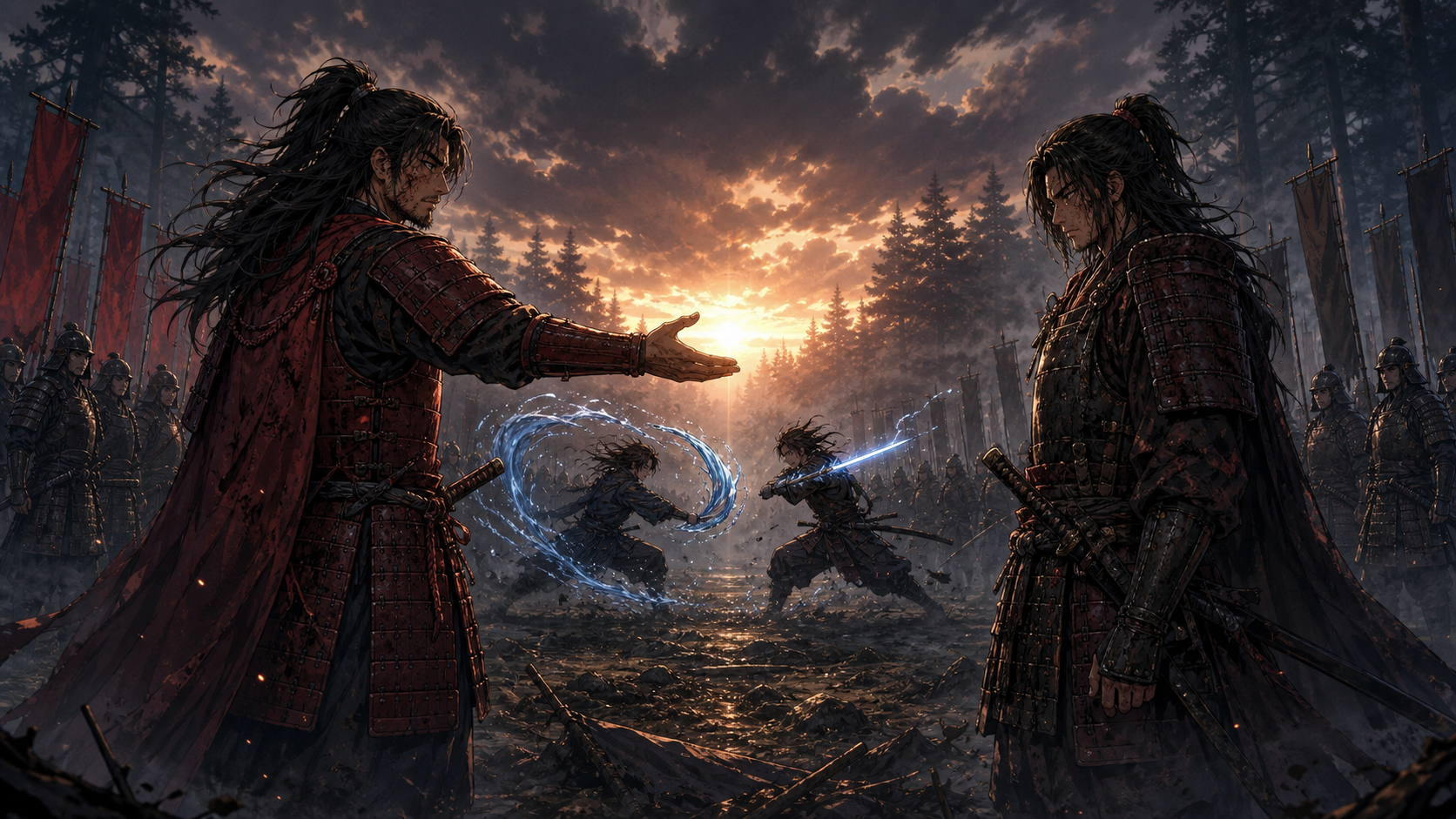
Era of Warring States
Hashirama and Madara inherit command of rival clans, but every new battlefield casualty makes their childhood dream harder to hear as anything except a threat.
Bottom line
“Era of Warring States” shows why wanting peace and trusting peace are different jobs. Hashirama and Madara grow into clan leaders while Senju and Uchiha fighters continue killing one another. Tobirama mortally wounds Izuna, and Madara loses the last brother who survived beside him. Hashirama offers an alliance, but the offer comes from the stronger clan after Madara’s family has paid a devastating cost. Madara therefore demands proof that Senju promises will outweigh Senju blood loyalty. His demand that Hashirama kill Tobirama or himself is cruel, traumatized, and politically revealing. Hashirama prepares to die rather than order another person’s death. Madara stops him and accepts the truce. The agreement does not erase grief or make the clans suddenly equal. Peace begins when two leaders interrupt retaliation, but lasting peace will require institutions strong enough to protect people who do not share their personal bond.
The river confrontation exposes the inheritance
Butsuma and Tajima arrive ready to use their sons’ friendship as an opening against the enemy. Tobirama and Izuna stand beside them with weapons drawn.
Four children are already carrying the military expectations of two fathers.
Hashirama and Madara interrupt the strike
The boys prevent their families from turning the meeting into another pair of funerals. Their warning system and quick action protect the brothers beside them.
Friendship produces an immediate practical result before any formal peace exists.
Each boy chooses family without attacking friendship
Hashirama leaves with the Senju. Madara leaves with the Uchiha. Neither can abandon a younger brother in the name of a private dream.
Peace that demands instant family betrayal would reproduce the same cruelty under a kinder slogan.
The meetings end because surveillance wins
Once both clans know, the river cannot remain neutral ground. Continued contact could expose siblings, tactics, routes, and internal decisions.
The boys lose a relationship because the political system offers no safe category for cross-clan trust.
Time turns the boys into commanders
Hashirama and Madara eventually lead the clans that shaped their childhood. Their personal abilities grow, but authority also ties them more tightly to collective grief and obligation.
Power increases the chance to negotiate and the pressure to keep fighting.
Clan leadership inherits a casualty ledger
Every proposal arrives after brothers, parents, cousins, and comrades have died. Leaders do not enter talks with clean emotional accounts.
The dead cannot be restored, yet their memory can be used either to stop retaliation or demand another payment.
The Senju and Uchiha keep meeting in battle
Childhood recognition does not automatically change contracts, resource competition, or security fears. The clans remain the strongest rivals in a market built around military force.
Personal conviction without institutional change cannot hold the battlefield still.
Hashirama continues to seek alliance
He repeatedly treats cooperation as the only route that can protect the next generation. His strength gives the proposal weight because the Senju do not need peace merely to escape immediate defeat.
An offer from strength can be credible and threatening at the same time.
Madara cannot hear the offer outside history
He knows Hashirama’s childhood dream, but he also leads people whose relatives died by Senju hands. Trusting one man could expose the whole clan if that man cannot control his brother or successors.
Madara’s refusal grows from more than pride.
Tobirama and Izuna embody the unresolved conflict
Both younger brothers became capable fighters and close political partners to their elder siblings. Both carry fierce loyalty and suspicion formed through war.
The founders’ dream cannot bypass the people expected to help govern after peace.
Tobirama develops a lethal advantage
His speed and technique allow him to strike Izuna during battle. Tactical innovation changes the balance between two fighters and the political balance between their clans.
Military brilliance remains attached to a human wound.
Izuna is mortally wounded
The injury removes Madara’s last surviving brother from the future they once imagined protecting. Izuna is not simply a step toward Madara’s stronger eyes or a reason for later policy.
His death closes a relationship and intensifies a leader’s fear that peace will arrive only after Uchiha losses become irreversible.
Battlefield responsibility remains direct
Tobirama strikes an enemy combatant during an active clan battle. The context explains the act without turning the death into weather.
People created the conflict, chose the engagement, and maintained the system that placed both brothers there.
Hashirama offers treatment and truce
He tries to stop further death and proposes an alliance while Izuna still needs care. The offer reflects his long-held goal and practical awareness that continuing will destroy more families.
Timing also means Madara hears peace while desperate and vulnerable.
Medical help should not become leverage
Saving Izuna would be right regardless of whether Madara accepts a political agreement. Care tied to surrender becomes another weapon.
Hashirama’s intent appears compassionate, but unequal battlefield power complicates every offer.
Izuna distrusts the Senju proposal
He urges Madara not to accept. From his position, the clan that wounded him now asks the Uchiha to lower their guard.
Suspicion is not irrational when betrayal could finish the family.
A dying brother still has political influence
Izuna’s advice matters to Madara because love and leadership overlap. Madara cannot separate the proposed truce from the person he is about to lose.
Private grief becomes part of public decision making.
Madara receives Izuna’s eyes
The transfer strengthens Madara and carries the body of his brother into future combat. Power here comes through loss, family consent, and a clan technique shaped by repeated tragedy.
The result should not make Izuna’s death feel productive.
Strength cannot compensate for brotherhood
Madara gains greater visual power and still loses the person he wanted to protect. New capacity gives him more ability to fight without answering why the fight deserves another generation.
Grief armed with power can deepen danger.
The Uchiha position deteriorates
Senju strength and defections or exhaustion within the Uchiha leave Madara with fewer credible options. Continuing the war may preserve pride while destroying the clan he leads.
Peace negotiated under decline cannot be treated as a meeting of equal leverage.
Madara fights Hashirama again
The former friends meet as clan leaders carrying accumulated deaths. Their battle tests bodies and competing definitions of protection.
Hashirama wants Madara alive and defeated enough to accept cooperation. Madara refuses to trust a future built by the rival who can overpower him.
Hashirama’s victory creates responsibility
Greater strength gives him the ability to kill Madara, impose terms, or stop. Choosing restraint matters because victory often becomes another excuse for domination.
Restraint alone cannot prove what future Senju leaders will do.
Madara expects the defeated to be disposable
His experience teaches that a rival clan removes threats when opportunity appears. A promise of friendship after defeat sounds cheap unless Hashirama accepts a comparable risk.
Trust requires evidence that power will limit itself.
Hashirama asks again for peace
He returns to the childhood dream rather than treating battlefield success as final permission to rule. The repeated offer shows consistency across years.
Madara still needs more than consistency from one person.
The demand targets Hashirama’s deepest bond
Madara tells Hashirama to kill Tobirama or take his own life. The terms force Hashirama to place peace against the brother he has spent his life protecting.
The demand is morally brutal because Madara wants pain to function as proof.
Madara’s test comes from unequal grief
Izuna is dead after Tobirama’s strike. Tobirama remains alive beside Hashirama. Madara sees a proposed alliance where one leader keeps his brother and the other must absorb the loss.
The test attempts to make that imbalance visible through another threatened body.
Killing Tobirama would poison the alliance
If Hashirama executed his brother, peace would begin with internal sacrifice offered to the rival clan. Senju trust would collapse, and Madara would become tied to the killing.
Another dead brother cannot build durable equality.
Hashirama chooses his own life
He refuses to kill Tobirama and prepares to die himself. The choice accepts personal cost while protecting his brother from a condition Tobirama did not agree to.
Hashirama treats leadership as responsibility for the promise he made.
Self-sacrifice remains a dangerous political tool
His willingness demonstrates sincerity, but a system cannot depend on good leaders threatening their own deaths whenever trust fails. That pattern creates emotional coercion and succession crises.
The gesture can open negotiation without becoming a model for governance.
Madara stops the blade
He prevents Hashirama from completing the act. Seeing his friend accept the condition far enough changes Madara’s judgment about whether the offer carries real risk.
Stopping Hashirama also shows that Madara never needed another death for its own sake.
The truce begins through mutual interruption
Hashirama interrupts the cycle by refusing to kill Madara after victory. Madara interrupts the cycle by refusing Hashirama’s death once sincerity becomes visible.
Peace begins through two decisions not to take the available body.
Acceptance does not equal emotional repair
Madara can agree to alliance while mourning Izuna and distrusting Tobirama. Hashirama can welcome peace while knowing his brother remains a source of fear for the Uchiha.
The agreement creates work rather than finishing grief.
Clan members need guarantees beyond friendship
Ordinary Senju and Uchiha did not share the river conversations. Some lost relatives without ever seeing the opposing clan as human.
Rules, representation, fair security practices, and shared decision making must carry what the founders’ bond begins.
A truce changes incentives
When the two strongest clans stop fighting, clients and smaller clans must reconsider contracts, alliances, and retaliation. Cooperation can make continued war less profitable and less defensible.
Peace becomes more durable when institutions and material incentives support personal conviction.
The agreement also concentrates power
Senju and Uchiha cooperation can protect children from their feud while creating a dominant military bloc. Smaller families may experience the new alliance as stability or pressure.
Founding a village will require accountability beyond the two largest clans.
Madara’s consent matters politically
Hashirama cannot create legitimate union by defeating the Uchiha and announcing harmony. Madara’s acceptance gives the agreement a path toward internal support.
Consent under unequal strength remains imperfect, which makes later power sharing essential.
Tobirama’s future role is already a problem
Hashirama protects his brother, but Madara has reason to fear Tobirama’s hostility. Any alliance that ignores that conflict leaves a fracture inside the governing core.
Peace cannot rely on Hashirama always being present to restrain everyone.
Izuna’s absence remains in the room
The truce arrives too late to save the brother whose safety shaped Madara’s dream. Later celebrations cannot rewrite that timing.
Founding memory should include the people peace failed to reach.
Hashirama’s dream becomes a negotiation
As a child, he imagined a place where brothers could live. As a leader, he must bargain with grief, force, distrust, and competing obligations.
The dream matures when ideals accept political detail without surrendering their purpose.
Leadership arrives before either man has healed
Hashirama and Madara inherit command because war keeps removing older leaders. Rank does not mean grief has been processed or that either young man received preparation for governance beyond combat.
Both now control lives while carrying brothers, fathers, and childhood warnings into every decision. The clans call that maturity because the alternative would require admitting how thoroughly war has compressed their development.
Hashirama keeps offering peace as a concrete policy
He is not asking Madara to feel friendly on command. Hashirama proposes ending paid clan warfare, combining protection, and creating a settlement where children can survive long enough to learn something besides killing.
The proposal needs details about authority, land, representation, and accountability. Its practical purpose remains clear: stop producing funerals faster than either clan can absorb them.
Madara hears risk inside every promise
The Senju remain the opposing force that killed people he loves. Joining them would expose Uchiha families to leadership arrangements not yet written and to trust that can be withdrawn after weapons are lowered.
Caution is not proof that Madara secretly wanted endless war. A durable negotiation must answer his material concerns instead of treating reluctance as a character defect.
Izuna is a political actor, not an obstacle
Izuna distrusts the Senju from experience and fears that peace will place the Uchiha beneath their strongest rival. His position affects Madara, but he is not merely the bitter brother blocking a noble friendship.
He deserves direct terms, evidence, and a voice in what happens to his clan. Peace built by dismissing influential skeptics creates the resentment opponents already expect.
Tobirama carries his own inherited fear
Tobirama sees Madara and the Uchiha through battles, casualties, and the need to protect Hashirama. His suspicion has context. Context does not make collective judgment fair.
As a strategist, he should help design verification, shared command, and remedies for breaches. Treating distrust as permanent truth guarantees that every new institution will reproduce the battlefield line.
The brothers need a negotiation they can inspect
Hashirama and Madara’s personal bond cannot substitute for provisions that Tobirama, Izuna, and ordinary clan members can evaluate. A peace agreement needs transparent duties, dispute procedures, resource sharing, and limits on unilateral force.
Trust becomes safer when people do not have to bet survival on whether two powerful friends remain aligned forever.
Izuna’s injury changes the bargaining conditions
Tobirama wounds him during battle, creating urgency, grief, and another reason for Madara to reject reconciliation. The injury is not abstract symbolism. Izuna is a person facing pain and possible death.
A peace offer made after that wound must acknowledge what happened, protect medical care, and stop combat without using vulnerability to force consent. Timing can make a sound proposal feel like surrender.
Hashirama’s strength creates obligation
He possesses power capable of dominating the field, which makes restraint meaningful and insufficient by itself. Hashirama must build structures that prevent his successors from converting the same strength into unreviewable rule.
A benevolent founder cannot guarantee benevolent leadership forever. Institutions should protect residents when the person holding power is frightened, angry, biased, or far less generous.
Madara’s strength does not erase clan consent
He may be the Uchiha’s most powerful fighter and recognized leader, but the clan contains widows, children, elders, dissenters, and shinobi with different risk calculations. Their future cannot be reduced to his friendship or grief.
Leadership requires bringing terms back, allowing disagreement, and ensuring that people asked to disarm gain enforceable protection rather than symbolic reassurance.
Peace must include memory without organizing revenge
Neither clan can pretend the dead disappeared when an agreement is signed. Families need names, burial, testimony, and permission to mourn without being ordered into another retaliatory cycle.
Memory becomes protective when it documents what institutions must stop. Memory becomes another weapon when leaders use every loss as authorization to create the next one.
The future village begins with an unequal coalition risk
If the Senju enter negotiations from military advantage, formal equality can still hide practical imbalance. Positions, policing, land, and decision rights must be designed so the Uchiha are partners rather than a defeated clan absorbed under softer language.
Madara’s fear of subordination should be tested against the agreement, not waved away because Hashirama means well.
Ending war is a beginning rather than absolution
A truce can save lives immediately while leaving deeper work unfinished. The clans will still need to demobilize children, integrate services, investigate breaches, share public space, and prevent old command networks from becoming secret factions.
Peace should be celebrated for stopping slaughter and judged by whether former enemies can live with rights that do not depend on ancestry.
Sasuke should notice that the village was born from vision and unresolved fear. The founders stopped one form of violence while carrying clan assumptions into government. That does not make peace fraudulent. It makes maintenance a public duty. Every generation must test whether offices, policing, education, and representation still serve child safety, or whether old battle lines have learned new administrative names.
RaeRae’s verdict
“Era of Warring States” makes the Senju–Uchiha truce difficult enough to matter. Hashirama offers peace for years, but Madara cannot gamble his clan on a childhood promise after Tobirama kills Izuna. The Uchiha enter negotiation through loss and declining leverage. Madara’s demand for Hashirama’s life or Tobirama’s is cruel, yet the demand exposes the central trust problem: why should the defeated believe the stronger side will ever place limits on family power?
Hashirama answers with personal risk, and Madara answers by stopping another death. That exchange creates an opening, not a finished moral victory. Izuna remains dead. Tobirama remains distrustful. Clan members still carry private casualty lists. The alliance becomes worthwhile only if the village they build can turn two leaders’ restraint into rules that protect every child, including children whose surnames hold less power.
RaeRae’s call
Hashirama’s offer is necessary, and Madara’s caution is not irrational. Izuna and Tobirama are stakeholders shaped by real loss, not inconvenient brothers standing between destined friends. Peace needs terms everyone can inspect: shared authority, medical protection, dispute review, clan consent, and an end to child deployment. A village becomes worthy when safety survives disagreement instead of depending on one friendship.
Episode details and viewing routes
- Official episode reference: Naruto Official episode guide
- Licensed episode route: Crunchyroll licensed episode page
What I am carrying forward
Hashirama and Madara have become leaders of the Senju and Uchiha. Tobirama mortally wounded Izuna, Madara inherited his brother’s eyes, and the balance of the clan war shifted toward the Senju.
After defeating Madara, Hashirama again offered peace. Madara demanded Tobirama’s death or Hashirama’s life as proof, then stopped Hashirama from killing himself and accepted the truce. Episode 369 follows the clans as they build the village, choose its name and leadership, and discover that ending open war does not end political distrust.