
Squad 7
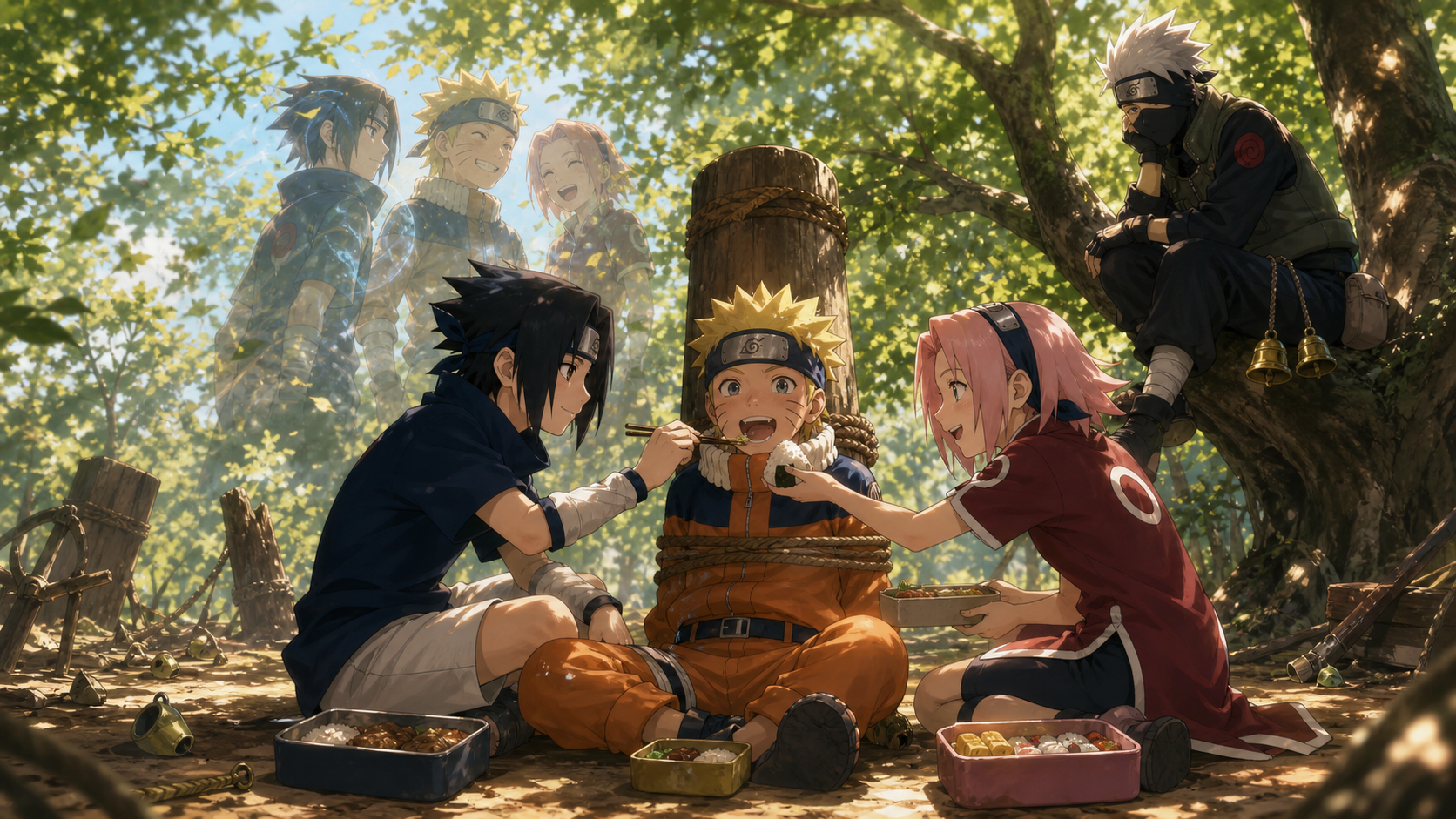
Naruto, Sasuke and Sakura pass the bell test when sharing food matters more than Kakashi’s literal order and imposed competition.
Bottom line
“Squad Seven” closes Kakashi’s ANBU history by placing Naruto, Sasuke, and Sakura in his care. Hiruzen recognizes echoes of Team Minato, but resemblance should guide attention rather than assign replacement roles. Naruto is not Obito restored, Sasuke is not young Kakashi repeated, and Sakura is not Rin reborn to hold boys together. Each child arrives with a separate history, need, and capacity. Kakashi uses the bell test to create apparent scarcity and tells the students not to feed Naruto after failure. Sasuke and Sakura ultimately share food with him, choosing a teammate over the literal order. Kakashi passes them because they discovered the ethical standard underneath the exercise. Their solidarity is genuine and still incomplete. Passing one test does not dissolve rivalry, loneliness, grief, gendered expectations, or Sasuke’s trauma. Team Seven begins because three children demonstrate that relationship can interrupt imposed competition.
Hiruzen assigns Kakashi a specific team
Naruto, Sasuke, and Sakura become Kakashi’s responsibility as new genin. The composition places three very different children inside one developmental unit.
Assignment creates opportunity and does not guarantee compatibility.
Team composition carries institutional judgment
Academy records, abilities, temperament, and village needs influence which children are grouped. Students rarely control the initial arrangement.
Because authority creates the team, authority also owes the team enough support to become functional.
Kakashi receives histories, not blank students
Naruto, Sasuke, and Sakura bring years of village treatment, family experience, classroom dynamics, and private belief into the first meeting.
Leadership begins by learning what existed before leadership arrived.
The team resembles Team Minato
Hiruzen and Kakashi can see familiar patterns in personality and group dynamics. Recognition may help Kakashi anticipate conflict.
Similarity becomes dangerous when adults stop seeing the present children.
Resemblance can activate grief before teaching begins
A gesture, argument, or team position may return Kakashi to people he lost. Emotional recognition can happen faster than conscious comparison.
He needs awareness of those reactions so students do not receive consequences meant for the past.
A familiar pattern can invite protective overreach
Kakashi may try to prevent every earlier failure by controlling the new team too tightly. Protection shaped by fear can limit students’ own judgment.
The goal is safer development, not a perfectly managed reenactment.
Naruto is not an Obito replacement
Both boys can appear loud, underestimated, relational, and determined to become Hokage. Naruto also carries jinchūriki isolation and a childhood without parents.
He deserves responses fitted to his own life rather than correction aimed at Kakashi’s regret about Obito.
Naruto’s Hokage dream has a different foundation
Recognition is not only ambition for office. Naruto wants proof that a village which ignored him can finally see his worth.
Kakashi should hear both the public goal and the attachment need beneath the goal.
Humor can conceal social injury
Pranks and loud claims create attention while protecting Naruto from openly naming loneliness. Adults may respond only to disruption and miss the reason disruption persists.
Team belonging can reduce the need for harmful attention-seeking without demanding a quieter personality as the price.
Sasuke is not young Kakashi repeated
Both are talented, reserved, and marked by early loss. Sasuke survived the Uchiha massacre and lives inside a vengeance story created through hidden politics.
Shared traits do not make their grief or choices interchangeable.
Sasuke’s excellence is organized around control
Training gives him measurable progress toward an avenger identity and protection against helplessness. Skill becomes a response to loss as well as talent.
Praise that focuses only on strength can deepen the structure isolating him.
Clan history is hidden inside his silence
Others may see arrogance or distance. Sasuke carries memories of family, massacre, Itachi’s imposed story, and a district emptied around him.
Understanding does not require allowing harmful behavior toward teammates.
Sakura is not Rin assigned again
Both girls may appear between two boys in a three-person team. Sakura has her own ambition, intelligence, insecurity, attraction, and need for technical growth.
Her role cannot be emotional maintenance for male teammates.
Academy intelligence deserves practical development
Sakura’s chakra awareness, study discipline, and pattern recognition offer real foundations. A teacher should convert those strengths into field confidence and independent technique.
Potential should not remain secondary because teammates display louder inherited power.
Attraction should not define her assessment
Sakura’s focus on Sasuke affects early choices, but one adolescent attachment does not summarize her capacity. Kakashi must evaluate the whole student.
Growth includes learning to recognize Naruto and herself outside Sasuke’s approval.
Kakashi must meet three present children
Memory can make him attentive to risks he once missed. Memory can also make him assume motives before listening.
Good teaching uses comparison as a question rather than an answer.
First impressions need revision
Naruto can appear reckless, Sasuke selfish, and Sakura distracted. The bell test produces additional evidence under stress.
A fair instructor updates assessment as relationships reveal more.
Private context should not become public labeling
Kakashi may receive sensitive records about Naruto’s seal or Sasuke’s massacre history. Necessary knowledge must guide protection without exposing students to teammates before consent and readiness.
Confidentiality becomes part of trust.
Naruto enters hungry for recognition
His disruptive behavior often seeks acknowledgment from a village that treated him as a problem before explaining why. Attention carries emotional survival value.
Discipline without relationship can reinforce the rejection underneath the behavior.
Food carries more than test mechanics
Naruto has known inconsistent care and often meets basic needs alone. Withholding lunch places ordinary nourishment inside an authority exercise.
The choice to feed him therefore communicates belonging at a bodily level.
Being singled out repeats a village pattern
Naruto is accustomed to becoming the visible problem while adults conceal the Nine-Tails context. The post-and-food punishment can resemble that social isolation.
Kakashi must ensure the reveal repairs rather than reinforces the pattern.
Sasuke enters organized around loss
He has extraordinary academy performance and a private goal centered on killing Itachi. The truth behind the massacre remains hidden from him.
Competence and vengeance conceal a child whose entire family was taken.
Team attachment threatens and offers something
New bonds can provide support while creating people Sasuke fears losing or being delayed by. Distance may feel safer than dependence.
Sharing food becomes meaningful because he accepts a small obligation to someone else.
Rivalry with Naruto can become recognition
Competition draws attention to Naruto’s persistence and makes each boy test the other. Rivalry can motivate development and conceal admiration.
Kakashi must keep competition from becoming permission to dehumanize.
Sakura enters through social pressure
She understands classroom success and carries intense concern about how Sasuke sees her. Those priorities can limit honest teamwork at first.
Her growth should include self-defined skill and voice beyond romantic approval.
Team placement challenges classroom hierarchy
Academy success no longer guarantees field confidence, and popularity does not determine combat judgment. Sakura must build a new understanding of competence.
That transition deserves instruction rather than ridicule.
She can learn solidarity through action
Feeding Naruto asks Sakura to choose team welfare over the image she wants to present. Participation gives her a practical route into broader care.
The choice belongs to her even where Sasuke acts first.
The bell test introduces scarcity
Three students compete for fewer bells, suggesting one person must fail. The setup invites individual strategy and abandonment.
Scarcity reveals whether they accept competition as the only reality.
Scarcity encourages hierarchy inside the team
Students may decide the weakest member should lose, the strongest deserves priority, or alliances should exclude one person. Each response reproduces a social ranking.
The hidden answer rejects ranking as the foundation of belonging.
Manufactured scarcity needs disclosure
Kakashi knows the bell shortage is pedagogical rather than an unavoidable resource limit. Students do not.
Debriefing should show how authorities can create competition by defining resources and rules narrowly.
Kakashi controls the apparent rules
He sets the objective, time, food consequences, and standard while withholding the deeper criterion. The power imbalance is intentional.
Teaching value depends on proportional stakes and a truthful debrief.
His overwhelming skill shapes the emotional field
Students cannot realistically defeat Kakashi through isolated academy techniques. The gap makes individual failure predictable.
Challenge should reveal teamwork without persuading children that they are fundamentally powerless.
Playfulness can soften and obscure power
Kakashi’s casual manner reduces formal intimidation while making his intentions difficult to read. Students may underestimate danger or feel mocked by effortless control.
Humor needs a stable foundation of respect.
Individual attacks fail
The students initially approach Kakashi through separate strengths and motives. An elite Jonin can isolate and defeat them.
Failure shows a coordination need rather than proving any child worthless.
Each approach reveals usable strength
Naruto brings persistence and unpredictability. Sasuke brings technical discipline and analysis. Sakura brings observation and classroom knowledge.
The teacher’s job is to help those strengths connect rather than rank them in isolation.
Failure can generate shared information
Watching a teammate struggle reveals Kakashi’s tactics and the limits of a solo plan. Cooperation becomes easier when observations are communicated.
The exercise teaches that another person’s attempt can contribute even without a bell.
Naruto becomes the punished teammate
His impulsive choices place him in the visible failure position and leave him without food. The setup risks making the isolated child the group’s burden.
The ethical test becomes whether Sasuke and Sakura accept that frame.
Visible failure makes care socially costly
Helping Naruto could associate Sakura and Sasuke with the person Kakashi has marked as unsuccessful. Refusal protects their individual standing.
Sharing food rejects both the rule and the status hierarchy created by the rule.
Naruto depends on people he competed against
Receiving care challenges the idea that recognition must be won through solo victory. He cannot force the food-sharing choice.
Dependence becomes an experience of trust rather than humiliation.
Kakashi orders them not to feed Naruto
The explicit rule conflicts with the deeper value Kakashi wants to measure. Obedience would leave a teammate hungry.
Students must decide whether care can justify disobedience.
The contradiction carries institutional risk
Shinobi culture punishes disobedience, and children know failure can return them to the Academy. The decision is not emotionally neutral.
Kakashi asks them to risk advancement for a teammate.
Ethical disobedience needs a principle
Ignoring any inconvenient order would not constitute teamwork. Sasuke and Sakura act because basic care and team readiness outweigh the prohibition.
The lesson should teach reasoned refusal, not arbitrary defiance.
Sasuke shares food
The most openly competitive student recognizes that the team needs Naruto and that leaving him hungry weakens everyone. Practical judgment and care overlap.
Sasuke’s action reveals relational capacity that vengeance has not erased.
Practical reasoning does not diminish compassion
Sasuke may explain that a hungry Naruto weakens team performance. Protecting someone through tactical language still protects someone.
Care often enters through the vocabulary a guarded person can safely use.
He acts against the imposed competition
Giving food helps a rival who could later compete for a bell. Sasuke chooses shared capacity over individual advantage.
The move creates a first piece of trust without requiring emotional confession.
Sakura joins the choice
She follows the move toward shared support rather than preserving approval through literal compliance. Her participation matters beyond agreement with Sasuke.
Teamwork becomes real only when each person carries responsibility.
Agreement is still agency
Sakura does not lose authorship because Sasuke initiates the decision. She evaluates the risk and participates.
Editorial care should avoid turning her action into passive following while still acknowledging his influence.
Feeding Naruto widens her perception
The teammate she dismissed becomes someone whose wellbeing affects her own integrity and future. Relationship grows through concrete responsibility.
One choice begins growth without finishing every bias.
Feeding Naruto rejects imposed expendability
The students refuse a structure where one member’s failure justifies exclusion from basic care. Food becomes the concrete expression of belonging.
A team begins when nobody is treated as the acceptable loss.
Kakashi reveals the actual standard
He passes them because they value their teammate above the stated prohibition. The test joins Obito’s lesson with Kakashi’s authority as teacher.
Explanation turns confusing pressure into articulated principle.
Passing should include a full debrief
Students need to know why solo tactics failed, why sharing mattered, and how the rule contradiction served the test. Celebration alone leaves the method mysterious.
Clear feedback turns success into repeatable judgment.
Kakashi also receives assessment data
The children show they can revise competition under pressure. Their different routes into cooperation reveal future teaching needs.
The instructor should learn from the test as much as students do.
The lesson challenges blind obedience
Shinobi operate through orders, but Naruto’s world repeatedly shows leaders using orders to hide harm. Students need judgment alongside discipline.
Comrade protection becomes a limit on institutional command.
Passing does not mean the method was perfect
Hunger, threat of rejection, and hidden criteria can cause unnecessary distress. Successful insight does not make every feature beyond criticism.
Kakashi should continue evaluating how students experienced the test.
Passing does not make the team complete
Naruto and Sasuke still compete. Sakura still has uneven investment between teammates. All three carry needs they barely understand.
One cooperative decision establishes potential rather than finished trust.
Future conflict will test whether the lesson holds
Real missions include fear, status, secrecy, and consequences Kakashi cannot fully control. Shared food in training provides a reference point rather than immunity.
Teamwork must be chosen repeatedly under changing conditions.
Bonds can become both strength and vulnerability
Caring creates coordination and reason to persevere. Caring also gives loss, manipulation, and fear more emotional reach.
Kakashi should teach students how to protect bonds without treating detachment as safety.
Kakashi becomes responsible after the reveal
The bell test is an entrance, not the conclusion of teaching. He must build communication, distribute attention, and protect each child from being reduced to technique.
Teamwork must become daily practice across missions.
Attention must be distributed deliberately
Naruto’s disruption, Sasuke’s talent, and Sakura’s quieter needs can pull unequal focus. A teacher should track who receives instruction, patience, and expectation.
Team balance includes the adult’s allocation of care.
The leader must remain accountable to students
Kakashi can ask for trust while acknowledging mistakes, explaining changed plans, and listening when a method harms them. Authority should not make feedback one-directional.
Reliable repair strengthens rather than weakens leadership.
Team Seven gives Kakashi no clean redemption
Their success cannot undo Team Minato, the Uchiha massacre, or ANBU years. Students are not a second draft of dead friends.
Kakashi’s care matters because these children deserve care.
The team creates a different future possibility
Naruto, Sasuke, and Sakura can learn the solidarity institutions repeatedly denied earlier generations. Their bonds will be tested by secrecy and ambition.
Beginning with shared food gives the team a standard to return to.
A meal becomes the first team tradition
The act is small beside future battles, yet scale makes the choice accessible. Team identity begins through meeting an immediate need.
Grand loyalty grows from ordinary practices of not leaving someone out.
Squad Seven is a beginning, not a destiny
The team will change, fracture, reunite, and challenge the village that formed the team. Nothing about assignment guarantees the final shape.
Their future remains a series of choices built from this first refusal to abandon one another.
Kakashi tests the rule beneath the rule
His food restriction is deliberately unjust. Naruto needs food, the team needs strength, and Sasuke and Sakura must decide whether literal obedience matters more than a teammate’s welfare. Their violation reveals that they understand the value the instruction was built to test.
This works only because Kakashi controls the consequence and intends no lasting deprivation. A teacher cannot excuse arbitrary harm by announcing that students should have discovered a hidden lesson.
Sharing food turns three placements into a team
Sasuke and Sakura do not suddenly erase rivalry, loneliness, or uneven skill. They make one concrete choice that treats Naruto’s need as shared responsibility. Team identity begins through conduct before affection becomes easy.
Kakashi recognizes the choice because Obito’s lesson survived inside him: people who abandon comrades are worse than people who break procedure. Squad 7 forms when inherited grief becomes protection instead of another reason to stay detached.
RaeRae’s verdict
“Squad Seven” works because Kakashi’s past changes what he values without determining who his students are. The resemblance to Team Minato is emotionally meaningful, but Naruto, Sasuke, and Sakura need space to exceed that template.
The bell test succeeds at its central moment: two children violate a direct order to care for the teammate positioned as expendable. Kakashi recognizes the answer and welcomes them as a team. The work begins afterward. Solidarity found once under a tree must become a relationship capable of surviving missions, rivalry, grief, and the hidden histories adults have left them.
RaeRae’s call
Squad 7 begins with a shared meal and a broken order because Kakashi finally uses the past to protect the future. Naruto, Sasuke, and Sakura pass when they refuse imposed scarcity and recognize a teammate’s need as their problem. The bell test matters because its real standard is care under pressure, not obedience performed for authority. The meal says belonging begins when another person’s hunger becomes impossible to ignore or dismiss.
Episode details and viewing routes
- Official episode reference: Naruto Official episode guide
- Licensed episode route: Crunchyroll licensed episode page
What I am carrying forward
Hiruzen has assigned Naruto, Sasuke, and Sakura to Kakashi. The three resemble members of Team Minato without becoming replacements for them.
Sasuke and Sakura share food with Naruto despite Kakashi’s prohibition, demonstrating the teamwork standard behind the bell test. Kakashi passes them, and Team Seven formally begins. Episode 362 returns to the war, where Kakashi tries to reach Obito and Naruto defends his teacher.