
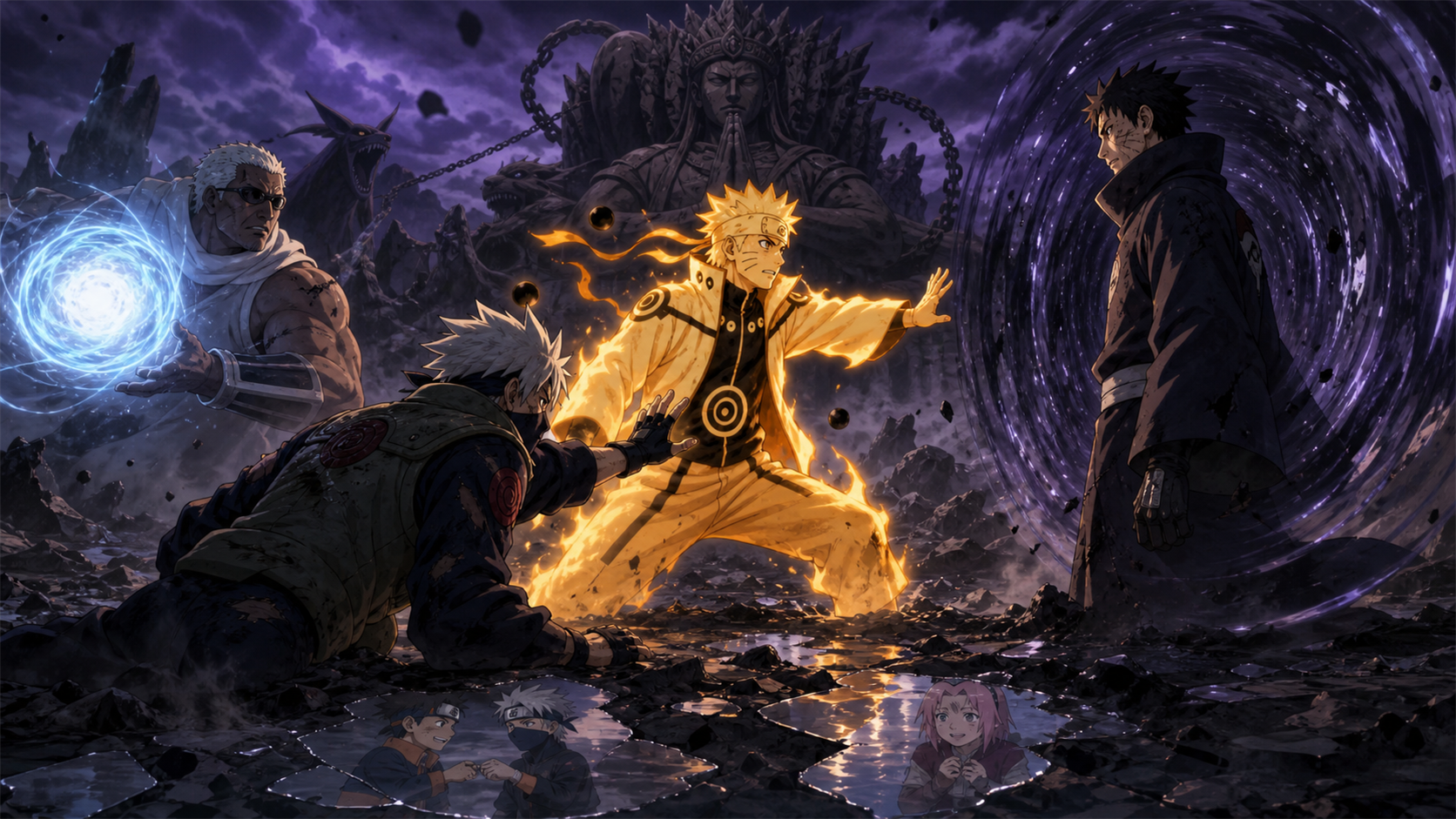
Kakashi’s Resolve
Kakashi reaches for Obito through accusation and grief, while Naruto refuses to let his teacher’s worst memories define the man standing beside him.
Bottom line
“Kakashi’s Resolve” returns from the ANBU history to the battlefield where that history matters. Kakashi tries to reach Obito after learning that the masked architect of war is the teammate he mourned. Obito rejects the appeal and calls Kakashi trash, turning Kakashi’s old language about rule-breakers back against him. Naruto intervenes to defend his teacher. The defense matters because Naruto knows Kakashi through years of present conduct, not because Kakashi has never failed. Kakashi cannot repair Obito by saying the correct sentence, and Obito’s trauma does not remove responsibility for the Nine-Tails attack, Akatsuki manipulation, Uchiha massacre, or war. The resolve in the title is Kakashi’s decision to protect the living values Obito once taught him, especially through Naruto. Memory becomes a commitment to the person Obito was without surrendering judgment to the person Obito currently chooses to be.
The episode returns to the current battlefield
The extended past has shown how Obito and Kakashi traveled from Team Minato into opposite political projects. Present danger now demands action.
Historical understanding changes responsibility without pausing the war.
The flashback changes how the present reads
Viewers now know the grooming, grief, and political decisions beneath Obito’s mask. Kakashi still faces the consequences of those events as immediate attacks.
Context deepens the scene without converting explanation into tactical permission.
Time for processing does not exist here
Kakashi receives life-altering truth while allies remain under threat. Reflection, mourning, and combat are forced into the same minutes.
The battlefield asks for function before his mind can integrate what has returned.
Kakashi’s resolve has been shaken
The enemy behind the mask is someone whose death organized years of grief and guilt. Discovery destabilizes the story Kakashi used to understand his life.
Shock is a human response and an immediate battlefield vulnerability.
The mask reveal reopens multiple losses
Obito’s presumed death, Rin’s death, Minato’s death, and Kakashi’s promise become connected through a survivor he never knew survived. Old grief changes shape all at once.
Reinterpretation can be destabilizing even when new facts reduce false guilt.
Hesitation is not cowardice
Kakashi’s body and judgment encounter a conflict between defending allies and recognizing a beloved friend in the enemy. Brief paralysis reflects the scale of that contradiction.
Recovery of action should not require contempt for the shock.
Obito is alive and radically changed
Kakashi must hold the child who saved him beside the adult directing mass violence. Neither image alone explains the whole person.
Past goodness does not excuse current harm, and current harm does not make the past relationship imaginary.
Continuity exists without inevitability
Adult Obito still carries memories, abilities, and attachments from childhood. Those continuities do not prove that massacre and war were unavoidable developments.
Many decisions and influences sit between the child and the masked commander.
Kakashi faces a person rather than two separate figures
The boy under the boulder and the adult beside Madara belong to one life. Splitting them entirely would protect memory from discomfort while denying change.
Holding both versions together allows care and accountability to coexist.
Kakashi tries to reach him through words
The appeal recognizes that Obito once valued comrades, dreams, and shared reality. Kakashi seeks a remaining connection beneath the doctrine.
Attempting dialogue does not require ending defense against active danger.
Relationship provides a unique opening
Kakashi knows the values Obito once claimed and the moments that formed their bond. An anonymous opponent could not make the same appeal.
Personal access creates possibility, not a guarantee of influence.
Words recognize agency
Trying to persuade Obito assumes that his current decisions can still change. Kakashi addresses him as more than a mechanism built by Madara.
Accountability depends on the same premise that choice remains possible.
Desperation shapes the appeal
Kakashi wants explanation, interruption, and perhaps proof that the friend he remembers still matters. Multiple needs converge in one battlefield conversation.
No response from Obito can resolve every one of those needs.
Kakashi may seek relief from guilt too
If Obito returns, Kakashi might feel that the promise, Rin’s death, or years of mourning can be given another meaning. That desire is understandable.
Obito cannot be required to heal Kakashi, just as Kakashi cannot be required to surrender others for Obito’s healing.
Urgency can make one conversation carry too much
The battle offers no private setting, shared records, or time for emotional regulation. Kakashi asks words to interrupt an ideology built across years.
Failure of the appeal does not prove dialogue is worthless or sufficient.
Obito refuses the invitation
He does not accept memory as a reason to abandon Project Tsuki no Me. The dream-world plan has become the framework through which he interprets loss.
Refusal remains his choice even where Madara’s grooming explains the origin.
Project Tsuki no Me protects his conclusion
Any pain in reality becomes evidence that reality should be replaced. Any relationship that challenges the project can be dismissed as temporary illusion.
The doctrine contains a response designed to neutralize counterevidence.
Accepting Kakashi would reopen grief
Dialogue could require Obito to face Rin as a person who chose under coercion, Kakashi as another traumatized child, and himself as an author of later harm.
The dream project offers escape from that unbearable accounting.
“Trash” returns Kakashi’s old language
Young Kakashi used harsh categories for shinobi who violated rules. Obito once challenged him by placing abandoned comrades below rule-breakers.
The adult Obito now uses condemnation to deny Kakashi moral standing.
A childhood correction becomes an adult weapon
Obito once used the hierarchy to teach that comrades matter more than rigid rules. The phrase helped Kakashi grow.
Adult Obito removes the invitation to growth and uses the category as a final sentence.
Moral language can serve opposite purposes
The same idea can challenge harmful authority or shame someone into silence. Meaning depends on context, evidence, and what action the speaker seeks.
Obito wants Kakashi immobilized beneath guilt.
The accusation targets Kakashi’s deepest guilt
Kakashi already believes he failed Obito’s request to protect Rin. Calling him trash presses on a wound that has shaped decades.
An insult becomes effective because the target carries a related private accusation.
Internal shame gives propaganda an entry point
Kakashi has rehearsed his failure privately for years. Obito does not need to create a new wound when he can speak through an existing one.
Healing false responsibility would reduce the power of this attack without denying real mistakes.
Shame narrows present usefulness
If Kakashi accepts that one traumatic moment defines him, he may conclude that he has no right to protect anyone now. Self-condemnation becomes a strategic advantage for Obito.
Present responsibility requires resisting total identity collapse.
Rin’s death remains coerced context
Kakashi did not choose to execute Rin. She moved into his Chidori after the Mist made her the Three-Tails vessel.
Restoring context does not erase grief, but context rejects Obito’s total character verdict.
Rin cannot be reduced to the bond between men
Kakashi and Obito interpret themselves through her death, but Rin had her own judgment and acted to protect Konoha from the Three-Tails plan.
Any reconciliation that uses her only as shared pain repeats the erasure beneath their conflict.
Her choice does not authorize endless punishment
Rin accepted death under an enemy’s coercive design. She did not assign Kakashi lifelong shame or Obito jurisdiction over the world.
Neither survivor honors her by converting the moment into permanent control.
Obito knows only part of Kakashi’s aftermath
He saw the fatal moment and then entered Madara’s project. He did not live beside Kakashi’s nightmares, ANBU years, teaching, or repeated protection of comrades.
One image has been made to define a whole life.
He refuses evidence carried by Naruto
Naruto’s loyalty shows that Kakashi built relationships capable of trust and growth. That living outcome complicates the “trash” verdict.
Obito dismisses the evidence because accepting the evidence would challenge his doctrine.
Kakashi’s life continued through service and error
ANBU ruthlessness, protection of Tenzo, mentorship of Itachi, and formation of Team Seven belong to one imperfect path. No single act summarizes the whole.
Moral evaluation requires sequence rather than a frozen frame.
Kakashi knows only part of Obito’s underground history
Madara’s rescue, isolation, manipulation, and preparation occurred beyond Kakashi’s awareness. He cannot address every mechanism from the battlefield.
Incomplete knowledge limits dialogue without making intervention meaningless.
Understanding arrives through an adversarial account
Obito controls much of what he reveals and frames events through his conclusion that reality is hell. Kakashi needs to hear pain without accepting every interpretation.
Empathy is not surrender of critical judgment.
Missing knowledge should produce curiosity and boundaries
Kakashi can remain open to learning how Madara shaped Obito while protecting people from the plan already underway.
Information gathering and active resistance can occur together.
Naruto steps into the exchange
He refuses to let Obito’s accusation settle the meaning of Kakashi. A student becomes support for the teacher who once taught him not to abandon comrades.
The relationship is reciprocal rather than one-directional authority.
A student recognizes the teacher’s isolation
Naruto sees Kakashi pulled inward by an accusation and refuses to let him carry the confrontation alone. Teamwork becomes emotional presence on a battlefield.
Support begins by interrupting the isolation shame demands.
Naruto’s anger protects a bond
He reacts strongly because Obito attacks someone who repeatedly protected him. Anger identifies a boundary even where anger still needs tactical control.
Defending Kakashi does not require Naruto to understand every detail of Team Minato.
Naruto defends conduct he has witnessed
Kakashi protected Team Seven, trusted Naruto’s growth, fought Pain, and entered the war beside him. Naruto’s judgment comes from shared life.
Direct relationship supplies counterevidence to Obito’s frozen memory.
Witness over time matters
Naruto has seen Kakashi under danger, loss, frustration, and command. Repeated conduct offers stronger character evidence than one accusation.
Long relationship does not make Naruto unbiased, but bias toward someone loved is not automatic error.
The defense also reflects Naruto’s own values
He refuses categories that declare wounded people disposable. That position grew through his experience with Gaara, Nagato, Sasuke, and Kakashi.
Naruto speaks as a moral agent, not merely a loyal student.
Defense does not require idealization
Kakashi made mistakes as child, operative, and teacher. Naruto can defend his worth without claiming flawless history.
Comradeship becomes stronger when support survives accurate accountability.
Naruto can oppose the verdict without knowing every mistake
He does not need proof that Kakashi has always acted correctly. He needs enough evidence that “trash” is a dehumanizing totalization.
Rejecting a false whole-person judgment leaves room for specific criticism.
Kakashi remains responsible to receive support
Naruto’s defense gives him an opening to return to action. Kakashi must accept the support rather than insisting guilt makes him unreachable.
Reciprocity includes allowing others to help.
The student returns the teamwork lesson
Kakashi taught Team Seven that those who abandon comrades are worse than rule-breakers. Naruto now refuses to leave Kakashi alone inside emotional attack.
Teaching has become a value capable of supporting the teacher.
Authority has not made the relationship one-way
Kakashi trained Naruto, but Naruto’s resolve now exceeds Kakashi’s in this moment. The teacher can learn without losing legitimacy.
Healthy mentorship allows roles to shift when one person falters.
Team Seven extends Team Minato’s best lesson
Obito’s childhood challenge traveled through Kakashi into the bell test and now returns through Naruto. The principle survives because people adapt the principle.
Inheritance becomes a network rather than a possession.
Obito’s old will survives outside Obito
The child who valued comrades influenced Kakashi, who taught Naruto, who now acts on that principle. A person’s earlier good can continue through others.
Obito cannot erase that legacy simply by repudiating his past.
A value can outgrow its originator
Once shared and practiced, comradeship belongs to everyone who acts through comradeship. Adult Obito has no exclusive authority to revoke the lesson.
Naruto carries the value without inheriting Obito’s later ideology.
Legacy does not absolve the living person
The good influence Obito left in Kakashi and Naruto does not balance away people harmed by his adult choices. Moral bookkeeping cannot exchange one group for another.
Both legacy and accountability remain true.
Memory is not ownership over the present person
Kakashi can honor young Obito while recognizing adult Obito as responsible for current choices. Love for memory does not require obedience to the remembered person’s later demands.
The distinction protects grief from becoming political surrender.
Resolve means protecting current Naruto
Kakashi cannot return to Kannabi Bridge or save Rin through retroactive action. He can protect the student standing beside him and the world Obito threatens.
Present duty gives grief a direction without pretending grief has ended.
The present student is not a substitute
Naruto embodies a value young Obito shared, but Naruto remains himself. Protecting him should not become another attempt to save Obito by proxy.
Kakashi’s commitment respects Naruto’s separate life and future.
Protection includes trusting Naruto’s strength
Kakashi should not reduce support to shielding Naruto from every danger. Naruto is an active fighter whose judgment helps restore Kakashi.
Care combines defense with recognition of capability.
Fighting Obito is not abandoning him
Stopping someone from harming others can be a form of refusing the destructive identity that person has chosen. Opposition recognizes that choices matter.
Care without limits would leave victims unprotected.
Resistance treats Obito’s choices as real
Refusing to fight could imply that childhood trauma makes his current actions beyond judgment. Taking his agency seriously means responding to what he is doing.
Accountability affirms personhood when accountability avoids dehumanization.
Stopping harm can preserve a route back
As long as the war plan advances, Obito must keep defending the doctrine through more violence. Interrupting the plan may create space for another decision later.
The immediate priority remains protecting everyone placed in danger.
Dialogue and force remain in tension
Kakashi wants to reach his friend while participating in a battle that may require lethal action. Neither desire can be treated as emotionally simple.
The episode keeps relationship alive inside necessary resistance.
Conversation should not become a demand on victims
Kakashi has unique reasons to speak with Obito. Other shinobi under attack do not owe the aggressor patience, empathy, or personal rehabilitation.
One person’s relational opening should never suspend collective protection.
Force should remain bounded by purpose
The goal is to stop the Ten-Tails plan and active violence, not punish Obito for making Kakashi feel betrayed. Personal anger cannot define battlefield necessity.
Kakashi’s resolve requires keeping grief from becoming revenge.
Naruto defends Kakashi without declaring him perfect
Naruto does not need a spotless teacher to reject Obito’s accusation. He knows Kakashi can be late, avoidant, grief-stricken, and wrong. He also knows the man who protected Team 7, taught cooperation, admitted fear, and kept choosing people after losing nearly everyone.
Defense becomes credible because it rests on a relationship with evidence. Naruto refuses to let Obito select one wound and use that wound as Kakashi’s entire biography.
Obito turns shared grief into a private prosecution
Rin’s death belongs to Kakashi too, but Obito speaks as though only his pain can interpret the event. Kakashi becomes defendant, symbol, and target while the Mist operation, Madara’s manipulation, Rin’s decision, and the children’s impossible battlefield vanish behind accusation.
Grief explains why Obito wants an answer. Grief does not authorize him to erase every responsible actor or make present victims pay for a past they did not create.
Resolve means acting after words fail
Kakashi keeps trying to reach the friend beneath the mask because abandoning Obito would repeat another loss. Conversation has limits when the other person is actively directing mass harm. Kakashi’s duty includes protecting Naruto, the alliance, and everyone trapped in the Ten-Tails attack.
Compassion and force are not opposites here. A boundary can preserve the possibility of future accountability by stopping present destruction. Resolve means Kakashi will not confuse understanding Obito with surrendering other lives to him.
Naruto’s intervention returns care to Kakashi. The teacher who has spent years stepping between students and danger now hears a student reject the story that he is only failure. That reversal is not rescue from responsibility. It is community refusing isolation. Kakashi can face what happened, oppose Obito, and keep moving because someone beside him remembers the choices grief tried to hide.
RaeRae’s verdict
“Kakashi’s Resolve” pays off the ANBU arc by showing that Kakashi’s past has produced a living ethical inheritance rather than only damage. Obito calls him trash through the same moral language their childhood transformed. Naruto answers through conduct learned from Kakashi and, indirectly, from the young Obito.
Kakashi’s resolve is not certainty that words will save his friend. His resolve is to protect Naruto and the shared world even when Obito refuses the person he once was. Understanding grooming and grief keeps Obito human. Accountability keeps everyone harmed by his choices human too.
RaeRae’s call
Naruto protects Kakashi from being reduced to Rin’s death, and Kakashi protects Naruto from a friend whose grief has become mass violence. Obito deserves the full truth of what happened. He does not get to erase the Mist, Madara, Rin, or his own later choices. Resolve is care with a boundary: reach for the person and stop the harm.
Episode details and viewing routes
- Official episode reference: Naruto Official episode guide
- Licensed episode route: Crunchyroll licensed episode page
What I am carrying forward
Kakashi has tried to reach Obito through their shared past, but Obito rejects the appeal and attacks Kakashi’s worth through the label “trash.” Naruto intervenes to defend his teacher.
Kakashi recognizes that young Obito’s will survives through Naruto and commits to protecting the present student and world before him. Episode 363 follows the Ten-Tails breaking free and the Allied Shinobi Forces confronting its overwhelming power.