
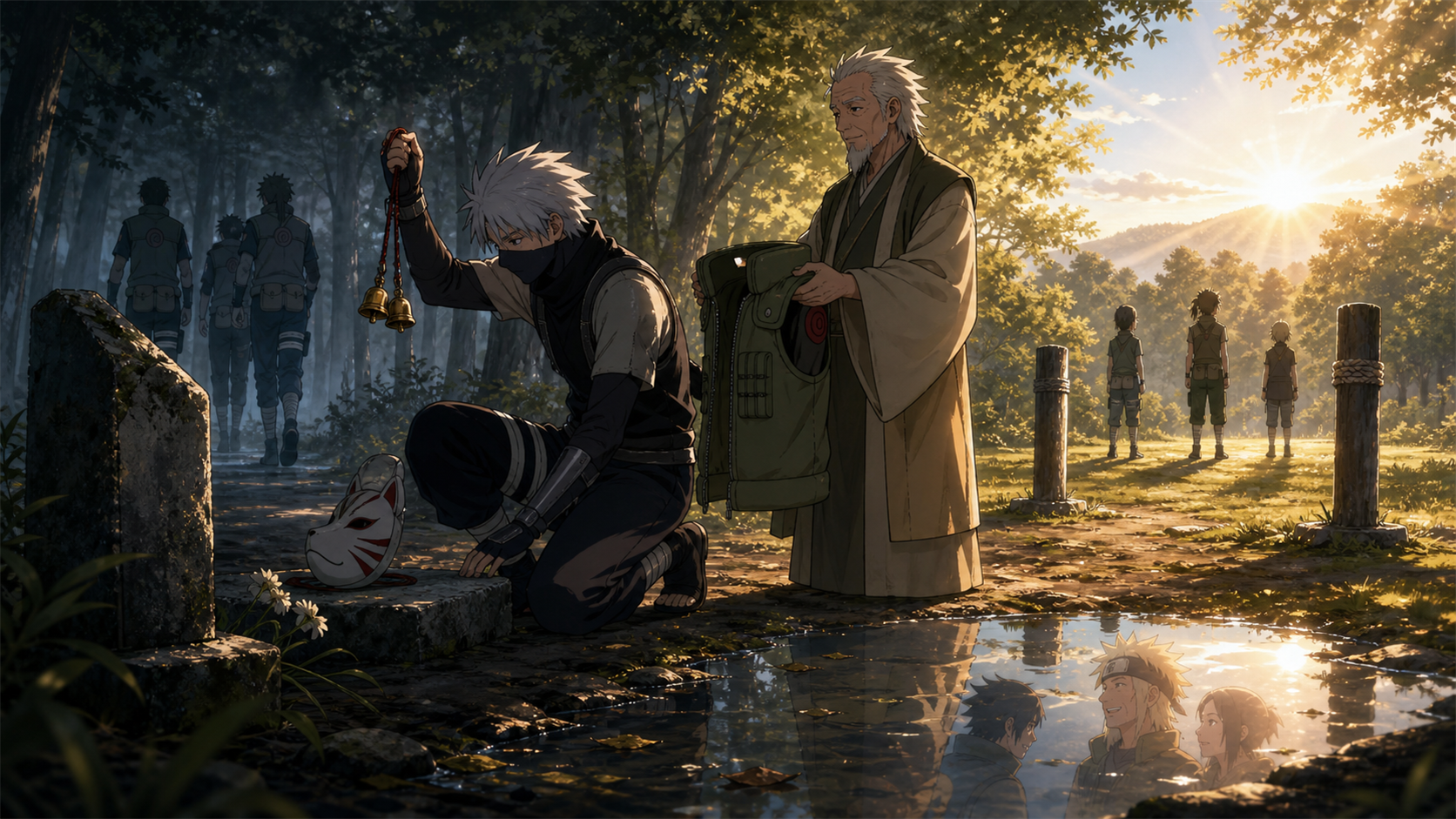
Jonin Leader
Hiruzen removes Kakashi from ANBU and gives him students, forcing a brilliant operative to decide what his bell test should actually teach.
Bottom line
“Jonin Leader” moves Kakashi out of ANBU and into responsibility for young teams. Hiruzen relieves him of covert duties after years in a system that rewarded secrecy, lethal efficiency, and emotional concealment. The reassignment is not proof that those years no longer affect him. A Jonin Leader must translate painful experience into safer instruction rather than repeat the conditions that produced that experience. Kakashi chooses the teamwork exercise Minato once used with Team Minato. The test asks students to discover that protecting comrades matters more than individual competition or blind rule-following. Kakashi has lived the cost of learning that lesson too late, then watched institutions repeatedly turn people into assets. Teaching teamwork becomes a deliberate ethical practice. The challenge is whether a harsh test creates space for cooperation or merely reproduces fear. Inheritance becomes meaningful when Kakashi adapts Minato’s lesson for students rather than copying surface mechanics without care.
Hiruzen removes Kakashi from ANBU
The Third Hokage ends Kakashi’s current covert assignment and gives him a different role. Leaving the unit changes his daily exposure, command structure, and professional identity.
Removal can function as intervention without being punishment.
The timing follows accumulated warning signs
Kakashi has carried ruthless mission reputation, internal Foundation conflict, Itachi’s burden, and the aftermath of the Uchiha massacre. No single incident tells the whole story.
Leadership should recognize cumulative exposure before another crisis becomes the only acceptable reason to act.
Relief should be explained with dignity
Changing someone’s assignment can feel like rejection when identity has been built around elite service. Clear explanation helps distinguish care, performance concerns, and new trust.
Silence would invite Kakashi to interpret removal through his existing fear of failure.
ANBU service has shaped him
Years of masks, classified violence, assassination, surveillance, and contradictory command cannot be switched off with a new title.
Experience enters the classroom through habits, expectations, and what Kakashi notices first.
Hypervigilance may look like strong supervision
Kakashi can anticipate ambush, deception, and rule-breaking with exceptional speed. Those skills protect students during danger.
Constant threat expectation can also make ordinary mistakes appear more dangerous than students experience them.
Secrecy may limit emotional transparency
ANBU taught Kakashi to reveal only what an operation requires. Students need enough explanation to understand correction and trust their leader’s decisions.
He can preserve classified history without making every teaching choice mysterious.
Reassignment is not treatment
Less covert work may reduce certain harms and create new relationships. The position does not automatically resolve nightmares, grief, or moral injury.
Professional change should be paired with continuing support.
New work can still support recovery
Predictable relationships, lower covert exposure, and a role centered on development may create conditions where Kakashi reconnects with ordinary life. Those benefits are real.
Supportive conditions help recovery without becoming a substitute for intentional care.
Students cannot serve as therapy
Their growth may bring Kakashi meaning and joy. They do not owe him emotional repair or reenactments that resolve his past.
The adult must keep responsibility for adult healing rather than placing that task on a genin team.
Hiruzen recognizes a need for change
Moving Kakashi suggests that the current role no longer serves him or the village well. Leadership acts rather than allowing elite performance to justify indefinite exposure.
The intervention arrives after many years, which leaves earlier institutional responsibility intact.
Leadership should evaluate the receiving role too
Removing Kakashi from harm is only half the decision. Hiruzen must consider whether he has support, patience, and teaching readiness before placing children under him.
A safer assignment for one person must also be safe for everyone entering that assignment.
Reassignment can express trust in another capacity
Kakashi is not merely being taken away from covert work. He is being entrusted with the development of future shinobi.
That framing recognizes wisdom and relationship as professional skills beside combat.
A Jonin Leader carries young lives
Kakashi will guide genin who are still learning combat, judgment, and village expectations. His decisions shape both mission safety and the values students take into adulthood.
Teaching requires a different kind of accountability from completing an ANBU objective.
Mission success now includes student development
A leader must evaluate whether genin understand decisions, recover after mistakes, and learn how to protect one another. The outcome cannot be measured only through task completion.
Long-term growth may require slower short-term performance.
Authority becomes visible and personal
ANBU command often arrives through masks and classified hierarchy. Genin will know Kakashi as the adult who praises, disciplines, protects, and decides whether they advance.
His relational conduct becomes part of the curriculum every day.
Students are not replacement operatives
Genin need instruction, supervision, correction, and room to develop. Treating them as smaller ANBU would reproduce the child-soldier acceleration Kakashi experienced.
Training should expand capacity without making vulnerability shameful.
Youth changes acceptable risk
Genin need missions suited to current development, meaningful supervision, and room to retreat. The village’s military structure does not erase those duties.
Exceptional students remain children even when ability exceeds an adult’s expectation.
Comparison with Kakashi’s childhood would mislead
He survived early promotion and war assignments. That history can motivate protection or normalize excessive demands.
Survival proves what happened, not what should happen again.
Reflection turns experience into curriculum
Kakashi considers past mistakes rather than presenting himself as a flawless veteran. Memory becomes evidence for what students need.
Reflection matters when reflection changes method.
Past mistakes need precise language
Kakashi can distinguish decisions he made, coercive conditions others created, and losses no child could fully control. Vague self-blame teaches neither him nor students.
Accurate responsibility produces better lessons than permanent guilt.
Students deserve principles without private projection
Kakashi may see traces of Obito, Rin, or himself in future genin. Similarity can create empathy and bias.
Each student needs to be understood through present conduct rather than assigned a role from Team Minato.
Team Minato remains the central lesson
Obito, Rin, Kakashi, and Minato learned under conditions that eventually demanded impossible sacrifice. Their relationships continue shaping Kakashi’s idea of shinobi responsibility.
The new role lets him carry people forward without making students reenact their deaths.
Memory can guide without governing
Kakashi can ask what would have protected his old team and translate the answer into safer practice. He should remain open when current students need something different.
Inheritance becomes living judgment rather than ritual repetition.
The team included competing values
Kakashi prioritized rules, Obito prioritized comrades, Rin held relationships together, and Minato carried command responsibility. The lesson did not belong to one voice alone.
Teaching teamwork should preserve that complexity rather than turning Obito into a slogan.
Minato’s test measured teamwork
The exercise appears to reward individual capture of a limited objective. The deeper measure concerns whether students cooperate and protect one another.
Surface competition exposes the values a team uses under pressure.
Scarcity is deliberately introduced
Limited bells encourage students to imagine that one person must lose. The design reveals whether they accept imposed competition as the whole reality.
Scarcity can teach solidarity only if the instructor later makes the manipulation explicit.
The instructor controls the stakes
Kakashi decides how frightening failure appears and whether consequences are real, reversible, or explained. Students do not enter an equal experiment.
Ethical use depends on proportional pressure and reliable safety.
The hidden lesson challenges rule worship
Students may believe success means obeying every stated instruction and defeating teammates for scarce reward. The real standard asks them to recognize comradeship above the literal frame.
Rules matter, but rules cannot replace moral judgment.
A paradox asks students to interpret authority
Kakashi may tell them not to share while expecting them to feed a teammate. Passing requires disobedience in service of care.
The lesson can build judgment, yet students also need assurance that adult contradiction will not always be a trap.
Obedience and trust need repair after the reveal
If instructors regularly misstate the real standard, students may learn that no direction can be taken seriously. Debriefing should distinguish pedagogical paradox from everyday command.
Trust survives difficulty through explanation.
Obito changed Kakashi’s hierarchy of values
Young Kakashi once treated mission rules as the highest duty. Obito insisted that abandoning a comrade was worse.
The teamwork test makes that argument part of formal instruction.
Sakumo’s history also shapes the lesson
Kakashi’s father was condemned for choosing comrades over mission completion. That loss pushed young Kakashi toward rule absolutism before Obito challenged him.
The bell test carries multiple generations of conflict between institutional success and human loyalty.
Comrade care needs operational skill
Valuing teammates does not mean abandoning planning or objectives whenever emotion rises. Teams need communication, risk assessment, and coordination to protect one another effectively.
Kakashi can teach care as disciplined practice rather than impulsive sentiment.
Rin’s memory keeps the lesson costly
Kakashi promised to protect Rin and could not prevent her coerced death. Teaching care does not erase his guilt or convert loss into a neat motivational story.
The lesson honors her best when students receive protection she was denied.
No student should become mission infrastructure
Rin’s body was turned into a weapon by enemy planners. Later institutions repeatedly treated rare bodies as assets.
Kakashi’s classroom can resist that pattern by placing personhood before technique value.
Girls should not be assigned emotional maintenance
Rin’s role is often remembered through how she connected boys around her. Female students deserve full tactical, intellectual, and emotional development beyond keeping teammates stable.
Teamwork distributes relational labor rather than assigning that labor by gender.
Minato’s example is inherited critically
Kakashi respects his teacher and uses the same foundational exercise. He also knows that Team Minato entered a war where children carried adult missions.
Inheritance should preserve wisdom while examining the system around the wisdom.
Good teachers can make harmful decisions
Minato cared deeply for Team Minato and still participated in a military structure that placed children in war. Respect need not require idealization.
Kakashi honors him through learning from both strength and limit.
Copying form can miss purpose
Bells, posts, food, and stated failure are memorable pieces of the exercise. Teamwork remains the reason those pieces exist.
If students leave only afraid of Kakashi, the form has overwhelmed the lesson.
A harsh test can still create harm
Fear of failure may reveal teamwork, but fear can also reproduce insecurity and teach students that belonging is conditional on reading an adult’s hidden intention.
Kakashi must evaluate method as well as desired lesson.
Fear can reproduce prior trauma
Students may arrive with abandonment, family pressure, shame, or isolation Kakashi does not yet know. Threatening permanent failure can activate those wounds.
Assessment should gather context before interpreting every response as character.
Difficulty should remain proportional
A meaningful test can frustrate and challenge without humiliating or endangering students. Hardness has no educational value by itself.
The instructor must know which pressure serves learning and which pressure serves reputation.
Hidden criteria require fairness
Students deserve enough information and feedback to learn from assessment. A secret moral standard can become arbitrary when the instructor alone decides what counts.
The test needs consistent purpose, debriefing, and a genuine path to growth.
Students need a second chance to apply learning
Insight after failure is still insight. A fair system creates another opportunity to demonstrate changed teamwork.
Permanent rejection after a deliberately confusing test would reward prior social experience more than teachability.
Assessment should examine the whole team
One student may initiate cooperation while another resists because of fear or misunderstanding. Team results should not erase individual needs.
Kakashi can evaluate shared function and each child’s developmental next step.
Failure should not define a child permanently
A team that does not understand the lesson on one day may need teaching rather than rejection. Assessment identifies a current need, not an essential defect.
The instructor’s responsibility continues after the result.
Earlier teams can reveal weaknesses in the method
If Kakashi repeatedly fails every group, the pattern may reflect selection, student readiness, or his assessment design. An instructor should include personal method in review.
Consistency is not automatically fairness when nobody can succeed.
Teaching means more than screening
A leader who only identifies ready-made teamwork acts as a gatekeeper. A teacher helps students build teamwork they do not yet possess.
The distinction determines whether failure ends a path or begins instruction.
Teamwork is more than tactical coordination
Moving together and combining techniques can serve any objective, including harmful ones. Kakashi’s lesson concerns valuing the people beside the mission.
Ethical teamwork includes refusal to abandon someone for convenience.
Leadership requires relational availability
Students must be able to ask questions, make mistakes, and experience their teacher as more than a masked evaluator. Trust grows through repeated conduct.
Kakashi’s emotional privacy can remain while he creates reliable presence.
Reliability matters more than constant disclosure
Students do not need every detail of Kakashi’s trauma. They need consistent arrival, honest feedback, protection, and actions matching stated values.
Trust can grow without requiring the teacher to surrender every boundary.
Humor may soften authority without replacing clarity
Kakashi’s relaxed manner can make interaction less intimidating after years of severe command culture. Eccentricity also risks confusion when students need direct guidance.
Warmth and precision should work together.
Teaching offers a new use for expertise
Tracking, combat, intelligence, and survival knowledge can now reduce young people’s risk rather than only advance covert objectives.
Skill becomes care when power is directed toward another person’s development.
Prevention becomes a professional achievement
ANBU often measures success through threats eliminated. Teaching can measure success through injuries avoided, judgment improved, and young people who need less rescue later.
Invisible prevention deserves institutional value.
Students can change the teacher too
Relationship may challenge Kakashi’s assumptions and reconnect him with parts of life hidden during ANBU service. Mutual influence is natural.
The adult remains responsible for keeping that influence from becoming emotional dependence on children.
The role creates no clean redemption
Guiding future teams cannot undo Rin’s death, Itachi’s burden, ANBU killings, or the Uchiha massacre. Students should never become instruments for repairing Kakashi’s self-image.
Good teaching matters because students deserve good teaching.
Removing the mask is an institutional admission
Hiruzen’s decision acknowledges that Kakashi’s usefulness in ANBU does not mean ANBU remains healthy for him. The transfer arrives late, after years of grief, secret killing, and exposure to Danzō’s parallel machinery. Late care still matters when it changes the next assignment.
A responsible exit should include evaluation, rest, disclosure, and support. A new vest cannot carry every wound the mask helped conceal.
Students are people, not rehabilitation equipment
Giving Kakashi a team may reconnect him to ordinary life and Minato’s example. The children cannot be assigned the job of healing their teacher. Hiruzen remains responsible for choosing a leader ready to keep them safe, supervise development, and ask for help before trauma becomes classroom policy.
Kakashi’s growth and student welfare can support each other only when adults protect both sides of that relationship.
The bell test carries a hidden ethical question
The exercise looks like competition for limited places. Minato used scarcity to expose whether young shinobi would abandon one another for individual success. Kakashi inherits the method after institutions repeatedly rewarded isolation, secrecy, and obedience.
If he teaches teamwork through humiliation alone, he repeats the system. If he explains the principle and evaluates care under pressure, the test can become a boundary against that system.
Kakashi can interrupt what shaped him
He cannot recover Obito, Rin, Minato, or the years spent treating survival like proof that detachment worked. Leadership gives him influence over what the next generation learns before loss hardens into identity.
Breaking a cycle does not require becoming flawless. It requires naming the harmful lesson, building a different practice, and accepting responsibility when old reflexes enter the room.
The most important promotion here is not Kakashi’s rank. It is the possibility that experience can become stewardship instead of repetition. He knows what happens when teams learn that rules matter more than people, grief must stay hidden, and usefulness determines worth. A jonin leader can challenge those lessons in practice: explain decisions, notice exclusion, reward cooperation, admit mistakes, and protect students from missions beyond their readiness. That work is quieter than ANBU heroics and far more consequential.
RaeRae’s verdict
“Jonin Leader” gives Kakashi a believable route out of the shadows without pretending reassignment cures him. Hiruzen changes the work. Kakashi must change how his experience enters the work. Choosing Minato’s teamwork test shows that he wants students to learn the principle Obito forced him to confront: comrades cannot be reduced to mission costs.
The exercise still deserves scrutiny. Hidden criteria and harsh pressure can repeat the culture Kakashi wants to challenge. His growth will appear not merely in using the bell test, but in how he teaches, debriefs, protects, and allows young people to become more than tools.
RaeRae’s call
Kakashi leaving ANBU is not a magical cure. The change matters because Hiruzen finally stops measuring his value only through covert usefulness. Jonin leadership can become another form of extraction unless Kakashi receives support and his students remain children, not treatment. The bell test works when teamwork becomes protection, not another secret adults expect children to decode alone.
Episode details and viewing routes
- Official episode reference: Naruto Official episode guide
- Licensed episode route: Crunchyroll licensed episode page
What I am carrying forward
Hiruzen has relieved Kakashi of ANBU duty and assigned him as a Jonin Leader. The change moves him from covert operations into direct responsibility for genin development.
Kakashi has chosen Minato’s teamwork test as his central assessment, reflecting on the failures and losses of Team Minato. Episode 361 follows the formation and testing of Squad Seven with Naruto, Sasuke, and Sakura.