
RaeRae Reacts · One Piece Episode 110
Luffy vs. Crocodile
One Piece Episode 110 begins Luffy’s first Crocodile duel, exposes the Logia contact problem, and turns a sandstorm toward Yuba into deliberate civilian leverage.
Quick reaction
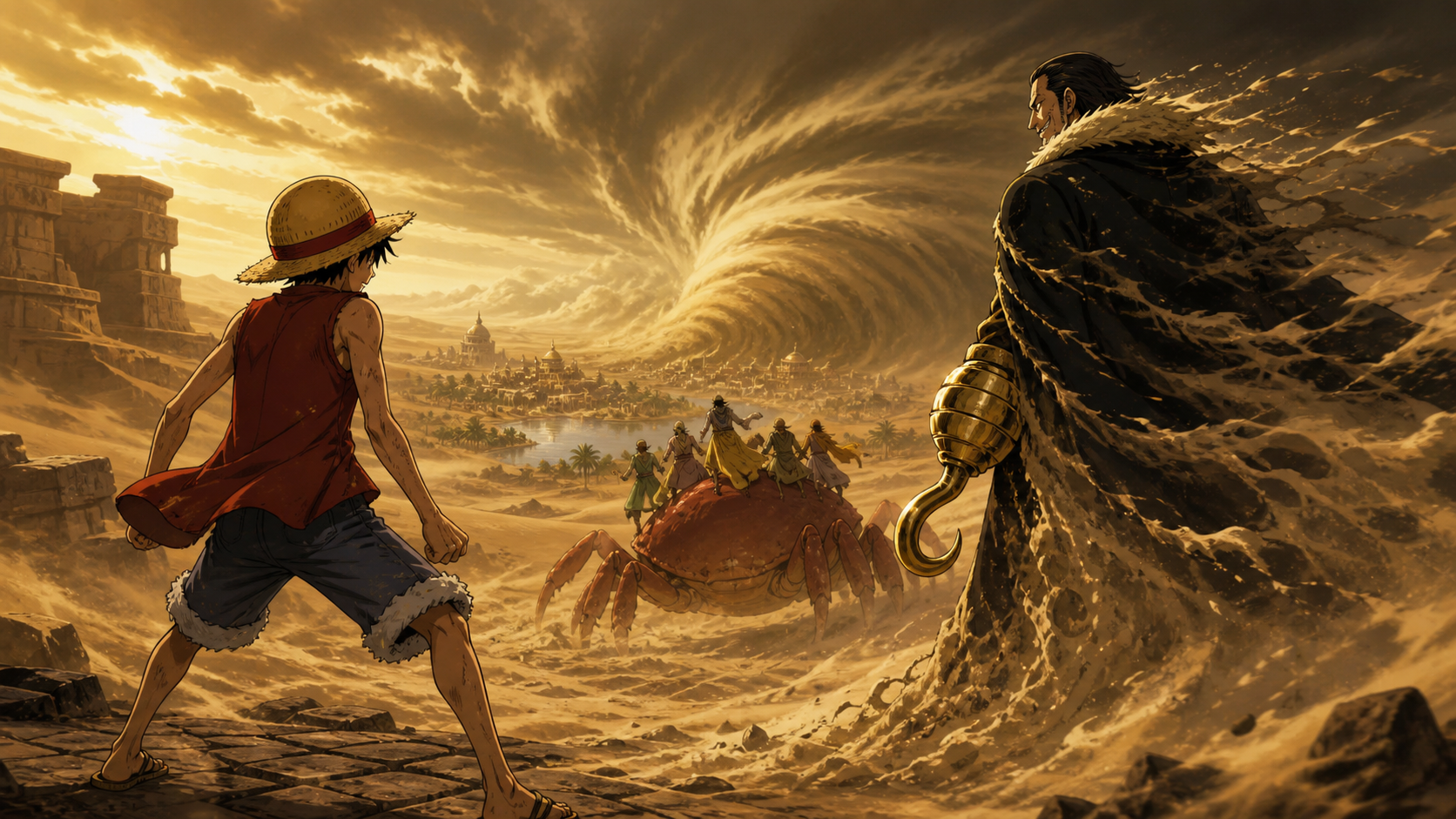
One Piece Episode 110 finally puts Luffy and Crocodile face to face without a cage between them. The Straw Hats and Vivi race toward Alubarna on Chopper’s giant crab, but Crocodile catches Vivi with his hook. Luffy frees her, sends everyone onward, and stays behind to hold the Warlord in place.
The duel immediately exposes a brutal mismatch. Luffy’s punches pass through Crocodile’s sand body, while Crocodile controls the battlefield, the air, and the desert itself. Then Crocodile aims a sandstorm toward Yuba, turning Toto’s exhausted town into leverage against Luffy.
RaeRae’s bottom line is simple: Crocodile does not fight to test strength. He fights to prove that every person, town, and resource around Luffy can become a weapon.
The giant crab turns escape into movement
Breaking the Rain Dinners cage only returns the crew to a larger emergency. The rebellion and royal army are moving toward Alubarna, and Vivi needs to reach the capital before both sides collide.
Chopper prepares a giant crab capable of carrying the group across the desert. The animal provides what the crew lacks after the underground rescue: speed, capacity, and a route that does not depend on Crocodile’s roads.
Transportation becomes direct intervention. Every minute saved improves Vivi’s chance of reaching Koza before Baroque Works agents manufacture more violence.
The sequence also recognizes support labor. Winning a fight at Rain Dinners means little if nobody arranges the next movement. Chopper’s contribution connects survival to the actual mission.
Crocodile catches Vivi because he understands the real objective
Crocodile does not waste time chasing every Straw Hat equally. His hook reaches for Vivi because her voice can expose Operation Utopia and interrupt the civil war.
The choice shows strategic clarity. Luffy is dangerous, but Vivi is politically disruptive. She carries relationships with the palace, Koza, the royal army, and citizens who may believe her warning.
Capturing her also attacks the crew’s purpose. The Straw Hats did not cross the desert merely to escape Crocodile. They came to help Vivi protect Alabasta.
Crocodile therefore aims at the person whose survival keeps the mission meaningful. The hook is physical violence and information control at the same time.
Luffy frees Vivi and refuses to keep her beside him
Luffy’s protective instinct could produce the wrong decision. Keeping Vivi close might feel safer in the next few seconds, but Alaburna needs her more than the duel does.
He sends Vivi and the crew onward while choosing to remain behind. The decision separates two urgent tasks: stop Crocodile from pursuing and deliver the warning to the capital.
Leadership means accepting that the person with the most important mission cannot always stay in the most protected position. Vivi must keep moving even while a friend faces the enemy alone.
Luffy trusts the crew to carry her forward. That trust prevents Crocodile from concentrating every objective in one battlefield.
The one-on-one fight is a delay operation
Luffy wants to defeat Crocodile, but the immediate function of the duel is simpler: keep the Warlord away from Vivi.
A delaying action can succeed without a clean victory if the protected group gains enough distance. Every moment Crocodile spends responding to Luffy becomes a moment Vivi can use to approach Alubarna.
That framing changes how courage should be judged. Luffy does not stand alone because he has complete information about Crocodile’s power. He stands because no safer person can occupy that position.
The risk remains enormous. Delay only helps if the defender survives long enough and the escaping group can use the time effectively.
Crocodile’s sand body invalidates Luffy’s normal evidence
Luffy understands combat through contact. A punch lands, a body moves, and damage provides feedback. Crocodile dissolves into sand, so familiar evidence disappears.
Attacks passing through the target create both a technical problem and a psychological one. Luffy knows he committed force, yet the battlefield shows no lasting effect.
Logia power therefore changes the rules before raw strength receives a fair comparison. The first requirement is not a harder punch. The first requirement is discovering how contact can become possible.
Crocodile enjoys that gap because inexperienced opponents often spend energy repeating the same failed action.
Intangibility is not invincibility
Crocodile presents his sand transformation as absolute superiority. Episode 110 shows only that Luffy’s current method cannot hold him.
Those claims are different. A system can resist one input while remaining vulnerable to another. Sand changes with moisture, containment, pressure, and environment.
Luffy does not yet possess the full answer, but the fight begins the necessary research. Which conditions make Crocodile solid? When does he reform? What movements require concentration? What part of the terrain belongs to his power rather than ordinary desert wind?
Survival depends on replacing awe with questions. Calling an opponent invincible ends analysis before evidence earns that conclusion.
Crocodile controls terrain instead of trading punches
Crocodile fights through the desert around him. Sand can obscure vision, shift footing, redirect movement, and extend danger beyond arm’s reach.
That control reduces the value of Luffy’s mobility. Stretching attacks still need a target and a stable path. A battlefield that changes shape can interrupt both.
The Warlord also conserves effort by making the environment perform work. Luffy must spend energy moving, defending, and searching while Crocodile remains integrated with the terrain.
Power over infrastructure and landscape often matters more than isolated strength. Crocodile built his public image, casino, criminal network, and combat style around the same principle.
The hook makes threat personal
Crocodile’s golden hook gives his violence a fixed, visible edge beside the diffuse sand. The weapon can seize Vivi, control distance, and remind Luffy that one clean contact may decide the fight.
The contrast supports Crocodile’s method. Sand removes his own body from retaliation, while the hook concentrates harm against other bodies.
Asymmetry defines the duel. Luffy must solve contact before causing damage. Crocodile can threaten through weapon, terrain, dehydration, and storm without accepting the same exposure.
A fair fight has never interested him. Crocodile wants a demonstration of control that discourages resistance.
The weapon also carries the authority of Crocodile’s public image. Alabasta citizens recognize the hook beside the man celebrated as a protector. Private violence and public branding occupy the same body, which explains why direct witnesses such as Vivi, Luffy, and Smoker threaten more than Crocodile’s reputation. Their testimony connects the symbol people trust to the harm hidden beneath Rain Dinners.
The sandstorm toward Yuba is targeted collective punishment
Crocodile launches a sandstorm toward Yuba rather than keeping every attack inside the duel. The town has already suffered drought, displacement, and repeated environmental collapse.
Toto remains there digging for water and protecting hope that most people abandoned. Crocodile knows that history and turns the town into a pressure point.
Collective punishment works by harming people who cannot control the target’s decision. Yuba’s residents did not choose Luffy’s challenge, yet their homes and survival become part of Crocodile’s retaliation.
The storm also communicates scale. Crocodile wants Luffy to understand that personal bravery cannot shield every distant community at once.
Yuba matters because Toto’s labor made hope visible
Toto continued digging after the oasis failed. His work did not produce enough water to reverse the drought, but the labor preserved a refusal to surrender Alabasta to Crocodile’s narrative.
Aiming the storm at Yuba attacks more than buildings. Crocodile attacks proof that somebody can keep working without accepting his manufactured despair.
Luffy received water and trust from Toto. The storm therefore creates a personal obligation alongside the broader political harm.
Crocodile mistakes care for weakness. Care can distract Luffy, but care also supplies the reason he will keep searching for a way to land the next blow.
Crocodile weaponizes distance
Luffy cannot defend Yuba and confront Crocodile in the same location. The storm exploits that separation.
Distance creates delayed knowledge, limited response, and moral uncertainty. Luffy sees the attack begin but cannot immediately measure the damage or help the people in its path.
Crocodile has used the same structure across Alabasta. Leaders make decisions in one city while agents manufacture consequences elsewhere. By the time accurate information travels, the next crisis has already started.
Stopping the source becomes essential because chasing every consequence leaves the architect free to create more.
Vivi must keep moving despite the duel behind her
Vivi has every emotional reason to remain. Luffy is fighting the person who destroyed her country, and his decision protected her from the hook.
Turning back would waste the exact sacrifice he chose. Her responsibility is to reach Alubarna, find Koza, and stop the armies from completing Crocodile’s plan.
Mission discipline can look cold when friends separate under danger. The real coldness would be allowing personal fear to abandon thousands of civilians facing war.
The crew’s movement shows trust as action. They honor Luffy by using the time he purchases.
The duel exposes the limits of confidence without preparation
Luffy’s confidence helps him stand against a Warlord. Confidence does not automatically supply knowledge about Logia mechanics.
The first exchange punishes that gap. His usual attacks fail, and Crocodile controls the pace without needing to match every punch.
RaeRae does not read the failure as proof that Luffy should have walked away. Somebody needed to stop pursuit. The failure shows why courage and preparation must support each other.
The next step is adaptation. A useful fighter treats failed contact as data rather than humiliation.
Crocodile’s arrogance creates an information leak
Crocodile enjoys explaining superiority because he believes Luffy cannot use the knowledge. Every demonstration still reveals behavior.
Becoming sand shows when his body disperses. Creating a storm shows how his power interacts with existing terrain. Choosing Yuba reveals what emotional leverage he expects to work.
Arrogant opponents often confuse explanation with control. Luffy may lose an exchange while learning the condition that changes the next encounter.
Crocodile wants the duel to end as a lesson in helplessness. Luffy can convert the same lesson into research for resistance.
Production choices sell the mismatch
Junki Takegami’s script moves cleanly from escape transport to capture, separation, failed contact, and environmental threat. Each beat increases the scale of Crocodile’s control.
Yuji Endo’s direction keeps the retreating group and isolated duel connected. Viewers understand that Luffy’s battle matters because Vivi continues moving beyond the frame.
Eisaku Inoue’s animation direction makes Luffy’s force visible even when the attacks fail. Crocodile’s dispersal must feel materially different from a dodge or blocked punch.
Yuri Sanami’s art gives the desert narrative weight. Open distance, dry ground, and the storm toward Yuba turn landscape into both battlefield and victim.
What Episode 110 changes
Chopper’s giant crab carries the Straw Hats and Vivi away from Rain Dinners toward Alubarna, restoring momentum after the cage escape.
Crocodile catches Vivi with his hook. Luffy frees her and sends the crew onward so the mission to stop the civil war can continue.
Luffy remains behind for the first direct duel with Crocodile. His normal attacks pass through the Warlord’s sand body, revealing the Logia contact problem.
Crocodile creates a sandstorm aimed toward Yuba. The fight now threatens Toto and an already devastated community far beyond the immediate battlefield.
Episode details
Japanese title: 情無用の死闘!ルフィVSクロコダイル
English title: Merciless Mortal Combat! Luffy vs. Crocodile!
Japanese broadcast: May 5, 2002
Saga: Alabasta
Material: Manga-canon adaptation
Script: Junki Takegami
Episode direction: Yuji Endo
Animation direction: Eisaku Inoue
Art: Yuri Sanami
The official One Piece guide confirms the crew and Vivi traveling toward Alubarna on Chopper’s giant crab, Crocodile capturing Vivi with his hook, Luffy sending her onward, Luffy staying for a direct confrontation, his attacks passing through Crocodile’s sand body, and Crocodile launching a sandstorm toward Yuba. The environmental, tactical, political, labor, and accountability analysis is RaeRae’s reading of those events.
Final verdict
Episode 110 earns a 9.8 out of 10. The long-awaited duel refuses to flatter Luffy. His courage gets him into the correct position, but his current method cannot touch the opponent standing there.
Crocodile makes the mismatch uglier by aiming beyond Luffy. Yuba becomes a target because Toto’s survival matters to him, and because Crocodile treats civilian suffering as useful pressure.
The episode begins the fight Luffy actually needs to win: not merely hitting harder, but understanding a system designed to deny contact and spread harm across distance. Crocodile controls the desert today. Luffy now has evidence that control has rules.