
RaeRae Reacts · One Piece Episode 109
The Wax-Wax Escape Key
One Piece Episode 109 turns the Rain Dinners escape into a team victory built from Chopper’s decoy, Smoker’s evidence, Sanji’s kick, and Usopp’s wax-key idea.
Quick reaction
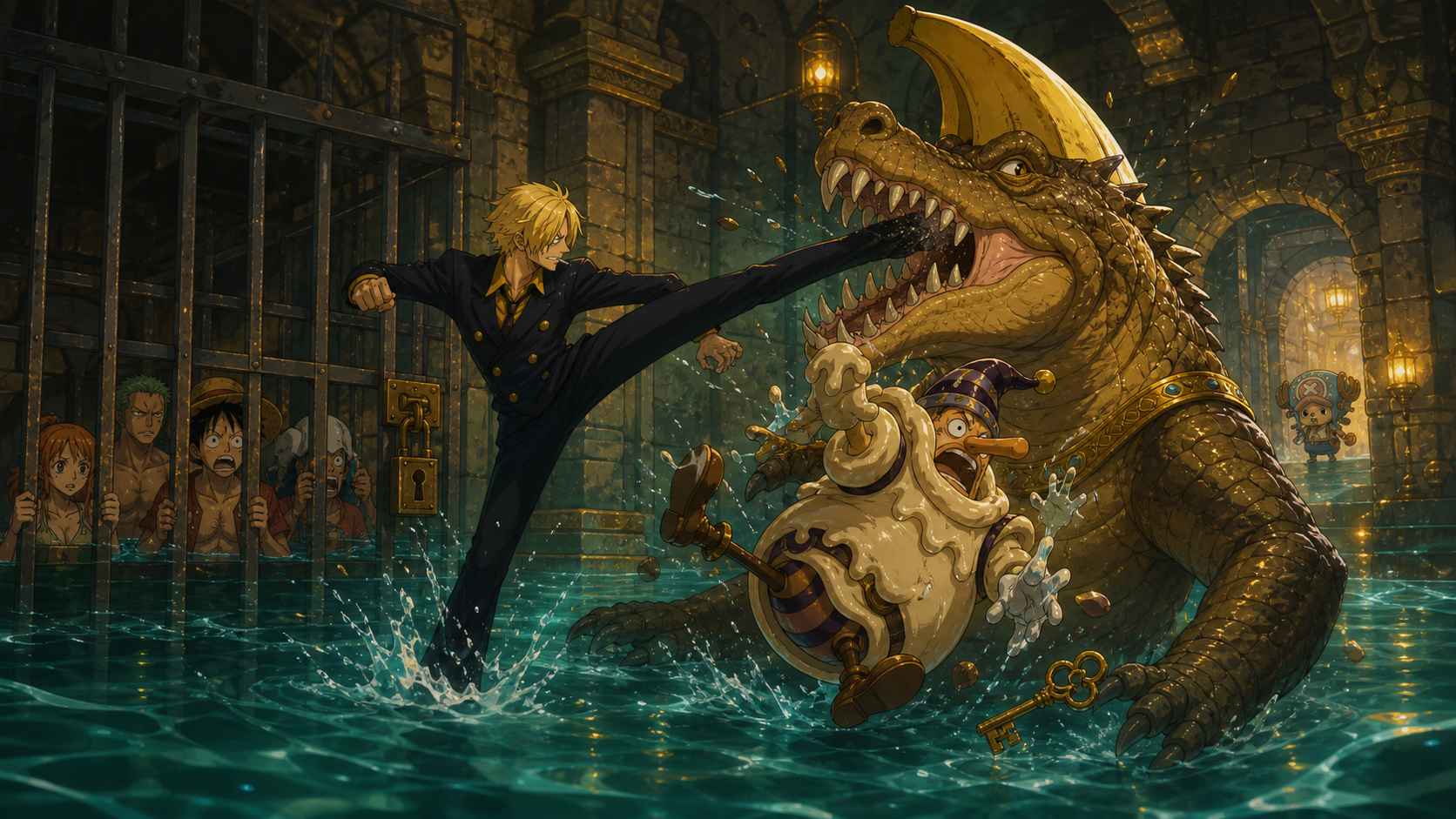
One Piece Episode 109 pays off the Mr. Prince setup with a rescue built from misdirection, observation, force, and one deeply inconvenient specialist. Chopper runs into town pretending to be Mr. Prince, Crocodile follows the decoy, and Sanji returns to the flooding chamber. Smoker identifies the Bananawani that swallowed Mr. 3, Sanji kicks the creature, and both Mr. 3 and a key come flying out.
The apparent solution immediately fails because Crocodile kept the real cage key. Usopp then sees the option everyone else misses: Mr. 3’s wax can reproduce the key shape. The escape does not belong to one hero. Every person contributes a different piece that nobody else can replace.
RaeRae’s bottom line is simple: Crocodile built a trap around a single official key. The crew survives by refusing to accept that official object as the only possible route.
Chopper turns Mr. Prince into a moving decoy
Sanji created the Mr. Prince identity through a call. Chopper gives the alias a body and a direction. Running into town draws Crocodile farther from the chamber while protecting Sanji’s freedom to return below Rain Dinners.
The maneuver works because Crocodile knows almost nothing about Mr. Prince. He has a voice, a claimed location, and evidence that an unknown opponent reached his headquarters. Chopper exploits that uncertainty without needing to resemble Sanji.
Decoy work carries real risk. Chopper must stay visible enough to preserve Crocodile’s attention while staying mobile enough to avoid capture. A frightened or inexperienced runner could lead the enemy directly back to the rescue team.
Chopper’s role also rejects the idea that the smallest crew member receives the smallest responsibility. The entire cage rescue depends on his ability to move Crocodile at the correct moment.
Misdirection buys time but does not solve the cage
Drawing Crocodile outside removes the trap’s architect from the room. The prisoners still face Seastone bars, rising water, enormous predators, and a missing key.
That distinction matters. Tactical success often creates opportunity rather than completion. Sanji cannot celebrate the decoy because the rescue window begins closing as soon as Crocodile realizes the deception.
The crew must convert borrowed time into concrete progress. Every action now needs a purpose: identify the correct creature, recover whatever the creature swallowed, evaluate the result, and find another path if Crocodile anticipated the obvious solution.
Episode 109 keeps pressure on the sequence by refusing a single miracle. Each solved problem reveals the next layer.
Smoker becomes the witness Sanji needs
Smoker watched the key disappear and can identify the relevant Bananawani. His position inside the cage gives him visual evidence that Sanji lacks.
The Marine captain and the pirate cook do not suddenly become friends. Their immediate interests overlap because Crocodile intends to kill everyone in the chamber.
Cooperation across conflict requires precise boundaries. Smoker provides the observation. Sanji performs the physical intervention. Neither person needs to surrender every future disagreement before sharing the fact that can prevent multiple deaths.
Crocodile’s trap therefore produces a witness against him. Keeping Smoker alive long enough to understand the machinery gives the Marines direct evidence of Baroque Works operations and Crocodile’s abuse of public authority.
Sanji applies force after information narrows the target
A room full of Bananawani invites frantic violence. Smoker’s direction lets Sanji attack one creature for one defined reason.
That sequence separates useful force from spectacle. Sanji’s kick matters because observation has already connected the target to the missing person and key. Kicking random predators would waste time and increase danger around the cage.
The rescue respects specialization. Smoker observes from the best angle. Sanji supplies speed and impact. The trapped crew tracks the outcome. Distributed knowledge becomes coordinated action.
RaeRae will always take one informed strike over ten loud guesses. Episode 109 makes the competent choice look exciting without pretending analysis slows action.
Mr. 3 emerges as both victim and resource
The Bananawani coughs up Mr. 3 along with a key. His appearance is absurd, useful, and morally complicated.
Mr. 3 served Baroque Works and tried to kill the Straw Hats at Little Garden. Crocodile nevertheless discarded him into the predator system. Loyalty inside Baroque Works flows upward, while protection does not flow back down.
Sanji and the prisoners now face a former enemy who has suffered under the same leader. Shared victimization does not erase prior harm, but the changed conditions create a reason to cooperate.
Mr. 3 also carries a capability the rescue needs. Treating him only as an enemy would waste the expertise capable of opening the cage.
The first key fails because Crocodile planned for recovery
Mr. 3 throws the recovered key toward the cage, creating a burst of hope. The key does not open the lock because Crocodile still holds the genuine one.
The false key proves Crocodile expected somebody might survive the predators or recover what entered the enclosure. His redundancy turns the obvious rescue route into another delay.
A decoy object is effective because people stop searching once the expected item appears. Shape, timing, and location tell a convincing story even when function contradicts that story.
The crew tests the key quickly and updates its understanding. That response matters. Clinging to the first theory would waste the remaining air.
Usopp changes the question
Everyone begins with the question Crocodile designed: where is the real key? Usopp asks a better one: can somebody make a key that works?
The shift moves the rescue from retrieval to fabrication. Crocodile can control possession of the original object, but he cannot control every material process available to the people he trapped.
Usopp’s contribution is not a joke or consolation prize beside Sanji’s kick. The idea transforms Mr. 3 from rescued baggage into the central technical specialist.
Problem solving often advances when a team stops treating the enemy’s rules as natural law. A lock requires a compatible shape, not the villain’s permission.
The Wax-Wax Fruit becomes emergency manufacturing
Mr. 3 normally uses wax for traps, restraints, weapons, armor, and elaborate displays. The same ability can manufacture a key.
Power receives moral meaning through purpose, control, and consequence. Wax that once immobilized victims can now release prisoners from an execution chamber.
The scene also treats fabrication as skilled labor. A useful copy needs the correct dimensions, ridges, stiffness, and alignment. Producing a vaguely key-shaped object would not satisfy the lock.
Mr. 3’s value comes from practiced control over his material. The rescue depends on technical precision as much as physical courage.
Coerced expertise raises an accountability problem
Mr. 3 does not enter the rescue as a trusted volunteer. Sanji and the trapped crew need his ability, while Mr. 3 needs protection from the predators and Crocodile.
That bargain contains coercive pressure. A fair reading should acknowledge the danger surrounding his choice without pretending his past actions disappear.
Emergency cooperation can be necessary while later accountability remains open. The crew can require a wax key now and still judge Mr. 3’s conduct at Little Garden afterward.
Crocodile depends on permanent categories: useful agent, failed agent, prisoner, enemy. The rescue succeeds because people respond to present capability and present duty instead.
The cage exposes Crocodile’s single-point failure
Crocodile believes possession of the authentic key guarantees control. That belief makes one object the authority behind an entire execution system.
Mr. 3’s ability reveals the weakness. If the lock recognizes shape rather than ownership, control can be duplicated.
Secure systems need more than a scarce token. They need monitoring, revocation, multiple safeguards, and plans for adversaries who can reproduce credentials.
Rain Dinners has spectacle and physical danger, but Crocodile’s confidence in one mechanical boundary gives the prisoners a technical opening.
Rising water keeps every debate honest
The chamber continues flooding while the group identifies the creature, recovers Mr. 3, tests the false key, and proposes a wax replacement.
Time pressure can produce panic, but the crew refuses to confuse speed with disorder. Each person communicates the minimum fact needed for the next action.
The episode also shows why emergency planning should happen before water reaches the cage. Clear roles, trusted signals, and known capabilities reduce the decisions people must invent under pressure.
The Straw Hats lack a formal incident manual, yet familiarity with one another lets them improvise. Usopp knows strange abilities can solve practical problems. Sanji trusts Chopper to carry the decoy. The crew’s history becomes operational infrastructure.
The rescue crosses pirate and Marine lines
Luffy’s crew and Smoker entered Rain Dinners as opponents. Crocodile’s execution trap places both inside the same material threat.
Saving the cage means saving people who may resume conflict afterward. That possibility does not weaken the duty to prevent deliberate drowning.
Smoker’s cooperation also prevents Crocodile from controlling the official account. A Marine witness can connect the casino’s hidden chamber to a Warlord protected by government status.
Crocodile has spent years separating public heroism from private violence. Every survivor carries evidence capable of collapsing that separation.
Mr. Prince works because the whole crew performs the role
Sanji invented the name, but Episode 109 makes Mr. Prince a team operation. Chopper performs the visible decoy. Sanji returns to the chamber. Smoker supplies target information. Usopp identifies the manufacturing solution. Mr. 3 produces the required material.
No single person can claim the entire escape. The alias becomes a shared tactical fiction that gives each contributor room to act.
That structure separates the sequence from a chosen-one rescue. Sanji remains brilliant, but his brilliance includes assigning trust instead of hoarding every task.
Leadership looks strongest when other people become more useful, not less visible.
Baroque Works discards the knowledge that defeats the trap
Crocodile fed Mr. 3 to the Bananawani after judging him a failure. The discarded agent returns carrying the exact capability needed to undermine Crocodile’s lock.
Organizations lose resilience when leaders punish failure by erasing people rather than learning from outcomes. Crocodile never asks what Mr. 3 knows, what his wax can reproduce, or how abandonment might change his incentives.
Fear can enforce short-term obedience, but fear also produces brittle loyalty. Once survival requires cooperation with former enemies, Crocodile has offered Mr. 3 no moral or practical reason to protect Baroque Works.
The escape is therefore more than clever power use. The rescue converts Crocodile’s disposable-labor model into a direct operational liability.
Production choices make the reversal readable
Junki Takegami’s script organizes the sequence around clear handoffs: Chopper draws Crocodile away, Smoker identifies the creature, Sanji attacks, Mr. 3 emerges, the key fails, and Usopp proposes fabrication.
Daisuke Nishio’s direction balances urgency with comic surprise. Mr. 3 flying from a Bananawani could become pure gag material, but the rising water keeps the consequence visible.
Masayuki Takagi’s animation direction gives Sanji’s kick the force needed to sell a physical reversal while preserving readable positions around the cage and water.
Miyuki Sato’s art keeps Rain Dinners coherent as an engineered environment. Stone, iron, water, predators, and casino ornament all belong to Crocodile’s hidden machine.
What Episode 109 changes
Chopper carries the Mr. Prince deception into town and successfully keeps Crocodile away from the underground chamber.
Smoker identifies the Bananawani connected to the missing key. Sanji kicks the creature and recovers Mr. 3 along with an apparent key.
The recovered key proves false because Crocodile still possesses the original. The crew loses the obvious route but gains direct evidence that retrieval alone cannot solve the lock.
Usopp realizes Mr. 3 can use wax to manufacture a working key. A discarded Baroque Works specialist becomes the route to reversing Crocodile’s execution trap.
Episode details
Japanese title: 逆転大脱出への鍵!ドルドルボール!
English title: The Key to a Great Escape! The Wax-Wax Ball!
Japanese broadcast: April 28, 2002
Saga: Alabasta
Material: Manga-canon adaptation
Script: Junki Takegami
Episode direction: Daisuke Nishio
Animation direction: Masayuki Takagi
Art: Miyuki Sato
The official One Piece guide confirms Chopper running into town as Mr. Prince to lure Crocodile away, Smoker identifying the correct Bananawani, Sanji’s kick recovering Mr. 3 and a key, the discovery that Crocodile still holds the genuine key, and Usopp’s proposal that Mr. 3 manufacture a replacement. The labor, systems, cooperation, coercion, and accountability analysis is RaeRae’s reading of those events.
Final verdict
Episode 109 earns a 9.6 out of 10. The escape sequence works because every apparent answer arrives with another problem. The decoy clears the room but does not open the cage. The correct predator contains Mr. 3 but not the authentic key. The failed key reveals the need for fabrication.
Usopp delivers the decisive conceptual move by rejecting Crocodile’s definition of the problem. The crew does not need his key. The crew needs a shape that operates his lock.
That distinction captures the Straw Hats at their best. Chopper takes the risk, Smoker shares evidence, Sanji applies force, Usopp reframes the problem, and Mr. 3 supplies technical skill. Crocodile built a trap around centralized control. The rescue answers with distributed competence.