
Who Are You?
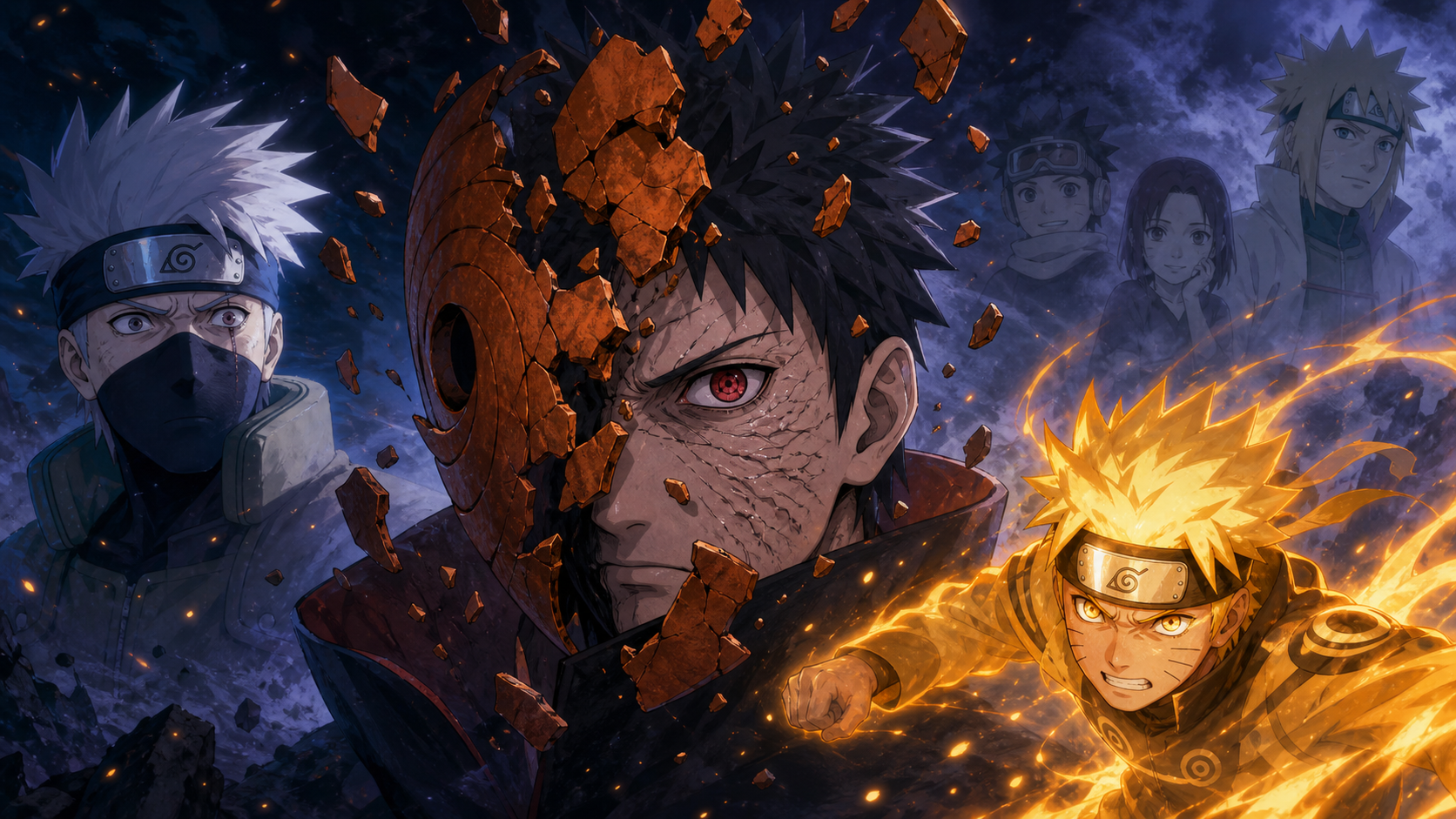
The mask breaks after the evidence has already named the man beneath the disguise, and Kakashi’s oldest grief returns with Obito’s face.
Bottom line
“Who Are You?” makes the mask break only after the mystery has already been solved. Kakashi traced the masked man’s transportation technique to the same private dimension used by Kamui. Naruto then turns that knowledge into impact, driving an attack through the opening until the orange spiral shell shatters. The face underneath belongs to Obito Uchiha, the teammate Kakashi and Guy believed died at Kannabi Bridge. The reveal lands because the episode refuses to treat identity as trivia. Obito is proof that a cherished memory can survive in a form nobody wanted. Kakashi’s eye, his guilt, Rin’s death, and the ideals Team Minato once shared all stand on the battlefield at once. Naruto asks the simplest possible question, but Obito answers with contempt for the world that made their histories possible. Recognition does not end the fight. Recognition removes the emotional distance that allowed everyone to call the enemy a mask.
Kakashi already knows what the evidence suggests
The shared Kamui dimension has narrowed the field of possibilities before anyone sees a face. Kakashi understands where his Sharingan came from and what a paired ocular technique could mean.
His hesitation is not confusion. He is resisting a conclusion that would reopen the foundation of his adult life.
Naruto keeps the battlefield moving
Kakashi cannot remain inside private shock while the Gedo Statue approaches transformation. Naruto continues attacking and forces the masked man to phase on a predictable schedule.
That pressure gives Kakashi a practical route through grief. He can contribute the precise Kamui timing that makes Naruto’s next strike matter.
Kamui turns defense into exposure
The masked man transfers threatened body parts into Kamui’s dimension. Kakashi sends Naruto’s attack into that same space at the moment the target phases.
The technique that once guaranteed safety now places the vulnerable body beside the incoming blow. Knowledge changes the meaning of the same movement.
The plan requires complete trust
Naruto cannot see the pocket dimension, and Kakashi cannot deliver Naruto’s physical force by himself. Each has to commit before the result becomes visible.
Their coordination is a direct answer to Obito’s isolated control. Shared trust defeats a secret that one man believed belonged only to him.
Naruto strikes the mask
The attack lands across dimensions and reaches the face Obito has protected through war, manipulation, and staged identities. Fractures spread through the orange shell.
This is more than damage. Naruto attacks the boundary between the enemy’s invented persona and the hidden history beneath that disguise.
The broken mask ends several lies at once
The masked man has spoken as Madara, acted as an anonymous architect, and treated his body as unreachable. The falling fragments remove each layer of distance.
One visible face replaces a collection of strategic disguises. Everyone must now respond to a person rather than a legend.
Obito Uchiha is alive
The scarred face belongs to Kakashi’s childhood teammate. Obito was crushed beneath stone and entrusted Kakashi with his left Sharingan before the cave collapsed.
The impossible survivor is not returning home. He is standing beside the weapon meant to erase the world Kakashi protected in his name.
Kakashi’s eye becomes physical evidence
Kakashi has carried Obito’s Sharingan as a gift, a memorial, and a promise. Its connection to the enemy’s right eye proves that the past never stayed buried.
The paired Kamui abilities make their bodies a divided record of the same disaster.
Guy recognizes the lost teammate too
Guy knew Obito before the mask, before the war plan, and before adulthood hardened everyone around their losses. His recognition confirms that Kakashi is not hallucinating.
The reunion wounds more than one survivor. Team history has returned as an active threat.
Naruto refuses to let the reveal stop him
Naruto does not share Kakashi’s memories, but he understands that identity does not excuse present choices. The Ten Tails still threatens every village and every person nearby.
His urgency keeps the episode from turning revelation into paralysis. Answers matter because action must follow them.
The question is personal and tactical
“Who are you?” asks for more than a name. Naruto wants to know what kind of person chooses a false identity and builds a war around despair.
The question also challenges Obito to account for the gap between the boy he was and the man he became.
Obito rejects the value of his own name
Obito has treated individual identity as disposable because his plan promises a dream world where painful reality no longer has authority. A name ties him to relationships he abandoned.
Refusing that attachment protects his ideology from the boy Kakashi remembers.
Kakashi searches for a reason
Kakashi cannot reconcile the teammate who valued comrades with the man orchestrating the Fourth Great Ninja War. He needs an explanation that connects those two points.
The demand is emotionally honest, but Obito does not owe him a comforting bridge between memory and catastrophe.
The scars make survival visible
Obito’s damaged face records the collapse that should have killed him. The right side bears the cost of being crushed and rebuilt.
His body proves both rescue and exploitation. Someone preserved him long enough to turn trauma into a weapon.
Rin stands inside the silence
Kakashi and Obito cannot confront each other without Rin’s absence entering the exchange. She connected Team Minato’s emotional center and became the loss neither man escaped.
The episode delays a full explanation, allowing her name and memory to shape every unanswered question.
Kannabi Bridge changes meaning
Kakashi believed Kannabi Bridge ended with Obito’s sacrifice and a command to protect comrades. That story guided his later values and his instruction of Team Seven.
Obito’s survival does not erase the sacrifice, but his survival makes the aftermath far more complicated than the memorial version.
A gift can outlive the giver’s ideals
The Sharingan helped Kakashi become famous and helped him protect countless people. Obito used the paired eye to move unseen and destabilize nations.
The same origin produced opposite legacies. Power carries no automatic loyalty to the intention present when someone gave that power away.
Kakashi faces survivor guilt without distance
For years Kakashi could punish himself while speaking to a grave. The person attached to that guilt now watches him from across the battlefield.
Private remorse becomes a conversation with someone capable of answering, accusing, and attacking. That is far harder than mourning a fixed memory.
Obito controls what he reveals
Losing the mask does not mean surrendering his internal history. Obito confirms the face while withholding the full road that led him here.
He still controls information, and that control keeps Kakashi emotionally off balance even after the central identity mystery ends.
The episode protects cause and responsibility
Trauma may explain how Obito became vulnerable to manipulation, but explanation cannot remove responsibility for the Nine-Tails attack, Akatsuki, and the present war.
The reveal invites investigation without asking the audience to confuse pain with innocence.
Naruto sees another corrupted dreamer
Naruto has repeatedly met people whose hopes collapsed into domination or revenge. Obito fits that pattern while carrying a uniquely intimate link to Kakashi.
Naruto’s role is not to inherit Kakashi’s guilt. He can judge the present choice and challenge the logic behind that choice.
The mask fragments become a visual verdict
Every falling piece represents a persona that can no longer contain the truth. The image gives physical shape to a mystery collapsing under evidence and teamwork.
Obito remains dangerous without the mask. What disappears is the protection of abstraction.
Killer B keeps the scale honest
B’s presence reminds everyone that the battlefield is not only a reunion among Leaf shinobi. Tailed Beast chakra has been stolen to build a global weapon.
Personal history must be confronted without allowing that history to eclipse the people endangered by Obito’s plan.
Guy provides a second memory of Obito
Kakashi remembers Obito through guilt, the eye, and the promise surrounding Rin. Guy remembers a peer whose effort and awkward determination belonged to their generation.
Multiple witnesses prevent Obito’s childhood from becoming a story owned by one grieving teammate.
Team Minato becomes present through absence
Minato is not standing in this confrontation, and Rin cannot speak. Yet their relationships define the emotional geometry between Kakashi and Obito.
The former team exists as promises, failures, gifts, and wounds rather than a clean nostalgic image.
Obito’s calm is part of the threat
He does not collapse when exposed. The face reveal shocks everyone else more than the exposure changes his immediate objective.
That composure shows how long he has lived beyond the identity Kakashi preserved. Recognition alone cannot call the old teammate back.
The answer creates a larger question
Knowing the masked man is Obito resolves the mystery of the paired eye. That answer does not explain who saved him, how he met Madara, or what transformed his beliefs.
Identity closes one investigation and opens the history behind the Moon Eye Plan.
Madara’s shadow reaches the battlefield
Obito has used Madara’s name because the older Uchiha supplied more than prestige. The alias points toward mentorship, inheritance, and a plan designed across generations.
The next stage must examine the relationship between the survivor and the legend whose identity he borrowed.
Recognition is not reconciliation
Kakashi can name Obito and still fail to reach him. Shared memories provide language, but they do not guarantee shared meaning after years of different choices.
The episode respects that distance. A face is access to truth, not an automatic restoration of friendship.
Naruto and Kakashi carry different responsibilities
Kakashi needs to confront what happened to his teammate and what role his own history played. Naruto needs to stop the Ten Tails and protect the living.
Those responsibilities overlap without becoming identical. The team works because personal and collective duty can move together.
The reveal rewards continuity
Obito’s goggles, his dream of becoming Hokage, the gifted Sharingan, Kakashi’s habits, and Kamui’s mechanics have all prepared this moment.
The answer feels consequential because the reveal reorganizes old information rather than appearing as an isolated surprise.
The episode refuses a clean emotional release
The mask breaks, but Kakashi receives no reunion, apology, or complete explanation. Instead, the truth adds new grief to an active emergency.
That restraint makes the reveal linger. Certainty can hurt more than uncertainty when the answer contradicts the life built around a loss.
The mask breaks because the team solved the system
Naruto lands the strike, but Kakashi’s dimensional model, Guy’s protection, and Killer B’s pressure create the opening. The reveal belongs to coordinated reasoning rather than one heroic punch.
That distinction matters because the masked man built authority through secrecy and apparent invulnerability. Shared observations reduce both advantages. Once the team understands where his body goes, even the face he treated as unreachable becomes vulnerable.
Kakashi recognizes Obito before he can accept him
The matching Kamui space, transplanted eye, scars, voice, and surviving face form an evidence chain. Kakashi’s mind reaches the answer while grief resists the conclusion.
That delay is believable. He spent years mourning a teammate whose death shaped his values, guilt, and relationship to rules. Recognition forces Kakashi to revise his own life history during an active battle.
Obito treats his name as strategically irrelevant
He answers Kakashi’s question by dismissing the importance of identity. The posture protects him from explaining how a child who wanted to become Hokage became an architect of war.
Names remain relevant because responsibility needs a person, history, and chain of choices. A mask can express ideology, but ideology did not manipulate Nagato, attack Kushina, release Kurama, kill civilians, or build this war without a human actor.
The scars document survival without explaining allegiance
Obito’s face shows the physical cost of Kannabi Bridge and the reconstruction that followed. The injuries confirm that survival required intervention, but they do not prove why he accepted Madara’s worldview.
Trauma explains vulnerability, not every later decision. Viewers can recognize a wounded child inside the adult without reducing victims to background material for his pain. Survival creates context, not immunity.
Kakashi’s gifted eye becomes evidence against the giver
Obito once entrusted the Sharingan to Kakashi as a symbol of teamwork and belief. Years later, the paired eye reveals the masked man’s location and helps break his disguise.
The gift preserved Obito’s earlier values even after he abandoned them. Kakashi’s use of Kamui does not steal that legacy. He developed the technique through years of responsibility, grief, training, and choices Obito did not control.
Guy supplies memory outside Kakashi’s private guilt
He recognizes Obito as a former classmate and teammate, which prevents the reunion from becoming only Kakashi’s subjective shock. Another witness confirms that the person behind the mask once belonged to a wider community.
Guy can also help separate memory from responsibility. Kakashi did not create every choice Obito made after Kannabi Bridge. Friendship requires honest grief, not accepting ownership of another adult’s war crimes.
Naruto refuses to let identity stop the defense
He sees Kakashi freeze and keeps pressuring the enemy because the Gedo Statue and war do not pause for emotional processing. Naruto’s action protects the time Kakashi needs.
That support is stronger than demanding an immediate explanation. A teammate can hold the battlefield, state the present danger, and leave room for shock without treating grief as weakness or allowing grief to endanger everyone nearby.
Rin is present before anyone names the full story
Kakashi and Obito both orbit the memory of the teammate who died between them. Her absence shapes their silence, but Rin cannot become a trophy explaining which boy deserved a future.
She was a shinobi, medic, friend, and person caught inside village warfare. Any later account must preserve her agency and the institutions that placed children in fatal missions, not use her death only as a switch that changed Obito.
The reveal returns Team Minato to unfinished history
Minato, Kakashi, Obito, and Rin were children and a young teacher inside a military system that normalized impossible responsibility. Three lives fractured around one mission, and the surviving adults carried different pieces of the result.
Calling the tragedy personal would miss the structure. Villages trained children, classified information, and sent teams into wars whose consequences outlived every official report. The reunion exposes a debt larger than one friendship.
Recognition creates accountability before reconciliation
Kakashi can ask why, mourn who Obito was, and still oppose the person standing in front of him. Understanding does not require surrender, forgiveness, or silence about victims.
Obito may have reasons that deserve a full hearing. The army outside deserves protection while that hearing occurs. The order matters: stop the continuing harm, preserve the truth, then judge every cause without turning explanation into absolution.
The reveal changes Kakashi’s body before his words
His posture, focus, and response time show the shock before he can form a useful question. Battlefield trauma is physical. Recognition alters breathing, attention, and the ability to process new information.
The team should treat that response as an injury requiring cover rather than a moral failure. Guy and Naruto can protect the next seconds while Kakashi regains enough orientation to decide what he needs from Obito.
Obito controls the pace by refusing explanation
He lets the face answer one question, then withholds the path between Kannabi Bridge and the war. That silence keeps Kakashi emotionally exposed while preserving Obito’s tactical focus.
Kakashi deserves answers, but the team must prioritize verified actions, civilian protection, and evidence over forced confession.
The mask protected a political fiction
Calling himself Madara gave Obito inherited authority, fear, and historical weight. Enemies responded to the founder’s legend while the actual survivor avoided scrutiny of age, motive, and personal connection.
Breaking the mask collapses that borrowed identity. The war does not become smaller, but responsibility becomes more precise. A young Uchiha survivor carried Madara’s project forward through choices that now need their own accounting.
Naruto sees a warning about abandoned dreams
Obito once wanted the Hokage title and cared about teammates, which places him close to Naruto’s values before their paths split. The resemblance may help Naruto understand how despair recruits people.
Their resemblance invites prevention questions without erasing the support and choices each received.
RaeRae’s verdict
“Who Are You?” delivers one of Naruto Shippuden’s defining reveals by treating identity as relationship rather than trivia. Kakashi’s Kamui analysis supplies the proof, Naruto supplies the force, and the shattered mask makes a long-hidden history impossible to avoid. Obito’s face turns a remote war architect into the living consequence of Kannabi Bridge, Rin, and Madara’s influence.
The strongest choice is that exposure does not weaken Obito’s resolve. Kakashi recognizes him, Guy confirms him, and Naruto demands an answer, yet the war continues. The episode gives the audience certainty while denying the characters emotional relief.
RaeRae’s call
The face matters because accountability needs a name, history, and chain of choices. Kakashi can grieve the child at Kannabi Bridge without accepting responsibility for the adult’s war. Keep Naruto on defense, let Guy hold the second memory, preserve Rin as a person, and demand the explanation only after the continuing harm is contained.
Episode details and viewing routes
- Official episode reference: Naruto Official episode guide
- Licensed episode route: Crunchyroll licensed episode page
What I am carrying forward
Naruto and Kakashi exploited the shared Kamui dimension to strike the masked man and shatter his orange spiral mask. The face underneath belongs to Obito Uchiha, Kakashi and Guy’s former teammate, who was believed to have died at Kannabi Bridge.
Obito offers no immediate reconciliation and dismisses the importance of the identity everyone else finds devastating. The reveal explains the paired Sharingan techniques but leaves his survival, corruption, and relationship with Madara unresolved. Episode 344 will place Obito’s return beside the arrival and influence of Madara Uchiha.