
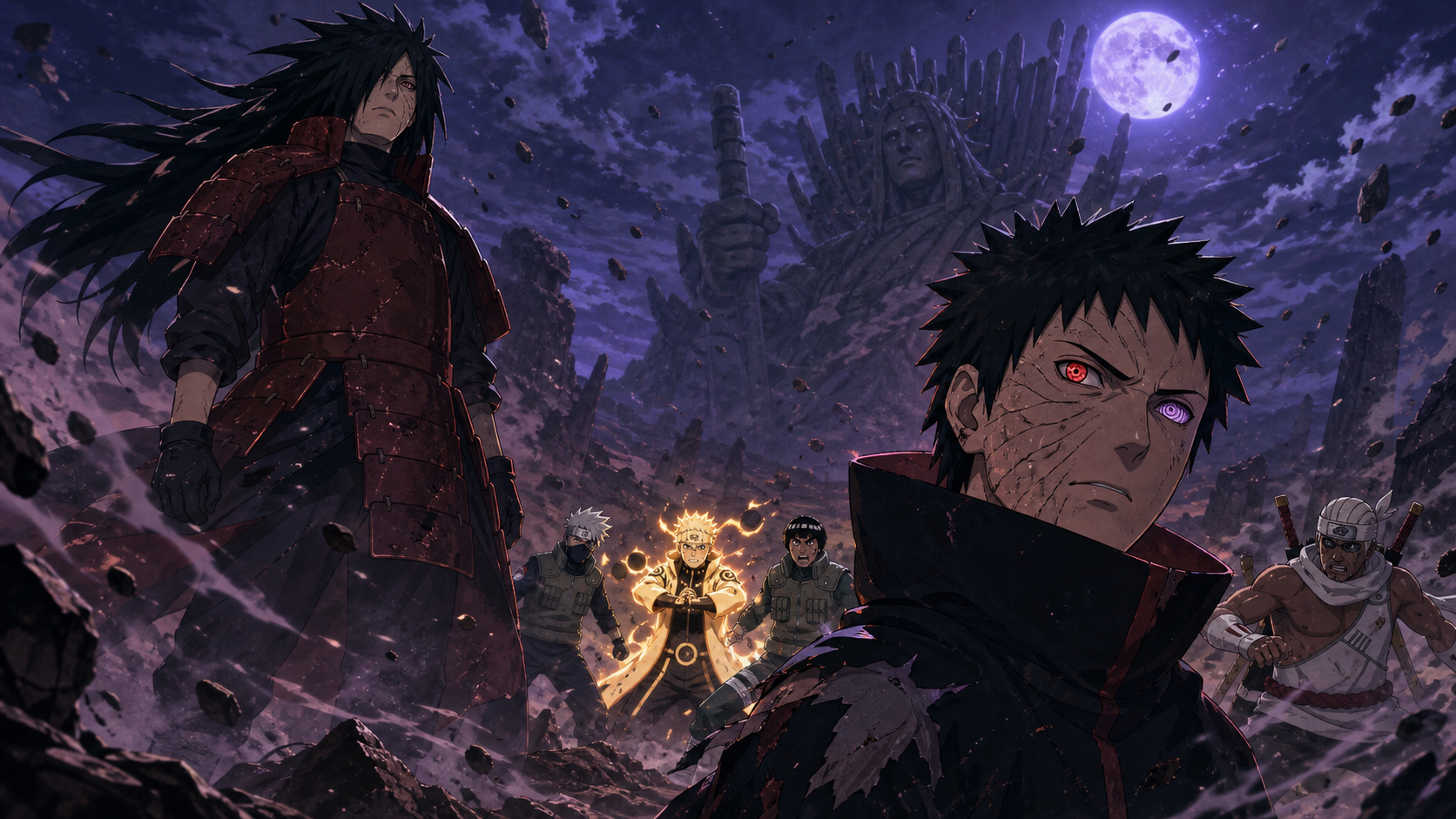
Obito and Madara
Madara arrives to inspect the conspiracy bearing his name, turning Obito’s exposed identity into proof of a plan inherited across generations.
Bottom line
“Obito and Madara” refuses to let Obito’s exposed face remain a private crisis for Kakashi. Madara arrives from the Five Kage battlefield, stands beside the man who borrowed his name, and reveals that the war has always belonged to a partnership shaped by unequal power. Naruto, Killer B, Kakashi, and Guy now face two Uchiha enemies while the Gedo Statue continues becoming the Ten Tails. Kakashi wants to understand how the boy from Kannabi Bridge became the architect of Project Tsuki no Me. Madara cares only that Obito has failed to follow the plan efficiently. Their exchange turns the Moon Eye conspiracy from an anonymous threat into an inheritance passed from an older manipulator to a wounded survivor. The episode also protects Obito’s responsibility. Madara’s influence explains a hidden history, but Obito has made years of deliberate choices. The result is not a reunion and not a simple master-and-student reveal. This is an audit between conspirators conducted while everyone else is forced to survive the consequences.
Madara arrives as the answer nobody wanted
Obito’s identity explains the paired Kamui abilities, but Madara’s appearance expands the mystery. The legendary Uchiha is no longer only a stolen name or historical shadow.
He enters the same battlefield as Obito and treats the war plan as shared business.
The Five Kage battlefield follows Madara here
Madara’s arrival carries an immediate implication about the leaders who tried to stop him. He left that confrontation by choice rather than through defeat.
Naruto’s team must understand that a second overwhelming opponent has joined before they have recovered from learning Obito’s identity.
Obito loses the protection of Madara’s name
For years Obito used Madara as an identity that supplied fear, authority, and historical weight. The real man standing beside him ends that useful ambiguity.
Obito must now occupy his own face and answer for decisions made under a borrowed legend.
Madara speaks to Obito like an asset
The reunion between conspirators contains no warmth. Madara evaluates progress, notes failures, and expects Obito to justify deviations from the intended sequence.
Their hierarchy becomes visible through tone. Madara assumes ownership over the plan and over the man assigned to complete the groundwork.
Project Tsuki no Me has a lineage
The Moon Eye Plan did not emerge from Obito’s despair alone. Madara developed a vision that uses the Ten Tails and Infinite Tsukuyomi to replace reality with controlled dreams.
Obito became the operator who carried that vision through Akatsuki, the Tailed Beast hunt, and war.
Kakashi needs a human explanation
Kakashi remembers a boy who valued comrades above rules. The adult before him has manipulated nations and sacrificed thousands for a false peace.
His questions search for the missing road between those identities, not for a technical summary of the plan.
Obito refuses Kakashi’s emotional framing
Obito does not accept that their shared childhood grants Kakashi special access to his motives. He treats the old team as evidence of a world already proven worthless.
That refusal denies Kakashi the reunion structure he instinctively seeks.
Madara makes the personal crisis strategic
Kakashi might have focused entirely on Obito, Rin, and Kannabi Bridge. Madara’s presence forces every private question back into the war.
The person responsible for shaping Obito now stands near the weapon their alliance intends to awaken.
Naruto keeps asking who Obito chose to become
Naruto hears the name and sees Kakashi’s shock, but present action remains his standard. Obito is helping create the Ten Tails right now.
The past matters because the past produced this choice, not because memory cancels accountability.
Killer B reads the Tailed Beast threat
B understands what partial chakra from the Eight Tails contributed to the statue. The conspiracy has turned pieces of living beings into ingredients.
His presence prevents the episode from reducing the conflict to Uchiha history alone.
Guy witnesses the collapse of a generation
Guy remembers Obito as a peer and Madara as a legend from an earlier age. Both now occupy the same side of the battlefield.
The alliance shows how unresolved violence can connect generations that should never have shared a purpose.
The Gedo Statue remains the countdown
Every identity reveal occurs beneath a larger transformation. Chakra from all nine Tailed Beasts has placed the statue on the path toward the Ten Tails.
Conversation can clarify motive, but conversation cannot be allowed to consume the time needed to stop that emergence.
Madara is dissatisfied with improvisation
Obito has adjusted the plan around Nagato’s death, Kabuto’s intervention, and the survival of Naruto and Killer B. Madara views those adjustments as inefficiency.
His criticism exposes the difference between designing a conspiracy and operating one across unpredictable years.
Obito is not merely following orders
Madara’s dominance can make Obito look like a subordinate without agency. The history already visible contradicts that simplification.
Obito recruited, deceived, attacked, and declared war through choices requiring initiative. Manipulation and responsibility coexist.
The borrowed name served both men
Obito gained authority by calling himself Madara. Madara gained a living agent who could extend his will beyond death and secrecy.
The deception worked because each man benefited from making the world believe one legend had remained active.
Edo Tensei changes the partnership
Madara’s reanimated body allows the planner to return before Obito completes the intended resurrection route. Kabuto has disrupted the private arrangement.
The master can now inspect the project directly, which reduces Obito’s freedom to define success on his own terms.
Kabuto’s interference still matters
Kabuto is absent from this battlefield, yet his decision to summon Madara has transformed every alliance. Obito never wanted the coffin containing the real Uchiha exposed.
An outsider forced the conspiracy’s hidden hierarchy into public view.
The Rinnegan links Madara, Nagato, and Obito
The eyes used across the Moon Eye Plan have moved through bodies and identities just as names and commands have moved through generations.
Power functions as inheritance, theft, and control rather than as a simple personal possession.
Kakashi’s Sharingan forms another inheritance
Kakashi carries an eye Obito freely gave him during an apparent final act of friendship. That gift helped Kakashi protect others.
Beside Madara’s manipulative lineage, Kakashi’s eye shows that inherited power can preserve a promise instead of erasing autonomy.
Two models of legacy face each other
Madara treats legacy as the continuation of his will through another person. Kakashi treated Obito’s legacy as a moral obligation he had to interpret and live.
Neither relationship is simple, but only one attempts to turn a survivor into an instrument.
Obito’s face changes the meaning of silence
Behind the mask, refusal could feel like theatrical mystery. With his scars visible, every withheld answer belongs to a recognizable person.
Silence becomes a choice Obito makes while watching Kakashi struggle with the truth.
Madara does not care about Kakashi’s grief
Kakashi’s questions hold enormous emotional weight for Team Minato. Madara treats that history as irrelevant beside the plan.
His indifference demonstrates the worldview that likely made Obito’s pain useful rather than worthy of care.
A dream world requires contempt for reality
Project Tsuki no Me promises peace by replacing genuine relationships with controlled experience. Such a plan assumes reality cannot be repaired through human choice.
Obito’s dismissal of his old name reveals how fully he has accepted that premise.
Naruto represents the rejected alternative
Naruto has suffered isolation, manipulation, and repeated loss without deciding that every bond is fraudulent. He continues building imperfect relationships in the real world.
His presence challenges the claim that pain makes Obito’s conclusion inevitable.
Madara and Obito are united by outcome
They may differ in temperament, timing, and authority, but both accept Infinite Tsukuyomi as the solution. Shared purpose holds the alliance together despite visible tension.
The team cannot depend on internal contempt to break that commitment automatically.
The alliance contains a struggle for control
Madara speaks as the originator, while Obito has spent years running the operation and developing his own authority. Their cooperation is not equality.
Each man needs the other’s access, knowledge, and timing while remaining capable of betrayal.
The battlefield gains a second Kamui problem
Naruto’s team learned how to reach Obito through the shared dimension. Madara’s arrival adds overwhelming power that can interrupt the careful timing required for that counter.
A solved defense becomes difficult again when another enemy controls the pace.
Kakashi cannot finish processing the reveal
War grants no protected space for grief. Kakashi must use the very eye tied to Obito while facing Obito and Madara together.
Emotional destabilization becomes a combat disadvantage the enemy can exploit immediately.
Guy protects Kakashi’s operational space
Guy understands that Kakashi needs both time and trust. Physical pressure can keep enemies occupied while Kakashi organizes the Kamui counter.
Their long partnership provides a present bond strong enough to support confrontation with the past.
Naruto refuses inherited fatalism
Madara’s plan assumes generations will repeat hatred until reality becomes unsalvageable. Naruto has already challenged that cycle in encounters with Nagato and Kurama.
He enters this conflict as evidence that inheritance can be confronted rather than obeyed.
The title names a partnership and an imbalance
“Obito and Madara” places both identities in the open, but the conjunction does not make them equals. One created the plan and shaped the other’s route into despair.
The episode invites scrutiny of the space between collaboration, manipulation, and chosen loyalty.
The next answer belongs to Obito’s past
Kakashi knows who stands before him. The remaining question concerns how a crushed child survived and what happened after Kannabi Bridge.
The story must return to Obito’s body, isolation, rescue, and first encounter with Madara to explain the alliance.
Madara turns rescue into ownership
Obito’s survival should have created a future beyond the cave that nearly killed him. Madara instead speaks as though saving a life created the right to direct that life toward his unfinished objective.
That logic is central to the abuse beneath their alliance. Help becomes debt, recovery becomes recruitment, and vulnerability becomes an opening for ideological control. Obito later chooses to embrace the plan, but the conditions surrounding that choice were deliberately engineered by someone with greater knowledge and power.
The team must separate explanation from delay
Every answer Kakashi receives can help predict Obito, yet Obito and Madara also benefit when conversation consumes the team’s attention. The Gedo Statue does not pause for emotional clarity.
Naruto’s group needs enough history to understand the enemy without allowing history to become a stalling tactic. That balance preserves both truth and survival: Kakashi can demand an account while Naruto, B, and Guy remain focused on disrupting the Ten Tails transformation.
Madara’s arrival reveals who held the original plan
Obito operated for years behind Madara’s name, but the reanimated founder speaks as the person who designed Project Tsuki no Me and expected someone younger to complete it. Their reunion exposes succession rather than equal partnership.
Madara evaluates progress, corrects assumptions, and treats Obito’s survival as useful continuity. The language resembles an owner checking an asset, not comrades comparing choices.
Obito borrowed authority while developing his own power
Using Madara’s identity gave him historical fear, access to the Akatsuki, and a story large enough to manipulate enemies. The disguise never meant Obito lacked agency.
He recruited, deceived, killed, trained, and adapted the plan across years when Madara was absent. Grooming explains the framework and unequal relationship. Obito remains responsible for the decisions that kept the framework alive.
Madara turns rescue into permanent debt
The older man saved Obito after Kannabi Bridge, rebuilt his crushed body, and gave him shelter. Every act of care came attached to isolation, ideology, and a future role.
Rescue becomes ownership when the rescuer decides that survival creates lifelong obedience. Obito needed medical care and connection, not a sealed environment where one powerful adult controlled every explanation about the world outside.
Kakashi wants the missing human bridge
He can see the scars, matching eye, and Madara’s familiarity, but he still lacks the sequence connecting his teammate to the masked commander. Asking why is not a request for instant forgiveness.
Kakashi needs to know what happened after the cave-in, who intervened, what Obito witnessed, and when choices became commitments. Those facts matter for defense and for separating Kakashi’s guilt from Madara’s manipulation.
Madara benefits when Obito refuses the conversation
Every withheld answer keeps Kakashi disoriented and lets the older Uchiha define the encounter through strategy. Silence protects their immediate operation while preserving Madara’s control over the origin story.
The team should not chase emotional closure at the expense of the statue. They can demand accountability, record observed facts, and keep fighting until Obito’s explanation no longer functions as battlefield delay.
The Rinnegan connects bodies across generations
Madara awakened the eyes, placed them in Nagato, and later relied on Obito to recover and use them. Nagato’s body and life became infrastructure for a plan he never designed.
That chain matters because fandom shorthand can make inherited power sound neutral. Each transfer involved secrecy, manipulation, death, or bodily use without full consent. The eyes carry political history alongside technique.
Two legacies of the Sharingan confront each other
Kakashi received Obito’s eye as an explicit gift and built a life around protecting teammates. Obito used the paired eye to hide, transport, infiltrate, and control the timing of violence.
The same visual power supports different ethics because technique never determines purpose alone. Relationships, choices, institutions, and accountability shape what inherited ability becomes.
Naruto represents the support Obito was denied and rejected
Both boys experienced isolation, wanted acknowledgment, and dreamed about the Hokage title. Naruto later found teachers and peers who challenged despair, while Obito recovered under Madara’s exclusive influence.
Support changes available choices, but Naruto cannot become evidence that Obito should simply have tried harder. The comparison should expose the need for community while preserving responsibility for the adult who continued harming others.
Infinite Tsukuyomi requires contempt for consent
The promised dream world removes conflict by removing everyone’s right to choose reality. Madara and Obito call the result peace because no trapped person can disagree, leave, or demand repair.
That is control at planetary scale. Real peace needs institutions capable of handling grief, scarcity, power, and conflict among awake people. A perfect private dream cannot replace shared life.
The team faces two different kinds of urgency
The Gedo Statue continues transforming while Kakashi confronts an impossible survivor. One emergency threatens the world physically, and the other threatens his ability to function inside the response.
Guy, Naruto, and B must divide labor deliberately. Protect Kakashi’s recovery, maintain pressure on Madara and Obito, monitor the statue, and keep communication clear enough that grief does not become an opening the enemy owns.
Kabuto’s decision changed Madara’s leverage
Reanimating Madara returned the plan’s founder before Obito completed the promised resurrection. Kabuto intended the summon as bargaining power, but his intervention gives Madara an immortal body and direct access to the battlefield.
Kabuto’s ambition exposed Madara’s separate agenda and removed Obito’s control over timing, body, and battlefield access.
The Five Kage absence carries immediate consequences
Madara arrives without the leaders who were trying to contain him, which tells Naruto’s team that another battlefield may have collapsed. They cannot confirm casualties while two Uchiha and the statue demand attention.
The uncertainty matters for command. Communication routes, medical response, and succession planning should activate before rumors fill the gap. A war cannot depend on visual confirmation from leaders fighting beyond contact.
Obito’s adult choices need their own timeline
Madara’s grooming began when Obito was injured, isolated, and dependent. That origin explains vulnerability. The years afterward include training, planning, recruitment, the Nine-Tails attack, Akatsuki manipulation, and the present war.
Accountability must follow the entire sequence. A harmed child and a responsible adult can exist in one life. Refusing either truth turns analysis into either cruelty or absolution.
Reality deserves repair rather than replacement
Madara and Obito point to war, bereavement, betrayal, and institutional failure as proof that waking life cannot be saved. Their evidence identifies real harm. Their solution removes every person who might rebuild differently.
Consent matters because awake people can disagree, remember, organize, refuse, and judge the peace.
RaeRae’s verdict
“Obito and Madara” expands a devastating identity reveal into a structural explanation for the war. The real Madara’s arrival strips away Obito’s borrowed authority and exposes a partnership built on inheritance, manipulation, and shared contempt for reality. Kakashi’s need for answers stays emotionally central, yet the Gedo Statue and the damaged Kage battlefield keep that grief connected to public consequences.
The episode’s best decision is refusing to make Obito either a pure puppet or an isolated mastermind. Madara shaped the plan and holds greater power, but Obito carried the conspiracy through years of deliberate action. Understanding influence cannot mean erasing choice.
RaeRae’s call
Madara did not gain a partner when he rescued Obito. He created succession through isolation, bodily reconstruction, and debt. Obito later made that project his own through years of chosen harm. Protect Kakashi without handing his guilt to Madara, keep the statue under pressure, and reject any dream called peace when nobody inside can consent.
Episode details and viewing routes
- Official episode reference: Naruto Official episode guide
- Licensed episode route: Crunchyroll licensed episode page
What I am carrying forward
Madara has arrived beside the newly unmasked Obito after leaving the Five Kage battlefield. Their exchange confirms that Obito worked with Madara for years to orchestrate Project Tsuki no Me, using the older Uchiha’s name while gathering the Tailed Beasts and preparing the Ten Tails.
Kakashi still does not know how Obito survived Kannabi Bridge or why his former teammate rejected the real world. Naruto, Killer B, Kakashi, and Guy now face both conspirators while the Gedo Statue transforms. Episode 345 will return to Obito’s survival and the moment Madara began shaping his despair.