
RaeRae Reacts · One Piece Episode 102
Ruins and the Shape of a Country
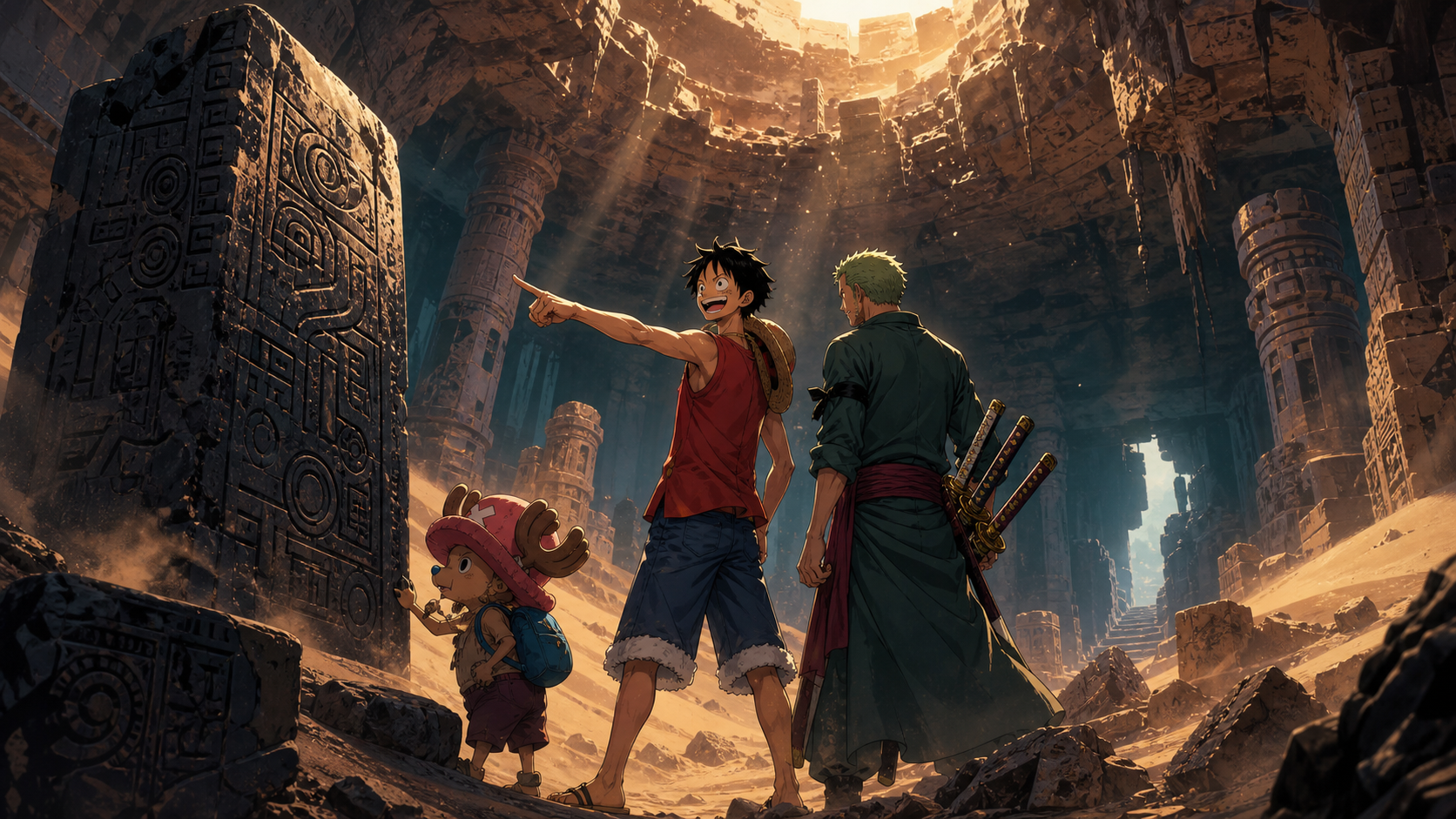
One Piece Episode 102 gets Luffy, Zoro, and Chopper lost in ancient ruins while Vivi asks what makes a country and the anime invents a non-canon Poneglyph.
Quick reaction
One Piece Episode 102 gets Luffy, Zoro, and Chopper lost beneath the Alabasta desert, lets Nami and Vivi talk about whether a country survives when a ruling structure falls, and quietly places an anime-only Poneglyph inside ancient ruins. The character work is thoughtful. The continuity choice is a mess unless the episode receives a clear filler label.
Luffy’s cactus hallucinations start the separation. Zoro tries to stop him without drawing blades, Chopper collapses from heat, and the three lose the main group after a fistfight ends with Luffy and Zoro knocking each other unconscious. Their underground detour produces comedy, a conversation about friendship, and a spectacular escape. Meanwhile, Vivi looks at the remains of an older civilization and worries that Alabasta could become another set of empty stones.
RaeRae’s bottom line is split. The episode understands that a country is more than a king, palace, flag, or border. People, shared obligations, memory, public trust, and the systems keeping families alive form the real national body. The invented Poneglyph does not deserve the same confidence. No manga chapter establishes this extra stone, Robin never reads this discovery, and later lore should not be built on a filler prop.
Luffy’s hallucination turns comedy into a group safety problem
Heat, dehydration, and cactus exposure leave Luffy seeing threats that are not present. He lashes out while the others need to keep the group moving toward Yuba. The gag fits his appetite-driven recklessness, but the consequences extend beyond one bruised captain.
Zoro chooses bare hands instead of swords because Luffy remains a friend, not an enemy. That restraint matters. A confused person may still create danger, yet intervention should use the least harmful force capable of stopping the immediate threat.
The two trade punches until both collapse. Chopper wakes with a medical response ready for Zoro, but the larger group has already disappeared. Desert wind erases tracks, making a temporary conflict into a navigation emergency.
A better travel protocol would keep water, shade, buddy checks, and exposure monitoring distributed across the team. Chopper should not be the only person responsible for recognizing impairment after symptoms become dramatic. Nami’s route planning can include scheduled rests, while Vivi can identify local plants nobody should eat because Luffy apparently needs rules printed directly onto lunch.
Zoro and Chopper talk about friendship through responsibility
Once separated, Zoro and Chopper have to work with the captain who helped create the problem. Neither man abandons Luffy in frustration. Friendship does not erase accountability, but accountability also does not cancel care during an emergency.
Chopper’s concern reflects both medical training and new-crew insecurity. He is still learning what belonging looks like outside Drum Island. Zoro’s steadier understanding shows that Straw Hat friendship often means trusting people’s core intentions while planning around their obvious weaknesses.
That trust should never become permission for endless risk. Luffy’s crew can believe he will protect them and still tell him that eating unknown desert plants, wasting water, or attacking hallucinations creates preventable danger. Loyalty becomes healthier when people can name harm without fearing exile.
The conversation works because nobody delivers a perfect family slogan. They are tired, lost, and solving a physical problem together. Care appears through navigation, restraint, medicine, and the refusal to leave somebody behind.
The underground ruins give Alabasta a longer memory
The collapsed chamber reveals that kingdoms existed before Cobra’s government and that stone can outlast the people who believed their city permanent. Ancient columns and buried routes make present-day Alabasta one layer inside a much longer human history.
That perspective helps Vivi’s fear. Crocodile is not only threatening current leadership. Civil war could damage homes, records, water systems, relationships, and collective memory until survivors inherit ruins without the institutions needed to understand them.
Ruins can inspire humility, but they can also romanticize collapse. An abandoned city may look beautiful after centuries erase hunger, displacement, and bodies from view. Vivi is right to think about what national failure means before Alabasta becomes another scenic warning for travelers.
The episode’s best environmental idea is simple: a country can disappear as an administration and remain present through people, language, memory, and material traces. Preservation needs living communities, not only impressive stones.
The Poneglyph is anime-only and cannot carry manga lore
Luffy, Zoro, and Chopper encounter a large inscribed stone presented as a Poneglyph. The official episode summary names the object directly. The manga does not include this underground discovery, and the stone receives no canonical reading or later consequence.
That boundary matters because Poneglyph locations are not decorative trivia. Each known stone contributes to historical, political, or navigational questions. Adding another Alabasta Poneglyph could alter assumptions about what the Nefertari family protected and what Robin investigated.
Chopper recognizing the category from a book also creates knowledge questions that the manga never needs to answer. His general education can plausibly include legends about indestructible stones, but this scene should not become proof of a specific curriculum or global public knowledge level.
The correct label is anime-original filler Poneglyph. Viewers can enjoy the visual foreshadowing without adding the stone to canon maps, Void Century evidence, or theories about Alabasta’s hidden inventory.
Vivi asks what shape a country really has
Vivi’s conversation with Nami moves beyond whether Cobra keeps the throne. She looks at the ruins and considers how civilizations grow, change, and vanish while people continue carrying needs and relationships.
A country has legal borders and government offices, but those structures work only when people can obtain water, food, medicine, safe movement, and a credible route for grievances. Crocodile attacks that social trust by manufacturing evidence that the royal family stole rain.
Vivi’s fear therefore cannot be solved by proving her father is morally good. Citizens experiencing drought need transparent records, visible relief, independent verification, and leaders willing to admit where state response failed even without criminal intent.
The ruins remind her that legitimacy must be renewed through service. A dynasty’s age does not guarantee a future. People protect institutions when those institutions protect people.
Nami offers confidence without pretending certainty
Nami tells Vivi that Luffy and the crew will defeat Crocodile. Her reassurance comes from observed behavior: Luffy has repeatedly challenged opponents who trap communities through fear, debt, or violence.
Confidence in a friend does not solve the civil war’s administrative work. Crocodile can be defeated while wells remain dry, displaced families remain scattered, and rebels remain afraid of royal retaliation. Nami’s promise addresses the immediate enemy, not every repair after victory.
Still, emotional support matters. Vivi has carried national responsibility as if personal exhaustion could purchase peace. Nami reminds her that the crew accepted shared risk. Friendship changes the workload even when no friend can guarantee the final outcome.
Nami also understands collapse from lived experience. Arlong controlled Cocoyashi through violence and extracted wealth while Marines ignored corruption. She knows a community can survive occupation through mutual care, records, planning, and people refusing to abandon one another.
The escape favors spectacle over archaeological care
Luffy’s rubber abilities turn the underground chamber into a launch mechanism, sending the lost trio back toward open sky. The sequence restores movement and gives the filler episode a memorable physical finish.
From an archaeological perspective, their improvisation is chaos. Ancient structures, unstable ceilings, and an undocumented stone deserve careful survey rather than elastic-force experiments. Survival takes priority during entrapment, but nobody should describe the result as responsible preservation.
The scene also shows why Luffy remains useful after causing the separation. His body can convert impossible terrain into an exit. Accountability does not require denying competence. The crew can be angry about the cactus disaster and grateful for the escape at the same time.
Once reunited, the group should document the approximate location and conditions without treating the filler Poneglyph as a main-story lead. Anime continuity can preserve the event locally while canon analysis keeps the boundary intact.
Anime filler helps Vivi more than the lore
The episode pauses before Baroque Works assembles its officer agents. That pause gives Vivi space to articulate what she fears losing beyond a palace or title. Her internal question strengthens the emotional bridge into the coming confrontation.
The Luffy, Zoro, and Chopper material also develops a smaller crew relationship. Chopper sees how older members manage conflict with the captain, while Zoro shows that loyalty can include forceful interruption when Luffy is impaired.
The lore addition is less successful because Poneglyphs become central to the entire series. A generic royal inscription, burial marker, or ruined archive could have supported the same atmosphere without adding a stone whose existence invites false canon theories.
Good filler expands emotional perspective while leaving the main story’s factual architecture stable. Episode 102 achieves the first goal and unnecessarily strains the second.
Production choices connect national memory to buried space
Michiru Shimada’s script divides the episode between comic separation and reflective national anxiety. The two threads meet through instability: friends lose each other above ground while Vivi imagines a country losing the shape holding people together.
Konosuke Uda’s direction gives the ruins scale and quiet after the noisy hallucination fight. That tonal drop lets viewers feel age, isolation, and the possibility that current political certainty may be temporary.
Hideaki Maniwa’s animation direction must make rubber-powered escape readable without losing the chamber’s geography. Zoro’s choice to fight barehanded also depends on body language showing restraint rather than ordinary hostility.
Miyuki Sato’s art provides the episode’s strongest argument. Buried architecture, sand, darkness, and narrow light make history feel physically present beneath the route Vivi’s group follows toward a modern war.
What Episode 102 changes
The Straw Hats reunite after a dangerous separation and continue toward Yuba. No permanent injury or route change follows, which keeps the anime-original detour bounded.
Vivi reaches a clearer understanding that saving Alabasta means protecting people and shared national life, not merely preserving royal succession. Nami reinforces that Vivi has companions willing to share the immediate fight.
Luffy, Zoro, and Chopper see an anime-only Poneglyph in underground ruins. The discovery has no manga counterpart and should not be used as canon evidence. That statement is part of the episode’s required continuity record, not an optional footnote.
The next episode moves from reflective travel into Baroque Works organization. Officer agents gather at the Spiders Cafe, bringing Crocodile’s plan and command structure closer to the foreground.
Episode details
Japanese title: 遺跡と迷子!ビビと仲間と国のかたち
English title: Ruins and Lost Ways! Vivi, Her Friends, and the Country’s Form!
Japanese broadcast: February 24, 2002
Saga: Alabasta
Material: Anime-original filler
Script: Michiru Shimada
Episode direction: Konosuke Uda
Animation direction: Hideaki Maniwa
Art: Miyuki Sato
The official One Piece guide confirms Luffy’s hallucination, the separation, the underground ancient ruins, the Poneglyph sighting, Zoro and Chopper’s friendship discussion, Vivi’s reflection on the shape of a country, and the production credits above. The continuity, governance, preservation, and safeguarding analysis is RaeRae’s reading.
Final verdict
Vivi’s reflection also needs a practical repair list. After conflict, Alabasta will need public water records, protected wells, medical access, safe return routes for displaced families, investigation of false-flag attacks, and a process allowing rebels to surrender without disappearing into revenge. Royal officials must document what they knew, when they knew the drought evidence was false, and why relief failed to restore trust. A country takes shape through those ordinary systems long after one villain loses a fight.
Episode 102 earns an 8.2 out of 10 for character work and a much lower score as canon housekeeping. Vivi’s conversation with Nami understands that nations live through people, trust, services, memory, and shared responsibility. Zoro and Chopper’s lost-route conversation gives friendship practical weight.
The Poneglyph should have been a generic ancient inscription. The same visual wonder could survive without inventing a lore object whose location matters. Enjoy the chamber. Keep the stone off the manga map.
Most of all, let Vivi’s question travel forward. Saving Alabasta does not mean freezing one royal shape forever. Saving Alabasta means making sure people can keep living, remembering, disagreeing, and building together after Crocodile’s manufactured war ends.