
RaeRae Reacts · One Piece Episode 103
Spiders Cafe at Eight
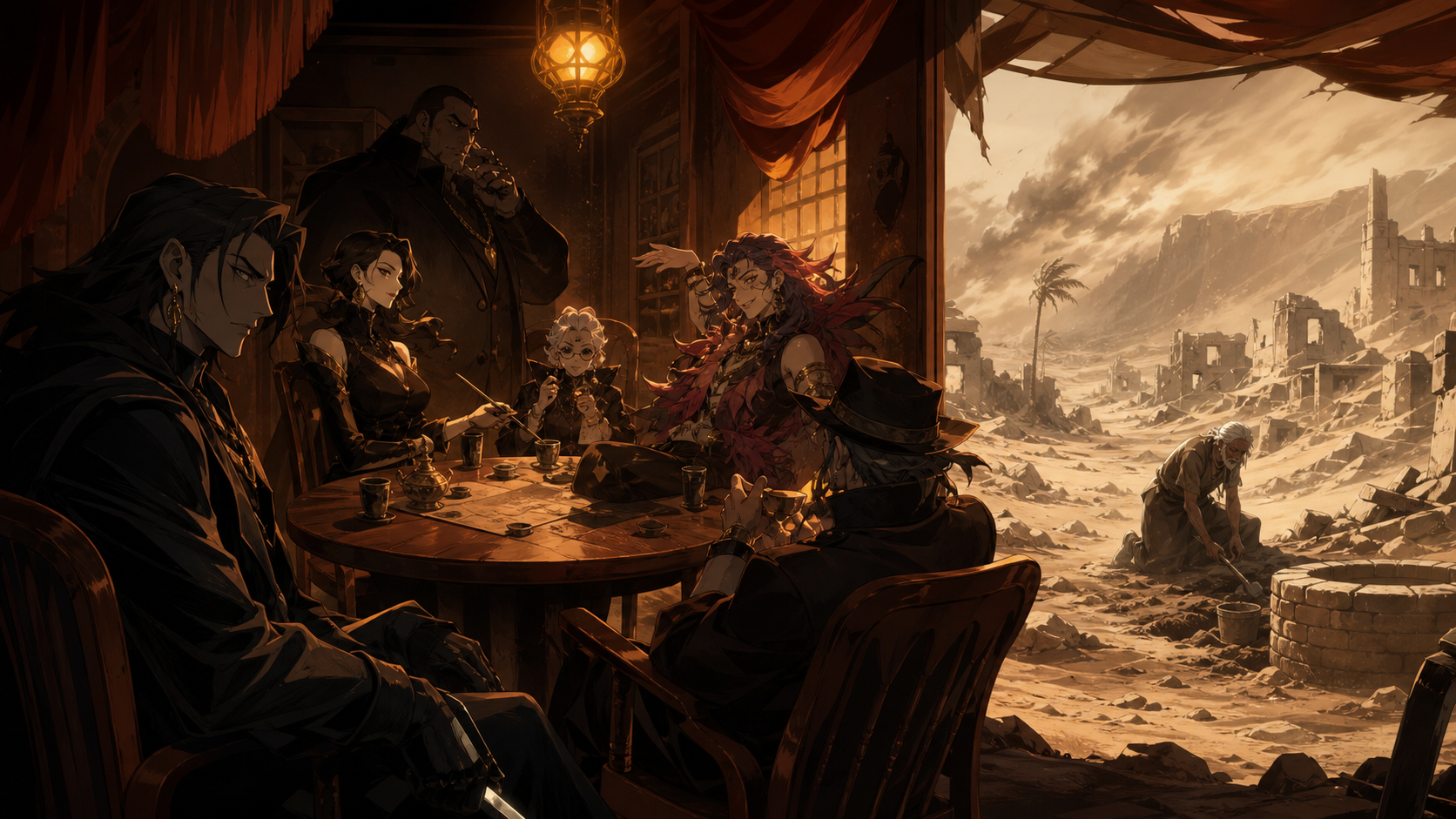
One Piece Episode 103 gathers Baroque Works at Spiders Cafe while Vivi reaches abandoned Yuba and finds Toto still digging after the rebels leave.
Quick reaction
One Piece Episode 103 finally puts faces around the Baroque Works officer table and shows why Crocodile’s conspiracy has survived without most agents knowing the boss. Mr. 1, Miss Doublefinger, Mr. 2 Bon Clay, Mr. 4, and Miss Merry Christmas gather at Spiders Cafe before traveling to Rainbase. They have codenames, assigned partners, specialized powers, and enough mutual hostility to make the meeting look like the world’s most dangerous staff retreat.
Across the desert, the Straw Hats reach Yuba expecting to find Koza and the rebel army. They find a city buried by sandstorms and Toto digging alone for water. The rebels have moved to Katorea. Vivi’s route has delivered her to the right history and the wrong present.
RaeRae’s bottom line is simple: Crocodile wins time by organizing information better than the people trying to stop him. His agents receive synchronized orders, transport, targets, and a fixed meeting place. Vivi carries truth, but truth without current location data, safe communication, or an operating coalition keeps arriving one step late.
Nami protects Ace’s paper before anyone understands the value
Luffy studies the blank scrap Ace left behind while the crew sees nothing useful. Nami sews the paper beneath the ribbon of his straw hat so the gift will not disappear during travel or combat.
The choice turns care into preservation. Nami does not need to understand the mechanism before respecting that Ace called the paper important. She protects Luffy’s relationship and a future navigation tool at the same time.
Later story identifies the scrap as part of Ace’s Vivre Card, which points toward the owner and reflects his life. Episode 103 still treats the object as a mystery. The review can name the later function without pretending Luffy currently knows more than he does.
Sewing the paper into the hat also connects two bonds. Shanks gave Luffy the straw hat, and Ace gives him the paper. Nami’s practical labor keeps both gifts traveling together.
Baroque Works uses compartmentalization as protection
The officer agents have worked inside the same organization without knowing Mr. 0’s public identity. Codenames, paired assignments, and separate routes reduce how much any captured member can reveal.
Compartmentalization protects leadership while increasing danger for workers. Agents cannot fully evaluate the purpose of their labor because the boss controls context. They know targets and rewards, not the national consequences of Operation Utopia.
Crocodile’s secrecy also prevents solidarity. People who lack shared information compete for rank instead of comparing how leadership manipulates them. Personal friction becomes another security layer.
The structure resembles an organization designed to survive exposure rather than a community designed to serve members. Everybody below Mr. 0 is replaceable, and secrecy makes replacement easier.
Spiders Cafe turns conspiracy into routine work
A roadside cafe is ordinary enough to hide extraordinary danger. Drinks, chairs, arrival times, and travel plans make the officer meeting feel administrative.
That routine is the point. National destabilization does not require every participant to perform villainy at maximum volume. Much of the harm moves through schedules, assignments, transport, and people completing a narrow task.
The cafe also gives the agents a temporary neutral space. They can posture, argue, and assess one another before Crocodile reveals the final operation.
Seeing them together changes the audience’s understanding of scale. Vivi is not racing one assassin. She is racing a coordinated hierarchy whose senior agents are now moving toward the same command center.
Mr. 1 brings professional violence without warmth
Mr. 1 arrives with the stillness of somebody who does not need to advertise every threat. His body and reputation suggest disciplined force rather than comic improvisation.
That restraint separates him from Mr. 2’s theatrical energy and Miss Merry Christmas’s noise. Baroque Works does not recruit one personality type. Crocodile recruits useful capacities and lets incompatible people share a payroll.
Mr. 1’s partnership with Miss Doublefinger also presents the highest-ranked officer pair below the boss and Miss All Sunday. Their calm creates a hierarchy even before formal introductions finish.
Professionalism should not be confused with ethics. Efficient violence remains violence, and composure can make harmful work easier to normalize.
Miss Doublefinger manages the room
Miss Doublefinger understands orders, timing, and the cost of letting egos derail movement. Her presence keeps the officer gathering from becoming nothing but a brawl.
She is not merely attached to Mr. 1. Her own judgment and combat ability make the partnership operational. Baroque Works pairs are built around complementary threat, even when the organization’s gendered naming system disguises women behind calendars and holidays.
The codename structure strips personal history from the workplace. Agents become functions. That anonymity can feel powerful while also making leadership less accountable for individual lives.
Miss Doublefinger appears comfortable inside the system, but comfort does not change who benefits most. Crocodile receives strategic control while officers absorb exposure and combat risk.
Bon Clay refuses to become background
Mr. 2 Bon Clay arrives with dancers, performance, and a fighting style built around movement. His presence turns the cafe into a stage before anyone reaches Rainbase.
The comedy should not erase capability. Bon Clay has already shown how the Clone-Clone Fruit can imitate faces and how deception can fracture trust inside the Straw Hat group.
Baroque Works usually assigns male-number and female-holiday pairs, but Mr. 2 operates alone and carries both parts of the naming pattern. The organization treats that exception as identity and role, not evidence that he lacks rank.
His visibility contrasts with Crocodile’s secrecy. Bon Clay wants an audience. Crocodile wants outcomes without public fingerprints. The same organization uses both instincts.
Mr. 4 and Miss Merry Christmas show another labor pair
Mr. 4’s slow, heavy presence and Miss Merry Christmas’s relentless speech create immediate comic contrast. Their partnership looks dysfunctional until combat reveals how timing and complementary abilities make them dangerous.
Crocodile does not require affection between partners. He requires task completion. That difference leaves no structure for consent, safety, or conflict repair beyond rank and fear.
The officer agents know enough to evaluate one another’s status but not enough to challenge the operation’s purpose. Performance reviews without mission transparency are still control.
The episode’s introductions wisely give each pair a recognizable rhythm. Later battles will mean more because the audience understands the working relationships behind the attacks.
Crocodile and Miss All Sunday control the clock
Miss All Sunday reports that preparations are complete and Operation Utopia can proceed in two days. Crocodile responds with confidence because each moving part appears aligned.
Time is one of his strongest weapons. The rebels, royal army, officer agents, weapons, false evidence, and public panic all need to converge before truthful explanation can interrupt the sequence.
Miss All Sunday occupies a complicated position. She delivers operational knowledge while keeping her own historical goal separate from Crocodile’s national ambition. Partnership at the top contains secrets just as surely as the lower ranks.
Crocodile believes he controls every clock and every person. That belief creates efficiency now and vulnerability later because people treated as instruments eventually make choices outside the plan.
Yuba reveals what the conspiracy costs
The crew arrives at Yuba and finds a dry, sand-buried town resembling Erumalu. The visual contrast with the warm cafe is brutal. Officers gather around a table while civilians lose homes, water, and population.
Yuba once represented planned settlement and shared national development. Repeated sandstorms and drought have emptied the oasis until Toto remains nearly alone.
The city proves that Crocodile’s operation is not abstract politics. Manipulated weather evidence and delayed relief change where people can live. Every abandoned wall records displacement.
Vivi has crossed the desert to prevent war, but Yuba shows that violence has already begun through deprivation and forced movement. No battlefield declaration is required before families lose a city.
Toto digs because hope has become physical labor
Toto keeps digging for water after most residents leave. His faith in Cobra and the country remains intact even though the ground provides almost no reward.
The work can look inspirational, but exhaustion deserves attention. One elderly man cannot repair a regional water crisis with a shovel. Hope without institutional support becomes unpaid survival labor.
Toto’s loyalty also complicates Koza’s rebellion. Father and son love Alabasta while interpreting responsibility through different evidence. Toto remembers royal support for Yuba. Koza sees years of drought and people who cannot wait for faith to produce water.
Neither perspective should become proof that one man cares and the other does not. Crocodile benefits when shared love for a country becomes an argument over who deserves betrayal.
The rebels moving to Katorea makes Vivi’s information stale
Vivi expected Koza in Yuba. By the time she arrives, the rebel army has relocated to Katorea. The failed interception shows why a plan needs live intelligence instead of memory alone.
Travel across Alabasta takes time, and Crocodile’s agents exploit that delay. Messages move unevenly. Sandstorms erase routes. Communities relocate. A correct destination can become wrong before a traveler reaches the gate.
The crew now needs a decision about whether to chase the rebels, confront Crocodile, or divide effort. Every option carries risk because Operation Utopia’s two-day timeline is already running.
Vivi should not blame herself for movement she could not observe. She should update the plan, share the new information, and let allies help choose the next route.
Production choices turn parallel spaces into one system
Junki Takegami’s script intercuts the officer gathering, Crocodile’s planning, and the Straw Hats’ arrival in Yuba. The structure shows cause and consequence without placing every character in one room.
Harume Kosaka’s direction gives Spiders Cafe social energy while allowing Yuba to feel emptied. Crowded conspiracy and civilian isolation become visual opposites.
Masayuki Takagi’s animation direction introduces multiple combat personalities through posture and movement before full battles begin. Mr. 1’s economy, Bon Clay’s flourish, and Miss Merry Christmas’s agitation need distinct rhythms.
Miyuki Sato’s art makes sand the connecting material. Outside the cafe, desert pressure surrounds the agents. In Yuba, the same sand has entered homes and erased ordinary life.
What Episode 103 changes
Nami secures Ace’s paper inside Luffy’s hat, preserving the future Vivre Card route. The officer agents gather and begin moving toward Crocodile at Rainbase.
Crocodile confirms Operation Utopia is ready to begin within two days. The conspiracy enters a final operational phase rather than remaining a distant investigation.
The Straw Hats reach Yuba, meet Toto, and learn Koza’s rebel army has moved to Katorea. Vivi’s original plan to negotiate at the oasis can no longer proceed as designed.
The story now places every major group in motion: Baroque Works toward Rainbase, the rebels toward open conflict, and the Straw Hats toward a decision about how to stop both the manufactured war and the man engineering the clock.
Episode details
Japanese title: スパイダーズカフェに8時敵幹部集合
English title: Spiders Cafe at 8 O’Clock! The Enemy Leaders Gather!
Japanese broadcast: March 3, 2002
Saga: Alabasta
Material: Manga-canon adaptation
Script: Junki Takegami
Episode direction: Harume Kosaka
Animation direction: Masayuki Takagi
Art: Miyuki Sato
The official One Piece guide confirms Nami sewing the Vivre Card into Luffy’s hat, the officer gathering at Spiders Cafe, their movement toward Rainbase, the crew’s arrival at ruined Yuba, and Toto digging alone. The labor, organizational, governance, and accountability analysis is RaeRae’s reading of those events.
Final verdict
Episode 103 earns a 9.2 out of 10. Baroque Works finally looks like a complete organization instead of scattered villains waiting for separate fights. The officers are funny, hostile, competent, and deliberately underinformed. Crocodile has built a workplace where secrecy protects leadership and risk flows downward.
Yuba supplies the receipt. Toto digs while the people coordinating national collapse sit around a cafe table. One side has schedules, transport, and a two-day operation. The other side has an old man, a shovel, and faith that the country can still produce water.
Vivi reaches the place where her childhood and political plan were supposed to meet. Koza is gone. The war did not wait for her arrival. Update the route, share the burden, and move before Crocodile’s clock reaches zero.