
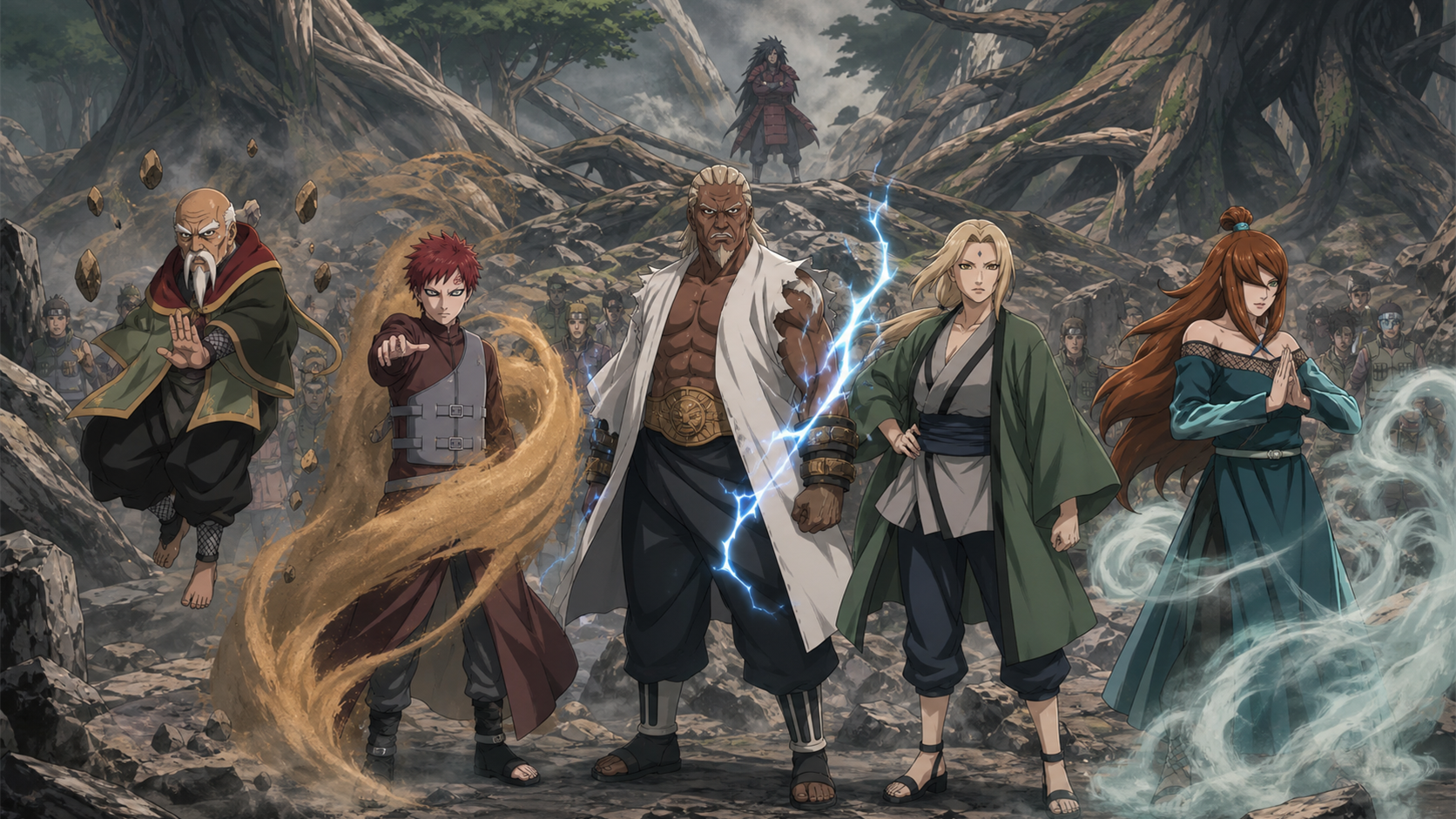
The Five Kage Assemble
Leadership becomes physical presence when all five Kage accept the battlefield risk their shinobi have carried and stand together before Madara.
Bottom line
“The Five Kage Assemble” turns leadership into physical presence. Madara’s forest is still swallowing the Fourth Division when Kurama voluntarily lends Naruto enough chakra to break through, proving their relationship has moved beyond theft and containment. At headquarters, Tsunade and A refuse to command the disaster from a safe room. They accept dangerous transport, Mei arrives through a coordinated Flying Raijin formation, and the five current Kage stand together before a founder who treats their titles as decoration. The episode does not pretend their arrival guarantees victory. Their value comes from accepting the same battlefield risk as the shinobi they ordered into war and combining specialties no one Kage can make sufficient alone.
Madara’s forest keeps expanding
Deep Forest Emergence tears through the ruined battlefield after the meteors have already broken the Fourth Division. Roots and branches trap survivors who have little strength left to escape.
Madara has changed the problem again. The Alliance is no longer fighting across terrain; the enemy is creating the terrain around them.
Hashirama’s power becomes battlefield evidence
Kabuto claimed that Hashirama’s cells were built into Madara’s reanimated body. The forest proves the modification functions at a devastating scale.
Nobody needs to accept Kabuto’s laboratory language on trust. Stolen biology is now crushing living people in front of them.
Naruto’s clone has almost nothing left
The Naruto shadow clone facing Madara was already low on chakra before the meteors fell. Sage Mode and Rasenshuriken spent another reserve without stopping the reanimation.
His condition preserves continuity. A new crisis does not refill the person who has been answering crises across the entire war.
Kurama chooses to help
Kurama offers Naruto chakra rather than waiting for Naruto to seize or bargain for the power. The choice is not a declaration of perfect friendship.
Kurama would rather support Naruto than allow Madara to control him again. Even that preference is a meaningful act of agency after generations of being treated as property.
Help is different from extraction
Naruto spent years taking chakra through a seal designed by other people. Kurama’s voluntary contribution changes the ethical shape of the exchange.
The power may look familiar from outside, but consent makes the relationship different. Naruto receives help from a thinking partner, not fuel from a container.
Madara’s history with Kurama matters
Madara once controlled Kurama through the Sharingan and used him as a weapon against Hashirama. Kurama remembers the loss of control attached to that gaze.
Supporting Naruto becomes resistance against repeating that history. Personal dislike and political freedom point in the same direction.
Naruto creates many shadow clones
Kurama’s chakra lets the exhausted clone produce a large group of additional clones. They spread across the advancing forest instead of concentrating on Madara’s body.
The decision prioritizes the immediate mass threat. Stopping one attacker means little if the technique has already killed everyone behind the front line.
Many Rasengans answer many branches
The clones drive Rasengans into separate sections of the forest. Repeated impacts open paths, break restraints, and protect surviving soldiers from the spread.
Naruto matches distribution with distribution. One enormous strike is less useful than enough interventions to reach several danger points at once.
The clone buys survival, not victory
Breaking the forest does not seal Madara or remove Mū. Naruto has created breathing room for an army that was moments from being buried.
That distinction keeps the scene honest. Rescue can be complete as an act even when the larger war remains unresolved.
Headquarters sees the scale of the loss
Reports from the Fourth Division make clear that Madara is not another reanimated specialist. The division has suffered catastrophic damage from techniques covering an entire battlefield.
Command now has enough evidence to change deployment. Continuing the old plan would be loyalty to a structure that the enemy has already invalidated.
Tsunade decides to leave headquarters
Tsunade chooses to travel to Madara’s location and join the fight. As Hokage and a medical ninja, her presence carries offensive, defensive, and recovery value.
The decision also carries political meaning. She will not ask exhausted soldiers to hold a founder-level threat while preserving her own safety behind maps.
A goes with her
The Raikage reaches the same conclusion. His speed, durability, and close-range power belong where the Alliance’s line is collapsing.
His departure is not impulsive abandonment. The remaining command structure can coordinate, while the field urgently needs capabilities headquarters cannot transmit through a radio.
Mabui explains the transport risk
Mabui’s Heavenly Transfer Technique normally moves objects at extreme speed. A human body can be torn apart by the forces involved.
The warning gives the journey weight. Instant movement is not a free shortcut, and rank does not make anatomy exempt from consequence.
A trusts his own durability
A accepts the transfer because the Lightning Release armor and conditioning of the Third and Fourth Raikage make his body unusually resilient.
Confidence rests on known capability, not title. He understands the method and chooses the risk because delay may cost more lives.
Tsunade trusts her regeneration
Tsunade activates the Strength of a Hundred Seal so her body can repair damage from the transfer. Her medical mastery becomes a transportation solution as well as battlefield recovery.
She does not claim the journey is safe. She prepares to survive the harm that Mabui accurately predicted.
Leaders should not romanticize self-harm
Their choice works because the emergency is extraordinary and both understand their bodies. The scene is not permission for every commander to confuse recklessness with solidarity.
Responsible leadership weighs who can survive the risk, what unique value they bring, and whether the command structure remains functional after they leave.
Mabui performs the transfer
The technique sends Tsunade and A from headquarters to the battlefield in an instant. Both arrive alive because their preparations match the danger.
Mabui’s contribution deserves credit. The Kage can assemble only because specialists far from the front execute difficult support work correctly.
Mei needs a different route
The Mizukage cannot use the same durability-based plan. Her movement depends on a team trained to reproduce the Fourth Hokage’s transportation method together.
Different bodies and skills require different logistics. Alliance unity does not mean pretending everyone should travel or fight identically.
The Flying Raijin formation requires three people
Genma, Raidō, and Iwashi combine their chakra and training to perform the Flying Raijin Formation Technique. No member alone can reproduce Minato’s technique at the required level.
Their teamwork turns partial inheritance into a functioning system. Shared competence can preserve a capability that individual imitation cannot.
Mei arrives through coordinated support
The formation brings Mei to the Fourth Division, completing the convergence with Gaara and Ōnoki already present.
Her arrival belongs partly to the support shinobi who moved her. The five Kage tableau rests on more people than the five figures shown at its center.
Gaara never left the front
Gaara has commanded the Fourth Division, fought the former Kage, challenged Madara, and helped Ōnoki hold the first meteor.
The youngest Kage does not need to prove that he belongs in the formation. His battlefield record has been building the argument throughout the war.
Ōnoki stands despite his injuries
Ōnoki remains badly wounded after the meteor impact, yet his knowledge and Particle Style are still essential. Tsunade’s arrival gives his survival a practical path forward.
Medical support does not erase what happened. Recovery lets experience remain available when the Alliance cannot afford to lose another source of historical knowledge.
Tsunade begins restoring the line
Tsunade’s medical ability allows the assembled leaders to stabilize injuries and prepare for another engagement. Healing becomes part of strategy, not an intermission from combat.
Madara’s advantage includes regeneration. The Alliance needs its own way to preserve fighters, even though living bodies cannot match Edo Tensei’s immunity.
The five villages are physically represented
The Hokage, Raikage, Mizukage, Tsuchikage, and Kazekage stand on one battlefield. The alliance stops being only a banner, headquarters, or shared forehead protector.
Each leader brings the authority of a village that once treated the others as enemies. Madara now faces the political change that occurred after his era.
Their specialties form a real plan
Gaara controls sand and restraint. Ōnoki alters weight and wields Particle Style. A supplies speed and force. Mei brings multiple elemental releases. Tsunade provides strength, endurance, and healing.
The group has value because the abilities interact. Five isolated attacks would only repeat the division’s earlier mistake at a more prestigious level.
Naruto is ordered toward the masked man
The Kage take responsibility for Madara and direct Naruto toward the other critical front. The decision separates two threats rather than letting one battlefield consume every resource.
Naruto’s mission still matters because the masked man controls the jinchūriki force and pursues the remaining tailed beasts.
Letting Naruto leave requires trust
The clone has helped keep the Fourth Division alive, but the Kage do not demand that Naruto solve Madara as well. They tell him where his unique role matters next.
Good leadership does not reward competence with endless ownership of every emergency. The Kage accept the problem appropriate to their office and power.
Tsunade names their responsibility
Tsunade frames the confrontation around what the Kage inherited and what they must protect for the future. The title becomes an obligation rather than a guarantee of superiority.
Madara represents a past that keeps consuming bodies to restore old power. The current Kage have to defend people who should not be trapped inside that past.
Madara dismisses the titles
Madara looks at the five leaders without treating the numerical advantage as decisive. He has fought at a scale where institutional prestige alone means little.
His contempt creates the correct test. If the titles carry meaning, the Kage must demonstrate that meaning through coordination and endurance.
Five against one is not unfair here
Madara has an immortal reanimated body, stolen Hashirama cells, Rinnegan absorption, Susanoo, and battlefield-wide attacks. Ordinary ideas about a fair duel do not apply.
The Kage are not bullying one opponent. They are concentrating the available defense against a weapon built to ignore individual limits.
The episode makes logistics heroic
Kurama supplies chakra, Naruto distributes clones, Mabui moves two leaders, three guards transport Mei, medics preserve survivors, and sensors keep information flowing.
The final lineup is satisfying because an entire support network makes the image possible. Assembly is an operation, not a magical entrance cue.
The title belongs to a choice
The five Kage hold their offices before the episode begins. They truly assemble when each chooses to place power, body, and responsibility on the same damaged ground.
Unity becomes visible through action. Their villages do not disappear, and their differences become the material of cooperation rather than an obstacle to cooperation.
Kurama’s chakra is offered rather than taken
Naruto reaches the edge of what his clone can sustain, and Kurama chooses to provide power. The transfer matters because the series has spent years showing villages extracting tailed-beast strength without consent.
Partnership begins to replace containment when help becomes a decision made between participants. Naruto still carries responsibility for how he uses the chakra, but the source is no longer treated like a silent reserve tank.
Kurama’s history with Madara changes the consent question
Madara once controlled Kurama directly and used him as a weapon against Hashirama. Helping Naruto now is both immediate survival and resistance to someone who previously erased Kurama’s will.
The choice belongs to Kurama’s own history, not only Naruto’s need. That distinction prevents the tailed beast from becoming a power upgrade whose feelings matter only when they benefit the hero.
The clone’s final attack buys collective survival
Many Rasengans tear through the expanding forest long enough for the Fourth Division to breathe and reorganize. The clone does not defeat Madara, and the episode wisely refuses to pretend otherwise.
Buying time is a complete contribution when medics need access, commanders need information, and reinforcements are moving. Survival created through seconds can matter more than a flashy finish.
Headquarters must record the loss before changing command
Tsunade sees the destruction and decides the Kage belong on the front. Before she leaves, casualty information, communications authority, and medical priorities need a clear handoff.
Leadership movement should not create a second crisis behind the battlefield. Staff members who remain at headquarters need explicit power to act rather than becoming voices waiting for absent titles to approve every response.
Mabui’s warning is professional consent work
She explains that the Heavenly Transfer Technique was built for objects and can tear apart a human body. Naming the danger is not hesitation or disloyalty. It is the expertise required for A and Tsunade to make an informed choice.
When leaders override specialists, they still owe those specialists attention, resources, and honest acknowledgment of risk. Courage begins after the warning is heard, not after it is silenced.
Regeneration does not make injury free
Tsunade relies on healing capacity to survive transport that would destroy another person. Her body can repair damage, but repair consumes chakra and may reduce what remains for mass treatment.
Leaders should not turn exceptional recovery into proof that self-harm has no cost. The medical calculation includes future patients, fatigue, and the possibility that a second emergency arrives before regeneration finishes.
The Flying Raijin formation makes support labor visible
Mei reaches the battlefield because three shinobi coordinate a technique associated with a famous individual. Their timing, chakra, preparation, and trust carry a Kage across impossible distance.
The arrival belongs in their record as more than transport. High-level leadership functions because support specialists convert decisions into movement. The episode’s logistics are heroic precisely because nobody can substitute raw power for coordinated execution.
Gaara and Ōnoki were already holding the line
The arriving Kage do not create resistance from nothing. Gaara remained with the division, while an injured Ōnoki confronted the meteors and survived the impact.
Assembly means joining existing labor, not replacing it. Tsunade, A, and Mei strengthen a defense that soldiers, medics, sensors, Gaara, and Ōnoki maintained through catastrophe. Naming that continuity prevents reinforcement from erasing endurance.
Five villages become accountable in one frame
The image of the Kage standing together represents political unity, but representation matters only if decisions flow back toward the people who absorbed the cost of earlier rivalry.
Each leader owes casualty reports, survivor care, honest explanation, and postwar repair to more than a flag. Their shared battle can prove cooperation is possible. It cannot become a substitute for institutional change after victory.
Tsunade sends Naruto onward without calling him disposable
She recognizes that his clone has contributed enough on this field and directs his remaining mission toward the masked man. The Kage accept responsibility for Madara instead of demanding that Naruto solve both crises.
That decision finally matches leadership language with burden sharing. Trust means believing Naruto can pursue his objective while adults stand between exhausted soldiers and the enemy behind him.
Kage unity must survive beyond one legendary enemy
Madara gives the five leaders an immediately obvious reason to stand together, but emergency unity is the easiest version of cooperation. The harder test begins when the threat is gone and villages return to borders, budgets, classified archives, and competing memories of the war. This battlefield should produce shared casualty records, cross-village medical agreements, protections for displaced civilians, and transparent rules for dangerous research. Support specialists who enabled the assembly need recognition across village lines, not medals trapped inside separate national stories. The Kage should also document disagreements rather than rewriting the meeting as perfect harmony. A worked through conflict teaches future leaders more than a polished myth. Gaara brings the perspective of a former child weapon, Tsunade brings medical command, Mei brings a village emerging from violent rule, A brings military urgency, and Ōnoki brings the burden of long memory. Their differences are resources when nobody treats one history as universal. Standing together against Madara is necessary. Building institutions that keep ordinary people from paying for the next leadership rivalry would make the image meaningful after the battlefield dust settles. Otherwise, the alliance becomes another temporary formation that borrows sacrifice from soldiers, medics, couriers, and civilians while allowing the leaders who benefited from cooperation to return home without changing the systems that made mutual distrust so deadly for everyone.
RaeRae’s verdict
“The Five Kage Assemble” earns its major lineup by showing the labor behind the arrival. Kurama’s voluntary chakra gives Naruto enough reach to save soldiers from the forest, but the episode refuses to leave the entire war on his shoulders. Tsunade and A accept a dangerous transfer, Mei depends on a three-person formation, and Gaara and Ōnoki remain standing after absorbing the worst of Madara’s opening assault.
The strongest idea is responsibility without certainty. The Kage cannot promise that five leaders will defeat Madara. They can promise that the people who sent an army into danger will now share that danger and combine every useful strength they possess.
RaeRae’s call
The five Kage assemble because soldiers, medics, sensors, transport specialists, Gaara, Ōnoki, Naruto, and Kurama kept the battlefield alive long enough for leadership to arrive. Hear Mabui’s warning, credit the Flying Raijin team, preserve headquarters authority, and make the titles mean shared risk without romanticizing broken bodies.
Episode details and viewing routes
- Official episode reference: Naruto Official episode guide
- Licensed episode route: Crunchyroll licensed episode page
What I am carrying forward
Kurama has voluntarily lent Naruto chakra, allowing the exhausted clone to break Madara’s advancing forest and protect Fourth Division survivors. Their cooperation has progressed, although the relationship is still developing.
Tsunade, A, Mei, Gaara, and Ōnoki now stand together against Madara. Naruto is free to continue toward the masked man and the reanimated jinchūriki while the five Kage assume responsibility for the founder-level threat.