
The Unbreakable Mask and the Shattered Bubble
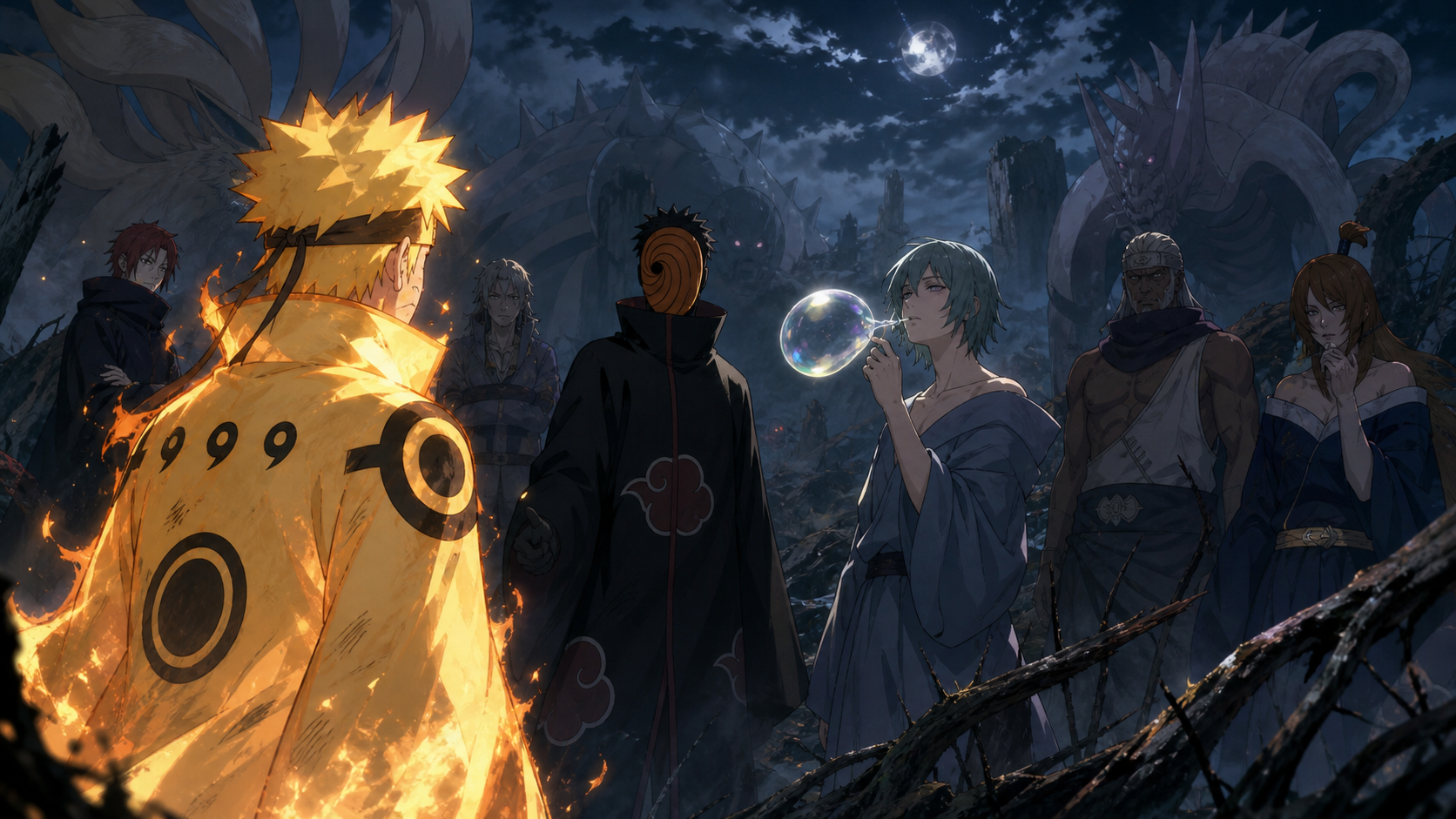
Naruto recognizes Utakata among six controlled jinchuriki and refuses to let the masked man erase the names, memories and promises of the dead.
Bottom line
“The Unbreakable Mask and the Shattered Bubble” reconnects the war to one of Naruto’s earlier promises. Naruto and Killer B face the masked man beside six reanimated jinchūriki, but one body breaks through the abstraction: Utakata, the wandering shinobi who agreed to become Hotaru’s teacher. Naruto learns that Utakata carried the Six-Tails and died before keeping that promise. The masked man treats names, memories, and feelings as useless because his weapons are dead. Naruto responds by insisting that the dead remain people whose lives matter. The episode’s repeated attacks on the unbreakable mask are therefore more than a tactical failure. Naruto is trying to reach the person who hides behind a false name while refusing to let that person erase everyone else’s identity.
Naruto reaches the second Madara battlefield
The five Kage have taken responsibility for the reanimated Madara, allowing Naruto to continue toward the masked commander. Killer B travels with him because the enemy is hunting both remaining jinchūriki.
Their arrival separates the war’s two central identity problems. One Madara is a resurrected historical figure; the other is an unknown man still using Madara’s name.
Six jinchūriki stand beside the masked man
The enemy formation contains Yugito, Yagura, Rōshi, Han, Utakata, and Fū. Each person once carried a different tailed beast and each died after Akatsuki extraction.
Edo Tensei has returned their bodies, while black receivers and the masked man’s ocular control turn those bodies into another Six Paths formation.
The Rinnegan changes every pair of eyes
The reanimated jinchūriki carry the Rinnegan alongside Sharingan vision. Their connected sight makes blind-side attacks far harder to create.
Naruto recognizes the battlefield logic from his fight against Pain. Separate bodies can function as one surveillance system when every angle is shared.
Sharingan adds prediction to shared vision
The Sharingan reads movement while the Rinnegan distributes sight across the group. The combination reduces the time between seeing an attack and answering the attack.
The masked man has not restored six people to their original fighting lives. He has rebuilt them as components inside his preferred control architecture.
Killer B recognizes fellow hosts
B understands what the bodies represent because he belongs to the same exploited class. Jinchūriki came from different villages, but each lived inside a political system that measured a person partly through the beast sealed within.
The encounter is not an ordinary lineup of enemy veterans. Two living hosts are being forced to fight six dead hosts whose choices have been removed.
Naruto recognizes Utakata
Among the unfamiliar faces, Naruto knows Utakata. He remembers the guarded traveler who protected Hotaru and resisted the responsibility of becoming her formal teacher.
Recognition changes the emotional scale. One controlled body now carries a voice, temperament, unfinished promise, and person Naruto met outside this war.
Naruto never knew Utakata was a jinchūriki
Their earlier encounter did not include an exchange of complete biographies. Naruto understood Utakata as a missing-nin pursued by hunters and connected to Hotaru’s dangerous inherited technique.
The Six-Tails remained hidden from Naruto. Shared status could have created another bond, but neither young man had enough safety or time for that honesty.
Utakata kept distance for a reason
Utakata resisted being called “master” because his own relationship with a teacher ended in perceived betrayal and violence. Accepting Hotaru meant accepting responsibility he feared repeating badly.
His reserve was not proof that he did not care. Distance became a defense against attachment and the possibility of harming someone who trusted him.
Hotaru asked for more than protection
Hotaru wanted Utakata to teach her, not simply rescue her and disappear. She saw a future relationship where he saw another route toward loss.
Her request required Utakata to imagine that his knowledge and presence could build something rather than only survive pursuit.
Naruto pushed Utakata toward the promise
Naruto challenged Utakata’s habit of leaving emotional work unfinished. Protecting Hotaru while refusing to answer her trust would still leave her abandoned.
The pressure mattered because Naruto recognized a familiar defense. Pretending not to need bonds does not prevent bonds from shaping every decision.
Utakata finally accepted the role
By the end of their shared conflict, Utakata agreed to become Hotaru’s teacher. The choice turned temporary protection into a promise about the future.
That promise is the bubble named in the title: beautiful, fragile, and destroyed before Hotaru could receive the life Utakata had chosen to offer.
Pain intercepted him afterward
Utakata was confronted by the Six Paths of Pain after separating from Hotaru. Akatsuki captured him, extracted Saiken, and left him dead.
Naruto did not witness that ending. He continued with the reasonable belief that Utakata had gone back to keep his word.
The war delivers the missing answer
Seeing Utakata among the reanimated jinchūriki tells Naruto that the promised reunion never happened. The information arrives through the person’s weaponized corpse rather than a friend, record, or memorial.
The cruelty includes delay. Naruto learns the truth only when the enemy can use his grief to disrupt him during combat.
Utakata cannot explain himself
The reanimated body does not greet Naruto, mention Hotaru, or describe the capture. Control has taken away the conversation that recognition should make possible.
Naruto has to reconstruct the loss from context. A familiar face stands behind enemy eyes, and silence confirms how thoroughly the person has been suppressed.
The masked man dismisses their names
The masked man argues that the jinchūriki are dead and therefore no longer need names or feelings. His language reduces biography to wasted information.
That reduction serves control. A body without a name becomes easier to describe as equipment, and equipment does not create moral responsibility for the operator.
Naruto refuses the inventory system
Naruto insists that the people in front of him had lives worth recognizing. Death does not retroactively turn those lives into anonymous containers.
His resistance is personal and political. Naruto knows what happens when a village sees the beast first and asks about the host only when the weapon becomes useful.
A name records relationship
Knowing “Utakata” does not provide Naruto with a new combat technique. The name connects this body to Hotaru, Saiken, a broken teacher relationship, and an unfinished future.
The masked man calls that information useless because relationships interfere with efficient control. Naruto values the interference.
Naruto attacks the mask directly
Naruto drives himself toward the masked man and tries to break the mask with a headbutt. The move is blunt, immediate, and emotionally honest.
He wants the false Madara identity removed from the battlefield. A hidden face has organized a war while demanding that everyone else surrender their names.
The mask does not crack
The impact fails to damage the material. The masked man treats the failure as proof that Naruto cannot reach him.
Physical durability supports psychological distance. As long as the face stays hidden, the enemy can present ideology without exposing the person responsible for choosing that ideology.
Repetition becomes defiance
Naruto keeps targeting the mask after the first failure. The repeated effort is not a sophisticated solution, but the refusal carries meaning.
The masked man has built an identity around being unreachable. Naruto refuses to accept that concealment as a permanent fact.
An unbreakable object can still hide fear
The mask may survive direct impact, yet the need for concealment remains visible. The enemy wants authority associated with Madara without allowing anyone to judge his own face and history.
Durability does not convert secrecy into truth. A stronger barrier only shows how much effort has gone into maintaining the separation.
Killer B keeps Naruto in the fight
B provides the experienced partner Naruto needs while grief and anger compete for his attention. He understands both jinchūriki combat and the danger of letting an enemy dictate emotional tempo.
Partnership matters because Naruto’s empathy is a strength with tactical costs. Another fighter can protect the seconds required to process recognition.
The dead hosts remain dangerous
Respecting the jinchūriki as people does not make their controlled bodies harmless. They retain specialized techniques, physical training, and enhanced shared vision.
Naruto and B have to stop the attacks without confusing necessary defense with contempt for the people being used.
Yagura carries institutional history
Yagura was both the Three-Tails jinchūriki and Mizukage. His body joins personal exploitation to the political damage inflicted on the Hidden Mist.
The masked man’s control over Yagura extends beyond this battlefield. Another hidden identity has already shaped a village through someone else’s face.
Yugito represents a village’s lost protector
Yugito fought Akatsuki with discipline and confidence before extraction killed her. The Hidden Cloud lost a skilled shinobi as well as the Two-Tails host.
Her return as an enemy weapon demonstrates how Akatsuki profits twice: first from the beast, then from the person’s corpse.
Rōshi and Han carried lives Naruto never learned
The Stone jinchūriki stand before Naruto with histories he did not have the chance to hear. Lack of personal familiarity does not make those histories smaller than Utakata’s.
Utakata opens the emotional door, but Naruto’s principle has to include the strangers beside him too.
Fū makes the youth of the losses visible
Fū’s appearance emphasizes how young some hosts were when villages and Akatsuki built strategies around their bodies. Her energy in life contrasts with the controlled stillness of the formation.
Edo Tensei preserves an exterior while removing the future that exterior once carried.
Saiken is missing from the visible person
Utakata’s identity was never identical to the Six-Tails, yet Saiken shaped his isolation, power, and pursuit. Extraction separated them through death.
The masked man later reconnects host and beast only as a control system. Forced reunion is not restoration.
The shattered bubble belongs to Hotaru too
Utakata lost the chance to teach, but Hotaru lost the teacher she believed was returning. Her side of the promise exists even when she is absent from the battlefield.
The episode asks the audience to remember the person waiting beyond the frame. Akatsuki’s body count includes futures disrupted far from each extraction site.
Naruto’s anger needs accurate direction
The controlled jinchūriki did not choose this confrontation. The masked man and Kabuto created the conditions that turned them into opponents.
Naruto’s best response will require breaking control rather than simply overpowering bodies. Moral clarity has to shape the tactical goal.
The masked man copies Pain’s structure
Shared Rinnegan vision and black receivers recall Nagato’s Six Paths. The masked man adopts the successful mechanics without carrying Nagato’s history or final change of heart.
Borrowed systems are part of his pattern. He uses Madara’s name, Nagato’s eyes, dead jinchūriki bodies, and tailed beasts while keeping his own identity hidden.
Borrowed authority is still dangerous
Exposing the false name does not remove the masked man’s control over real weapons. Naruto cannot defeat the battlefield by winning an argument about authenticity.
The distinction keeps the mystery grounded. Identity matters because choices have an author, while capability matters because those choices are killing people now.
The title joins two kinds of concealment
The unbreakable mask hides the living perpetrator. The shattered bubble represents a dead person’s fragile plan for life after pursuit.
One man protects himself from accountability while another man’s hope receives no protection at all. The imbalance explains Naruto’s fury better than a simple desire to see a face.
The controlled jinchūriki need individual intelligence files
Six bodies appear in one formation, yet each host carries different techniques, village training, relationships, and tailed-beast history. Treating them as interchangeable repeats the masked man’s inventory logic.
Naruto and B need names, known abilities, sensory cues, and sealing risks distributed quickly. Individual records protect the living fighters while preserving the dead as people rather than numbered paths.
Shared vision turns every blind angle into collective danger
The Rinnegan lets the controlled hosts exchange sight, while the Sharingan improves prediction inside that network. Attacking one opponent without accounting for the other five creates openings the formation can see immediately.
The response needs simultaneous disruption, terrain barriers, feints, and communication between Naruto and B. Raw speed matters less when every pair of eyes functions as one surveillance system.
B recognizes a community of hosts before Naruto can
Killer B understands the weight of seeing other jinchūriki used after death. His recognition comes from a shared political role, not from assuming every host lived the same life.
That perspective should guide Naruto’s anger. B can identify patterns of containment and isolation while still leaving space for Yagura, Yugito, Rōshi, Han, Utakata, and Fū to remain distinct.
Utakata’s silence is imposed, not emotional absence
Naruto recognizes him and finally learns what happened, but Utakata cannot explain the promise he made to Hotaru or the violence that interrupted it. Control steals testimony at the exact moment relationship returns.
Naruto should treat remembered behavior and missing speech as separate evidence. Silence under coercion cannot be read as rejection, agreement, or proof that the earlier bond meant less.
Hotaru belongs in the record of Utakata’s death
The shattered bubble is not only Naruto’s symbol. Hotaru asked Utakata to become her teacher, trusted his return, and was left without the truth after Pain captured him.
Any postwar account should notify her, preserve her testimony, and acknowledge the promise that never reached completion. Centering Naruto alone would repeat the disappearance by erasing the person who waited most directly.
Yagura’s body carries a village accountability crisis
A former Mizukage appears as a controlled weapon after a reign already associated with manipulation and bloodshed. Kirigakure must separate what Yagura chose from what outside control forced him to do.
That investigation affects survivors, victims, policy, and his own memory. A village cannot heal by assigning every atrocity to one name while leaving the machinery of control unexamined.
Fū makes the stolen future impossible to ignore
Her youth, energy, and desire for friendship expose how much life the jinchūriki system consumed before the war raised these hosts again. She is not tragic because youth automatically equals innocence.
The loss hurts because a village role narrowed her choices, Akatsuki ended them, and the masked man now converts her body into another controlled resource. Naming each step prevents one villain from absorbing every institution’s responsibility.
Naruto attacks the mask because identity now affects strategy
Breaking the mask could reveal the operator, unsettle his authority, and answer why the real Madara stands elsewhere. The repeated strikes are emotional, but the objective is not meaningless.
B keeps Naruto alive long enough to pursue it, reminding us that defiance needs partnership. Persistence becomes useful when someone else protects the fighter from mistaking rage for invulnerability.
The mask’s durability should not become mystical proof
Repeated Rasengan impacts fail to crack it, but material strength does not confirm the wearer’s claims, destiny, or emotional control. An object can be engineered for survival.
The Alliance needs fragments, observed repair behavior, dimensions, and technique interactions rather than mythology. Investigation begins by refusing to let a dramatic symbol replace physical evidence.
Names must survive the battlefield after bodies disappear
Naruto’s immediate refusal to accept namelessness is emotionally right, but remembrance needs a structure stronger than one person’s anger. The Alliance should create a shared jinchūriki archive with each host’s chosen name, village, relationships, known wishes, tailed beast, circumstances of capture, and unresolved questions. Survivors must be able to contribute or correct the record without surrendering private memories to military ownership. The tailed beasts also need their own names and testimony preserved rather than appearing as equipment attached to human biographies. Such an archive would help identify controlled bodies during war, but its deeper purpose is repair. Villages used secrecy to isolate hosts, which made disappearances easier to hide and grief easier to manage politically. Public truth can challenge that pattern after the fighting ends. Utakata’s page should name Hotaru. Yugito’s should include the people she protected. Rōshi, Han, Fū, and Yagura deserve more than technique lists. A name records relationship only when institutions keep listening to the people connected to it. Otherwise, the masked man’s inventory survives in every official history that remembers their power while forgetting the human lives and communities surrounding it.
RaeRae’s verdict
“The Unbreakable Mask and the Shattered Bubble” uses anime-original continuity well because Utakata gives Naruto a relationship inside the jinchūriki lineup. He does not see six abstract hosts. He sees someone who promised to return to Hotaru and learns, far too late, why that return never happened.
The episode’s ethical line is equally strong. The masked man argues that death removes the need for names and feelings. Naruto recognizes that memory is exactly what prevents a corpse from becoming morally convenient inventory. Breaking the mask and freeing the dead are connected goals because both require exposing the person who built power from stolen identities.
RaeRae’s call
The masked man calls six jinchūriki replaceable bodies because names would expose every village, promise, and person he stole. Let B read the shared political wound, let Naruto remember Utakata, put Hotaru back into the record, and fight the linked eyes without surrendering the individual lives behind them.
Episode details and viewing routes
- Official episode reference: Naruto Official episode guide
- Licensed episode route: Crunchyroll licensed episode page
What I am carrying forward
Naruto and Killer B now face the masked man and six reanimated jinchūriki equipped with shared Rinnegan and Sharingan vision. Naruto recognizes Utakata, learns that he carried the Six-Tails, and understands that Utakata died before returning to become Hotaru’s teacher.
Direct attacks have not broken the masked man’s reinforced mask. Naruto rejects his claim that dead jinchūriki no longer need names or feelings, but recognition alone cannot yet release the six bodies from control. Episode 325 moves into the full jinchūriki battle.