
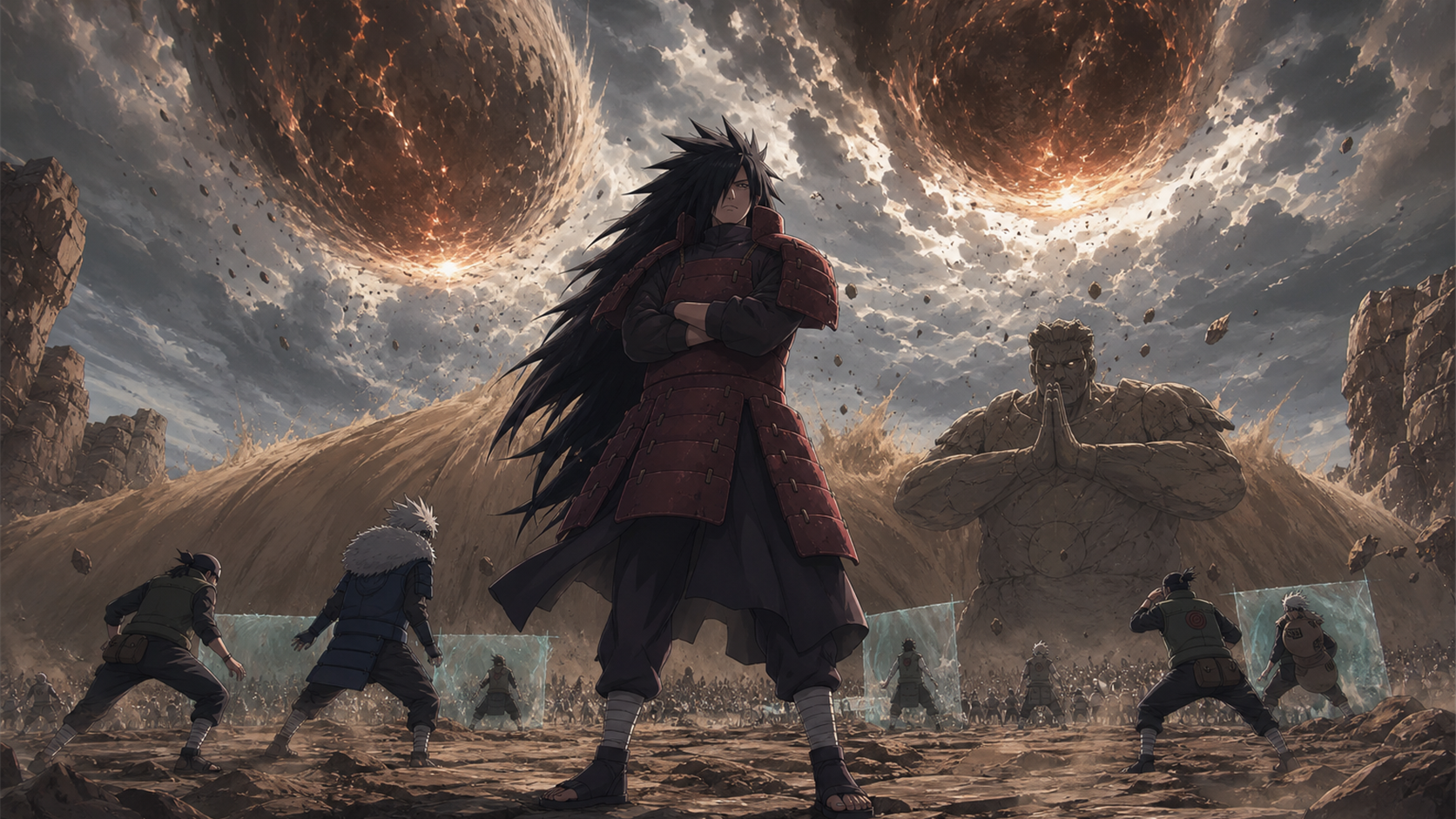
Madara Uchiha
Madara turns his name into battlefield evidence, then Kabuto’s modified corpse makes the Alliance pay for every attack he can regenerate.
Bottom line
“Madara Uchiha” does not ask the Fourth Division to fear a reputation. The episode makes Madara earn that fear in front of them. He walks through an army with taijutsu, weapons, Sharingan precision, Fire Release, Susanoo, Rinnegan absorption, and two falling meteors before revealing Wood Release as one more stolen advantage. Gaara, Ōnoki, Temari, Naruto’s clone, and hundreds of shinobi answer him together, yet every solution exposes another layer of his power. The episode also strips the romance from Kabuto’s claim that he improved Madara. His “achievement” is a modified corpse carrying Hashirama’s cells, protected from the consequences of attacks that kill living soldiers. This is spectacle with an ugly accounting system underneath the explosions: the Alliance pays in bodies while Madara regenerates.
The real Madara does not need an introduction
Episode 321 established the identity problem. The masked man is elsewhere, while the dead and reanimated Madara stands before the Fourth Division.
Episode 322 moves immediately from recognition to evidence. Madara does not explain why history remembers him. He attacks, and the battlefield learns through survival.
Kabuto speaks through Mū
Kabuto uses Mū as his voice and tells Madara that this reanimated body exceeds the strength of his prime. The boast turns grave robbery into a laboratory demonstration.
Madara hears more than confidence. He realizes Kabuto knows details about his body and plans that should not be common knowledge.
The original resurrection plan has changed
Madara expected a different return, connected to the Rinnegan and a living resurrection. Edo Tensei tells him that events continued without his control.
That uncertainty matters. The most dangerous person on the field is not fully briefed, and Kabuto assumes borrowed information gives him the stronger position.
Madara tests the army himself
He enters the Fourth Division instead of beginning at a safe distance. Swords, fists, kicks, and stolen weapons become enough to overwhelm trained shinobi in rapid succession.
The sequence makes scale personal. Madara is not only a distant source of giant techniques. He reads bodies, timing, and openings at arm’s length.
Sharingan turns numbers into opportunities
The division surrounds him, but more attackers create more movement for the Sharingan to track. Madara redirects one fighter into another and uses incoming weapons against their owners.
An army is powerful when its members coordinate. A crowd attacking without a shared rhythm gives a superior reader a field full of predictable lines.
The choreography earns the legend
Madara’s reputation could have become an excuse for everyone else to freeze. Instead, soldiers engage him, and his technique shows why their courage is not enough.
The difference is important. He looks terrifying because capable people try sensible attacks and still lose, not because the script orders them to stare.
Temari creates distance
Temari’s Wind Release knocks Madara away from the immediate formation. Her intervention gives the front line a breath and proves he can be displaced.
Displacement is not defeat. Madara rises without meaningful damage, treating a forceful counter as information about the next opponent.
Naruto’s clone is running low
Temari calls for Naruto to use his chakra mode, but the clone has already spent heavily across the war. His distributed victories have a real cost.
The episode refuses to reset him because a larger villain arrived. Reinforcement remains finite, and exhaustion carries from one emergency into the next.
Great Fire Annihilation demands an army
Madara releases a wall of flame too broad for one Water Release user to answer. A large group combines water techniques to stop the attack.
This is one of the episode’s clearest measurements. One man creates an elemental threat that requires mass cooperation merely to neutralize.
Collective defense still matters
The water wall succeeds. Madara’s power does not make organization meaningless, and the division survives because shinobi act together.
That success deserves attention even though he attacks again. Defense is not a lesser accomplishment when the alternative is hundreds of immediate deaths.
Smoke becomes another weapon
Steam and smoke cover the field after fire meets water. Madara uses the reduced visibility to continue attacking at close range.
The Alliance solved the flame without gaining control of the aftermath. A correct response can still create terrain that favors the person who forced that response.
Gaara changes the angle
Gaara’s sand reaches Madara from below and pulls him away from stable footing. The Kazekage does not repeat the frontal rush that Madara has already solved.
His attack begins a coordinated sequence built around movement, restraint, and a finishing strike rather than individual pride.
Ōnoki makes the sand faster
Ōnoki lightens Gaara’s sand, allowing greater speed. Their techniques become more useful together than either would be alone.
The oldest Kage and the youngest Kage answer a founder-era threat through cooperation that the old village rivalries once made impossible.
Susanoo blocks Naruto’s Rasengan
Naruto’s clone drives an Ultra-Big Ball Rasengan toward the opening, but Madara forms Susanoo and stops the attack.
The failure is not wasted. The blocked strike reveals the defensive layer protecting Madara when ordinary movement and weapons are no longer enough.
Naruto chooses Sage Mode
With Nine-Tails chakra depleted, Naruto gathers natural energy and shifts into Sage Mode. The choice uses a different reserve instead of pretending fatigue disappeared.
Adaptation has defined Naruto’s contribution to the war. Here, adaptation means respecting his limits and finding another route through them.
Gaara pulls Madara out of Susanoo
Gaara sends sand beneath the defense and yanks Madara away from its protection. The move treats Susanoo as a position to disrupt rather than a wall to overpower.
Naruto and Gaara create the opening together. Their plan is sound, fast, and built from what the previous exchange taught them.
Rasenshuriken meets the Rinnegan
Naruto launches a Sage Art: Wind Style Rasenshuriken at the exposed Madara. Madara reveals the Rinnegan and absorbs the technique.
The moment invalidates the division’s strongest available ninjutsu plan. More chakra will not solve a defense designed to consume chakra-based attacks.
Madara awakened those eyes late
Madara states that he awakened the Rinnegan near the end of his natural life. The reveal connects the Sharingan legend to a power the Alliance associated with Pain.
His wording also separates his original achievement from Kabuto’s later modifications. Kabuto recovered and altered a body; he did not create Madara’s eyes.
Kabuto treats desecration as research
Kabuto claims his experiments helped reconstruct and enhance Madara. He speaks as if technical difficulty turns the work into moral authority.
The body belongs to a dead person, the cells belong to Hashirama, and the battlefield casualties belong to neither scientist nor specimen. Calling theft an experiment does not make the theft clean.
Hashirama’s cells are the hidden upgrade
Madara discovers Hashirama’s power incorporated into his reanimated body. Kabuto has combined two founders inside one corpse because the result serves his war.
This is not a fair measure of Madara at his historical prime. Kabuto created a weaponized reconstruction with stolen biology and unlimited regeneration.
Tengai Shinsei changes the sky
Madara calls down a meteor large enough to cover the battlefield. Individual combat skill becomes almost irrelevant beneath its shadow.
The attack targets the division as a population. Soldiers cannot duel a meteor, and many cannot escape the impact radius in time.
Ōnoki refuses the impossible
Ōnoki flies upward and lightens the meteor while Gaara supports its mass with sand. Their combined effort slows and finally stops the descent.
The moment is heroic because the risk is plain. Ōnoki puts his aging body between thousands of soldiers and a disaster no one should be expected to hold.
The first success is a trap
The division looks up at the arrested meteor and receives a few seconds of relief. Madara then reveals a second meteor falling directly above the first.
The cruelty is structural. He allows hope and effort to concentrate under one target before adding weight that the defenders cannot manage.
The second meteor punishes heroism
The second impact drives the first into the battlefield. The people who stayed because their leaders were holding the sky now have almost no route out.
Madara converts Ōnoki and Gaara’s rescue into the center of a larger catastrophe. Their choice remains right even though he prepared a worse answer.
Mass casualties are not background decoration
The Fourth Division is devastated. Bodies, injuries, broken formations, and silence replace the organized army that confronted Madara moments earlier.
The spectacle works only when the cost stays visible. A meteor is not impressive because the impact makes a large crater; the weapon is horrifying because people were standing there.
Edo Tensei removes Madara’s restraint
Madara’s reanimated body reforms after the blast. He can use an attack that catches him inside its destruction because the living soldiers pay a consequence he does not share.
Kabuto’s technique creates strategic obscenity: an immortal weapon can choose exchanges that would be suicidal for anyone else.
Ōnoki survives wounded
Ōnoki remains alive but badly hurt. His survival preserves a witness who understands Madara’s history and has now experienced his current modification.
Survival is not proof that the defense failed. His effort saved people from the first descent and forced Madara to spend another catastrophic attack.
Madara reaches for the Nine-Tails
Madara attempts to summon the Nine-Tails as if an old claim over Kurama should still apply. The summon fails because Kurama remains sealed inside Naruto.
The failure tells Madara that the beast is unavailable, but the failed summon also directs his attention toward the exhausted clone carrying Kurama’s chakra.
Naruto is a person, not a container
Madara’s instinct is to locate the Nine-Tails as an asset. Kabuto likewise discusses bodies, cells, and eyes as inventory.
Naruto’s entire war contribution argues against that view. His choices, relationships, and judgment turned Kurama’s chakra into help across the battlefield.
Wood Release exposes the stolen inheritance
Madara answers the surviving division with Deep Forest Emergence. Trees erupt across the ruined field, confirming that Hashirama’s cells are operational power rather than a hidden laboratory note.
The technique is visually associated with the rival who once stopped him. Kabuto has placed that rival’s ability inside Madara without consent from either man.
The battlefield keeps losing its rules
Taijutsu could not contain him. Mass Water Release answered fire but not the follow-up. Susanoo stopped the Rasengan, Rinnegan absorbed the Rasenshuriken, meteors broke the army, and Edo Tensei repaired Madara.
Now Wood Release changes the terrain itself. Every layer forces the Alliance to abandon the previous definition of a workable plan.
Madara’s taijutsu turns an army into individual casualties
The choreography makes his legend visible through speed, timing, and ruthless use of every opening. It also risks turning the Allied shinobi into anonymous bodies arranged to demonstrate his greatness.
Each fallen soldier represents a unit, family, medic, and gap in the defensive line. The episode’s scale lands harder when spectacle does not erase the people paying for it.
Temari’s wind creates the first usable distance
She recognizes that close formation feeds Madara’s taijutsu and uses wind to interrupt his rhythm. The attack does not defeat him, but it changes the conditions for everyone behind her.
Support at this scale means buying seconds, clearing sightlines, and giving exhausted specialists room to choose. Temari’s contribution should remain visible even when the next exchange belongs to Naruto, Gaara, and Ōnoki.
Great Fire Annihilation is defeated collectively
No single water user answers the fire. An entire line combines technique and timing to keep the battlefield from becoming a mass burn site.
That defense is one of the episode’s most important images because it refuses the idea that only legendary bloodlines matter. Ordinary shinobi survive overwhelming power through shared training, coordinated breath, and trust in the person standing beside them.
Smoke requires a second emergency plan
Stopping the flames prevents immediate catastrophe, but steam and smoke erase visibility while Madara continues moving. A successful counter creates new conditions that command must recognize quickly.
Units need sound signals, paired movement, burn triage, and rules against firing blindly into obscured allies. Defense is not complete when the first element disappears. The aftermath can become the enemy’s next weapon.
Gaara and Ōnoki combine generations without surrendering authority
Gaara changes Madara’s position while Ōnoki lightens the sand, letting two Kage turn separate abilities into one opening. Neither becomes an accessory to the other.
The collaboration works because both understand the objective and contribute distinct judgment. Intergenerational leadership is strongest when experience and innovation meet as coordinated authority rather than a lecture moving in only one direction.
Naruto’s depleted clone still receives impossible expectations
The clone has crossed battlefields, detected infiltrators, shared intelligence, and fought repeatedly before Madara appears. Low chakra is not a moral failure or a reason to demand one final miracle.
Command should plan around the remaining capacity instead of treating Sage Mode as an unlimited reserve. Naruto chooses to continue, but informed choice requires honest knowledge of risk and a team prepared to act when his clone disappears.
Rinnegan absorption turns intelligence into survival
Rasenshuriken fails because Madara reveals an ability the battlefield did not know he possessed. Gaara reads the eyes, Kabuto explains the history, and every surviving fighter must update assumptions immediately.
Reports need the exact technique, range, visible cue, and failed counter. A frightening discovery becomes useful only when information travels faster than the enemy can repeat it.
Kabuto calls human modification research
He speaks proudly about restoring Madara beyond his prime through stolen cells and controlled resurrection. Technical achievement becomes a shield against the obvious fact that no subject consented.
Research language does not neutralize grave robbery, bodily alteration, or forced combat. The episode should leave viewers impressed by capability and disgusted by the system that treats a person as a platform for upgrades.
The first meteor makes support labor visible
Ōnoki rises because nobody else can reach the falling mass with his combination of flight and weight control. Below him, Gaara spreads sand while soldiers brace, evacuate, and wait beneath a shadow covering the field.
The defense belongs to every person maintaining enough order for the Kage to act. Heroism at the top depends on communication, triage, and movement below.
The second meteor weaponizes the instinct to rescue
Madara waits until the Alliance commits everything to stopping one catastrophe, then drops another onto exhausted defenders. The tactic punishes cooperation by exploiting the moment everyone is physically and emotionally invested.
Disaster planning needs reserve teams and a rule against spending every resource on the first visible threat. That lesson does not blame Ōnoki for trying. It identifies the cruelty of an enemy who designs escalation around compassion.
Mass casualty care begins before the dust clears
The impact destroys formations, buries soldiers, and overwhelms the survivors who can still move. Medical response needs sectors, casualty tags, breathing protection, extraction corridors, and honest estimates of what cannot be reached.
Names matter alongside numbers. A war report that records only lost strength repeats Madara’s view of the army as material placed in his path.
Hashirama’s cells reveal a stolen inheritance economy
Madara’s stolen Wood Release does not appear as a neutral expansion of his own training. Kabuto built the resurrected body with tissue taken from Hashirama and research inherited from Orochimaru’s experiments. Power moves through theft, secrecy, and laboratories that treat rare bodies as national resources. The battlefield sees a technique associated with one clan and one man, but the people harmed during decades of experimentation remain mostly unnamed. Konoha and the Alliance need a chain of custody for preserved tissue, research samples, medical archives, and remains connected to kekkei genkai. Destruction alone may erase evidence, while secrecy leaves the material available for the next unauthorized program. Survivors of earlier experiments deserve notice when their suffering informs a new weapon. Hashirama’s legacy also should not be reduced to cells endlessly harvested by ambitious men. His political choices, failures, relationships, and hopes matter more than the biological material others extracted. Naming the theft changes how we read Madara’s display. The Wood Release is impressive, but the achievement belongs partly to bodies and victims Kabuto refuses to credit. Every spectacular branch carries an institutional history underneath it. That history should follow the technique into every official report, memorial, medical review, and future debate about who has the right to inherit power.
RaeRae’s verdict
“Madara Uchiha” is one of Shippuden’s most effective power demonstrations because the episode keeps giving the Alliance intelligent responses. Temari creates space, water users combine defenses, Gaara and Ōnoki improve one another’s techniques, and Naruto changes modes when his chakra reserve runs low. Madara defeats solutions instead of defeating competence.
The episode is also careful about what Kabuto’s triumph means. He did not create Madara’s talent or Rinnegan. He exploited a corpse, added Hashirama’s cells, and removed the normal cost of catastrophic attacks. Madara earns the fear attached to his name, while Kabuto earns disgust for turning history’s dead into a modular weapon.
RaeRae’s call
Madara earns the legend through terrifying skill, but the episode must not let his spectacle erase the people beneath it. Credit the water line, Temari, Gaara, Ōnoki, sensors, medics, and every soldier who holds formation. Record the casualties by name, and call Kabuto’s upgrades what they are: desecration dressed as research.
Episode details and viewing routes
- Official episode reference: Naruto Official episode guide
- Licensed episode route: Crunchyroll licensed episode page
What I am carrying forward
Madara has revealed the Sharingan, Susanoo, Rinnegan, meteor summoning, Edo Tensei regeneration, and Hashirama-derived Wood Release. The Fourth Division has suffered mass casualties, and Ōnoki is injured after helping Gaara stop the first meteor.
Naruto’s clone is exhausted but still present. Madara failed to summon the Nine-Tails because Kurama remains sealed in Naruto. Episode 323 begins with the surviving Alliance facing the expanding forest and needing help at a scale equal to the threat.