
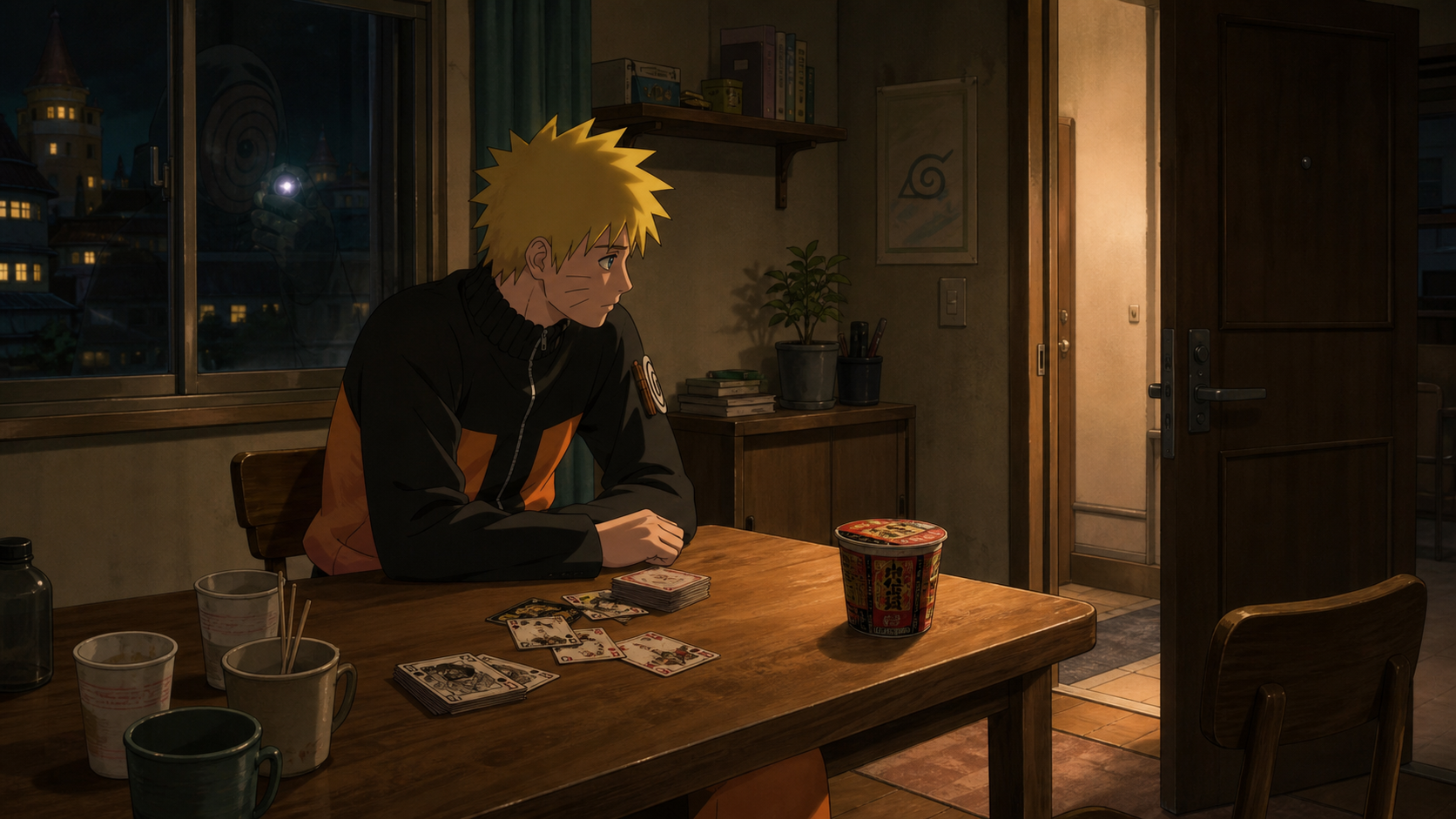
Prologue of Road to Ninja
A noisy day with friends ends in a quiet apartment, giving Tobi the private longing he needs for Limited Tsukuyomi.
Bottom line
“Prologue of Road to Ninja” pauses the war to show Tobi studying what Naruto wants before testing Limited Tsukuyomi on him. Naruto spends his final day off playing cards with shadow clones because nobody else is home. Rock Lee notices the loneliness and organizes a bathhouse trip, but slapstick accidents end with Lee accused of peeping and Naruto punished over Sakura's underwear caught on his towel. The boys later visit Naruto's apartment for cards, then leave before the premium ramen he hoped to share. Tobi reads the quiet disappointment as useful intelligence. The movie tie-in has a sharp emotional idea about loneliness hiding inside noisy friendship, but the bathhouse material relies on body comparison, harassment comedy, and violence against Naruto in ways that age badly.
Tobi begins with desire, not force
Tobi tells Zetsu that a limited trial of Infinite Tsukuyomi requires understanding the target's deepest wish. The technique will work through emotional precision rather than overwhelming chakra alone.
That premise makes observation part of the attack. Naruto's private longing becomes information an enemy can collect and reproduce without consent.
Naruto's day off is still solitary
The village has returned to routine around him, yet Naruto spends his last rest day alone in the apartment. A free schedule does not create companionship when everyone assumes somebody else will check in.
His room is safe and familiar, but silence makes the space feel smaller. The future Hokage can be celebrated publicly and lonely privately at the same time.
Shadow clones become substitute company
Naruto creates two clones and plays cards with himself. The gag depends on his competitive energy, but the image is painfully literal: he manufactures the other people needed for a social game.
Clones can talk, argue, and surprise him through divided attention. They cannot choose to arrive, stay for dinner, or tell Naruto that his company matters.
Premium ramen becomes an invitation
Naruto has saved a hard-to-find premium ramen and turns the meal into a prize for the card game. Food becomes his reason to make the lonely afternoon feel like an occasion.
He does not truly need to beat himself for the cup. The contest gives him a script for sharing something special when no guest is present.
Tobi watches a private coping strategy
The Telescope Technique lets Tobi observe Naruto without entering the room. Naruto never knows that boredom, self-talk, and invented company are being assessed by an enemy.
Surveillance is central to the violation. Limited Tsukuyomi will not offer what Naruto asked for; Tobi will construct bait from moments Naruto believed were private.
Team Guy returns with visible companionship
Guy, Lee, Neji, and Tenten come back tired from a mission together. Even exhaustion carries a social structure: they traveled, worked, and returned as a team.
Their scene contrasts with Naruto's empty room. Naruto has friends and comrades, but a day without an assigned mission exposes how inconsistent that support can be.
Tenten suggests the bathhouse
Tenten proposes a communal bath after the mission. The idea offers recovery and time together without turning rest into another achievement test.
Lee initially refuses because training feels more urgent. His response shows how easily discipline can crowd out the ordinary relationships he later realizes Naruto needs.
Lee notices what others miss
During training, Lee sees Naruto alone and understands the mood beneath the window. He does not wait for Naruto to admit loneliness.
That attention is Lee's best contribution. Friendship sometimes begins with recognizing that a person who seems self-sufficient has stopped expecting an invitation.
The group outing is care in practical form
Lee gathers their friends and includes Naruto in the bathhouse plan. He gives companionship a time and place instead of offering vague reassurance.
The episode should credit that labor. Organizing friends, matching schedules, and making the invitation explicit are meaningful forms of care.
The public bath creates gendered boundaries
The outing separates the group into men's and women's spaces. The layout turns privacy into a physical wall while the comedy immediately searches for ways to break that wall.
A bathhouse story can show relaxed friendship without making exposure the joke. Here, the episode repeatedly treats embarrassment as entertainment.
Sakura compares herself with Hinata
On the women's side, Sakura envies Hinata's chest while urging her to relax. The scene reduces two capable young women to a body comparison neither character needs.
Hinata's discomfort deserves respect, and Sakura's insecurity could be explored without positioning another woman's body as the standard she lacks.
Akamaru's disguise breaks the safety of the room
Akamaru enters transformed as Kiba and leaves soap across the floor. Even before the larger accident, bringing an unannounced animal into a communal bath creates hygiene and consent problems.
The prank is small by anime logic. The physical risk becomes real once wet tile and crowding turn the floor into a hazard.
Chōji's fall becomes spectacle
Chōji slips, crashes into the bath, and displaces much of the water. His body becomes the center of another joke built on size.
The episode could use the accident without humiliating him. A fall on wet tile can injure anyone, and concern should arrive before laughter.
Shikamaru solves the water problem
Shikamaru tells Chōji to use Multi-Size so his body can raise the bath's water level. The improvised solution fits their long partnership and turns a jutsu toward a mundane problem.
Practical creativity is funny enough without treating Chōji's body as public equipment. He should be asked, not simply assigned.
Naruto wonders about Sasuke in the middle of company
Even surrounded by friends, Naruto's thoughts drift toward Sasuke. Presence does not erase the absence that has structured so much of his adolescence.
The moment complicates Tobi's reading. Naruto wants family and enduring companionship, not merely a crowded room for one afternoon.
Neji recognizes Naruto's bad idea
Naruto considers looking toward the women's side despite Neji's warning. Curiosity does not make invasion of privacy harmless.
Naruto's choice matters because the later false accusation does not turn him into a perfect victim. He can defend Lee truthfully while still being accountable for approaching the boundary himself.
Lee trains above the wrong roof
Lee continues his routine on the roof over the women's changing area and crashes through. The physical accident is believable within his reckless training style, but location changes the harm.
Intent explains why Lee fell. Intent does not erase the fear and exposure experienced by people beneath him.
Ino responds to an apparent violation
Ino sees Lee drop into a private space and assumes he came to peep. From her position, anger is reasonable because she has no access to the chain of accidents above the ceiling.
The scene would work better if explanation and repair followed. Instead, escalating accusation becomes the next joke.
Naruto defends Lee's actual character
Naruto knows Lee organized the day because he did not want a friend left alone. He stands between Lee and the crowd and asks them to consider the person they know.
That defense is emotionally generous. Naruto moves beyond his own embarrassment to protect the friend whose care created the outing.
The underwear gag destroys the defense
A bra caught on Naruto's towel makes him look like the thief after his speech. Sakura responds by beating him before the accident can be understood.
The gag relies on sexual humiliation and reflexive violence. False evidence should create confusion, not permission to hurt someone for comedy.
Sakura's anger should not be her whole role
Sakura has a right to privacy and anger over missing underwear. The script still chooses the most familiar version of her: jealous about her body and physically punishing Naruto.
That framing wastes the emotional intelligence she shows elsewhere. Sakura could demand an explanation, recognize the accident, and remain funny without becoming a punch line delivery system.
The outing ends without repairing the harm
Naruto returns home injured and embarrassed, while Lee's attempt to help appears ruined. Nobody clearly restores trust with the women or checks what Naruto needs afterward.
Care should include cleanup after a failed plan. Good intentions do not finish the work once an outing causes harm.
The boys arrive for cards
Later, Naruto finds friends at his door ready to spend time in the apartment. Their visit confirms that Lee's concern reached the group even after the bathhouse disaster.
For a while, the room becomes what Naruto wanted: voices, competition, and people present because they chose him rather than because a mission assigned them.
Friendship has a closing time
The boys eventually leave for their own homes. Their departure is ordinary, yet Naruto remains in the silence they can exit.
That difference is the episode's emotional center. Friends can love Naruto deeply while still returning to families and routines he does not have.
The ramen remains unshared
Naruto hoped the visitors might stay for dinner, but the premium ramen survives the evening unopened. The saved meal becomes evidence of an invitation he never voiced.
He cannot expect friends to read every wish, but years of self-reliance taught him to hide need behind jokes. Support has to make room for needs that emerge slowly.
Tobi mistakes vulnerability for permission
Tobi decides he has learned enough. Naruto's wish for family and a home full of people becomes the emotional template for Limited Tsukuyomi.
Knowing what someone wants does not authorize giving a counterfeit version. The technique weaponizes care language while stripping away informed choice.
Zetsu recreates familiar threats
Zetsu clones shaped like Akatsuki members surround Tobi as the trial begins. Familiar enemies help construct a world that can feel connected to Naruto's fears as well as his desires.
The illusion's credibility depends on recognizable details. That makes every observed habit and relationship another stolen building block.
The movie connection is explicit
Episode 311 serves as a lead-in to *Road to Ninja: Naruto the Movie*, not a standard war chapter. Limited Tsukuyomi, Naruto's loneliness, and the contrast between chosen friends and absent parents prepare the film's alternate world.
Viewers following only the television war can treat the episode as optional. Movie viewers gain a clearer emotional runway before Naruto and Sakura enter the illusion.
The placement interrupts the war again
The episode follows multiple anime-original battlefield detours and replaces combat urgency with bathhouse comedy. The transition can feel abrupt even when the character theme is relevant.
A dedicated movie-special label would make expectations clearer. The story succeeds more easily when judged as a prologue than as the next movement of the Fourth Shinobi World War.
Naruto’s day off exposes what war usually hides
Without a mission, command briefing, or emergency to solve, he still returns to an apartment where silence waits. Shadow clones provide noise but cannot create separate lives that choose to stay.
The episode understands that public recognition did not automatically build private belonging. A village can cheer Naruto and still leave him responsible for arranging every ordinary meal alone.
Premium ramen is an invitation he cannot say aloud
Naruto buys something special because he wants to share pleasure without announcing that he needs company. The unopened package carries hope, embarrassment, and a backup plan for pretending the evening never mattered.
Friends should not be blamed for having homes and schedules. The sadness comes from Naruto lacking a dependable household where invitations do not feel like requests for rescue.
Tobi studies loneliness as an attack surface
He watches Naruto cope in private and interprets an unmet need as permission to construct a world around desire. That is predatory research, not empathy.
Understanding what somebody wants does not authorize overriding reality or consent. Tobi’s plan weaponizes accurate observation because he removes Naruto from every decision about how that longing will be answered.
Team Guy turns care into an actual outing
Tenten proposes the bathhouse, Lee notices Naruto’s isolation, and the group makes room without demanding a confession first. Practical companionship reaches him faster than a speech about friendship.
The outing works because Naruto can enter an existing plan instead of organizing everyone’s care himself. Inclusion sometimes means sending a time and place before asking a lonely person to explain why company matters.
The bathhouse boundary still matters during comedy
Akamaru’s disguise and the confusion around the women’s side create a gag from apparent intrusion. Ino and Sakura react to what looks like a violation of privacy.
The audience knows more than they do, which makes their alarm reasonable. Comedy should resolve the misunderstanding without treating women’s boundaries as proof that they are humorless.
Sakura’s comparison with Hinata deserves a wider life
The bathhouse scene narrows both girls into bodies placed beside each other for a joke. Neither relationship, skill set, fear, or current responsibility matters inside that framing.
A fandom editorial can acknowledge the gag and refuse to make measurement the most interesting thing about them. Sakura and Hinata carry separate wars, medical labor, family pressure, and choices no body comparison can explain.
Lee’s mistake is funny because intent and impact separate
He trains on the wrong roof without planning to violate anyone’s privacy. The women see a man above the bath and respond to the danger visible from their position.
Naruto is right that Lee’s character matters. The women are right that harmless intent was not available evidence in the moment. Repair needs both truths.
The underwear reveal ruins Naruto’s defense on contact
Lee’s behavior becomes harder to explain once the gag produces clothing as evidence. The joke works through terrible timing, but friendship should not require Naruto to deny what other people can reasonably see.
He can defend Lee from false character judgment while still asking for an explanation and acknowledging the women’s anger. Loyalty is not automatic acquittal.
Chōji’s fall should not become body spectacle
The collapse and water displacement use his size as the physical punchline. The team still needs Shikamaru’s quick response to prevent injury and restore the space.
Comedy can come from chaotic physics without turning Chōji’s body into the moral problem. The useful question is whether everybody is safe, not whether his size deserves another round of ridicule.
Shikamaru solves the water problem nobody planned for
His response is practical, fast, and unglamorous. A leisure outing suddenly needs containment, redirection, and enough calm to stop panic becoming injury.
That competence belongs beside his war strategy. Intelligence is not only brilliant battlefield prediction. Intelligence also handles the ridiculous emergency friends create on a day off.
Naruto thinks about Sasuke while surrounded by friends
Company does not erase the absent relationship. The thought arrives because belonging makes the missing person more visible, not because everyone present failed to matter.
Friends should not be forced to fill one another’s exact shapes. Naruto can enjoy the group, miss Sasuke, and still owe the people beside him full attention.
The card game gives friendship a closing time
The boys visit, play, laugh, and eventually leave for their own homes. That is normal social life and painful evidence that Naruto’s apartment is nobody else’s default destination.
A sustainable support network needs recurring plans rather than one dramatic night. Somebody should return next week without waiting for Naruto to manufacture another reason.
The unshared ramen is the episode’s strongest image
After noise and comedy, the premium meal remains unopened or uneaten with the person Naruto hoped would share it absent. The object does not need a speech.
The scene works because the loss is ordinary. Naruto survived enemies and earned public love, yet he still cannot produce a family dinner through effort alone.
The movie premise begins with a real need and a false answer
Road to Ninja can tempt Naruto with parents, home, and different versions of familiar people because this episode establishes what he lacks. Tobi sees the same need and removes consent.
Fantasy becomes dangerous when fulfillment requires replacing real people with compliant versions. Naruto deserves belonging built through choice, not a world engineered to make grief quiet.
RaeRae’s verdict
“Prologue of Road to Ninja” finds a strong emotional truth in Naruto's apartment: friendship can fill a room for an hour without erasing the loneliness waiting after everyone leaves. Lee's invitation and the later card game show real care.
The bathhouse comedy is the cost. Body comparison, privacy violations, false accusation, and physical punishment crowd a story that needed tenderness. Tobi's quiet surveillance remains the most unsettling thread because he sees Naruto's need clearly and responds through exploitation.
RaeRae’s call
The premium ramen hurts more than the bathhouse chaos because Naruto bought a special meal for company that never became a household. His friends care. Tobi notices the gap and decides longing gives him permission to rewrite people. That is the movie’s danger in miniature: a true need answered through control.
The adults near Naruto should notice the pattern before an enemy does. Iruka, Kakashi, Sakura, Shikamaru, and the others do not need to become a substitute family on command, but recurring meals and invitations would give belonging shape. Care should not appear only after a crisis exposes loneliness. Naruto needs room to say no, change plans, or spend an evening alone without solitude becoming evidence that abandonment no longer hurts. Community means choices that repeat, not one crowded apartment followed by silence.
Episode details and viewing routes
- Official episode reference: Naruto Official episode guide
- Licensed episode route: Crunchyroll licensed episode page
What I am carrying forward
I am carrying forward Naruto's unopened premium ramen, Lee noticing a friend who expected to be alone, the apartment briefly filled with chosen family, and Tobi converting private longing into a weapon.
I am also carrying forward a boundary for the movie: an illusion can reproduce parents, friends, and domestic warmth, but resemblance is not consent. Naruto's desire is real even when Tobi's answer is a trap.