
The Old Master and the Dragon’s Eye
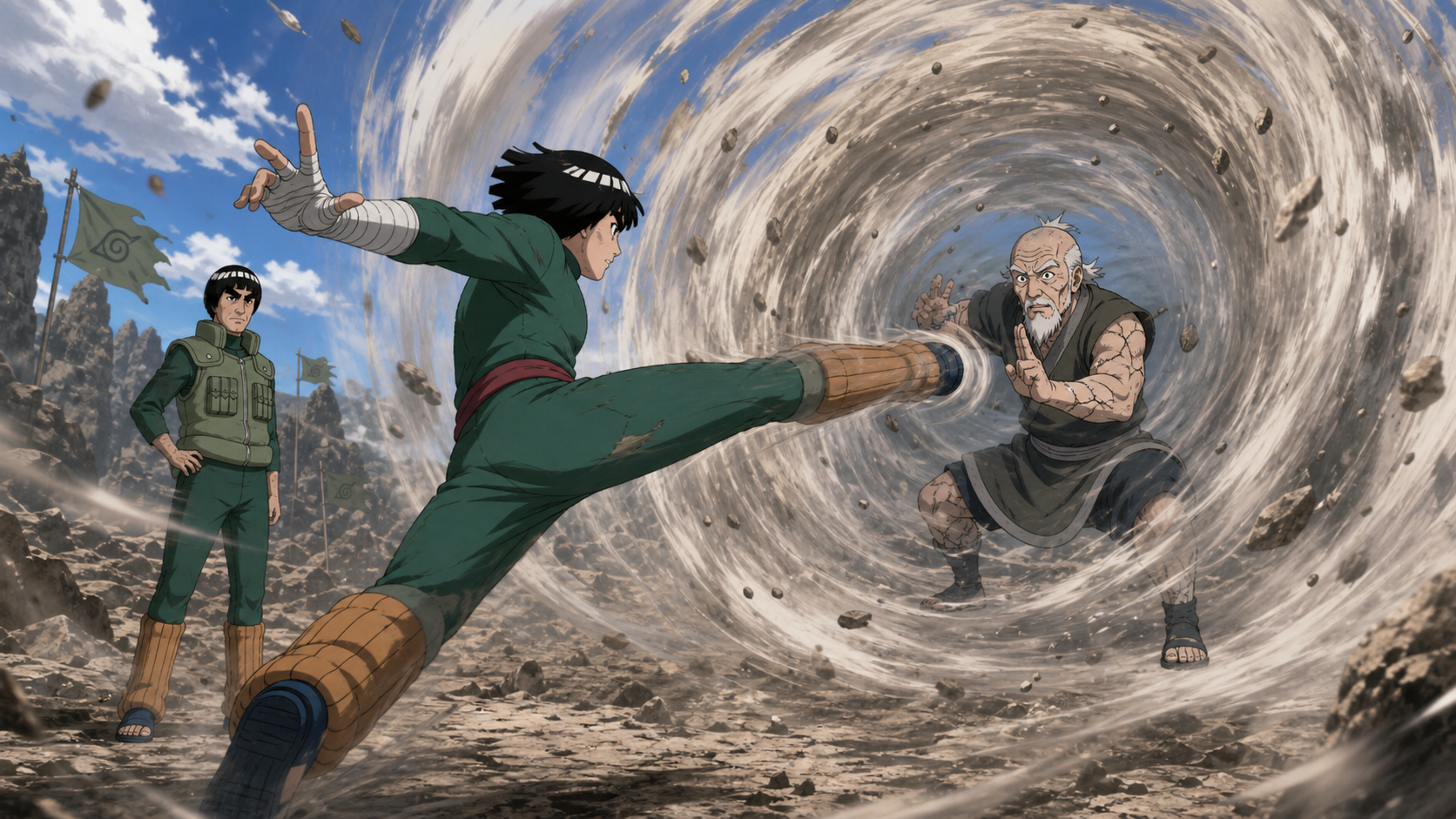
Lee enters the eye of a legendary taijutsu vortex and answers the teacher who once told him to abandon his future.
Bottom line
“The Old Master and the Dragon’s Eye” gives Rock Lee one of his rare Shippuden episodes by placing him against Master Chen, a legendary taijutsu specialist reanimated on the battlefield. Guy begins the fight out of admiration and quickly finds himself pressured by Leaf Dragon God. Lee recognizes Chen from childhood, when the old master dismissed his dream of becoming a ninja without ninjutsu or genjutsu. Years later, Lee counters the rotating wind around Chen's technique with One-Man Primary Lotus and proves that specialized training can become a complete path. Chen finally admits that fear shaped his judgment after a similar student died in war. The episode lands when mentorship means adaptation rather than gatekeeping, though Chen's grief does not excuse telling a disabled child to abandon his future.
The Third Division finds another Leaf legend
Allied forces searching for remaining enemies encounter Master Chen, a Konoha hero believed to have died during the Third Shinobi World War. Edo Tensei turns village history into an immediate threat.
The soldiers face a name they were taught to honor. Reverence can delay the practical work of restraint when the legend in front of them has no control over his body.
Guy arrives ready to test himself
Might Guy recognizes Chen as the ultimate taijutsu user and treats the meeting as a rare honor. His excitement reflects a lifetime devoted to physical technique.
The battlefield is still the wrong place for a friendly challenge. Chen warns that control prevents mercy, and every exchange risks the division positioned behind Guy.
Matching styles does not mean matching knowledge
Guy understands taijutsu at an elite level, but Chen brings a technique he has studied only through reputation. Shared discipline cannot replace specific preparation.
The fight becomes an argument for humility. A master can remain vulnerable when an opponent organizes familiar movement through an unfamiliar system.
Leaf Dragon God controls the space
Chen's signature technique creates a rotating wind formation that punishes direct entry. The apparent dragon is the visible edge of a larger vortex.
Raw speed and strong kicks cannot solve the structure. The defender must understand where the rotation begins, how pressure moves, and which point remains comparatively still.
Guy is forced onto defense
Guy enters expecting a demanding contest and discovers that Chen can dictate distance. The Third Division watches one of Konoha's strongest fighters lose ground.
That reversal creates urgency without diminishing Guy. Expertise includes recognizing when a technique has taken away the terms on which someone usually excels.
A messenger looks for reinforcement
One Allied shinobi escapes the immediate pressure and searches for help. Leaving the formation is risky, but staying inside an unwinnable exchange would only add bodies.
Calling reinforcement is not cowardice. A coordinated army should reward early escalation before admiration for a famous opponent becomes preventable loss.
Lee leaves his own recovery to help
The messenger finds Rock Lee resting near Sai, and Lee rushes toward Guy. Loyalty moves faster than caution even though his body has already been working through war.
Lee's history makes the urgency personal. The opponent threatening Guy is also the man whose rejection once challenged Lee's right to call himself a future ninja.
Recognition opens a childhood memory
Guy is surprised that Lee met someone officially dead before Lee was born. Lee explains that Chen had only staged his death and lived near the memorial built for him.
The false grave protected Chen from public life while allowing the village to preserve a clean heroic story. Neither version acknowledged the grief that drove him away.
Tenten finds the record of Chen
As children, Lee, Tenten, and Naruto learn about Chen's taijutsu reputation. The record describes a hero and master of Leaf Dragon God but treats his death as settled fact.
Archives often preserve outcomes while hiding the emotional conditions behind them. The children approach the grave expecting history and find a living person refusing that history.
Azami brings food to the grave
Chen's granddaughter Azami leaves rice balls at the memorial and insists that her grandfather is alive. Her routine holds family truth beside the village's official lie.
The arrangement asks a child to protect an adult's secret through repeated care. Azami deserves honesty and support, not responsibility for keeping Chen fed in hiding.
Naruto assumes Chen is exploiting her
When the old man appears for the food, Naruto believes he is tricking Azami. The conclusion is wrong, but the protective instinct makes sense because the setup looks like an adult using a child's devotion.
Naruto should ask before attacking. Care without investigation can turn a rescue impulse into disrespect toward the people supposedly being defended.
Lee asks Chen to teach him
Once Chen's identity is clear, Lee wants instruction from the most celebrated taijutsu specialist in Konoha history. The request comes from a child seeking evidence that his chosen path can lead somewhere.
Chen hears the absence of ninjutsu and genjutsu before he sees Lee's work. Diagnosis becomes destiny in his response.
Chen tells Lee to give up
Chen says Lee cannot become a proper ninja through taijutsu alone. The statement carries institutional authority because Chen embodies the exact discipline Lee hopes to master.
Adults often call exclusion realism when a system was built around one kind of ability. Chen offers no assessment, accommodation, alternate curriculum, or safer training route before closing the door.
The rejection repeats an older trauma
Chen once trained a student who also lacked ninjutsu and genjutsu. That student entered the Third Shinobi World War and died.
Chen turns one devastating loss into a universal rule. His fear is understandable, but protecting the next child by erasing the child's goal transfers grief instead of processing that grief.
A teacher can warn without foreclosing
Lee needed honest information about battlefield limits, teamwork, ranged attacks, medical risk, and the physical cost of the Eight Gates. None of those warnings require telling him that his life as a ninja is impossible.
Good teaching adapts objectives and builds safeguards. Gatekeeping abandons the student before evidence can develop.
Guy gives Lee a different model
Guy does not pretend determination makes every risk disappear. He trains Lee intensively, creates conditions around forbidden techniques, and ties his own responsibility to Lee's survival.
That devotion can become excessive, but the core difference matters. Guy sees an unusual learner and changes the teaching rather than demanding that the learner become typical.
Lee returns as evidence, not theory
On the battlefield, Lee no longer needs to debate whether a taijutsu-only ninja can exist. His record, survival, rank, and technique answer before the fight begins.
Chen still needs to see how Lee responds to Leaf Dragon God. Achievement does not make a legend surrender his assumptions without a concrete demonstration.
Guy makes room for Lee's answer
Guy could insist on finishing the fight himself. Instead, he recognizes that Lee has history with Chen and allows the student to take the central exchange.
Mentorship includes stepping aside when a learner is ready to answer an old wound through present competence.
Lee studies the vortex rather than overpowering the wind
Repeated attacks reveal that Leaf Dragon God behaves like a tornado. The rotating outer force is dangerous, while the Dragon's Eye at the center creates the technique's weakness.
Lee's breakthrough comes from observation. The episode validates intelligence inside physical practice rather than treating taijutsu as effort without analysis.
One-Man Primary Lotus is designed for this problem
Lee adapts Primary Lotus into a solo counter that enters the vortex and attacks its stable center. The technique answers Chen's rotation rather than merely adding more force.
Engineering a response over years shows what Chen failed to imagine. A limited toolkit can produce deep innovation when training focuses on relationships between movements.
The counter proves method, not human worth
Lee defeats Leaf Dragon God, but victory should not become the price of deserving respect. Children with disabilities should not need to surpass a legend before adults stop denying their goals.
The fight proves Chen's rule was wrong. Lee's human value existed before the proof.
Chen asks why Lee never quit
Chen cannot understand why injuries and rejection did not end the dream. Lee explains the period when surgery threatened both his career and his life.
Continuing was not simple optimism. Lee made a frightening medical decision with support, information, and Guy's promise that the risk would not belong to him alone.
Guy's promise changes Chen's understanding
Guy pledged his own life to Lee's operation and future. The promise is emotionally extreme, yet Chen recognizes the teacherly accountability he failed to provide his former student.
The lesson is not that teachers should die with students. Teachers should share responsibility for the risks their training and institutions create.
Chen remembers the student he lost
The war killed Chen's student after the young man pursued taijutsu specialization. Chen responded by staging his death and abandoning shinobi life.
His withdrawal shows trauma rather than indifference. The village celebrated a fallen hero without addressing a teacher destroyed by guilt.
Faking death avoided grief rather than resolving loss
Chen built a grave and lived beside the story that he was gone. Secrecy protected him from questions while trapping Azami inside the arrangement.
Withdrawal can be survival, but long-term isolation without care allowed fear to harden into doctrine about what students like Lee could never become.
Edo Tensei forces an unwanted return
Chen eventually died for real, only for Kabuto to summon him into another war. The man who left shinobi life because war took his student becomes a weapon in the same cycle.
The cruelty is precise. Kabuto makes trauma reenact the role Chen tried to escape.
Chen recognizes Lee and Guy as a different outcome
Lee's counter and Guy's support give Chen evidence that specialization can survive when teaching, adaptation, and shared responsibility surround the student.
That realization does not resurrect his lost pupil. Chen can stop using one death to declare every similar future impossible.
Sealing ends the forced battle
With Chen defeated and emotionally released, Allied sealing can end his service under Edo Tensei. The conclusion values containment over endless damage to an immortal body.
Lee wins the exchange without celebrating the destruction of a village elder. Respect and refusal coexist.
The anime-original episode repairs Lee's absence
Rock Lee receives limited central action through much of Shippuden despite the importance of his original-series arc. Episode 312 gives his growth a battlefield measure tailored to his identity.
The story is anime-original and optional for manga-only viewing. Lee fans receive a satisfying, if compressed, continuation of questions the main plot left quiet.
The disability framing still needs care
Naruto describes Lee through inability, determination, and exceptional compensation. That framework can inspire while implying disabled people earn inclusion only through extraordinary work.
Lee deserves accommodation, rest, and ordinary belonging alongside admiration. His body should not exist only as a test of how much pain willpower can overcome.
Chen mistakes one student’s death for a universal rule
He lost somebody he trained and converted grief into certainty that taijutsu alone could never be enough. The conclusion protects him from risking another attachment while sounding like professional wisdom.
A teacher can describe danger, limits, and likely outcomes. A teacher should not turn one tragedy into a verdict that every later student must accept before trying.
Lee hears the same rejection from a new authority
He already grew up being told that lacking ninjutsu and genjutsu made his dream impossible. Chen’s refusal arrives with the weight of a legendary taijutsu master, which makes the old wound sound officially confirmed.
The episode respects Lee by showing hurt without surrender. Persistence is not proof that rejection caused growth. Lee grew because Guy offered training, care, and a route forward.
Guy gives guidance without pretending risk vanished
He does not promise that effort guarantees every outcome. He believes Lee can build a shinobi life through the abilities available and commits himself to teaching the work required.
That is different from inspiration pasted over disability. Guy supplies methods, time, adaptation, and responsibility. Belief becomes useful because somebody helps turn belief into practice.
Tenten’s research changes the battlefield
She locates Chen’s record and helps connect the living opponent to an actual history. The information lets the division understand the technique, the teacher, and the emotional route beneath the attack.
Research is not background support waiting for a fighter to make it exciting. Accurate records prevent legends from becoming invincible rumors and give teammates questions worth asking.
Azami keeps a relationship alive through ordinary care
Bringing food to Chen’s grave shows memory through routine rather than a speech. Naruto initially reads the scene as exploitation because he lacks the context she carries.
His protective instinct needs a pause before accusation. Asking who somebody is and what the ritual means would protect Azami without turning her private grief into another emergency Naruto owns.
Leaf Dragon God controls space before hitting bodies
The rotating wind denies approach, disrupts footing, and forces every attacker to respond on Chen’s terms. More force applied from the outside strengthens the impression that no route exists.
Lee wins by studying the center and recognizing that a vortex has structure. The technique becomes solvable when he stops treating every visible wall of wind as the same problem.
Guy steps aside without making the moment about himself
He wants to test his strength against a famous master, yet he recognizes that Lee carries the specific answer and the deeper history. Giving space becomes part of teaching.
A mentor does not lose status when a student takes the decisive role. Guy’s success is visible in Lee’s judgment, not only in whether Guy lands the final blow.
The One-Man Primary Lotus is adaptation, not compensation
Lee shapes a familiar technique for a vortex whose center requires precision and commitment. The move does not imitate ninjutsu or apologize for what he cannot use.
He builds from taijutsu knowledge toward the exact problem in front of him. Disability-aware analysis should name that craft instead of treating every victory as miraculous proof that limits are imaginary.
Winning cannot become a test of human worth
Lee defeats Leaf Dragon God, which proves his method worked against this technique under these conditions. The result does not prove that only successful disabled people deserve belief.
He had worth when Chen rejected him, during training, and before the counter landed. Achievement can answer a technical claim without becoming permission to exist.
Chen’s false death abandoned other people’s grief
He withdrew after losing his student and allowed the village to believe he was gone. Avoidance protected him from questions while Azami and others built rituals around an absence they could not understand.
His pain deserves compassion. The people left behind also deserve an account of what his choice cost them.
Reanimation forces Chen into the relationship he fled
Kabuto returns his body, exposes his technique, and places him before living proof that his certainty was incomplete. The encounter produces insight through another violation.
The emotional result should not make Edo Tensei acceptable. Chen’s recognition matters because he claims one response inside captivity, not because coercion became therapeutic.
Sealing should honor the person resisting inside
Once Lee breaks the technique and Chen acknowledges the different path Guy created, endless attacks serve no purpose. The sealing team ends Kabuto’s use of him.
Reports should record Chen’s warnings, recognition, and release from forced combat. The final entry should not list him as an enemy defeated by Konoha without naming who controlled the battle.
Lee deserves stories where survival is not the punchline
This episode gives him analysis, history, technical innovation, and a mentor relationship with consequences. That attention should not remain an anime-original exception.
Lee can be funny without every appearance reducing his body or intensity to a gag. He is most compelling when effort meets specific craft and other people respect the labor involved.
RaeRae’s verdict
“The Old Master and the Dragon’s Eye” is a strong Rock Lee showcase because the victory comes from analysis, adaptation, and years of specific work. One-Man Primary Lotus answers Chen's tornado at the eye instead of trying to outmuscle the whole storm.
Chen's regret gives the conflict weight, but grief does not excuse his rejection. Guy's better lesson is simple: take the student's goal seriously, name the risks honestly, and change the teaching until a path becomes possible.
RaeRae’s call
Chen turned grief into a rule that told Lee to quit. Guy answered with training, responsibility, and belief sturdy enough to survive actual work. Lee breaks Leaf Dragon God by reading the vortex, not by pretending limits disappeared. The victory proves the method. Lee’s worth never needed the victory to become real.
The division should carry Chen’s lesson into future training without copying his despair. Taijutsu students need injury prevention, recovery time, adaptive technique design, and instructors who distinguish a genuine safety limit from a prediction about somebody’s entire life. Records should include failed attempts as well as celebrated counters so later students inherit knowledge instead of mythology. Lee’s success matters most when the system becomes less willing to discard the next child who learns differently from everyone else.
Episode details and viewing routes
- Official episode reference: Naruto Official episode guide
- Licensed episode route: Crunchyroll licensed episode page
What I am carrying forward
I am carrying forward Lee breaking Leaf Dragon God, Guy yielding space for his student, Chen confronting the fear beneath his certainty, and another reanimated Leaf shinobi released from forced service.
I am also carrying forward a standard for mentorship. A teacher's past loss can inform caution. That loss cannot become a gate locked against every child who arrives with the same difference.