
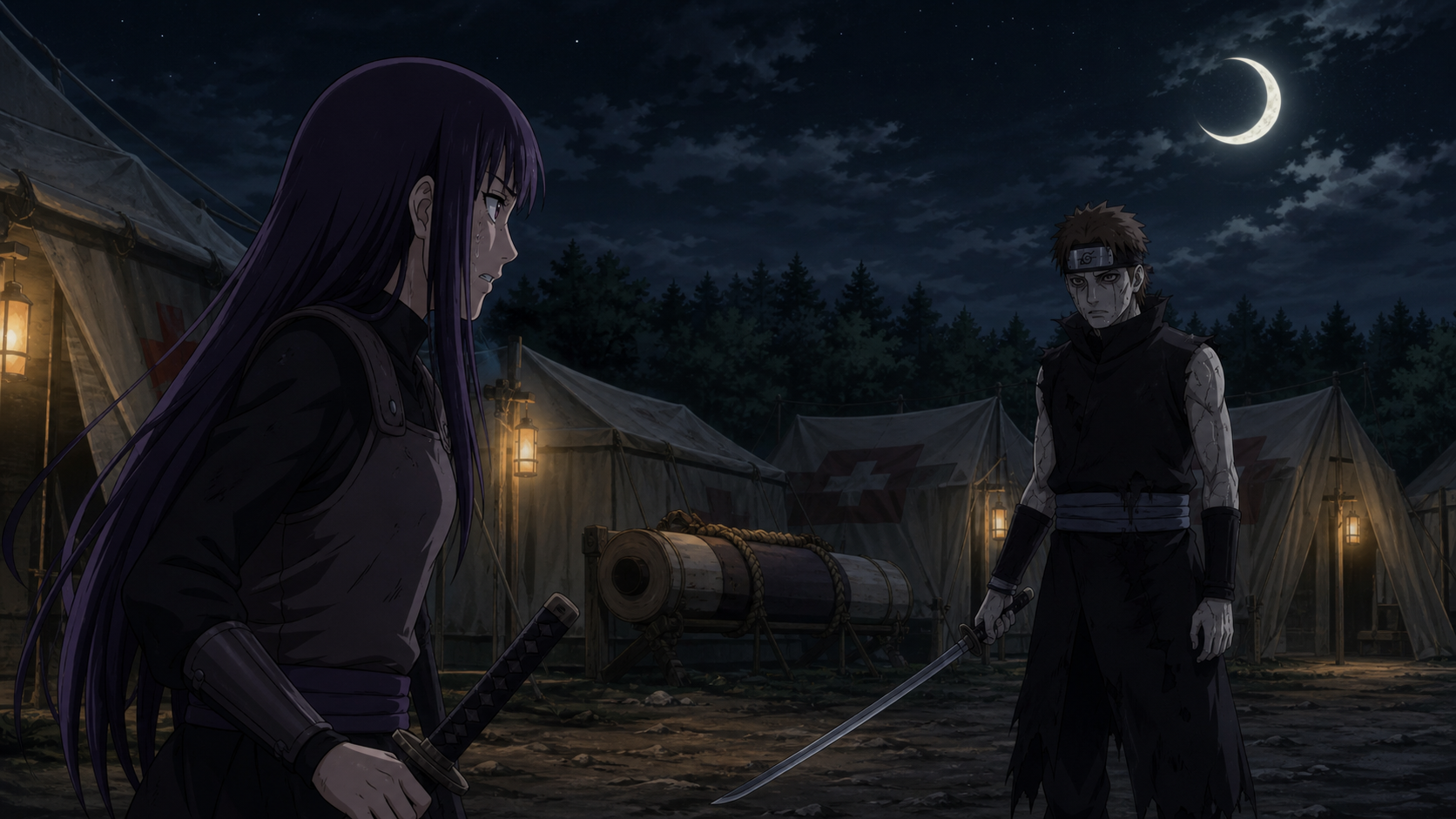
Fade into the Moonlight
Kabuto turns an old Konoha loss into a medical-camp raid, forcing Yugao to meet Hayate again beneath the moon.
Bottom line
“Fade into the Moonlight” turns the Fourth Shinobi World War into a violation of private grief. Kabuto reanimates Hayate Gekkō and sends him with two other dead shinobi to raid an Allied medical camp for a casualty scroll. The mission places Yūgao Uzuki, Hayate's former lover, between her duty to protect wounded people and the trauma that drove her from ANBU service. Episode 307 is the setup half of a two-part anime-original story, so no final duel or emotional resolution belongs here. What lands is the cruelty of forcing a medic to face a dead loved one as an enemy. What falters is the familiar Naruto habit of giving a woman's grief meaning mainly through the man she lost.
Three years earlier, Hayate hears too much
The episode returns to the conspiracy surrounding the Chūnin Exams. Hayate overhears Kabuto Yakushi and Baki discussing the planned attack on Konoha, then tries to carry that intelligence back to the village.
Hayate does exactly what a shinobi is expected to do. He recognizes a threat, avoids revealing what he learned, and attempts to warn his command. The system still leaves him isolated against a stronger opponent.
Baki kills Hayate before the warning arrives
Baki intercepts Hayate beneath the moon and kills him. Moonlight makes the scene beautiful without making the violence noble. A loyal intelligence officer disappears before his report can protect anyone.
That old death is not merely backstory for a romance. Hayate dies because espionage systems rely on individuals moving dangerous information through narrow chains. One missed handoff can erase both the witness and the warning.
Yūgao loses a partner without closure
Yūgao is left with Hayate's death rather than a goodbye, an explanation, or a choice. Her mourning begins inside a military institution that needs personnel to keep functioning even when private life collapses.
The episode understands that grief can change a person's relationship with work. Yūgao does not become less loyal to Konoha. She becomes unable to keep performing the role most closely tied to the night Hayate died.
Leaving ANBU is not cowardice
Yūgao transfers from ANBU to the Medical Corps because she can no longer wield a sword as before. That change should not be read as failure. A blade carries memory, muscle training, and the expectation that she can repeat the kind of encounter that took Hayate from her.
Moving into medical support lets Yūgao continue serving without pretending trauma vanished. Konoha benefits from her labor while offering no visible long-term care plan for the wound beneath that transfer.
The Medical Corps becomes her new front line
War medicine is not a retreat from danger. Medical teams stabilize casualties, manage identification, protect records, and make decisions while attacks continue around them.
Yūgao's new work also holds a cruel symmetry. She could not save Hayate, and now she helps keep other shinobi from becoming names on a casualty list. That purpose deserves recognition apart from any later return to combat.
Kabuto turns Hayate into a weapon
Kabuto uses Edo Tensei to bring Hayate back without consent. Hayate's skills, memories, body, and relationships become resources for somebody else's campaign.
Reanimation is especially vicious here because Hayate did not die in a famous duel. He died trying to expose a conspiracy linked to Kabuto. Kabuto now converts that victim into an instrument for another covert operation.
Two other reanimated shinobi complete the team
Hayate is joined by dead shinobi from Sunagakure and Kumogakure. Their nations matter less to Kabuto than the useful abilities their bodies retain.
The mixed team shows how Edo Tensei flattens identity. Old loyalties, village histories, and personal objections become inventory labels. The dead are deployed wherever their captor sees tactical value.
The target is an Allied medical camp
Kabuto sends the infiltration team toward a camp holding wounded members of the Allied Shinobi Forces. The location is vulnerable by design. Patients cannot evacuate quickly, medical workers are occupied, and stored information may be as valuable as physical supplies.
Attacking a hospital function is not clever warfare. The raid exploits wounded people and the workers obligated to remain beside them.
The casualty scroll makes bodies into intelligence
The infiltrators seek a scroll containing information about fallen shinobi and valuable remains. In Kabuto's hands, a record intended to manage casualties becomes a shopping list for bodies, bloodlines, and techniques.
The threat exposes a data-security failure as much as a perimeter failure. Names, locations, biological traits, and recovery status should never sit in one easily stolen record without access controls or a plan for destruction during evacuation.
Medical records need wartime protection
The Alliance has reason to track its dead and wounded. Families deserve identification, commanders need accurate numbers, and medical teams need continuity of care. None of those needs cancel privacy or security.
A safer system would divide operational records from biological details, restrict copies, log access, and assign a custodian who can remove or destroy sensitive material during an attack. Kabuto's methods make ordinary paperwork dangerous.
Sakura belongs in the camp's defense
Sakura Haruno's presence connects frontline medicine with active defense. She understands that protecting a patient includes protecting the space, supplies, and information surrounding that patient.
Her role should not be reduced to waiting for combat specialists. Sakura has the strength to stop intruders and the medical judgment to decide which patients can move. Those combined responsibilities make her one of the camp's most important leaders.
Hayate's infiltration skills fit the mission
Hayate served as a tokubetsu jōnin with swordsmanship and covert experience. Kabuto selects him because a quiet approach to a guarded camp requires more than raw force.
That tactical fit sharpens the violation. Skills Hayate used to protect Konoha now endanger its wounded. His professional identity becomes part of the trap laid for the people who remember him.
The moonlight carries a private memory
The title links Hayate's original death, his return, and Yūgao's unresolved mourning. Moonlight marks the visual space where a familiar silhouette can look alive before the truth becomes unavoidable.
“Fade into the Moonlight” also suggests a person being reduced to memory. Yūgao tried to build a life after Hayate disappeared from hers. Edo Tensei drags that fading image back into physical form without restoring the man she loved.
Yūgao recognizes what others only identify
For the Alliance, Hayate is a reanimated enemy with known techniques. For Yūgao, the same face holds shared routines, promises, and the exact shape of a loss she has spent years carrying.
Both readings are true, but they do not demand the same emotional cost. Commanders can brief a unit on Hayate's abilities. No briefing can make Yūgao's recognition neutral.
The request for her help has tactical logic
Yūgao knows Hayate's movement, sword style, habits, and likely choices better than most available shinobi. When the pursuit needs someone who can anticipate him, her name becomes an obvious operational answer.
Military logic can explain a request without making that request humane. Expertise gained through intimacy is not a resource command should claim without considering consent and psychological harm.
Her refusal deserves to be heard
Yūgao protests because Hayate was her lover. That response is neither irrational nor disloyal. She knows that the body approaching the camp is controlled by an enemy, and knowledge does not erase the shock of seeing him move and speak.
A responsible command would offer alternatives, provide a partner, set a limited role, and prepare an extraction plan. Pressuring her through duty risks turning grief into another weapon Kabuto gets to use.
Love does not create automatic combat fitness
Knowing someone closely can help predict a feint or recognize a signal. The same closeness can freeze judgment at the worst moment. Both possibilities must be assessed rather than romanticized.
Naruto stories often treat emotional connection as the final qualification for a confrontation. Yūgao's connection gives her insight, but trauma support and current readiness should decide whether she enters the fight.
Hayate remains a victim while posing a threat
The reanimated Hayate can endanger wounded people even though he did not choose the mission. Defenders may need to restrain or seal him. Moral clarity does not require pretending his controlled body is harmless.
The episode's strongest tension comes from holding two truths together. Hayate must be stopped, and Hayate is not accountable for Kabuto's orders.
Kabuto weaponizes recognition
Kabuto gains more than a skilled infiltrator. Familiar faces can delay attacks, fracture coordination, and force survivors to relive private loss in public.
Edo Tensei turns affection into a vulnerability map. Every person who loved the dead becomes a possible hesitation point, which makes emotional preparation part of battlefield defense rather than a soft concern for later.
Baki's place in the history complicates the alliance
Baki killed Hayate while serving Sunagakure's role in the Konoha invasion. Suna and Konoha later become allies, but political reconciliation does not automatically settle individual harm.
The episode brushes against a difficult question: what accountability followed Hayate's death once the villages cooperated? Yūgao is expected to defend the alliance while the story gives little space to what justice, apology, or truth looked like for her.
The war keeps reopening unfinished losses
The Fourth Shinobi World War does not only create new casualties. Kabuto's army returns old casualties to the battlefield, forcing survivors to revisit deaths from earlier conflicts and betrayals.
That structure denies ordinary mourning. A grave can no longer promise rest, and memory can no longer remain private when an enemy can make the dead walk toward a military objective.
The episode gives Yūgao overdue attention
Yūgao existed near the edges of the series as an ANBU member linked to Hayate. Episode 307 finally asks what his death cost her and how she continued afterward.
That attention is welcome because support characters carry consequences main plots often leave behind. Konoha's invasion ended as a major arc. Yūgao's life did not reset when the arc changed.
Yūgao still needs an identity beyond Hayate
Almost every important beat defines Yūgao through her dead lover: she mourns him, changes careers because of him, recognizes him, and may have to fight him. The story grants emotion while narrowing her world.
Her medical competence, friendships, ambitions, and judgment deserve equal weight. A woman is not made deep merely because a narrative gives her beautiful grief.
The setup works because the ending waits
Episode 307 should not resolve the confrontation. The raid, recognition, and demand placed on Yūgao establish a moral problem that needs more room than a quick battle can provide.
Stopping at that threshold lets the audience sit with her lack of a clean choice. Protecting the camp may require hurting Hayate's body. Refusing may place patients and colleagues at risk. Kabuto designed both outcomes to cause pain.
The anime-original material fits the war's premise
The manga does not supply this Hayate and Yūgao confrontation. As anime-original material, the story uses Edo Tensei to revisit a death the main narrative moved past.
The addition fits the war because Kabuto has already demonstrated that history is ammunition. The episode remains optional for a manga-only route, but character-focused viewers receive meaningful context for two recognizable Konoha shinobi.
The pacing repeats information too often
Flashbacks, explanations, and reaction shots make certain emotional facts unmistakable. Hayate died, Yūgao loved him, and facing him will hurt. The episode sometimes states those points after the visual language already communicated them.
A tighter edit could give more time to the medical camp's procedures, Yūgao's present-day work, or Hayate's resistance inside Edo Tensei control. Those details would deepen the conflict without changing the plot.
The violence needs no romantic glow
Moonlight, a lost couple, and crossed blades can turn suffering into a tragic romance image. The prettier the framing becomes, the more important the editorial boundary grows.
Hayate's murder was not destiny. Yūgao's trauma is not proof of perfect love. Kabuto's violation is not a gift that allows one last meeting. The story works when the reunion remains an assault on both people.
Hayate died because information had no protected route
He overheard a conspiracy, tried to carry the warning alone, and met Baki before the intelligence reached people who could act. His courage became a single point of failure.
Konoha should have offered silent alarms, dead drops, paired surveillance, and scheduled check-ins for exam security. Praising Hayate after death cannot substitute for asking why one injured tokubetsu jōnin carried the whole warning chain.
Yūgao’s grief was treated as a private staffing problem
She lost Hayate without a final conversation and left ANBU when continuing the same work became impossible. That decision is often read through whether she remained useful to combat.
Grief care should not depend on a shinobi proving immediate operational value. Reassignment to the Medical Corps can be honorable and necessary while still reflecting how little structured support the village offered.
The medical camp is not a softer battlefield
Patients, clinicians, records, supplies, and exhausted guards make the camp strategically valuable. Kabuto targets the place because harm there multiplies across every front.
Defense needs layered identity checks, protected evacuation lanes, duplicate records, and fighters assigned without blocking treatment. Calling the camp rear support does not move the danger away.
The casualty scroll turns death into exploitable data
The record may reveal names, abilities, injuries, unit losses, locations, and the condition of bodies Kabuto could use. Medical documentation becomes intelligence because the enemy treats people as available material.
Access should be divided, entries encrypted where possible, and copies stored separately. Families still deserve accurate records. Security cannot become an excuse to erase the dead from public accountability.
Yūgao recognizes Hayate as a person before a target
Other soldiers can identify a reanimated Leaf shinobi. She knows the movement, voice, habits, and moonlit memory attached to the body.
That knowledge may help predict him, but asking her to fight carries a cost. Expertise gained through love is not a free military resource. Command must explain the need and accept refusal without shaming her.
Love does not guarantee the safest matchup
A familiar person may reach the consciousness inside reanimation, or recognition may freeze the only fighter positioned to respond. Both outcomes are plausible.
The mission needs a partner who can intervene, a withdrawal signal, and a plan that does not depend on Yūgao killing Hayate to prove devotion. Emotional proximity should add options, not remove every boundary.
Hayate remains responsible for danger without becoming the villain
His body infiltrates a medical camp and threatens vulnerable people. The Allied force has to contain him even while acknowledging Kabuto controls the attack.
Accurate language protects both truths. Hayate is the immediate hazard, Kabuto is the author of the coercion, and sealing should aim to end the use of Hayate’s body with as little additional desecration as possible.
Baki’s alliance role needs an honest record
He killed Hayate while serving the Sand conspiracy during the Chūnin Exams, then entered an alliance where Konoha and Suna fight together. Political necessity does not close the personal case.
Yūgao deserves disclosure about Baki’s role and a process separate from battlefield command. She should not discover that history through rumor while being asked to defend the same alliance.
Reanimation makes unfinished mourning operational
Kabuto does not only revive strong techniques. He selects relationships, guilt, and missing closure that can delay the living at the exact moment speed matters.
Every unit should identify known ties to reanimated people and plan support before contact. Preparing for grief is not weakness. Preparing keeps the enemy from deciding when and how grief takes control.
Yūgao deserves a story after the moonlight
The episode finally gives her history and present responsibility, yet nearly every beat still points back to Hayate. She needs goals, friendships, competence, and choices that exist beyond being the woman who loved a dead man.
Facing him can be one chapter in her life. The encounter should not become the final definition of who she was before, during, and after the war.
RaeRae’s verdict
“Fade into the Moonlight” is a strong setup episode with a cruel, specific premise. Hayate's return connects the Chūnin Exam conspiracy to the present war, while the medical-camp raid shows that Kabuto values records and remains as much as battlefield victories.
Yūgao gives the story its real weight. Her transfer from ANBU reveals survival rather than weakness, and her refusal to face Hayate should be treated as informed self-knowledge. The episode loses ground whenever her identity shrinks to mourning alone, but the final pressure placed on her lands.
RaeRae’s call
Kabuto sends Hayate toward a medical camp because the stolen body carries infiltration skill and a living person’s grief. Yūgao’s recognition is tactically useful, but love does not make her automatically fit to fight him. Give her the truth, a partner, a withdrawal route, and the right to remain more than Hayate’s unfinished goodbye.
The camp needs a named defender who is not emotionally tied to Hayate. That person can protect Yūgao if recognition freezes her, preserve evidence if the seal succeeds, and keep patients moving while the confrontation unfolds. Backup does not question her courage. Backup acknowledges that Kabuto selected this body precisely because grief can interrupt even excellent training.
Episode details and viewing routes
- Official episode reference: Naruto Official episode guide
- Licensed episode route: Crunchyroll licensed episode page
What I am carrying forward
I am carrying forward Hayate under Edo Tensei control, the threatened casualty scroll, Sakura and the Medical Corps protecting vulnerable patients, and Yūgao being asked to use intimate knowledge against the person she lost.
I am also carrying forward the boundary Episode 307 establishes: recognition is not resolution. The next chapter must handle Yūgao's choice, Hayate's remaining agency, and the cost of their confrontation without pretending one moonlit battle can repair three years of grief.