
The Heart’s Eye
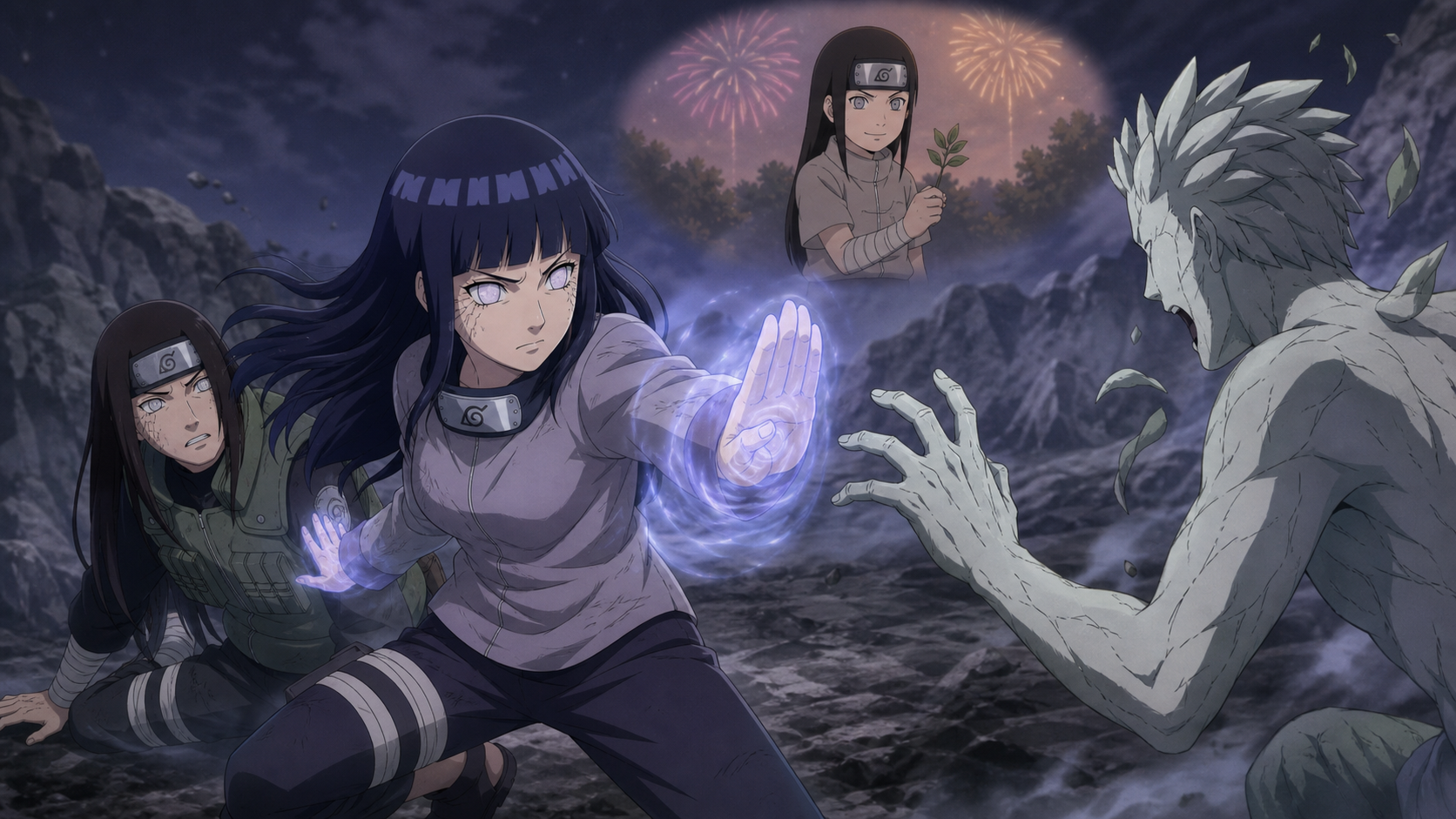
Hinata defends a recovering Neji from White Zetsu and remembers the childhood kindness that survived their Hyuga family conflict.
Bottom line
“The Heart’s Eye” gives Hinata and Neji a quiet repair story after three episodes built around the Sasuke Retrieval team. On the battlefield, Hinata protects a newly recovered Neji from White Zetsu and finally thanks him for a childhood kindness he never told her about. The flashback explains that harsh Hyūga training temporarily damaged Hinata's sight, leaving her unable to attend fireworks with friends. Neji, still carrying anger toward the main family, went into the forbidden Valley of Judgement with Naruto and Sakura to find an eye-medicine plant for her. The episode is anime-original and sometimes leans too hard on sentimental adventure logic, but the central point lands. Care existed between the cousins before either one knew how to speak across the branch-family wound.
Hinata protects Neji in the present
Neji has only just returned from the Underworld Transfer barrier when a White Zetsu clone attacks. Hinata steps between her cousin and the threat instead of assuming the stronger jōnin needs no protection.
The reversal matters because Neji spent years positioned as the Hyūga prodigy and Hinata as the failed heir. War strips that hierarchy down to a practical question: who can cover the next attack?
The official routes define the memory
Naruto Official catalogs Episode 306 as record `01_750`. Crunchyroll lists “The Heart’s Eye” under watch ID `GR09Q742R`, released March 28, 2013. Both summaries center Hinata defending Neji and remembering when he protected her after she temporarily lost her sight.
The episode is anime-original. The childhood incident adds relationship texture without rewriting manga canon. Fans can skip the story for adaptation-only viewing, while Hyūga fans receive a specific bridge between the cousins' hostile childhood and wartime trust.
The White Zetsu cleanup remains dangerous
The Alliance is eliminating scattered clones, but “cleanup” understates the risk. White Zetsu can copy allies, exploit exhaustion, and attack people who believe the main battle ended.
Neji's recent soul displacement makes him especially vulnerable. Recovery should include protected rest, chakra evaluation, and a partner assigned to watch for impostors rather than immediate return to unrestricted combat.
Hinata does not wait for permission to lead
Hinata recognizes the opening and acts. She does not ask whether Neji approves, apologize for standing in front, or frame protection as proof that she surpassed him.
That directness is growth. Younger Hinata often measured every action against family judgment. War-era Hinata makes the needed choice and explains the emotional history later.
The memory begins with Hyūga training
Hiashi leaves the village and places Neji in charge of Hinata's practice. The arrangement carries every tension in the clan: main-family authority, branch-family labor, talent comparison, and a girl trained under the eyes of a cousin whose father died for her household.
Neither child created that system. Both have to live inside roles adults designed, and training becomes one more place where grief and rank enter the room without being named.
Hinata pushes her Byakugan too far
Grueling practice strains Hinata's eyes until a doctor orders bed rest. The injury gives the dōjutsu a physical cost the series often forgets once battles become larger.
Training through pain is not automatically discipline. An heir who cannot admit visual damage without feeling weak may continue until temporary strain becomes permanent harm. The adults need monitoring standards, not praise for endurance after the injury.
Neji carries responsibility without authority
Neji supervised the training, so Hinata's condition feels like his failure even though the clan created the expectations. He can assign drills but cannot rewrite the main family's standards or openly discuss the resentment shaping his behavior.
That position mirrors the branch-family trap. Responsibility flows downward. Authority and protection remain above him.
Missing fireworks becomes the human problem
Hinata had planned to attend fireworks with friends. Temporary blindness transforms a simple childhood promise into another experience she may quietly surrender.
The stakes are small compared with war, which makes them useful. Children need ordinary joys. A clan that treats every missed celebration as irrelevant teaches them that duty deserves the whole life.
Neji learns about the eye-medicine plant
A rare plant said to help eye injuries grows in the Valley of Judgement. The location is dangerous and restricted, and Neji receives warnings against going.
The remedy creates hope without certainty. A responsible response would involve an adult medical team confirming the plant, dosage, risks, and legal access. Neji chooses action because the household has given him guilt and no meaningful route to repair.
His decision is caring and reckless
Neji wants Hinata to see the fireworks. That wish reveals affection he cannot express comfortably inside their damaged relationship.
Entering a forbidden valley could injure him, Naruto, Sakura, or the creatures living there. Love does not make an unsafe plan safe. The episode works better when viewers hold both truths at once.
Naruto joins because Neji asks through action
Naruto accompanies Neji despite their complicated history. Their Chūnin Exam fight challenged Neji's fatalism, but friendship does not instantly erase what happened between them.
The plant mission shows a more ordinary stage of repair. Naruto follows because somebody needs help, not because the story pauses for a grand declaration about destiny.
Sakura brings medical judgment
Sakura's presence is essential because the mission concerns an eye injury and an unknown medicinal plant. She can evaluate symptoms and challenge the assumption that finding a rare herb automatically creates a safe cure.
The story could use her expertise more aggressively. Too often Sakura joins a dangerous excursion while boys control the emotional objective. A trained medic should have real authority over whether the proposed treatment reaches Hinata.
The Valley of Judgement hides faceless inhabitants
Naruto, Sakura, and Neji encounter humanoid valley dwellers without visible faces. Their design turns the environment into a warning about perception, identity, and outsiders entering a place they do not understand.
The creatures are not simply obstacles guarding loot. The shinobi entered their home for a resource. The episode needs that ethical boundary because calling a plant medicinal does not grant Konoha ownership.
The battle becomes attrition
The group fights back, but more valley inhabitants continue arriving. Superior technique cannot solve a conflict where the defenders know the terrain and the intruders lack a clear exit.
Neji's original goal risks becoming the excuse that keeps everyone in danger. A caring mission needs a stop condition before persistence turns into entitlement.
Kakashi and Guy arrive before disaster
Kakashi and Might Guy intervene and drive the creatures away. Their arrival confirms that adults knew the valley posed a serious threat and had reason to monitor the area.
The rescue also exposes the supervision failure. Three young shinobi reached a forbidden zone before responsible adults stopped them. Arriving in time does not make the access controls adequate.
Orochimaru gives the plant another danger
The adults worry that Orochimaru could use the plant in research involving dōjutsu. A remedy for eye strain could become material for experimentation under somebody who treats bodies and bloodlines as inventory.
That context explains the valley's security without turning the inhabitants into villains. Protection of medical knowledge can be necessary when the likely thief is Orochimaru. Konoha still needs consent and stewardship rather than secret extraction.
Neji chooses Hinata over completing the quest
The group withdraws rather than escalating the fight for the plant. Neji accepts that Hinata would not want people harmed so she could attend one celebration.
That choice completes the kindness more honestly than returning with the herb. He learns to protect her values, not only the outcome he imagined for her.
Hinata sees the fireworks another way
Hinata experiences the celebration from a protected distance while recovering. The moment is bittersweet rather than a magical cure.
She misses the version she planned, but care gives her another route to the night. Ordinary accommodation can matter even when the original loss remains.
Neji never asks for credit
Naruto and Sakura later tell Hinata how far Neji went. He did not use the mission to demand gratitude or repair his reputation with the main family.
Silence can be generous, but silence also keeps the cousins from understanding each other. The Hyūga household trained both children to hide feelings that might challenge rank.
Hinata finally thanks him
In the present, Hinata tells Neji she knows what he tried to do and has wanted to thank him. The timing matters because she has just protected him in return.
Gratitude becomes reciprocal rather than hierarchical. Neither cousin owns the permanent role of savior, prodigy, burden, or failed heir.
The branch-family wound remains larger than one memory
One childhood kindness cannot resolve the Caged Bird Seal, Hizashi's death, Hiashi's choices, or the clan system that turned cousins into political categories.
The episode should not ask affection to erase structural harm. The memory proves that Neji and Hinata cared beneath the conflict. Repair still requires truth and institutional change.
The title points beyond physical sight
Hinata temporarily loses ordinary vision, yet Neji begins seeing what she values. In the present, Hinata reads his exhaustion before pride can hide the risk.
“The Heart’s Eye” works when the phrase means attention rather than mystical purity. Caring requires noticing the person instead of the role assigned by the clan.
The filler adventure stretches credibility
The forbidden valley, rare herb, faceless defenders, and perfectly timed adult rescue create a self-contained side quest with obvious anime-original seams.
The relationship material is stronger than the adventure mechanics. A smaller story about Neji arranging a safe view of the fireworks could communicate the same care without turning a medicinal plant into a dangerous retrieval mission.
Hinata deserves more present-tense action
Most of the runtime explains what Neji once did for Hinata. The opening and closing let her protect him, but the flashback again positions her as the person waiting at home while others act.
Her gratitude lands. The episode would land harder if the present battlefield gave Hinata a longer tactical sequence showing how her Byakugan and Gentle Fist protect a recovering partner.
Neji deserves life beyond sacrifice
The memory values him for seeking medicine, accepting risk, and protecting Hinata's happiness. Those qualities are real, but the series repeatedly connects Neji's worth to what he will suffer for others.
On a current rewind, that pattern carries a heavy shadow. Care should include Neji receiving protection, rest, choice, and a future that is not measured only by sacrifice.
The Japanese performances need quiet familiarity
The licensed route confirms Japanese audio and the returning cast. The present conversation between Hinata and Neji needs restraint because both characters have spent years saying less than they feel.
I can support the dialogue and scene structure. I am not inventing exact claims about vocal breath, pitch, or pauses without a fresh lawful performance review.
Hinata protects Neji without reversing their old hierarchy
She stands between his recovering body and White Zetsu because she can act, not because the main family has finally granted her permission to repay a branch-family debt.
The scene works when care remains personal and political at once. Hinata loves Neji, and the Hyūga structure still trained him to believe protecting her body could become his assigned death.
The present needs more than a memory of Hinata’s courage
The flashback explains the bond, but the war gives adult Hinata an immediate command problem. She has to identify threats, protect a patient, coordinate allies, and conserve her own chakra.
Her competence should remain visible after the childhood story ends. A woman does not become developed merely because somebody remembers that she once inspired care.
Losing the Byakugan threatens identity as well as sight
Young Hinata overuses the ability until her vision fails. In a clan that ties worth, succession, and combat usefulness to inherited eyes, temporary blindness can feel like personal erasure.
Medical care should name both injuries. Restoring vision matters, and so does protecting a child from adults who may treat recovery time as evidence that she failed the clan.
Neji is given responsibility without safe authority
He knows Hinata needs rest and understands the family expectations surrounding her, yet he remains a branch child whose choices can be punished by the same household demanding protection.
Fetching medicine becomes one of the few ways he can act directly. The recklessness grows from care constrained by hierarchy, not from a child lacking judgment.
The fireworks are not a trivial reason to leave
Hinata’s absence from the celebration reveals what illness and clan pressure remove from ordinary childhood. Neji understands that missing the moment hurts even when nobody calls the loss strategic.
Care includes pleasure, belonging, and memories that do not exist to improve combat. The medicine quest matters because he wants her world to contain more than training and recovery.
Naruto follows the request Neji cannot comfortably speak
Young Neji does not deliver a warm explanation of his concern. Naruto recognizes purpose through action and joins without requiring him to perform vulnerability first.
That response fits their early relationship. Trust can begin before polished intimacy when one child sees another carrying too much and decides the burden should not remain private.
Sakura supplies the medical boundary the boys need
Neji and Naruto can reach the plant, but neither should decide dosage, preparation, or whether Hinata’s condition permits use. Sakura brings knowledge that keeps urgency from becoming another injury.
Her role is not support in the decorative sense. Medical judgment changes what counts as a successful retrieval and prevents care from becoming a dangerous guess.
The Valley of Judgement is a strange detour with a useful point
The faceless inhabitants stretch the credibility of a simple medicine trip, and the prolonged battle feels larger than the emotional story requires. The detour still tests whether Neji will prioritize the mission object over Hinata’s immediate safety.
He chooses the person. That choice gives the adventure meaning even when the route feels built to fill airtime.
Orochimaru turns medicine into contested access
His interest adds danger to a resource that should exist for healing. Rare plants become vulnerable when powerful people can claim territory, information, or specimens without answering to the patients who need them.
Konoha should cultivate the medicine, document safe preparation, and avoid sending children into hidden valleys for replacement supply. A heroic retrieval is evidence of a broken system.
Neji’s quiet care should not become proof he accepted the branch role
He protects Hinata, finds medicine, and refuses credit because affection is real. None of those actions mean the Hyūga seal or main-family authority became fair.
Voluntary love must remain distinct from assigned sacrifice. The clan cannot point to his devotion as evidence that coercive duty merely formalized what he wanted.
Hinata’s gratitude arrives without demanding absolution
She finally thanks Neji for a kindness hidden under years of conflict and silence. The acknowledgment returns a piece of history to both of them.
Gratitude does not resolve every wound between their family branches. The scene succeeds because a specific act receives a specific answer without pretending one tender memory repairs an institution.
The heart’s eye is learned attention, not mystical purity
Hinata understands Neji’s care through what he did when words and physical vision failed. The title works best as attention to patterns, choices, and relationships.
Calling the insight pure intuition would flatten the evidence. She knows him because she remembers how he moved through danger, what he refused to claim, and who he protected.
White Zetsu cleanup still requires full war discipline
The major fronts create a false sense that smaller attacks are leftovers. One infiltrator reaching an injured specialist can kill a person the army already spent enormous resources saving.
Recovery zones need identity checks, layered guards, evacuation routes, and staff who can fight without abandoning patients. Cleanup is not the safe part of war.
Neji deserves a future larger than being remembered kindly
The episode emphasizes how often he protects other people and how rarely he asks to be seen. That history should lead toward care for him, not make later sacrifice feel inevitable.
Friends who understand his quiet habits must learn to ask what he needs while he is alive. Appreciation delivered only after loss becomes another way of consuming his devotion.
RaeRae’s verdict
“The Heart’s Eye” is a sweet Hyūga cousin story wrapped in a side quest that tries too hard. Neji's decision to help Hinata reveals care beneath family resentment, while his eventual retreat respects her values more than obtaining the plant would.
Hinata protecting him in the present is the better image. Their relationship becomes mutual for one quiet battlefield moment, and neither cousin has to stay trapped in the role the clan assigned.
RaeRae’s call
Hinata protects Neji in the present and finally names the care he gave her as a child. The memory is tender because the Hyūga system made tenderness difficult, not because the family hierarchy was secretly loving. Neji chose her. That choice belongs to him, not to the branch duty imposed on him.
The present-day medical record should ask what the soul-transfer ordeal changed in practice. Neji may wake with visual strain, chakra disruption, nightmares, or a reflex to hide weakness from the people he protects. Hinata should not become his only monitor because she understands him. Medics, teammates, and clan leadership must share work, respect his answers, and stop treating silence as proof that recovery is complete.
Episode details and viewing routes
- Official episode reference: Naruto Official episode guide
- Licensed episode route: Crunchyroll licensed episode page
What I am carrying forward
I am carrying forward Hinata and Neji fighting side by side, White Zetsu remnants exploiting recovery, the physical cost of Byakugan overuse, and a childhood kindness finally acknowledged.
I am also carrying forward the unfinished Hyūga question: private love can help two people survive a harmful system, but private love does not reform that system by itself.