
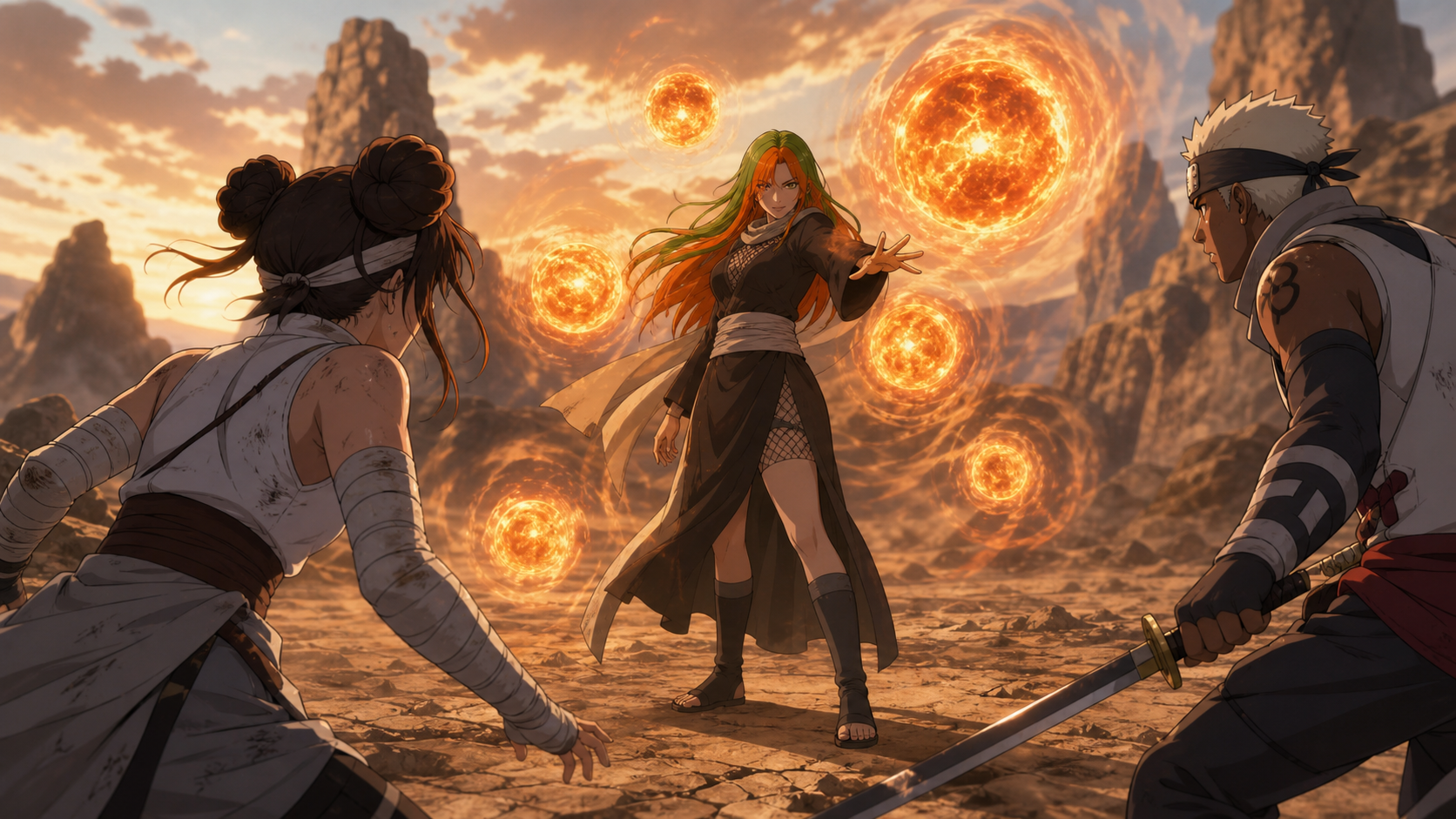
User of the Scorch Style: Pakura of the Sand!
Maki faces her reanimated teacher and the buried political betrayal behind Sunagakure’s polished hero story.
Bottom line
“User of the Scorch Style: Pakura of the Sand!” turns a battlefield reunion into an argument about who controls a hero’s memory. Maki remembers Pakura as the teacher who shaped her confidence and technique. Sunagakure preserved Pakura as a celebrated martyr while hiding the political bargain that sent her to die. Reanimation forces the buried truth into public view. Pakura’s Scorch Style creates the immediate danger, but the sharper wound comes from learning that a village can praise a woman after treating her life as negotiable.
The Allied Forces meet somebody Maki still loves
Omoi, Maki, and their unit face reanimated shinobi who arrive carrying reputations, personal histories, and techniques built to kill quickly. Maki recognizes Pakura before strategy can create emotional distance. Her former teacher is not an anonymous enemy wearing a familiar face. Pakura taught her directly, encouraged her growth, and became proof that a Sand kunoichi could earn public honor through skill.
That recognition changes the assignment. A standard sealing operation becomes a confrontation between a student and the official story surrounding her mentor. Maki must survive Pakura’s technique while processing evidence that the village narrative never gave her the whole truth. The war demands action before grief has time to settle.
The official routes establish the reunion
Naruto Official catalogs the story as the next Seven Ninja Swordsmen record after “Helmet Splitter: Jinin Akebino!” Crunchyroll lists “User of the Scorch Style: Pakura of the Sand!” as Shippuden Episode 285 under watch ID `GY09Q702Y`, released October 25, 2012. Both summaries identify Maki’s recognition as the emotional hinge: a Sand hero returns as an enemy, and the student who admired her must help stop her.
The episode number differs from the franchise-wide number used by Naruto Official because that archive counts across the broader Naruto television run. The story identity remains exact across both routes. That source pairing matters because readers deserve a verifiable record, especially when an episode depends so heavily on what institutions choose to record or conceal.
Pakura’s heat makes distance feel unsafe
Scorch Style is frightening because ordinary defensive instincts offer little comfort. Pakura surrounds herself with superheated spheres that can drain moisture from a body in moments. A fighter who misjudges the range does not receive a manageable injury or a second chance. The victim becomes a warning to everyone still standing.
The technique also fits Pakura’s history. Sunagakure presented her as a blazing symbol of strength, then used that symbol to cover a colder political calculation. Her power made her visible enough for public celebration and valuable enough for leaders to spend. The village loved the image while failing the woman.
Maki’s memory collides with the public version
Maki remembers lessons, patience, and personal attention. Those memories cannot be dismissed as propaganda because Pakura genuinely changed her student’s life. The betrayal rests beside that truth rather than erasing the relationship. Pakura was a hero to Maki, a formidable shinobi to the Sand, and a disposable piece inside a secret agreement.
That combination explains why Maki cannot simply condemn her mentor. Pakura’s anger has a legitimate source even when reanimation directs that anger toward living soldiers. Maki has to protect her comrades without pretending the village deserves uncomplicated loyalty. Her response becomes stronger because she refuses the easy lie.
A hero title cannot repay a stolen future
Public honor often arrives after institutions have already taken everything useful from the person being honored. Pakura’s title gave the Sand a clean story: a brave kunoichi died serving her village. The hidden account is uglier. Leaders sent her into a trap as part of diplomacy with the Hidden Mist, then converted the loss into patriotic memory.
A monument, title, or lesson-book paragraph cannot restore the choices she never received. Those honors can preserve a name, but preservation without truth protects the institution first. Pakura’s return exposes that imbalance. The dead hero can finally answer the story built around her absence.
Maki refuses to surrender her teacher to betrayal
Maki’s strongest move is not a superior jutsu. She speaks to the person inside the reanimated weapon. Her appeal does not deny what happened or demand immediate forgiveness. Maki reminds Pakura that her teaching produced living evidence of care, discipline, and courage.
The distinction matters. Village leaders betrayed Pakura, but they do not own every consequence of her life. Maki carries something the officials did not create and cannot rewrite: a student’s memory of being seen, trained, and trusted. That bond offers Pakura another legacy beyond martyrdom and vengeance.
Omoi turns anxiety into battlefield awareness
Omoi’s habit of imagining worst outcomes can sound comic in quieter scenes. Here, that mental pattern becomes useful. Reanimated specialists create cascading risk, and someone has to notice how quickly one failed formation can become several deaths. Omoi’s caution keeps the group attentive to angles, timing, and escape space.
He also provides emotional contrast without stealing Maki’s story. Omoi does not possess her history with Pakura, so his job is to respect the danger, support the sealing objective, and help living comrades survive the conversation. Support work often means recognizing whose voice has the best chance of reaching the person across the field.
The episode separates forgiveness from accountability
Pakura does not owe Sunagakure a clean absolution. Maki’s love for her teacher does not cancel the village’s deception. The episode works because emotional release and institutional accountability remain separate questions. Pakura can resist Kabuto’s control for her student without declaring the betrayal acceptable.
That separation protects the scene from cheap reconciliation. Maki offers proof that Pakura’s life meant more than the manner of her death. She does not claim that meaning excuses the leaders responsible. Healing begins with fuller truth, not with pressure on the harmed person to make everyone comfortable.
Reanimation weaponizes unfinished grief
Kabuto’s technique gains power from relationships that never received closure. A dead shinobi returns with memories intact but bodily control compromised. Former students and comrades must fight somebody they mourned while the resurrected person watches their own hands threaten people they once protected.
Pakura’s case adds political betrayal to that cruelty. Her death was already manipulated once. Reanimation manipulates her body again, turning a woman denied agency in life into a weapon after death. Maki’s appeal becomes an act of restoration because she addresses Pakura as a person rather than a resource.
Women’s mentorship becomes the real inheritance
Naruto often frames inheritance through fathers, masters, clans, and male rivals. Maki and Pakura offer a quieter but necessary line of transmission between women. Pakura’s instruction lives through Maki’s competence, values, and willingness to speak when silence would protect the village’s reputation.
The relationship deserves more than a tragic label. A mentor does not only hand down techniques. She gives a student permission to imagine a larger future. Maki’s refusal to abandon Pakura shows that the permission endured even after the official story tried to close the subject.
Sand leadership should preserve the complete record
After the battle, Sunagakure owes more than another heroic summary. The village should document who authorized Pakura’s mission, what diplomatic objective justified the deception, which leaders knew the likely outcome, and how the official account was produced. A sealed archive would repeat the original harm.
Maki should not carry the entire burden of correction. Historians, mission administrators, veterans, and surviving officials all have responsibilities. A complete memorial would include Pakura’s achievements, her teaching, the betrayal, and the political context without turning any one part into decoration.
A student should not have to prove a mentor was human
Maki enters the episode forced to defend a basic truth: Pakura was more than a weapon or symbol. Institutions frequently leave this labor to the people closest to the harmed person. Those witnesses must supply memories, explain context, and argue against convenient simplification while managing their own grief.
The Allied Forces can respond better by documenting testimony as a shared duty. Maki’s account should be supported, verified, and preserved rather than consumed as a dramatic battlefield moment. Care continues after the sealing succeeds.
The sealing corps needs emotional preparation too
Technical readiness alone cannot prepare shinobi for reanimated teachers, parents, partners, or friends. Units need protocols for recognition, protected communication, witness rotation, and recovery after contact. A fighter who freezes upon seeing a loved one is not weak. The mission has encountered a predictable human response.
Episode 284 showed Sai needing protection while emotion strengthened his sealing work. Episode 285 extends that lesson. Emotional knowledge is operational knowledge. Commanders who ignore relationships give Kabuto an advantage before the first technique lands.
Pakura’s legacy belongs partly to Pakura
Neither Sunagakure nor Maki should define Pakura alone. The village created a public hero, and Maki preserves a beloved teacher, but Pakura’s anger speaks for the part of her identity both stories could soften. She wanted recognition without deception and service without disposability.
Allowing that anger to remain visible honors her more fully than polishing her into an uncomplicated saint. A complete legacy includes generosity, lethal skill, wounded trust, mentorship, and resistance. Contradiction is not disrespect. Contradiction is evidence that a person lived beyond the role assigned to her.
Maki wins by keeping memory specific
Propaganda relies on broad labels because “hero,” “traitor,” and “sacrifice” can hide uncomfortable details. Maki answers with specifics: Pakura trained her, believed in her, and left methods that still guide her choices. Specific memory is harder to appropriate.
That is why the emotional appeal reaches deeper than a speech about village loyalty. Maki does not ask Pakura to return to the institution that betrayed her. She asks her to recognize the student standing in front of her. The bond has evidence, and that evidence survives official revision.
The battle exposes the cost of secret diplomacy
Villages often defend covert bargains as necessary protection for the many. Pakura’s story asks who gets selected to absorb that necessity. The answer is rarely random. A highly capable operative can become expendable precisely because leaders believe her death will purchase stability and her reputation will contain public anger.
Any system that claims necessity must still record responsibility. Secret diplomacy without later accountability invites repetition. The next talented shinobi becomes another asset whose loyalty is praised until leaders decide her life is the cheapest payment available.
What the next episode must carry forward
Maki cannot leave this encounter with only private closure. She now knows enough to question the official history and enough to demand a public correction. Her comrades also witnessed the gap between Pakura’s reputation and her treatment. Their testimony can keep the truth from returning to a locked room.
Pakura’s resistance should also influence Allied planning. Reanimated shinobi can sometimes reclaim moments of agency when living relationships reach them. Commanders should protect those conversations without romanticizing the risk. A personal appeal is not guaranteed, but dismissing every resurrected enemy as unreachable wastes knowledge and humanity.
The Sand made Pakura useful twice by controlling the story
First, leaders used her body in a diplomatic bargain. After death, they used her reputation to present sacrifice as willing service. The second use protected the first from scrutiny.
That pattern matters because propaganda does not always invent heroism. Pakura was brave, skilled, and important. The lie entered when officials used those truths to hide the choice they denied her. Praise became camouflage for state violence.
Maki inherits skill and a duty nobody assigned
Pakura trained Maki to survive, think, and imagine herself as a capable Sand kunoichi. When the concealed betrayal emerges, Maki also inherits the burden of correcting adults who built the official record.
A student should be allowed to grieve without becoming archivist, investigator, and public advocate. Maki accepts the work because silence would abandon Pakura again, not because the village had a right to outsource accountability to her love.
Teacher and student do not need uncomplicated memories
Maki can cherish Pakura’s instruction and fear the woman attacking her. Pakura can care about Maki and remain furious at the village whose uniform Maki still wears. Neither feeling cancels the other.
The reunion gains power from refusing emotional tidiness. Loyalty becomes mature when Maki can hold gratitude and accusation together. Pakura becomes more human when tenderness does not require immediate forgiveness or erase the lethal force Kabuto is pushing through her hands.
Scorch Style makes betrayal visible on the body
Pakura’s heat does not leave a clean heroic wound. Moisture disappears, bodies collapse, and distance becomes a calculation with no generous margin. The technique makes power terrifyingly intimate despite operating through floating spheres.
That physical severity mirrors the political harm around her. Sunagakure drained a life of future choices, then preserved the empty outline as a symbol. The episode does not need to state the parallel for the image to carry it.
Kabuto benefits from every village secret
Edo Tensei supplies bodies and compulsion. Hidden betrayals supply anger, confusion, and emotional delay among the living. Each institution that buried misconduct unknowingly prepared a pressure point Kabuto can exploit.
The alliance cannot seal its way out of that vulnerability forever. Truth-telling becomes war preparation. Soldiers who know the full history may still grieve, but they are less likely to discover institutional treachery while a revived teacher is already attacking.
Omoi’s anxiety can protect without directing Maki’s grief
He notices dangerous branches quickly and helps the group prepare for catastrophe. He does not possess the relationship at the center of the field. Support means keeping Maki alive and giving her room to speak, not explaining what she should feel about Pakura.
Omoi’s best contribution is disciplined flank awareness. He carries immediate risk so Maki can address the history only her voice can reach.
Pakura’s resistance is agency and not absolution
If Maki reaches her, Pakura may interrupt Kabuto’s control or redirect an attack. That act belongs to her relationship with a student. It does not certify Sunagakure as forgiven.
Institutions love interpreting one generous choice by a harmed person as closure for everyone. The episode should resist that convenience. Pakura can protect Maki while still condemning the leaders who traded her life. Compassion toward one person does not settle a state’s debt.
A memorial without the betrayal would continue the betrayal
Future students deserve to know Pakura’s technique, service, mentorship, and death. They also deserve the name of the policy and decision chain that sent her into the trap.
Complete history is not disrespect toward the village. Hiding the truth teaches leaders that patriotism can absorb any abuse once a monument is attractive enough. A better memorial makes institutional failure visible so loyalty no longer requires ignorance.
The alliance needs a protocol for reanimated relationships
Maki should not have to decide alone whether speaking is tactically safe. Units need cover positions, time limits, sealing readiness, and signals for when personal contact changes the revived person’s control.
That structure respects emotion without romanticizing it. Some appeals will fail. Some will create one useful second. Command should protect both possibilities and ensure the person speaking is not blamed for a technique designed to weaponize unfinished love.
Women’s mentorship deserves history beyond tragedy
Pakura should not exist only as the betrayed woman who motivates Maki. Her instruction, standards, humor, corrections, and expectations shaped a student before politics arranged the ending.
The episode offers pieces of that life, and RaeRae wants the archive to keep them. A woman’s legacy should contain the craft she taught and the community she built, not merely the violence men in authority committed against her.
Sunagakure’s reform has to include records and power
Reform also asks who can authorize covert sacrifice, what review follows classified missions, how families receive truth, and whether lower-ranked shinobi can challenge an order designed to erase them.
Transparency without changed authority becomes another performance. Maki’s testimony should reach policy, training, and memorial practice. Pakura deserves more than a truthful paragraph placed inside the same system that made her disposable.
Maki protects the village by refusing its cleanest lie
Silence might preserve morale. Maki’s insistence on complexity is therefore protective.
She does not weaken Sunagakure by naming harm. She gives the village a chance to become worthy of the loyalty it demands. Accountability is not the opposite of belonging. Accountability is how belonging stops requiring people to disappear inside official stories.
RaeRae’s verdict
This episode gives a side character enough emotional weight to reveal a whole political system. Maki’s grief is personal, Pakura’s rage is justified, and the battlefield forces both truths into the same frame. The strongest material comes from refusing to make village loyalty the automatic moral answer.
The action stays memorable because Scorch Style looks genuinely lethal, yet spectacle never becomes the final point. Pakura was celebrated, betrayed, remembered, and used again. Maki cannot reverse those events. She can make sure the last word about her teacher does not belong to the people who arranged the lie.
RaeRae’s call
Pakura can love Maki without forgiving the state that traded her life. Maki can serve the Sand without protecting its lie. Their bond survives because neither woman has to become a cleaner symbol for somebody else’s comfort.
Episode details and viewing routes
- Official episode reference: Naruto Official episode guide
- Licensed episode route: Crunchyroll licensed episode page
What I am carrying forward
I am carrying forward Maki’s insistence that love and accountability can stand together. She does not protect her village by hiding its failure. She protects the possibility of a better village by naming what happened and preserving the person behind the heroic title.
Pakura’s complete record should remain visible: elite kunoichi, Scorch Style master, betrayed operative, furious survivor of memory, and teacher whose care still moves through Maki. That is not a cleaner legacy. That is a truer one.