
White Zetsu’s Trap
Team 8 learns that defeating infiltration requires shared evidence and disciplined trust when any familiar face may belong to White Zetsu.
Bottom line
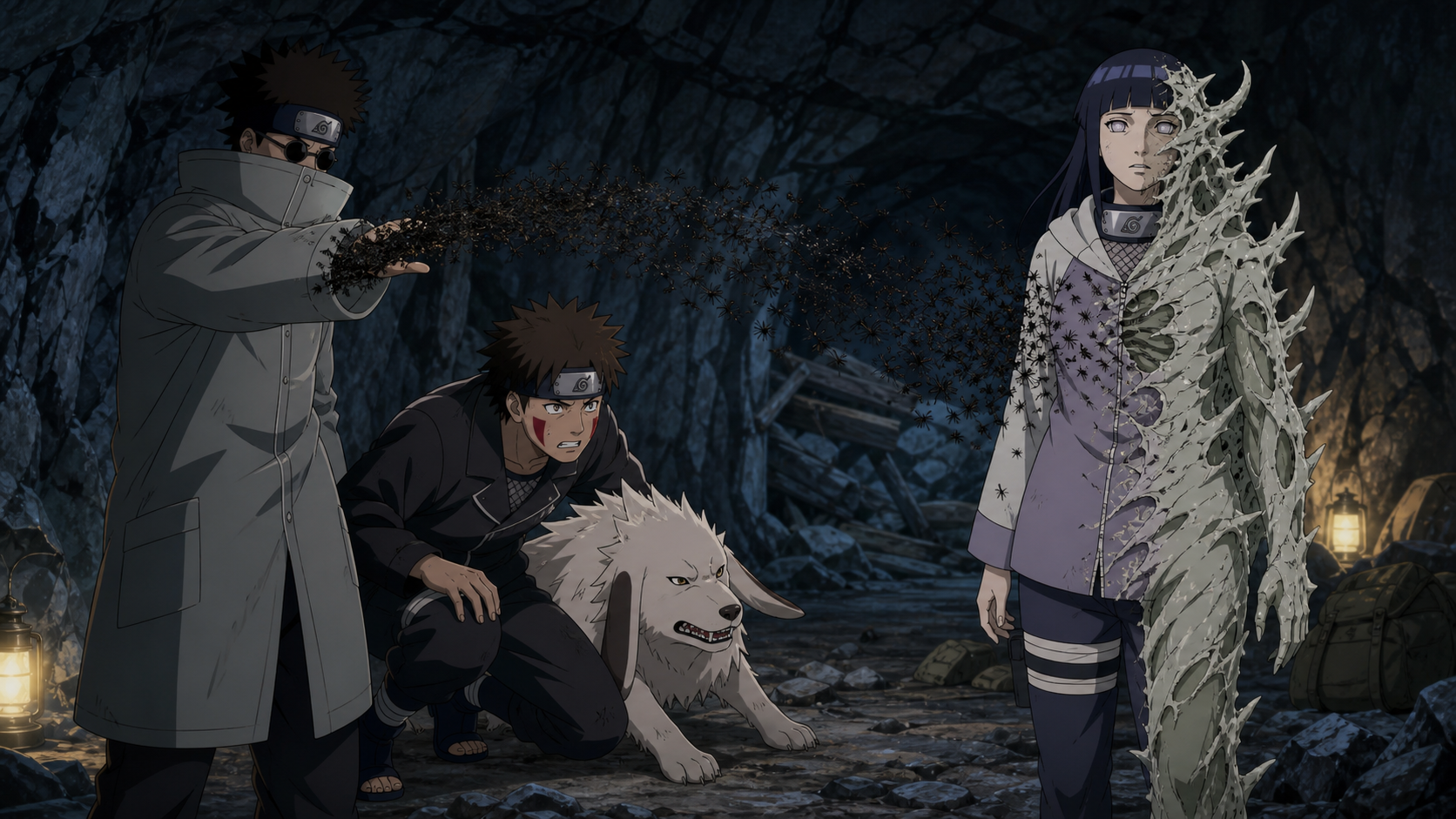
“White Zetsu’s Trap” gives Team 8 a problem built to ruin the skills that normally make them excellent trackers. Kiba can trust scent, Hinata can trust sight, and Shino can trust insects until White Zetsu separates them inside a mine and makes every familiar body questionable. Shino survives the trap by treating distrust as information instead of permission to panic. The episode is anime-original and skippable for the main war plot, but the Team 8 strategy gives the detour a real job.
The barrier leak creates a specific mission
Alliance defenses should prevent White Zetsu from entering easily, yet a nearby coal mine appears to contain a gap in the barrier. Kiba, Hinata, Shino, and Akamaru investigate because their team specializes in detection. The assignment fits their abilities. A hidden underground route can defeat a wide perimeter without defeating every guard. Finding and closing that route protects far more people than waiting for infiltrators to appear inside camp.
The official title contains its own typo
The Naruto official English page labels record `01_723` as overall animated episode 499 and prints “Whtie Zetsu’s Trap.” That spelling is an official-site typo, not a second title. Crunchyroll correctly lists “White Zetsu’s Trap” as Shippuden Episode 279 under watch ID `GRMG1854R`. The licensed listing places the episode inside the Seven Ninja Swordsmen road. Clear metadata matters because search systems may preserve the typo long after readers forget why two spellings appear.
Team 8 enters terrain that limits every advantage
A cave narrows movement, blocks long sight lines, changes echoes, traps odors, and gives insects fewer clean routes. Those limits affect each member differently. Hinata’s Byakugan remains powerful, but walls and separation complicate communication. Kiba’s smell competes with dust, explosives, and overlapping bodies. Shino’s insects can scout while also becoming harder for teammates to observe. White Zetsu chooses terrain where specialized senses cannot automatically produce shared certainty.
The explosion turns one unit into three witnesses
White Zetsu’s ambush separates the team. Each person experiences a different slice of the event and later returns with claims the others cannot directly verify. That is the perfect condition for impersonation. Trust normally fills gaps between individual viewpoints. Here, White Zetsu may occupy the gap. The team must decide whether a familiar voice belongs to a friend, whether a changed detail comes from stress, and whether asking the wrong question reveals more to the infiltrator than the answer proves.
Reuniting does not restore safety
Kiba, Hinata, and Shino find one another after the blast, but reunion creates a new problem. Any one of them may be a copy. Standing together therefore increases comfort and danger at the same time. Shino names that possibility rather than allowing relief to become carelessness. His warning feels cold because everyone wants the reunion to mean survival. Naming the threat is still an act of protection. False reassurance would give the impostor control over the next move.
Scent is strong evidence and not perfect evidence
Kiba and Akamaru often identify enemies through smell before other shinobi see them. White Zetsu’s copying ability challenges the reliability of that method. A transformed infiltrator may reproduce enough physical material or stolen chakra to confuse normal detection. The cave adds smoke and disturbed earth. Kiba must accept that a trusted sense has conditions and limits. Expertise becomes safer when the expert knows when one instrument needs confirmation from another.
Byakugan cannot read private history
Hinata can examine chakra pathways and scan through solid surfaces, but seeing a chakra network does not automatically reveal who is making a choice. White Zetsu’s disguise exploits that distinction. The eye can show structure while identity also depends on memory, motive, and behavior. Hinata’s power remains useful for locating movement and threats. The episode refuses to let one famous bloodline solve a social verification problem by looking harder.
Shino treats uncertainty as a design problem
Shino does not demand blind trust and does not surrender to total suspicion. He studies how an impostor would behave, what information each teammate holds, and which apparent choice might force the hidden enemy to reveal a priority. That approach suits him. His battles often depend on delayed observation and a trap whose meaning becomes clear after the opponent commits. Social uncertainty becomes another environment where he can place a marker and wait.
Rock-paper-scissors becomes controlled exposure
The team uses a simple game to assign action, but the choice carries more than chance. Shino can shape who appears threatened and who must respond. A familiar childhood mechanism gives the impostor a pattern to follow while the real teammates read the intention underneath the surface. The strategy works because Team 8 shares years of small habits. White Zetsu can copy a body faster than he can reproduce every unspoken expectation inside a team.
Shino makes his own apparent death useful
Shino allows the situation to make him look eliminated, pushing the hidden White Zetsu toward confidence. The move is risky because Kiba and Hinata must act without complete reassurance, and an actual mistake could become irreversible. Shino accepts personal exposure to create information. That choice matches his quiet loyalty. He rarely needs public credit, but the team repeatedly benefits from work opponents notice only after their advantage has disappeared.
Kiba’s aggression becomes part of the performance
Kiba is easy to read as impulsive, which makes his apparent willingness to attack Shino believable. The strategy uses a real personality trait without reducing him to that trait. Kiba must control enough force and timing to sell the conflict while preserving the teammate beneath the performance. Acting reckless safely requires trust in Shino’s plan and awareness of Akamaru. The episode lets his loudness serve deception rather than merely create the problem.
The false Hinata exploits expected gentleness
White Zetsu’s Hinata disguise benefits from the team’s instinct to protect her and from outsiders’ tendency to read her softness as harmlessness. That calculation is insulting and effective. A familiar gentle face can move close before anyone responds. The reveal also warns against assigning innocence through personality. Hinata’s real kindness is a pattern of choices, not a visual credential that an enemy can wear.
Akamaru becomes a target because animals notice gaps
Akamaru’s senses and bond with Kiba create another verification route. An impostor cannot assume the dog will interpret a copied body exactly as humans do. Attacking or disabling Akamaru removes both a witness and a combat partner. The danger makes clear that support animals are not accessories. Akamaru carries intelligence, emotional communication, and tactical value, which is why the enemy has reason to isolate him.
Team secrets work only when kept small
The teammates refer to private facts and memories that an impostor should not know. Shared secrets can verify identity, but a static password becomes dangerous once overheard. Strong verification uses recent context, rotating questions, and multiple people rather than one treasured answer. Team 8’s history gives them material White Zetsu lacks. The larger alliance cannot depend on every unit improvising the same solution under attack.
Team 8 can also combine partial evidence. Kiba reports scent, Hinata reports chakra movement, Shino reports insect behavior, and Akamaru reacts independently. No single signal has to carry the entire verdict. Agreement across different senses makes the final accusation harder for White Zetsu to manipulate.
The cave contains more than one infiltrator
Exposing the false teammate does not empty the mine. White Zetsu forces remain inside, using the underground route as a staging area. The mystery therefore returns to the original operational problem. Team 8 must survive, communicate, and close the access point rather than spend the whole episode congratulating itself for identifying one copy. Good detection creates the next responsibility.
Hinata sends the message outward
The team uses a messenger owl to call the sealing unit. Communication converts a trapped squad’s discovery into alliance action. Team 8 cannot permanently secure the entire cave while fighting multiple enemies. Asking specialists to seal the route is not weakness. The correct mission outcome depends on bringing the right unit to the right structure after the trackers identify what lies underneath the barrier.
Holding the cave is different from clearing the cave
Kiba, Shino, Hinata, and Akamaru need to contain White Zetsu until the sealing team arrives. They do not need to hunt every clone through every tunnel. That distinction protects them from an enemy who wants pursuit to create further separation. Defensive positioning, shared sight lines, insect coverage, scent checks, and Gentle Fist control become more valuable than chasing individual kills. The team wins by preserving the route long enough for closure.
Anime-original does not mean continuity-free
Episodes 279 through 281 are commonly treated as anime-original side stories within the war. “White Zetsu’s Trap” does not advance the manga’s central battlefield sequence, so viewers following only the core plot can skip. The episode still uses established White Zetsu abilities, alliance barriers, and Team 8 skills without requiring a contradictory new power. A clear directory label lets viewers choose without pretending every broadcast episode performs the same job.
Team 8 needed this screen time
Kiba, Hinata, Shino, and Akamaru often appear as support around Naruto’s larger story. A focused mission lets their team history drive the solution. Hinata is more than a reaction to Naruto. Kiba is more than loud competition. Shino is more than the forgotten quiet classmate. Their complementary detection methods and private trust become the actual plot mechanism. The episode’s value comes from allowing Team 8 to function as a unit when nobody from Team 7 is present.
Distrust can be temporary and bounded
The team suspects one another because the evidence requires suspicion. They do not need to make that suspicion permanent after the infiltrator is exposed. A healthy response records what happened, updates verification, and restores ordinary trust where evidence supports restoration. White Zetsu wins socially if every alliance relationship remains poisoned after the physical threat ends. Team 8’s deeper defense is the ability to question one another without destroying the bond that makes questioning useful.
The barrier failure needs an owner after the mission
Sealing the mine closes the immediate route, but somebody still needs to explain how the gap escaped earlier inspection. The answer may involve terrain, rushed construction, an enemy-created weakness, or a mapping failure. Blaming the nearest guard would be easier than tracing the system and would teach everyone to hide mistakes. The alliance needs an updated barrier map, a record of underground crossings, scheduled sensor checks, and a route for field teams to report suspicious access without waiting for an attack. Team 8’s survival supplies the evidence for that review. Their mission should change how the perimeter is maintained, not become a heroic story leaders tell while leaving the same structural opening for the next unit.
Team 8 survives because nobody has to become the whole answer
Kiba does not need scent to be infallible. Hinata does not need the Byakugan to reveal intention. Shino does not need insects to explain every missing minute. Each teammate brings one partial truth, and the overlap between those truths makes manipulation harder.
That is the team’s actual power. The mine keeps asking which member is strongest when the answer is structural: their abilities cover different failures. White Zetsu can imitate one visible identity, but copying the web of independent observations demands more than wearing the correct body.
Shino’s calm should not be confused with emotional distance
Shino speaks as if uncertainty were a puzzle because that is how he keeps fear from choosing for him. His quiet delivery does not mean he cares less about Kiba or Hinata. The risk of losing them is exactly why he refuses a comforting answer unsupported by evidence.
Shino offers another form: preparation, attention, and the willingness to look unpleasant while protecting people from a lie they desperately want to believe.
Kiba has to distrust the sense that defines him
Scent is not merely equipment for Kiba. His tracking identity, partnership with Akamaru, and confidence inside the team all depend on reading smells better than other shinobi can. White Zetsu does not only hide from that skill. The copy makes Kiba question whether his own body is giving reliable testimony.
Accepting corroboration could feel like admitting weakness. Instead, Kiba lets the team strengthen his evidence. Expertise does not disappear when conditions interfere with an instrument. Expertise includes recognizing those conditions before pride turns uncertainty into a fatal conclusion.
Hinata’s gentleness is knowledge the enemy uses badly
The false Hinata expects softness to purchase proximity and hesitation. That plan depends on reducing her kindness to an aesthetic: lowered voice, familiar posture, recognizable face. The real Hinata’s gentleness contains judgment, courage, and years of choices the disguise cannot reproduce on command.
This is why the reveal feels personal. White Zetsu treats a quality Hinata fought to define for herself as a costume anybody can wear. Team 8 answers by knowing her beyond the surface outsiders mistake for her entire personality.
Akamaru makes verification more than a human conversation
Passwords and memories privilege whoever can speak fastest under pressure. Akamaru adds another witness whose reactions develop through scent, routine, movement, and bond. He cannot deliver a courtroom explanation, yet his independent response changes what Kiba should investigate.
The episode respects that partnership when it treats Akamaru as a participant rather than an accessory attached to a technique. White Zetsu has to account for him because Team 8 already does.
The game works because performance has limits
Rock-paper-scissors looks childish enough to lower the infiltrator’s guard. Underneath, the teammates are watching who follows the visible rules and who understands the purpose hidden behind those rules. The copy can perform compliance without knowing what the group is arranging.
That gap resembles acting from a script while everyone else is improvising from shared history. Shino does not ask for an impossible confession. He creates pressure that makes the wrong participant reveal which outcome matters to the enemy.
A false accusation would also serve White Zetsu
The infiltrator wins if Team 8 attacks the wrong member, even before White Zetsu lands a blow. Friendly violence removes a tracker, fractures cooperation, and confirms that copied faces can make the alliance destroy itself.
Suspicion is necessary, but suspicion must remain answerable to evidence. The team cannot call paranoia wisdom simply because the enemy is deceptive. Their method has to protect the innocent teammate while exposing the copy.
The mine turns trust into something practiced under pressure
Trust is easy when everyone agrees about what happened. The blast takes away that shared account. Kiba, Hinata, and Shino return with gaps, conflicting perceptions, and reasons to fear that any reassurance may be bait.
They still coordinate. They test rather than abandon one another. That makes trust active instead of sentimental. The bond survives because members permit questions and accept temporary limits without treating doubt as a declaration that the friendship was fake.
The alliance needs procedures that do not imitate the enemy
White Zetsu reduces people to usable appearances. A panicked security system could repeat that dehumanization by treating every body as a threat until violently proven otherwise. The answer cannot be endless detention based on nervous behavior, clan, injury, or one failed memory.
Verification should be layered, documented, and reversible when time permits. The goal is to identify hostile copies while keeping actual comrades recognizable as people, not to make terror the alliance’s new commanding officer.
Anime-original episodes still owe the characters consequences
A side mission can reveal personality without changing the manga’s central sequence. That freedom becomes wasteful when an episode teaches something valuable and the series behaves as if nobody learned it. Team 8’s method should travel into later identification rules, even if the specific cave never matters again.
Emotional and institutional continuity ask whether experience leaves residue. The mine should alter how these teammates question, protect, and trust each other after escape.
Team 8’s independence is the episode’s best gift
Naruto is not present to inspire the solution, and Team 7 does not arrive to finish the fight. Kiba, Hinata, Shino, and Akamaru own the problem from detection through containment. Their history supplies both the vulnerability and the defense.
Here, her vision and team relationships belong to a mission with its own stakes. She is not waiting to be noticed. She is helping keep the route closed.
Closing the tunnel cannot close the emotional breach
A sealing team can repair stone and chakra barriers. Nobody can seal away the memory of watching a friend’s face become an enemy. The squad needs space to compare what happened, correct false assumptions, and restore confidence in the senses the trap exploited.
Recovery does not require pretending doubt never entered the cave. Recovery means doubt no longer controls every reunion. White Zetsu’s deepest defeat arrives when Team 8 can question carefully and still choose one another afterward.
RaeRae’s verdict
“White Zetsu’s Trap” is a solid Team 8 side mission because the mine turns each specialty into an incomplete instrument. Shino’s planning, Kiba and Akamaru’s sensory partnership, Hinata’s vision, and their shared history all contribute. The episode still stretches the impostor game longer than the main war needs, but the cave containment and sealing objective keep the story from becoming pure paranoia. Watch for Team 8. Skip if only the manga road matters.
RaeRae’s call
Team 8 wins by combining incomplete evidence without turning uncertainty into permission for friendly fire. The copy steals a face. The team protects the relationships, habits, and independent witnesses that make a person more than a face.
Episode details and viewing routes
- Official episode reference: Naruto Official episode guide
- Licensed episode route: Crunchyroll licensed episode page
Next on the road
Episode 280, “Aesthetics of an Artist,” shifts to Deidara, Kurotsuchi, and another anime-original battlefield detour. The argument changes from copied identity to artistic ego, clan history, and the danger of letting a captured bomber control the emotional pace of an escort mission.