
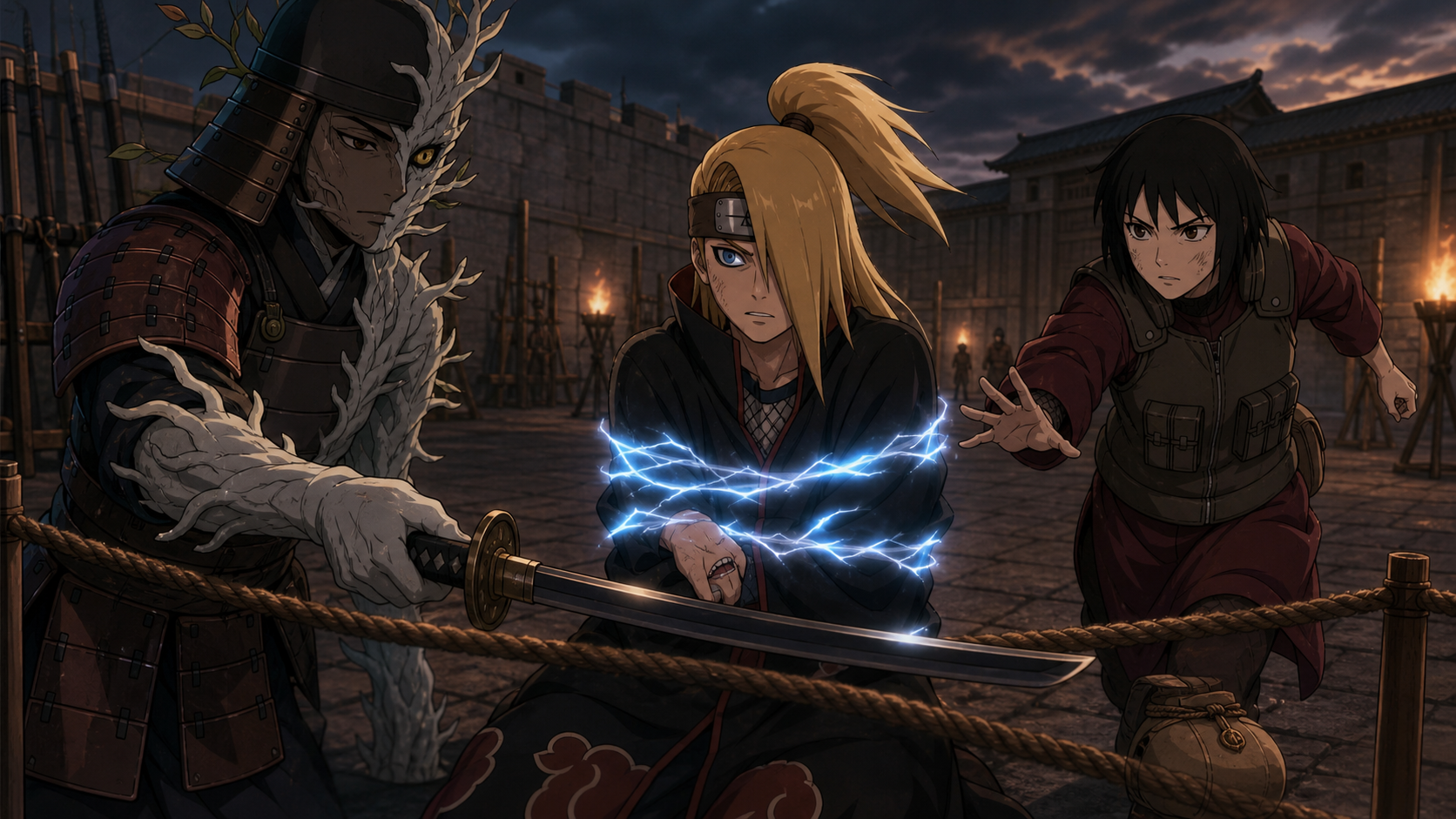
Aesthetics of an Artist
Deidara calls the escape art, but copied authority, tool control, clay access, and bruised ego explain why the custody failure becomes possible.
Bottom line
“Aesthetics of an Artist” works when Deidara’s talk about art is treated as a security problem rather than charming eccentricity. Kurotsuchi wants Kabuto’s location, White Zetsu wants Deidara free, and Deidara wants another chance to prove that his final explosion meant something. His wounded pride over Sasuke’s survival becomes the lever everybody can pull. The episode is anime-original, but the escape shows how easily a captive can control an escort when guards underestimate ego, outside support, and the tools already within reach.
Deidara begins as a restrained weapon
The Fifth Company holds reanimated Deidara under electrical restraint because lightning release interferes with his explosive abilities. That method reflects actual knowledge of his technique rather than generic chains. His body can regenerate under Edo Tensei, and his mouths can turn clay into mobile bombs. Custody therefore depends on continuously denying the process, materials, and movement his art requires. One lapse can return a prisoner to battlefield scale.
The records mark another anime-original detour
The Naruto official site catalogs “Aesthetics of an Artist” as overall animated episode 500 under record `01_724`. Crunchyroll lists the story as Shippuden Episode 280 with a September 20, 2012 release and watch ID `GR3VGW9V6`. The episode expands an anime-only custody incident around Deidara, Kurotsuchi, White Zetsu, and the Fifth Company. Viewers following only the manga road can skip without losing the central war sequence.
Kurotsuchi arrives with an intelligence objective
Kurotsuchi wants information about Kabuto’s location. The goal is reasonable because Kabuto controls the reanimations and remains a strategic center of the war. Deidara is a poor cooperative witness. He enjoys provocation, resents authority, and has little reason to help the alliance. An interrogation plan needs leverage, verified questions, and a realistic expectation of what he actually knows. Familiarity with his past does not guarantee useful access.
Their shared Stone history complicates the room
Kurotsuchi knew Deidara before his Akatsuki life and remembers the damage surrounding his departure from Iwagakure. That history gives her insight into his pride and habits. Shared origin also gives Deidara emotional material to exploit. He can dismiss her as a younger acquaintance, attack village loyalty, or turn the exchange into an old family argument. Interrogators need to know when personal history improves a question and when personal history narrows judgment.
Deidara’s art theory hides a demand for control
Deidara insists that art exists in a fleeting explosion. The philosophy sounds grand until his audience remembers that people live inside the landscapes he destroys. His “art” forces witnesses to receive his meaning through danger. Consent never enters the composition. The episode is strongest when his aesthetics remain attached to conduct. He wants the right to choose the canvas, timing, audience, and cost, then calls resistance proof that others fail to understand him.
Sasuke’s survival breaks the story Deidara told himself
Deidara died believing his final self-destruction would become an ultimate artistic statement and kill Sasuke. Learning that Sasuke survived makes the sacrifice feel unsuccessful on Deidara’s own terms. The news does not create a new ideology. The news exposes how dependent his supposedly pure art was on an audience and outcome. If the blast mattered only as a perfect instant, Sasuke’s survival should not ruin the meaning. Deidara’s rage proves that victory and recognition were always part of the work.
Kurotsuchi uses truth as pressure
Telling Deidara that Sasuke lived destabilizes him more effectively than threats might. The fact reaches a wound built from rivalry, insecurity, and the Sharingan’s ability to dismiss his techniques. That pressure can produce mistakes and can also trigger escalation. An interrogator who opens a captive’s deepest grievance needs a containment plan for the response. Kurotsuchi gains emotional leverage while the guards inherit the physical risk.
White Zetsu attacks custody through identity
White Zetsu infiltrates the Fifth Company by copying alliance personnel. The attack continues the war’s trust crisis from Episodes 278 and 279, but the target changes. Here, impersonation reaches a high-value prisoner. A copied guard does not need to defeat the entire camp. The infiltrator needs proximity, one useful object, and a moment when legitimate personnel assume the uniform has already been checked.
A katana becomes an escape tool
White Zetsu slips Deidara a sword so he can interrupt the lightning restraint. The transfer is small compared with a giant summon, which makes the failure more instructive. Custody can collapse through an ordinary item when guards understand a weapon only by its usual purpose. The sword does not need to defeat the company. The sword needs to break the mechanism denying Deidara access to explosive release.
Okisuke notices the guard who cannot answer
Okisuke challenges a suspicious samurai and recognizes that the response does not fit. His intervention shows why verification needs more than appearance. A legitimate guard should know the current post, orders, recent rotation, and immediate chain of command. White Zetsu’s copy can wear armor without carrying every operational fact. The check comes late enough for the escape plan to move, but the method gives the company a better security model.
Custody needs two-person control
No single guard should possess enough access to disable a high-value restraint without confirmation. Rotating pairs, logged tool transfers, distance from weapons, and challenge-response checks would reduce the chance that one copied body frees Deidara. Those procedures sound less exciting than combat and matter because combat becomes necessary when procedures fail. The episode’s escape is partly enemy skill and partly a custody design that trusts a uniform too much.
The restraint also needs a visible power-status check and an immediate alarm when current drops. Guards should inventory every blade before and after a shift instead of discovering a missing sword only after Deidara has already used the metal to break the circuit.
Deidara still needs clay
Breaking the lightning restraint restores possibility, not full capacity. Deidara’s signature techniques depend on explosive clay processed through the mouths in his hands. He and the White Zetsu group therefore need supplies and distance. That logistical dependency gives the pursuers a route to predict. An escaped bomber cannot produce every preferred weapon from empty air. Denying material can matter as much as landing another attack.
White Zetsu bodies become disposable cover
The escape burns through multiple White Zetsu clones. Deidara shows little concern because their deaths serve his return to “art.” Kabuto and Obito similarly treat the army as replaceable mass. The behavior reflects the larger enemy system. Individual bodies matter only by function. Deidara’s obsession with his own artistic immortality sits beside complete indifference to the temporary lives used to carry him toward another explosion.
The pursuit must protect the camp too
Chasing Deidara with every available fighter would leave prisoners, wounded personnel, and command routes exposed. The Fifth Company still needs a pursuit element and a security element. White Zetsu may want guards to abandon their posts after the obvious target. Escort failure becomes worse if the response creates a second breach. Command must decide who follows, who verifies identities, and who restores control where the escape began.
Chūkichi becomes a delay rather than the objective
Kabuto deploys reanimated support to interfere with the pursuit. Chūkichi’s role is to consume time and attention while Deidara moves. The alliance needs to identify that function before turning the distraction into the whole battle. Stopping a delaying force can feel like progress while the primary target increases distance. Clear mission priorities help fighters decide when containment, bypass, or coordinated sealing serves the larger objective.
Kurotsuchi’s disguise turns performance back on Deidara
Kurotsuchi uses transformation and deception to manipulate Deidara’s expectations. The tactic is fitting because Deidara has spent the episode treating everyone else as an audience. She creates a scene he wants to believe, then uses his ego to control his movement. Deception remains risky, but the plan attacks the captive’s actual vulnerability rather than competing with his explosions through raw force.
Deidara’s ego makes him predictable
He wants clay, distance, an audience, and proof that his art cannot be dismissed. Those desires narrow his choices. A less theatrical fugitive might hide, preserve mobility, and avoid confrontation. Deidara needs to demonstrate something. The pursuers can shape where he goes by offering an apparent chance to reclaim status. Ego becomes a tracking signal as reliable as footprints when the target keeps choosing recognition over escape.
The episode does not redeem village abandonment
Kurotsuchi’s familiarity may make Deidara feel like a difficult older brother from Iwa. That texture should not erase his terrorism, Gaara’s abduction, village attacks, or willingness to kill strangers for artistic proof. Shared history explains why she understands him. Shared history does not transform accountability into affectionate teasing. The emotional bond can remain complicated while the custody requirement remains absolute.
Art criticism needs the people outside the artist
Deidara judges art by the instant he creates. A fuller judgment includes labor, materials, audience consent, destroyed homes, injured bodies, and what remains after the smoke. His explosions may be technically inventive and visually striking. The human bill does not become aesthetically irrelevant. RaeRae can appreciate the design of his techniques without adopting the artist’s belief that beauty grants ownership over everyone nearby.
The escape exposes a wider verification problem
Sakura proved White Zetsu could copy Neji. Team 8 faced the same uncertainty in the mine. The Fifth Company still suffers another infiltration. Information has not moved fast enough to become procedure across every division. A discovery does not protect an institution until warnings reach the field, units understand the threat, and verification changes at actual access points. Communication speed becomes part of battlefield defense.
Recapture should trigger a custody review
Putting Deidara back under restraint cannot be the final administrative step. The company needs to document how White Zetsu reached the post, which guard identity was copied, how the katana crossed the secure boundary, how long the lightning restraint was interrupted, and which materials Deidara sought after escape. A revised plan should separate weapons from the cell, require two verified guards for every adjustment, rotate identity challenges, and assign an independent observer during interrogation. Kurotsuchi’s personal history may still help, but personal history should operate inside the security plan rather than replace the security plan. Otherwise the next escape will be treated as another exciting Deidara incident instead of evidence that the same preventable access failure remained open.
Anime-original placement has a tradeoff
The detour gives Kurotsuchi, Mifune’s forces, Okisuke, and Deidara additional screen time. The episode also delays Naruto’s entry into the central war after multiple side stories. Viewers are allowed to feel both. Character texture has value, and pacing cost remains real. A directory should label the episode as anime-original so fans can choose between a broader war-world experience and the direct manga route.
Deidara mistakes being remembered for being understood
He wants the explosion to survive in another person’s mind even while insisting art belongs only to the vanishing instant. That contradiction makes his anger over Sasuke painfully revealing. A witness who survives incorrectly has power over the meaning Deidara tried to impose.
He does not merely want attention. He wants obedient interpretation. Sasuke’s survival refuses the ending, and Kurotsuchi’s teasing refuses the reverence. Deidara calls both failures of taste because admitting other people control their own response would break the authority his art gives him.
Kurotsuchi knows which wound pride keeps reopening
Shared village history gives Kurotsuchi a map of Deidara’s vanity that a stranger could not build during one interrogation. She knows the posture behind the philosophy and can tell when artistic language is covering humiliation.
Familiarity can sharpen a question, but irritation can make an interrogator chase the satisfaction of winning an old argument. Kurotsuchi needs intelligence about Kabuto, not a confession that she understood Deidara better than he understood himself.
Restraint is a system, not a glowing line around a prisoner
The lightning technique appears to be the cell, yet the cell includes guards, distance, tools, power continuity, identity checks, clay control, and response time. White Zetsu attacks the relationships between those pieces.
That is why the ordinary sword matters so much. A spectacular prisoner does not always require a spectacular breach. If one common object can interrupt the condition holding him, every person and pathway near that object belongs inside the custody design.
The copied guard exposes authority without accountability
Uniforms make institutions move quickly because people cannot investigate every order from the beginning. White Zetsu borrows that efficiency. The disguise receives trust created by real guards who trained, served, and answered to a chain of command.
The infiltrator contributes none of that responsibility. He takes only the access. Verification must therefore connect appearance to current duty: who assigned this post, who shares the shift, what changed at the last handoff, and which actions require a second person.
Deidara’s body is not harmless because Kabuto owns the contract
Edo Tensei control can encourage captors to think of a reanimated fighter as equipment awaiting somebody else’s command. Deidara remains observant, motivated, inventive, and capable of exploiting a gap for his own reasons.
Kabuto’s control adds risk rather than replacing Deidara’s agency. Guards must prepare for direct orders from the summoner, independent sabotage from the captive, and coordination between both. Treating him as a passive object creates exactly the freedom he needs.
Clay denial is the least glamorous and most useful defense
Deidara’s mythology encourages everyone to focus on hands, mouths, and giant explosions. His process still needs material. Inventory control can reduce a celebrated Akatsuki artist to a furious man searching for supplies.
Logistics decide what power can become real. The company should track earth, pouches, transport containers, and every place clay could be hidden or substituted. Respecting a technique means understanding the boring dependencies beneath the legend.
Kurotsuchi turns his need for an audience into a leash
Deidara could prioritize distance after escape. Instead, the promise of proving himself keeps pulling him toward scenes other people arrange. Kurotsuchi does not defeat his philosophy in debate. She lets his behavior expose how much the philosophy depends on spectators.
Her deception works because he cannot leave a perceived insult unanswered. Recognition matters more than freedom at the decisive moment. The artist who claims to master the instant becomes predictable whenever somebody threatens the story he wants that instant to tell.
The episode should let Kurotsuchi be more than the familiar girl
Her connection to Deidara gives the plot energy, but she is also a commander shaped by Iwa politics, the Tsuchikage’s legacy, and an alliance that requires former rivals to share risk. Her decisions carry more than childhood annoyance.
I want the episode to trust that authority. She can joke, bait him, and remember who he used to be without becoming a side character inside his ego.
Art does not become apolitical because the artist says so
Deidara treats destruction as an aesthetic event separated from villages, wars, and bodies. The separation is a privilege created by making everyone else absorb the consequences. His explosions produce political facts after the flash disappears.
Calling the work pure cannot remove the system paying for materials, access, information, or victims. The episode becomes sharper whenever Kurotsuchi refuses to discuss beauty without also discussing what Deidara did with it.
The Fifth Company needs learning more than embarrassment
A humiliating escape invites blame. Blame may identify misconduct, but shame alone teaches guards to hide the next weak signal. A useful review reconstructs how the copy entered, why the sword remained available, and which alerts failed to reach the people controlling restraint.
The purpose is not to protect every reputation. The purpose is to make the next custody team harder to deceive. Accountability should produce changed practice, not merely a lower-ranking person offered as the explanation.
Anime-original freedom works best when it studies neglected labor
The central manga war cannot pause for every guard rotation, prisoner transfer, or supply decision. An anime-original episode has room to show those systems. That is a worthwhile expansion when the detour reveals why a battlefield victory can be lost during custody.
The cost arrives when comedy and repetition stretch a simple breach past its insight. The episode earns the pause when each beat clarifies Deidara, Kurotsuchi, or the structure that failed around them.
Recapture does not restore the meaning Deidara wanted
He can escape, explode, perform, and demand another witness. None of those actions forces Sasuke’s survival to become the ending he prefers. That frustration will remain after the restraints return.
Deidara will continue reaching for any opportunity that promises revision, recognition, or spectacle. Captors do not need to cure his ego. They need to stop designing situations where his ego controls everybody else’s movement.
RaeRae’s verdict
“Aesthetics of an Artist” succeeds as a custody-failure story more than an art debate. White Zetsu exploits copied authority, Deidara uses a basic sword to interrupt a specialized restraint, and Kurotsuchi uses his bruised ego to make him predictable. The episode knows that explosive genius still depends on clay, access, guards, and an audience. Deidara calls the result art. The Fifth Company has to treat the same result as a preventable security breach.
RaeRae’s call
Deidara calls the escape art because that story makes every guard part of his audience. Kurotsuchi’s best answer is not admiration or outrage. She turns his demand for recognition into predictable movement and puts the security failure back where accountability belongs.
Episode details and viewing routes
- Official episode reference: Naruto Official episode guide
- Licensed episode route: Crunchyroll licensed episode page
Next on the road
Episode 281, “The Allied Mom Force!,” moves away from the front to the Leaf Village, where mothers, children, and remaining civilians confront what home defense looks like after most trained fighters leave for war. The comedy carries a real question about who gets counted as part of an alliance’s protective capacity.